
الموارد
استكشف مجموعة واسعة من الموارد القيمة حول تعليم المواطنة العالمية لتعميق فهمك وتعزيز البحث والمناصرة والتعليم والتعلم.
تم العثور على 2,781 نتيجة
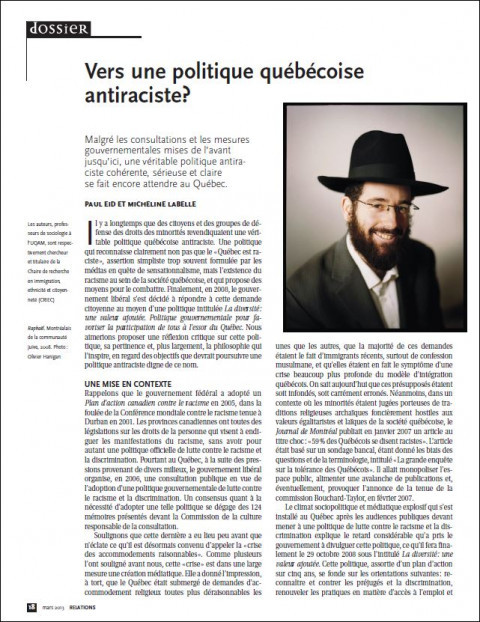 Vers une politique québécoise antiraciste? سنة النشر: 2013 المؤلف: Paul Eid | Micheline Labelle المؤلف المؤسسي: Relations Malgré les consultations et les mesures gouvernementales mises de l’avant jusqu’ici, une véritable politique antiraciste cohérente, sérieuse et claire se fait encore attendre au Québec.
  The Concept of Citizenship for Immigrants and Members of the Host Society within the Minority Francophone Context: A Lexical Analyse سنة النشر: 2014 المؤلف: Aïcha Benimmas | Sylvia Kasparian المؤلف المؤسسي: Revue de l’Université de Moncton Given the changes and constant mutations which occur in societies at the social, political, economic, technological, and educational levels, the concept of citizenship must be continually redefined. While French-speaking citizens, immigrants and members of the host society can find common ground thanks to the French language, they can also find differences because of other characteristics linked to their identity, such as culture, ethnic background, religion, and history. This is why we must analyze the meaning that these groups give to the concepts of citizenship and citizen participation, interpreting the differences and similarities that surface in their discourse regarding these two concepts. The use of computerized tools and statistics has enabled us to find through a constant comparison between qualitative and quantitative analyses-the perceptions, similarities, and divergences in the discourse of four groups of participants involved in our study: immigrant youth, immigrant parents, host society youth, and host society parents. Le concept de citoyenneté chez des immigrants et des membres de la société d’accueil en milieu minoritaire francophone : une analyse lexicale سنة النشر: 2014 المؤلف: Aïcha Benimmas | Sylvia Kasparian المؤلف المؤسسي: Revue de l’Université de Moncton Étant donné les changements et les mutations constantes que connaissent les sociétés sur différents plans (social, politique, économique, technologique, etc.), le concept de citoyenneté nécessite une redéfinition d’une manière continue. Si les citoyens francophones, immigrants et membres de la société d’accueil, peuvent se rejoindre grâce à la langue française, ils peuvent différer à cause de leurs autres caractéristiques identitaires à savoir, la culture, l’ethnie, la religion et l’histoire. C’est dans ce sens qu’il importe d’explorer le sens que ces différents groupes donnent aux concepts de citoyen et de participation citoyenne. L’utilisation des outils informatisés et statistiques nous a permis de relever, par un aller-retour constant entre les analyses qualitatives et quantitatives, les ressemblances et les divergences dans le discours de quatre groupes de participants à notre étude : jeunes immigrants, parents immigrants, jeunes de la société d’accueil et parents de la société d’accueil.
  La didactique de l’éducation à la citoyenneté en colloque سنة النشر: 2017 المؤلف: Claire Ravez المؤلف المؤسسي: Institut Français de l'Education (IFÉ) Les enjeux de l’éducation à la citoyenneté ont été depuis deux ans renouvelés par des orientations politiques prises à l’échelle nationale (onze mesures pour une grande mobilisation de l’Ecole pour les valeurs de la République annoncées par la ministre N. Vallaud-Belkacem le 22 janvier 2015) et européenne (déclaration de Paris du 17 mars 2015 des ministres européens de l’éducation de l’Union européenne portant sur la promotion de l’éducation à la citoyenneté et aux valeurs communes de liberté, de tolérance et de non-discrimination). Au sein du système éducatif français, de nouvelles prescriptions curriculaires sont apparues : le domaine 3 du socle commun de connaissances, de compétences et de culture entré en vigueur en septembre 2016 porte sur la formation de la personne et du citoyen, l’enseignement moral et civique a été mis en place du cours préparatoire au baccalauréat, un parcours citoyen a été créé.
  From Ethnocultural Diversity to Living Together: Examples of Future Teachers Using a Multicultural Approach to Education سنة النشر: 2010 المؤلف: Mirela Moldoveanu المؤلف المؤسسي: McGill University. Faculty of Education This text looks at how future teachers define multicultural education in order to discover its relevance and objectives in the context of living together. Nine masters students in an initial teacher training program at an Ontario university participated in an exploratory research study using qualitative data. The interpretation of the results led to the construction of a multicultural education model that attempts to legitimize the data within the framework of a differentiated pedagogical approach.
 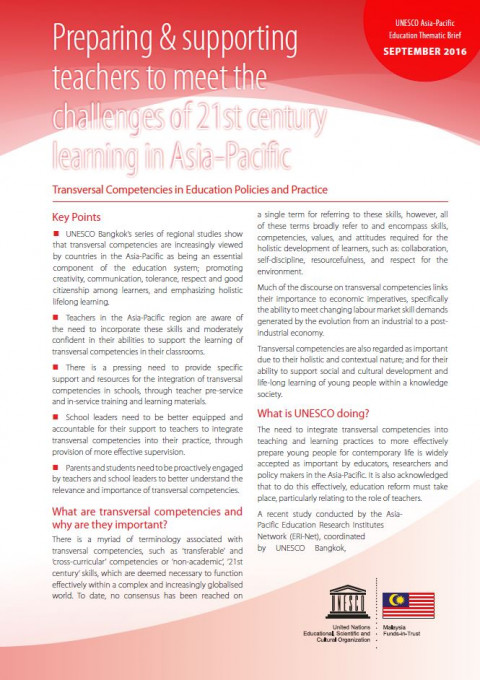 Подготовка и поддержка учителей для решения задач обучения 21-го века в Азиатско-Тихоокеанском регионе سنة النشر: 2016 المؤلف المؤسسي: Regional Bureau for Education in Asia and the Pacific | UNESCO Bangkok Подготовка и поддержка учителей для решения задач обучения 21-го века в Азиатско-Тихоокеанском регионе. Междисциплинарные компетенции в области политики и практики в области образования. Это итог исследований III фазы ERI-Net для междисциплинарных компетенций в области политики и практики в образовании.
  Inégalités sociales et migratoires : Comment l’école amplifie-t-elle les inégalités ? سنة النشر: 2016 المؤلف المؤسسي: Conseil natiional d'évaluation du système scolaire (CNESCO) En se fondant sur 22 contributions commandées pour l’occasion par le Cnesco à près de 40 chercheurs français et étrangers, ainsi que sur des enquêtes, des études et des articles publiés par des chercheurs ou des organismes, le Cnesco présente dans ce rapport un bilan global des inégalités scolaires d’origines sociale et migratoire en France aujourd’hui. Cette analyse à visée holistique se déroule en trois parties : tout d’abord, une définition conceptuelle des inégalités sociales à l’école et des approches de la justice scolaire ; ensuite, un état des lieux quantitatif présentant ces inégalités scolaires ; enfin, une présentation des politiques scolaires entreprises depuis quatre décennies dans l’objectif de combattre les injustices sociales à l’école tant au primaire qu’au secondaire, ainsi qu’un bilan sur leur efficacité.Qu’est-ce qu’une école juste ? Comment décrire, observer les inégalités ? Toutes les inégalités scolaires sont-elles illégitimes ? Dans une approche historique, les différences de parcours selon les niveaux scolaires ont longtemps eu lieu dès la fin de l’école primaire. L’avènement du collège unique en 1975 marque un tournant majeur dans la recherche de davantage d’égalité des chances à l’école.La massification de l’enseignement secondaire permet à davantage d’élèves d’accéder au baccalauréat, les inégalités sociales face à ce diplôme reculent plus encore avec la création du baccalauréat professionnel. Le socle commun de connaissances, de compétences et de culture, l’adaptation de l’école à l’élève, la différenciation pédagogique, la revalorisation des parcours individuels : autant de concepts plus récents, reflets d’une école du 21e siècle, qui ont pour objet un apprentissage minimum de certaines connaissances pour tous, et qui tendent donc à plus de justice.Mais si l’école française ségrégue moins les élèves de façon flagrante qu’il y a 50 ans, elle tend cependant à maintenir de nombreuses inégalités sociales et migratoires en son sein, plus cachées, moins observables, mais pourtant bien présentes. Ce sont ces inégalités que le Cnesco souhaite étudier.
  Éducation à la citoyenneté à l’école : Politiques, pratiques scolaires et effets sur les élèves سنة النشر: 2016 المؤلف: Géraldine Bozec المؤلف المؤسسي: Conseil natiional d'évaluation du système scolaire (CNESCO) Ce rapport de recherche, commandé par le CNESCO, constitue une revue de la littérature à la fois française et internationale portant sur l’éducation à la citoyenneté. Il vise à avancer dans la compréhension d’un objet de recherche encore délaissé à ce jour dans les études françaises et à identifier des pistes de recherche qui pourraient s’avérer fécondes à l’avenir. Il privilégie les travaux mobilisant des données empiriques. Le rapport dresse d’abord un état de lieux de l’apprentissage de la citoyenneté à l’école française, à partir d’une analyse des politiques, des programmes et des pratiques scolaires (Partie I). Il met ensuite en perspective le cas français en resituant ses spécificités et les points communs qu’il partage avec d’autres cas nationaux en matière d’éducation à la citoyenneté (Partie II). Enfin, il présente un bilan des recherches visant à évaluer les effets de l’éducation à la citoyenneté sur les représentations, les attitudes et les pratiques des élèves (Partie III). En conclusion, des orientations de recherche qui apparaissent, à l’issue de cet état des lieux, comme encore peu explorées et potentiellement fructueuses, sont identifiées.
  ÉDUCATION A LA PHILOSOPHIE ET A LA CITOYENNETÉ : AVEC LES PARENTS ? (Analyse UFAPEC 2016) سنة النشر: 2016 المؤلف: Bernard Hubien المؤلف المؤسسي: Union francophone des associations de parents de l'enseignement catholique (UFAPEC) L'éducation à la philosophie et à la citoyenneté est une mission fondamentale de l'école. En septembre dernier, la Fédération Wallonie-Bruxelles a publié un référentiel qui décrit les objectifs et les contenus attendus de cette éducation. Si l'école a donc son rôle dans cet apprentissage fondamental, on peut se demander où sont les parents. Un partenariat positif et une école qui met en cohérence cette éducation avec ses pratiques devrait permettre à chaque enfant de grandir en devenant un citoyen, responsable, actif, critique et solidaire, enjeu sociétal plus que jamais d'actualité.
 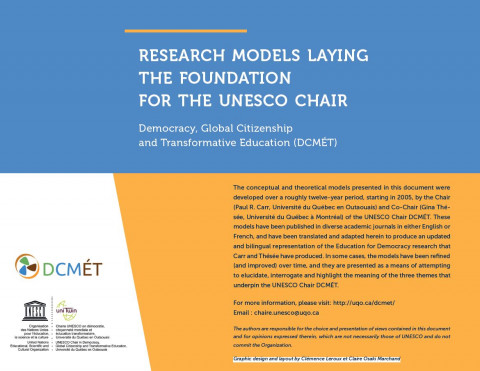 MODÈLES DE RECHERCHE: Démocratie, citoyenneté mondiale et éducation transformatoire سنة النشر: 2018 المؤلف: Paul R. Carr | Gina Thésée المؤلف المؤسسي: Chaire UNESCO Démocratie, citoyenneté mondiale et éducation transformatoire (DCMÉT) Les modèles conceptuels et théoriques présentés dans ce document ont été élaborés sur une période d’environ douze ans, commençant en 2005, par le titulaire (Paul R. Carr, Université du Québec en Outaouais) et la co-titulaire (Gina Thésée, Université du Québec à Montréal) de la Chaire UNESCO. Ces modèles ont été publiés dans diverses revues académiques, en anglais ou en français et ont été traduits et adaptés ici pour produire une représentation mise à jour et bilingue de la recherche sur l’éducation pour la démocratie que Carr et Thésée ont réalisée. Certains de ces modèles ont été affinés (et améliorés) avec le temps et sont des moyens qui aident à élucider, interroger et mettre en évidence le sens des trois thèmes qui sous-tendent la Chaire UNESCO DCMÉT.