
الموارد
استكشف مجموعة واسعة من الموارد القيمة حول تعليم المواطنة العالمية لتعميق فهمك وتعزيز البحث والمناصرة والتعليم والتعلم.
تم العثور على 3,389 نتيجة
 论 “多元文化主义” 视阈下的世界公民教育 سنة النشر: 2011 المؤلف: Wang Haiying | WU Minghai 在多元文化背景下,世界公民教育是在共同的国家认同的前提下对族群身份的认同方式,实现在统一中尊重多元,在多元中追求统一。世界公民教育必须倡导平等、尊重、宽容和理解的价值观。我国的世界公民教育应该是在维护国家领土完整、意识形态统一的前提下,寻求族群认同和差异的平衡.
  The Rising and Development of the Global Citizenship Education Thoughts سنة النشر: 2010 المؤلف: Chen Yicang Since the 1980s, especially the 1990s,modern citizenship education theories which are based on nation states have been increasingly challenged with the strengthening of the trend of globalization and the rising of the theory about global interconnectedness. The thought of global citizenship education has been discussed intensely and been partly put into practice in some developed countries,and gradually the ideological trend of global citizenship education has come into being. The establishment of global citizenship education thoughts is not finished overnight,which has experienced three stages of sprouting,establishment and development based on the growth of initial worldwide citizenship education thought factors. 全球公民教育思潮的兴起与发展 سنة النشر: 2010 المؤلف: Chen Yicang 自20世纪80年代尤其是90年代以来,随着全球化趋势的增强以及全球相互依存理论的兴起,原有的以民族国家为背景的现代公民教育理论不断受到挑战。全球公民教育思想在这样的背景下受到了广泛的关注。这一思想在发达国家的教育实践中已经有所体现,许多学者投入对其研究中,从而逐渐形成一股思潮。全球公民教育思潮的确立,并非一蹴而就,而是由最初的世界公民教育的思想因子逐渐地萌发和成长,经历了萌芽、确立和发展三个时期。
 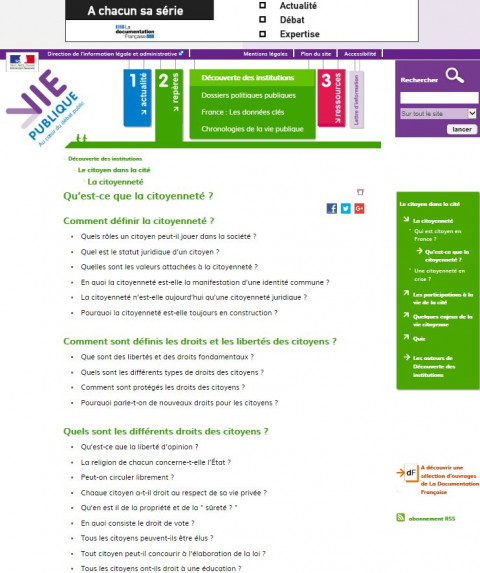 Qu’est-ce que la citoyenneté ? سنة النشر: 2018 المؤلف المؤسسي: Direction de l'information légale et administrative Qu’est-ce que la citoyenneté ? Comment définir la citoyenneté ? Comment sont définis les droits et les libertés des citoyens ? Quels sont les différents droits des citoyens ? Les citoyens ont-ils des devoirs ? Quels sont les devoirs des citoyens ?
  L'éducation à la citoyenneté globale mise en contexte المؤلف المؤسسي: Global Hive L’éducation à la citoyenneté mondiale est essentielle pour les raisons suivantes:L’éducation à la citoyenneté mondiale donne aux jeunes les connaissances, la compréhension, les compétences et les valeurs qu’il leur faut pour contribuer pleinement à leur propre bien-être et à celui des autres et pour améliorer la situation tant sur le plan local qu’à l’échelle mondiale.L’éducation à la citoyenneté mondiale engage pleinement les enfants et les jeunes dans leur propre formation grâce à tout un éventail d’activités et de méthodes d’apprentissage fondées sur la participation. Elle engage l’apprenant-e, mais développe également la confiance, l’estime de soi, et la pensée critique ainsi que l’art de la communication, de la coopération et du règlement des différends.L’utilisation faite actuellement des ressources mondiales est inéquitable et n'est pas viable. À mesure que se creuse le fossé entre riches et pauvres, la misère continue de violer les droits fondamentaux de millions de personnes dans le monde.L’éducation est un outil puissant pour changer le monde parce que les adultes de demain sont les enfants et les jeunes que nous éduquons aujourd’hui.Pour les enseignantes et les enseignants intéressés à promouvoir la citoyenneté mondiale, la question qui se pose tout de suite est celle du comment: comment vais-je pouvoir intégrer à mon enseignement l’éducation à la citoyenneté mondiale alors que le programme m’impose déjà tant de matière et de contraintes? Comment faire le lien entre l’éducation à la citoyenneté mondiale et l’enseignement du français ou de l’éducation physique? Notre boîte à outils cherche à expliquer comment intégrer l’éducation à la citoyenneté mondiale à plusieurs domaines du programme, propose des outils et des méthodes pour le faire et illustre le tout par des études de cas susceptibles de vous inspirer et de vous orienter.
  Gender Justice, Citizenship and Difference in Latin America سنة النشر: 2010 المؤلف: Maxine Molyneux This article surveys feminist citizenship practices and scholarship on gender, justice, citizenship and rights in Latin America. Feminism’s critique of patriarchal privilege expressed a modern desire for greater individual freedom and collective recognition, a combination that produced tensions and some inconsistencies in regard to the «difference» question, notably in its encounter with indigenous populations. However, central to feminism’s project was the pursuit of both recognition and redistribution, which achieved greater success in the realm of law and politics than in the distribution of public and private goods. A review of Latin American feminism’s achievements reveals a history of substantial advances but a striking persistence of gender inequality, which provides a rich agenda for further investigation. Justicia de Género, Ciudadanía y Diferencia en América Latina سنة النشر: 2010 المؤلف: Maxine Molyneux Este artículo hace un recorrido por las prácticas feministas ciudadanas y los estudios sobre género, justicia, ciudadanía y derechos en América Latina. La crítica al privilegio patriarcal realizada desde el feminismo expresa un deseo moderno de mayor libertad individual y reconocimiento colectivo. Unas peticiones que han producido tensiones y algunas contradicciones en relación a la cuestión de la «diferencia», especialmente en el encuentro con los pueblos indígenas. No obstante, el feminismo siempre se ha dedicado a lograr tanto el reconocimiento como la redistribución; si bien, ha alcanzado más éxito en los terrenos legales y políticos que en la redistribución de recursos públicos y privados. El análisis de los logros del feminismo en América Latina revela una historia de éxitos significativos, pero parciales; y una serie de desafíos para futuras investigaciones al respecto.
  Education and Countering Violent Extremism: a case study of schools in Pakistan سنة النشر: 2015 المؤلف: Hussain-Mohiud-Din Qadri This paper explores the role of education in combating the violent extremism by using the Pakistani education system as a case study. It undertakes a historical perspective of growth of the educational sector in Pakistan by delving deep into the pre-partition system. Education and Countering Violent Extremism: a case study of schools in Pakistan سنة النشر: 2015 المؤلف: Hussain-Mohiud-Din Qadri Cet article analyse le rôle de l'éducation dans la lutte contre l'extrémisme violent en prenant pour exemple le système éducatif pakistanais. Il développe une approche historique de la croissance du secteur éducatif, en analysant en détail le système précédant la partition du pays.
  The Time Period of the Holocaust in the Beliefs of Primary School Children – Children’s Perspectives and the Thematization of the Holocaust and National Socialism in Primary-School Instruction (in General Subjects) سنة النشر: 2012 المؤلف: Andrea Becher The original title: Die Zeit des Holocaust in Vorstellungen von Grundschulkindern – Perspektiven von Kindern und die Thematisierung von Holocaust und Nationalsozialismus im (Sach-)Unterricht der Grundschule(In I. Enzenbach, C. Klätte, & D. Pech, (Eds.). Kinder und Zeitgeschichte: Jüdische Geschichte und Gegenwart, Nationalsozialismus und Antisemitismus, Supplement, 8, pp. 101–120) This is a summary of a study of German primary school children’s beliefs about the Holocaust, based on interviews conducted in two classes in 2005. The author finds that the children almost exclusively focus on Hitler; that one can find “latent anti-Semitic fragments” in their statements; that, even without formal education, the pupils still possess knowledge about the Holocaust; and their main source of information about Nazi Germany seems to be family members. However, the family narratives mainly touch upon everyday-life and avoid the topic of the Holocaust. From these findings, the author argues that one could and should teach the Holocaust already in the German primary school. The above abstract is taken from the International Holocaust Remembrance Alliance Education Research Project. Please also consult the full list of abstracts in 15 languages and the accompanying publication Research in Teaching and Learning about the Holocaust: A Dialogue Beyond Borders. Ed: IHRA, Monique Eckmann, Doyle Stevick, Jolanta Ambrosewicz-Jacobs, 2017, Metropol Verlag.