
الموارد
استكشف مجموعة واسعة من الموارد القيمة حول تعليم المواطنة العالمية لتعميق فهمك وتعزيز البحث والمناصرة والتعليم والتعلم.
تم العثور على 328 نتيجة
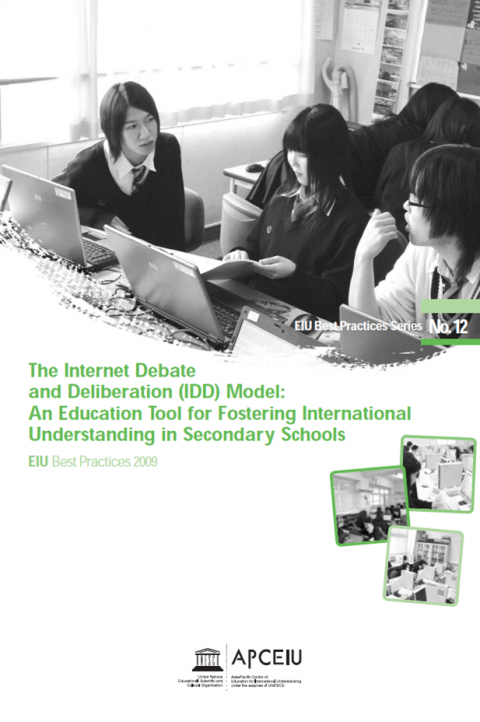 EIU Best Practice Series No. 12: The Internet Debate and Deliberation (IDD) Model: An Education Tool for Fostering International Understanding in Secondary Schools سنة النشر: 2009 المؤلف: Rose Sabanal المؤلف المؤسسي: APCEIU This document introduces a case of the internet-based debate and deliberation with an aim to strengthen critical and integrated thinking among high school students from various countries. The case demonstrates that the school in case has been making a devoted effort to develop effective methods of communication among young people with different cultural backgrounds and perspectives, eventually leading to the development of educational content that will enable young learners to critically reflect on highly contending issues of EIU. Le débat sur Internet et Délibération (The Internet Debate and Deliberation, IDD) modèle: un outil pédagogique pour favoriser la compréhension internationale dans les écoles secondaires (ECI Série des Meilleures Pratiques no.12) سنة النشر: 2009 المؤلف: Rose Sabanal المؤلف المؤسسي: Centre Asie-Pacifique d'éducation pour la compréhension internationale (APCEIU) Ce document présente un cas du débat basé sur Internet et de délibération dans le but de renforcer la pensée critique et intégrée entre les élèves du secondaire provenant de divers pays. Le cas démontre que l'école en cas a été un effort consacré à développer des méthodes de communication efficaces entre les jeunes de différentes origines et perspectives culturelles, menant éventuellement à l'élaboration du contenu éducatif qui permettra aux jeunes apprenants à une réflexion critique sur des questions très rivales d’ECI.
 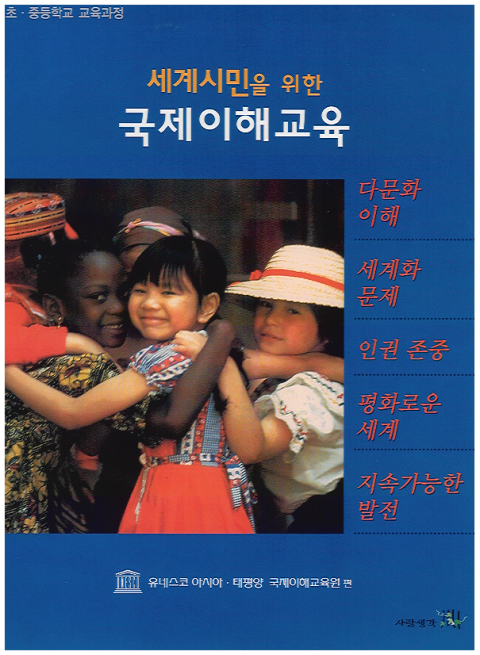 세계시민을 위한 국제이해교육 سنة النشر: 2003 المؤلف المؤسسي: APCEIU International Commission on Education for the Twenty-first Century of UNESCO proposed “Learning to Live Together” as the worldwide educational goal at the twenty-first century. Also, as many countries have become multiethnic or multicultural societies due to increasing interdependences, globalization and ICT, the necessity and importance of Education for International Understanding (EIU) on how to live in harmony with others is growing. In Korea, EIU was included as a selective subject for creative experience activities in the seventh national curriculum and the number of schools teaching EIU on the ground has been increasing since 2000. However, in many cases what to teach was left up to teachers’ discretion owing to the lack of clear guidelines or materials. This book is comprised of systematized educational goals and contents in accordance with primary and secondary school curricula, and was developed by Asia-Pacific Centre for Education for International Understanding (APCIEU) under the auspices of UNESCO for its first three years since its establishment in 2000. EIU as a school subject aims to provide students with knowledge, values and ethical attitudes needed for the people of global society to move beyond the borders of ethnicity, culture and religion into a life of peaceful coexistence. Within the frame of EIU, students learn about cultural relativity and universal values. Based on holistic perspective, this book is designed with the following five units - multicultural understanding, issues of globalization, respect for human rights, a peaceful world, and sustainable development - to be utilized for learning at the level of primary and secondary level students. 세계시민을 위한 국제이해교육 سنة النشر: 2003 المؤلف المؤسسي: Centre Asie-Pacifique d'éducation pour la compréhension internationale (APCEIU) Commission internationale sur l'éducation pour le XXIe siècle de l'UNESCO a proposé « Appredre à Vivre Ensemble» comme l'objectif de l'éducation dans le monde au XXIe siècle. En outre, comme de nombreux pays sont devenus des sociétés multiethniques ou multiculturelles en raison de l'augmentation des interdépendances, la mondialisation et les TIC, la nécessité et l'importance de l'Éducation pour la Compréhension Internationale (ECI) sur la façon de vivre en harmonie avec les autres. En Corée, ECI a été inclus en tant que sujet sélectif pour les activités d'expérience créatives dans le septième programme national et le nombre d'écoles d'enseignement ECI sur le terrain a augmenté depuis 2000. Cependant, dans de nombreux cas, ce qu'il faut enseigner a été laissé à la discrétion des enseignants en raison de l'absence de lignes directrices ou des matériaux transparents. Ce livre est composé de buts et contenus éducatifs systématisés en conformité avec les programmes de l'école primaire et secondaire, et a été développé par le Centre Asie-Pacifique d'éducation pour la compréhension internationale (APCEIU) sous les auspices de l'UNESCO pour ses trois premières années depuis sa création en 2000 . ECI en tant que matière scolaire vise à fournir aux étudiants des connaissances, des valeurs et des attitudes éthiques nécessaires pour les gens de la société mondiale pour se déplacer au-delà des frontières de l'ethnicité, la culture et la religion dans la vie de la coexistence pacifique. Dans le cadre de l'ECI, les élèves apprennent la relativité culturelle et des valeurs universelles. Sur la base de la perspective holistique, ce livre est conçu avec les cinq unités suivantes - la compréhension multiculturelle, les questions de la mondialisation, le respect des droits de l'homme, un monde pacifique, et le développement durable - pour être utilisé pour l'apprentissage au niveau des élèves de niveau primaire et secondaire. 세계시민을 위한 국제이해교육 سنة النشر: 2003 المؤلف المؤسسي: 유네스코 아시아태평양 국제이해교육원 21세기를 위한 유네스코 국제 교육위원회는 21세기 세계교육 목표로 “더불어 사는 학습(Learning to Live Together)”을 제안했다. 오늘날 많은 국가들이 상호 의존성 증가에 기인하는 다문화 혹은 다민족 사회가 되었고, 이에 따라 어떻게 타인과 함께 성장하며 어떻게 조화를 이루며 살아가는 가에 대한 국제이해교육(EIU)의 중요성과 필요성, 세계화와 정보통신 기술(ICT)도 대두되었다. 한국에서는 제 7차 국가 교육 과정에 창의적 체험 활동 과목에 국제이해교육을 포함시켰고, 이를 가르치는 학교의 수가 2000년 이후 꾸준히 증가하고 있다. 그러나 명확한 가이드 라인 또는 자료의 부족으로 많은 경우, 국제이해교육은 교사의 재량에 따라 그 학습이 달려있었다. 본서는 초등 및 중등 교육 과정에 따라 체계화된 교육 목표와 그 내용으로 구성되었고, 2000년도에 설립된 이래 첫 3년동안 유네스코의 후원 하에 국제이해교육을 위한 아시아-태평양 교육원(APCIEU)에 의해 개발되었다. 학과목으로서의 국제이해교육(EIU)은 인종, 문화와 종교의 경계를 넘어 평화롭게 공존할 글로벌 사회의 사람들을 위해 필요한 윤리적 태도 및 가치, 지식을 갖춘 학생을 배양하는 것을 그 목표로 삼고 있다. 국제이해교육의 프레임 안에서 학생들은 문화의 상대성과 보편적 가치에 대해 학습한다. 전인적 관점에 근거하여, 본서는 다음의 다섯 가지 단위-다문화의 이해, 세계화의 쟁점 사안들, 인권 존중, 평화로운 세계, 지속 가능한 계발-로 고안되었으며, 초등 및 중등 학생 수준의 교육을 위해 사용된다.
  함께 사는 세상 만들기 سنة النشر: 2004 المؤلف المؤسسي: APCEIU This book, in essence, aims to introduce Education for International Understanding (EIU) to high school students, college students and teachers at all levels as well as the general public. The growing interconnectedness and interdependence compels all of us to understand the world beyond our immediate living space, to critically reflect on issues affecting us and others, and to work together to make our world a more peaceful and sustainable one. It requires values education that is transformative and participatory in nature to arouse genuine interests and passions to learn more and eventually to make positive changes. The book is comprised of five parts, organized by five thematic areas of EIU, namely, intercultural understanding, globalization, human rights, peace and Education for Sustainable Development (ESD). It introduces carefully chosen topics and discussions which may pique readers’ interest in some of the issues at stake, thus, encourage them to critically reflect on the complexities surrounding the issues and motivate them to engage further. Using an interdisciplinary lens, the book also borrows some ideas and approaches commonly practiced in critical anthropology. 함께 사는 세상 만들기 سنة النشر: 2004 المؤلف المؤسسي: 유네스코 아시아태평양 국제이해교육원 유네스코 아시아태평양 국제이해교육원에서는 국제이해교육을 가르치는 교사와 배우고자 하는 고등학생들에게 도움을 주기 위하여 고등학생을 위한 국제이해교육 교재를 출간하게 되었습니다우리 교육원은 아시아·태평양 지역의 45개 나라들과 함께 국제이해교육을 학교와 시민사회에서 강화하고 발전시킬 책임을 부여받았기 때문에, 여러가지 국제 회의와 연수과정, 전문가 협의회 등을 통해 이 과목의 교육 내용과 교과 과정에 대한 그림을 그려보는 노력을 부단히 전개하고 있습니다. 우리 교육원은 국내·외 여러 전문가들과 함께 많은 토론을 거쳐 국제이해교육의 기본 골격을 ① 문화 간 이해, ② 세계화, ③ 인권, ④ 평화, ⑤ 지속가능발전의 다섯 가지로 정했으며, 이를 바탕으로 초·중·고 국제이해교육 교육과정을 개발했습니다.우리 교육원은 앞으로 수년간 이러한 토대 위에서 교육자료나 수업 모형 등을 개발해보려고 합니다. 이번에 발간되는 교재 『함께 사는 세상 만들기』도 이러한 노력의 한 결실입니다. 이 책이 세계화 시대의 사회구조와 문제들을 파악하고, 함께 살 수 있는 가치관과 태도를 길러주는 데 크게 도움이 될 수 있기를 바랍니다.
 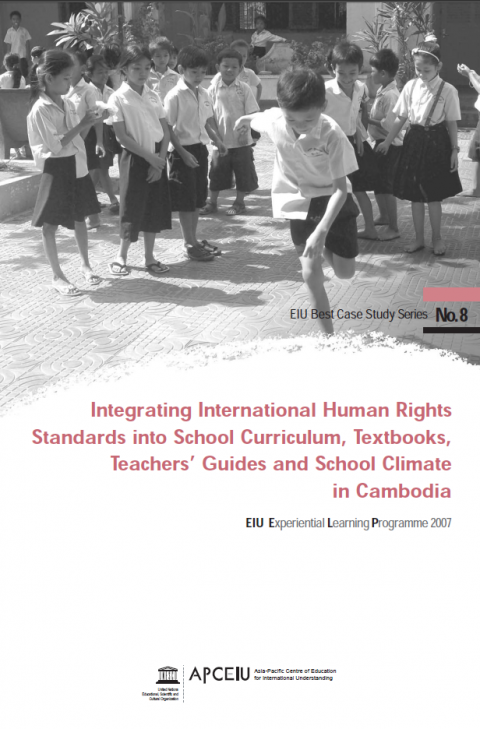 EIU Best Practice Series No.8: Integrating international human rights standards into school curriculum, textbooks, teachers' guides and school climate in Cambodia سنة النشر: 2007 المؤلف: Seungmi Lee | Hyewon Jung المؤلف المؤسسي: APCEIU It goes without saying that the aftermath of the war brings various challenges such as poverty, displacement, disability, destroyed culture, etc. and it is of critical importance that it should be well-remedied to preclude its recurrence. In this regard, value education and human rights education are considered crucial and to my mind, so is the educational role that religion can play. Although religions have harmonized the impaired society, but generally they have not been appreciated by their ignorant disciples or followers. Thus, value education is considered to be able to play a crucial role. It is in this context that human rihts education is gaining currency in Cambodia in recent years and has been implemented gradually. Préliminaire d'inventaire L'intégration des normes internationales des droits de l'homme dans les programmes scolaires, les manuels, les guides de l'enseignant et le climat scolaire au Cambodge (ECI no. 8) سنة النشر: 2007 المؤلف: Seungmi Lee | Hyewon Jung المؤلف المؤسسي: APCEIU Il va sans dire que le lendemain de la guerre apporte de nombreux défis tels que la pauvreté, le déplacement, le handicap, la culture détruite, etc., et il est d'une importance cruciale qu'il devrait être bien remédié à empêcher qu'elle ne se reproduise. À cet égard, l'éducation de la valeur et l'éducation aux droits de l'homme sont considérés comme cruciaux et à mon avis, est donc le rôle éducatif que la religion peut jouer. Bien que les religions ont harmonisé la société avec facultés affaiblies, mais généralement ils ne sont pas appréciés par leurs disciples ou adeptes ignorants. Ainsi, l'éducation de valeur est considérée pour être en mesure de jouer un rôle crucial. Il est dans ce contexte que l'éducation rihts humaines gagne la monnaie au Cambodge ces dernières années et a été mis en œuvre progressivement.
  EIU Best Practice Series No. 5: Peace and human rights education through education for sustainable development: lessons from four case studies in the Philippines سنة النشر: 2007 المؤلف المؤسسي: APCEIU The four case studies showed that EIU through peace and human rights education in the context of education for sustainable development can build a critical mass of Filipinos who will reject wars and promote social security. Education can play a role to direct the children, youth, and adults toward peace building and better understanding of cultural differences. It should also be noted that when institutions adopt a peace culture, establishing local and international organizations and putting up resources for various peace-building initiatives become possible. Educational intervention can effect changes in the minds of men and build a lasting and substantive foundation for peace based on justice and respect for human rights.