
الموارد
استكشف مجموعة واسعة من الموارد القيمة حول تعليم المواطنة العالمية لتعميق فهمك وتعزيز البحث والمناصرة والتعليم والتعلم.
تم العثور على 3,433 نتيجة
 التعليم والهوية ومنع التطرف: من منع التطرف العنيف إلى تعزيز السالم والصمود والمساواة في الحقوق والتعددية )PREP) سنة النشر: 2017 المؤلف: Sanam Anderlini المؤلف المؤسسي: International Civil Society Action Network فـي تشـرين الثانـي / نوفمبـر 2016 ، خـال منتـدى ايـكان ICAN السـنوي الخامـس للمـرأة والسـام واألمـن ، قــام أعضــاء التحالــف النســائي مــن أجــل القيــادة األمنيــة )وصــل( وغيرهــا مــن المنظمــات التــي تقودهــا النســاء فــي أكثــر مــن 30 دولــة بتحليــل دور التعليــم الرســمي وغيــر الرســمي فــي المســاهمة فــي تمكيــن الظـروف و تخفيـف العنـف المتطرف.كمـا قامـوا بتسـليط الضـوء علـى تجاربهـم العمليـة الخاصـة والـدروس المســتفادة مــن توفيــر التعليــم لمنــع التطــرف العنيــف مــن خــال تعزيــز الســام والصمــود والمســاواة فــي الحقـوق والتعدديـة )PREP )فـي المسـاحات الرسـمية وغيـر الرسـمية، بمـا فـي ذلـك مـن خـال تعاليـم بديلـة إلـى جنـب مع األبحـاث المكتبيـة حـول حالـة السياسـات والممارسـات للروايـات الدينيـة.إن تجاربهـم، جنبـا الحاليــة، وأول اجتماع للمنصــة العالميــة لتبــادل الحلــول )GSX ) حــول العالقــة بيــن التعليــم والجنــدر والتطـرف الـذي عقـد فـي مقـر اليونسـكو فـي باريـس فـي مـارس 2017 ، تقـوم بإبـاغ نتائج هـذا التقريـر .
 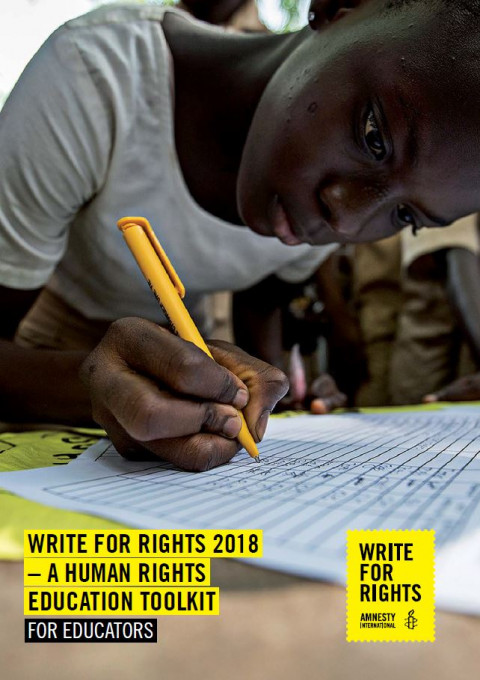 Write for Rights 2018: A Human Rights Education Toolkit for Educators سنة النشر: 2018 المؤلف المؤسسي: Amnesty International The annual Write for Rights (W4R) campaign is one of Amnesty International’s biggest human rights events. In 2018 the campaign focuses on women human rights defenders who have suffered human rights violations or are at great risk because of the positions they have taken on certain human rights issues.This Human Rights Education toolkit was created to support teachers’ participation with their students in the W4R campaign. It provides a broad perspective on human rights issues and offers the opportunity to open young people’s minds to global concerns. By learning about and writing persuasive letters to help end human rights violations and achieve justice, teachers and students contribute to the international human rights movement and see for themselves how words can make a difference in the world.This toolkit was created for students aged 13 and above and is primarily designed for use in a school setting: both inside the classroom as well as in clubs or school-wide events. Activities can also be adapted for use in other, non-formal education contexts such as youth groups and community settings. The toolkit contains general activities on human rights and highlights six women human rights defenders from the W4R campaign who have made extraordinary contributions to the advancement of human rights around the world. Écrire pour les droits 2018: Manuel d´éducation aux droits humains pou les éducateurs et éducatrices سنة النشر: 2018 المؤلف المؤسسي: Amnesty International La campagne annuelle Écrire pour les droits est l’une des plus importantes actions d’Amnesty International autour des droits humains. L’édition 2018 est axée sur les défenseures des droits humains qui sont victimes de violations de leurs droits fondamentaux ou en grand danger du fait de leur position sur certaines questions relatives aux droits humains.Le manuel Éducation aux droits humains vise à favoriser la participation des enseignant-e-s et de leurs élèves à la campagne Écrire pour les droits. Il offre une perspective large sur les questions relatives aux droits humains et la possibilité de sensibiliser les jeunes à des préoccupations mondiales. En en apprenant davantage et en rédigeant des lettres convaincantes pour aider à mettre fin aux violations des droits humains et à obtenir justice, les enseignant-e-s et leurs élèves contribuent au mouvement international des droits humains et voient par elles/eux-mêmes que les mots peuvent faire la différence.Ce manuel est destiné aux élèves de 13 ans et plus pour une utilisation en contexte scolaire, tant en classe que dans des clubs ou des manifestations organisées à l’école. Les activités peuvent cependant être adaptées à des contextes d’apprentissage plus informels comme des groupes de jeunes et des associations. Le manuel propose des activités générales sur les droits humains et met en avant six défenseures des droits humains choisies au titre de la campagne Écrire pour les droits qui ont apporté des contributions extraordinaires à la progression des droits fondamentaux dans le monde entier. Escribe por los derechos 2018: Carpeta de materiales de educación en derechos humanos para educadores/as سنة النشر: 2018 المؤلف المؤسسي: Amnesty International La campaña anual Escribe por los Derechos es uno de los mayores eventos de derechos humanos de Amnistía Internacional. En 2018, la campaña se centra en defensoras de los derechos humanos que han sufrido violaciones de derechos humanos o corren grave riesgo a causa de la postura que han adoptado respecto a ciertas cuestiones de derechos humanos.Esta carpeta de materiales de Educación en Derechos Humanos se creó para ayudar a profesores y profesoras a participar con sus estudiantes en la campaña Escribe por los Derechos. Ofrece una amplia perspectiva de cuestiones de derechos humanos y brinda la oportunidad de abrir la mente de los y las jóvenes a cuestiones de preocupación mundiales. Al aprender sobre estas cuestiones y escribir cartas convincentes para ayudar a poner fin a las violaciones de derechos humanos y lograr justicia, los profesores y profesoras y sus estudiantes contribuyen al movimiento internacional de derechos humanos y ven con sus propios ojos cómo las palabras pueden hacer cambiar las cosas en el mundo.Esta carpeta se creó para estudiantes de a partir de 13 años y está concebida principalmente para utilizarla en un entorno escolar: tanto dentro del aula como en clubes o eventos de toda la escuela. Las actividades también se pueden adaptar para utilizarlas en otros contextos de educación no formal, como grupos de jóvenes y entornos comunitarios. La carpeta contiene actividades generales sobre derechos humanos y destaca el caso de seis defensoras de los derechos humanos de la campaña Escribe por los Derechos que han hecho contribuciones extraordinarias al progreso de los derechos humanos en todo el mundo.
  The Role of Education in Countering Violent Extremism سنة النشر: 2013 المؤلف المؤسسي: Center on Global Counterterrorism Cooperation and Hedayah On 18 and 19 September 2013, the Center on Global Counterterrorism Cooperation (CGCC) and Hedayah co-hosted in New York City an expert roundtable on “The Role of Education in Countering Violent Extremism.” The meeting brought together a group of policy-makers, researchers and practitioners to discuss challenges and best practices related to efforts to counter violent extremism through education. The Role of Education in Countering Violent Extremism سنة النشر: 2013 المؤلف المؤسسي: Center on Global Counterterrorism Cooperation and Hedayah Les 19 et 20 septembre 2013, le Centre de coopération internationale pour la lutte contre le terrorisme (Center on Global Counterterrorism Cooperation, CGCC) et Hedayah ont accueilli une table ronde d'experts, à New York, sur « le rôle de l'éducation pour lutter contre l'extrémisme violent » (The Role of Edcuation in Countering Violent Extremism). Cet événement a réuni des décideurs politiques, des chercheurs et des praticiens afin de discuter des défis et des meilleures pratiques dans les efforts réalisés pour lutter contre l'extrémisme violent par l'éducation.
  Education and Conflict: Complexity and Chaos سنة النشر: 2003 المؤلف: Lynn Davies Based on the author's extensive research and experience of education in several areas afflicted by conflict, the book explores the relationship between schooling and social conflict and looks at conflict internal to schools. It posits a direct link between the ethos of a school and the attitudes of future citizens towards 'others'. It also looks at the nature and purpose of peace education and war education, and addresses the role of gender and masculinity. Education and Conflict: Complexity and Chaos سنة النشر: 2003 المؤلف: Lynn Davies Basé sur une recherche approfondie de l'auteur et sur son expérience en terme d'éducation dans plusieurs zones affectées par des conflits, ce livre analyse la relation entre le fait d'aller à l'école et le conflit social, et s'attache aux conflits qui surviennent au sein des établissements scolaires. L’auteur postule un lien direct entre l'éthos adopté par une école donnée et le comportement de ses futures citoyens envers « les autres ». Il s'attache également à la nature et à l'objet de l'éducation pour la paix et de l'enseignement des conflits, et aborde la question du rôle joué par le genre et la masculinité.
  Schools and war: urgent agendas for comparative and international education سنة النشر: 2005 المؤلف: Lynn Davies المؤلف المؤسسي: Taylor & Francis This paper looks first at the contributions that education makes to conflict, through the reproduction of inequality and exclusion, through perpetuation of ethnic or religious divisions, through its acceptance of dominant aggressive masculinities, through selection, competition and fear, and through distorted curricular emphases on narrow cognitive areas of learning. However, the paper also outlines some ‘possibilities for hope’, such as resilient schools, the impact of peace education initiatives and the rise of global citizenship education.
  Inter-agency peace education programme: skills for constructive living; overview of the programme سنة النشر: 2005 المؤلف: Antonella Verdiani المؤلف المؤسسي: UN. Office of the United Nations High Commissioner for Refugees (UNHCR) | Inter-agency Network for Education in Emergencies (INEE) This manual is one of the components of the “Inter-Agency Peace Education Programme”. The programme is designed for education managers of ministries dealing with both formal and non-formal education and for agencies which implement education activities on behalf of the government. The implementation structure is based on the experience acquired over the eight years the programme has been in use, from 1998 to 2005. The programme has been evaluated by external experts and the new revised materials (2005) incorporate both the suggestions made in the evaluation and the feedback from the specialists who implemented it in the field.