
الموارد
استكشف مجموعة واسعة من الموارد القيمة حول تعليم المواطنة العالمية لتعميق فهمك وتعزيز البحث والمناصرة والتعليم والتعلم.
تم العثور على 2,199 نتيجة
 Global Citizenship Education in Australian Elementary Schools(Journal of Ethics; Vol. 137, No 1) سنة النشر: 2022 المؤلف: 한은영 | 추병완 المؤلف المؤسسي: 한국윤리학회 Global citizens think and act about the world as a universal community of borderless members who care for each other and are dedicated to taking care of the earth. Considering these visions and moral ideals, global citizenship education is an important goal and content of moral education. However, at present, we do not have a framework for dealing with global citizenship education in moral education. In this regard, Australia is the country we should pay attention to. Australia declared a national statement for global citizenship education in 2002. Since 2009, it has been reflected in the Australian curriculum. This article examines the historical development of global citizenship education in Australia, analyzes the current systems of global citizenship education system in primary schools, and investigates what Australia's approach to global citizenship education suggests for elementary moral education in Korea. In conclusion, we proposed three things. First, we must develop and apply a framework for the practice of global civic education in moral education. Second, we should emphasize the aspects of knowledge and understanding, skills and processing, behavior and participation as well as values and attitudes. Third, we must seek a balance between moderate global citizenship education and critical global citizenship education. 호주의 초등학교 세계시민교육(윤리연구; Vol. 137, No 1) سنة النشر: 2022 المؤلف: 한은영 | 추병완 المؤلف المؤسسي: 한국윤리학회 세계시민교육을 통해 우리가 길러내고자 하는 세계 시민은 서로 배려하고 지구를 돌보는 국경 없는 구성원들의 보편적 공동체로서의 세계에 관해 생각하고 행동하는 사람의 비전과 도덕적 이상을 드러내므로, 세계 시민성과 세계시민교육은 도덕교육이 다루어야 할 중요한 목표이자 내용에 해당한다. 1960년대부터 세계시민교육에 관심을 가졌던 호주는 학교 교육에서 세계시민교육을 실천하기 위한 국가 차원의 프레임워크를 이미 2002년에 발표하였고, 초등학교에서는 ‘인문학과 사회과학’, 일반 능력, 범교과 우선순위를 통해 세계시민교육에 주력하는 중이다. 이에 이 논문은 호주에서 세계시민교육의 역사적 전개를 살펴보고, 현재 초등학교에서 세계시민교육 체제를 분석하며, 호주의 세계시민교육 접근법이 초등학교 도덕 교과에서 세계시민교육의 실천에 시사하는 바가 무엇인지를 규명하였다.
  교사를 위한 안내서: 세계시민교육 سنة النشر: 2025 المؤلف المؤسسي: 옥스팜 빠르게 변하는 ‘세계화’의 세상은 청소년들에게 엄청난 기회와 함께 그에 못지 않은 수많은 도전 과제를 주고 있습니다. 옥스팜은 세계 시민 교육을 통해 청소년들에게 교육분쟁, 기후변화, 불평등과 빈곤 등 전 세계에서 일어나고 있는 기회와 도전을 받아들이고, 나아가 자신이 살고 싶은 세상을 만들어 나갈 수 있도록 관련된 지식, 기술, 가치를 교육받을 권리를 실현시킬 수 있도록 지원합니다. 이슈 트리, 결과의 바퀴, 역할 놀이 등 옥스팜이 소개하는 구체적인 활동안을 활용해 학생들과 함께 유익한 세계 시민 교육을 진행해 보세요. 주요 내용 세계 시민의식 키우기 세계 시민의식에서 중요한 개념들 교실 수업에서 세계 시민의식 키우기 학습과 의사 결정에 참여하기 질문하기 연관성 찾기 관점과 가치 탐구하기 세계 시민으로서 적극적으로 행동하기 수업 평가하기
  SDG4 이행 촉진을 위한 지표 연구 سنة النشر: 2025 المؤلف: 박근영 | 주형미 | 문무경 | 오예진 | 류기락 | 조혜승 | 변종임 | Sunmi Ji | 이슬비 | 박기웅 | 안해정 | 서무계 المؤلف المؤسسي: Korean National Commission for UNESCO 지속가능발전목표(SDGs) 이행의 전환점을 맞아 국내 교육의 현황과 과제를 SDG4 지표를 통해 진단하고 향후 방향을 탐색한 연구 보고서 <목차> 발간사 ‘SDG4 이행 촉진을 위한 지표 연구’ 보고서를 발간하며 서론 현 시점의 SDG4 이행 수준 점검과 개선 방향 탐색의 당위성 SDG 4.1 공평하고 양질의 초·중등 교육 이수 보장에 대한 한국 현황 및 향후 과제 SDG 4.2 영유아 교육과 보육 지표 검토와 향후 과제 SDG 4.3 고등교육의 수월성과 형평성 논의 및 향후 과제 SDG 4.4 고용을 위한 스킬: SDG 4.4의 이행 현황과 과제 SDG 4.5 교육 형평성 실현을 위한 SDG 4.5 지표 검토와 이행 현황 분석 SDG 4.6 한국의 SDG 4.6 이행 현행과 과제: 성인 문해력 SDG 4.7 더불어 살기 위한 학습을 향하여: 세계시민교육 및 지속가능발전교육 이행 현황과 모니터링 개선 방안 탐색 SDG 4.a SDG 4.a.1과 한국 디지털 교육 이행 현황: 접근성, 사용도, 스킬 SDG 4.b 공적개발원조(ODA) 장학금 확대 SDG 4.c 자격을 갖춘 교사의 공급 관련 이행 현황 및 개선 방안 결론 엄격한 현실 인식에 기반한 다음 목표로의 이행 준비
  The Development of Asian Primary Students’ Global Citizenship Literacy Scales: An Exploratory Study of Taiwan Primary Student (Educational Journal ; Vol.45, No.1) سنة النشر: 2017 المؤلف: 吴时省 | 蔡清华 This study aimed to develop an instrument to measure the effect of Taiwan’s policy on global education. Four constructs were developed, namely rights and responsibilities of global citizenship, competencies of global citizenship, participation of global citizenship, and reflection of global citizenship. The instrument was tested with a sample of 1,112 elementary school students in Taiwan. Content validity was established. Exploratory factor analysis and confirmatory factor analysis confirmed construct validity. All the indexes were satisfied except the convergent validity. 亚洲小学生全球公民素养量表之发展:以台湾小学生为探索个案 (教育学报; Vol.45, No.1) سنة النشر: 2017 المؤلف: 吴时省 | 蔡清华 本研究主要目的在发展一份全球公民素养量表,作为台湾过去这些年来对于小学阶段全球教育努力成果的检视。透过文献分析,研究者归纳出全球公民素养四个构念,分别为「全球公民权利与义务」、「全球公民能力」、「全球公民参与」、「全球公民反思」,并根据这四个构念进行量表的编制和信效度的检核。研究样本为台湾各地小学生,总计1,112名。量表整体信度为.868,与各个效标工具的相关亦都至少达到.05显着水准;模式的考验方面,除了内在品质的聚敛效度稍嫌不理想外,其余结果都达到预期。
  2022 세계시민교육 보고서: 국제 수업 교류 사례 및 세계시민교육 교원학습공동체 연구 자료 سنة النشر: 2022 المؤلف المؤسسي: 서울특별시교육청 2022 세계시민교육 보고서는 크게 두 파트로 나누어 Part.1에서는 국내 12개 초·중·고등학교의 국제 수업 교류 사례와 수업설계, 학습지도안 활동사진 등을 담고 있고 Part. 2에서는 수달스, 더불어 평화 등 5개 세계시민교육 교원학습공동체의 연구 자료를 수록하고 있다.
 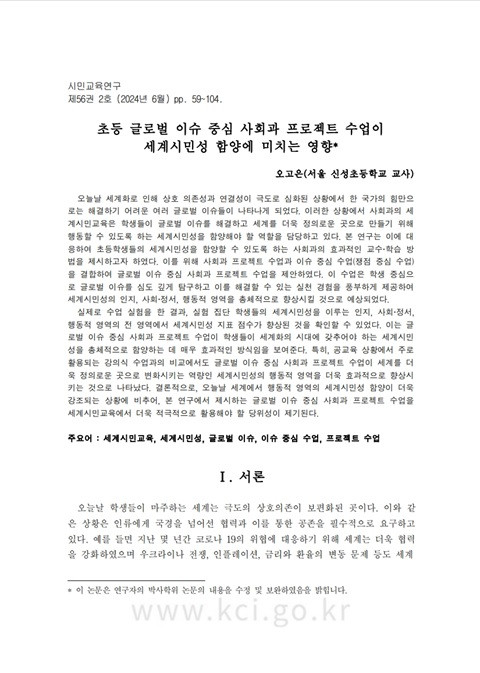 초등 글로벌 이슈 중심 사회과 프로젝트 수업이 세계시민성 함양에 미치는 영향 (시민교육연구; Vol. 56, No. 2) سنة النشر: 2024 المؤلف: 오고은 المؤلف المؤسسي: 한국사회과교육학회 오늘날 세계화로 인해 상호 의존성과 연결성이 극도로 심화된 상황에서 한 국가의 힘만으로는 해결하기 어려운 여러 글로벌 이슈들이 나타나게 되었다. 이러한 상황에서 사회과의 세계시민교육은 학생들이 글로벌 이슈를 해결하고 세계를 더욱 정의로운 곳으로 만들기 위해 행동할 수 있도록 하는 세계시민성을 함양해야 할 역할을 담당하고 있다. 본 연구는 이에 대응하여 초등학생들의 세계시민성을 함양할 수 있도록 하는 사회과의 효과적인 교수-학습 방법을 제시하고자 하였다. 이를 위해 사회과 프로젝트 수업과 이슈 중심 수업(쟁점 중심 수업)을 결합하여 글로벌 이슈 중심 사회과 프로젝트 수업을 제안하였다. 이 수업은 학생 중심으로 글로벌 이슈를 심도 깊게 탐구하고 이를 해결할 수 있는 실천 경험을 풍부하게 제공하여 세계시민성의 인지, 사회-정서, 행동적 영역을 총체적으로 향상시킬 것으로 예상되었다. 실제로 수업 실험을 한 결과, 실험 집단 학생들의 세계시민성을 이루는 인지, 사회-정서, 행동적 영역의 전 영역에서 세계시민성 지표 점수가 향상된 것을 확인할 수 있었다. 이는 글로벌 이슈 중심 사회과 프로젝트 수업이 학생들이 세계화의 시대에 갖추어야 하는 세계시민성을 총체적으로 함양하는 데 매우 효과적인 방식임을 보여준다. 특히, 공교육 상황에서 주로 활용되는 강의식 수업과의 비교에서도 글로벌 이슈 중심 사회과 프로젝트 수업이 세계를 더욱 정의로운 곳으로 변화시키는 역량인 세계시민성의 행동적 영역을 더욱 효과적으로 향상시키는 것으로 나타났다. 결론적으로, 오늘날 세계에서 행동적 영역의 세계시민성 함양이 더욱 강조되는 상황에 비추어, 본 연구에서 제시하는 글로벌 이슈 중심 사회과 프로젝트 수업을 세계시민교육에서 더욱 적극적으로 활용해야 할 당위성이 제기된다.
 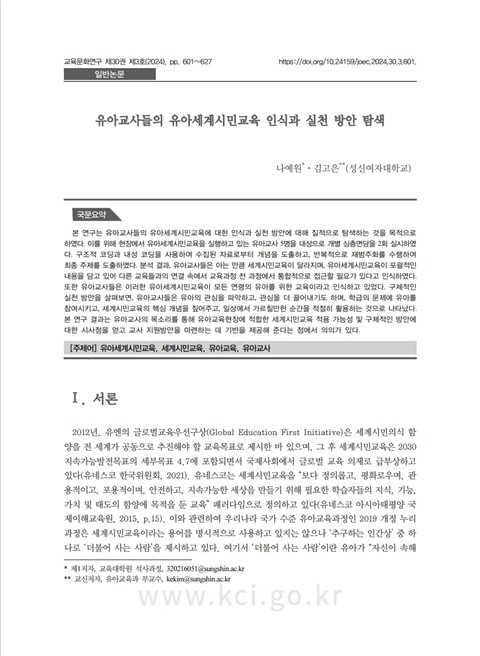 유아교사들의 유아세계시민교육 인식과 실천 방안 탐색 (교육문화연구; Vol. 30, No. 3) سنة النشر: 2024 المؤلف: 나예원 | 김고은 المؤلف المؤسسي: 인하대학교 교육연구소 본 연구는 유아교사들의 유아세계시민교육에 대한 인식과 실천 방안에 대해 질적으로 탐색하는 것을 목적으로 하였다. 이를 위해 현장에서 유아세계시민교육을 실행하고 있는 유아교사 5명을 대상으로 개별 심층면담을 2회 실시하였다. 구조적 코딩과 내성 코딩을 사용하여 수집된 자료로부터 개념을 도출하고, 반복적으로 재범주화를 수행하여 최종 주제를 도출하였다. 분석 결과, 유아교사들은 아는 만큼 세계시민교육이 달라지며, 유아세계시민교육이 포괄적인 내용을 담고 있어 다른 교육들과의 연결 속에서 교육과정 전 과정에서 통합적으로 접근할 필요가 있다고 인식하였다. 또한 유아교사들은 이러한 유아세계시민교육이 모든 연령의 유아를 위한 교육이라고 인식하고 있었다. 구체적인 실천 방안을 살펴보면, 유아교사들은 유아의 관심을 파악하고, 관심을 더 끌어내기도 하며, 학급의 문제에 유아를 참여시키고, 세계시민교육의 핵심 개념을 짚어주고, 일상에서 가르칠만한 순간을 적절히 활용하는 것으로 나타났다. 본 연구 결과는 유아교사의 목소리를 통해 유아교육현장에 적합한 세계시민교육 적용 가능성 및 구체적인 방안에 대한 시사점을 얻고 교사 지원방안을 마련하는 데 기반을 제공해 준다는 점에서 의의가 있다.
 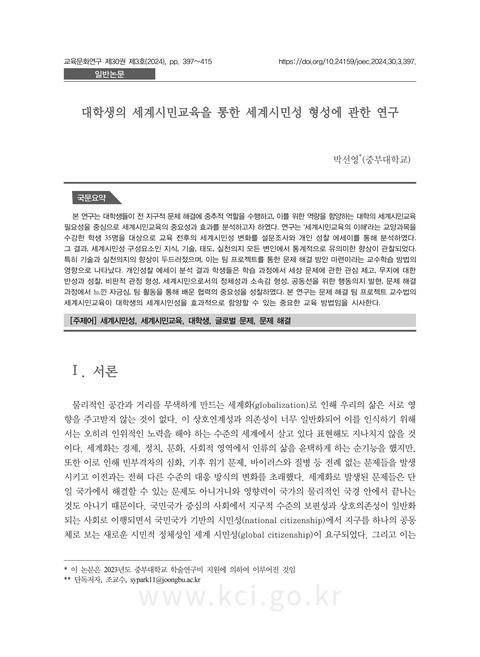 대학생의 세계시민교육을 통한 세계시민성 형성에 관한 연구 (교육문화연구; Vol. 30, No. 3) سنة النشر: 2024 المؤلف: 박선영 المؤلف المؤسسي: 인하대학교 교육연구소 본 연구는 대학생들이 전 지구적 문제 해결에 중추적 역할을 수행하고, 이를 위한 역량을 함양하는 대학의 세계시민교육필요성을 중심으로 세계시민교육의 중요성과 효과를 분석하고자 하였다. 연구는 '세계시민교육의 이해'라는 교양과목을수강한 학생 35명을 대상으로 교육 전후의 세계시민성 변화를 설문조사와 개인 성찰 에세이를 통해 분석하였다. 그 결과, 세계시민성 구성요소인 지식, 기술, 태도, 실천의지 모든 변인에서 통계적으로 유의미한 향상이 관찰되었다. 특히 기술과 실천의지의 향상이 두드러졌으며, 이는 팀 프로젝트를 통한 문제 해결 방안 마련이라는 교수학습 방법의영향으로 나타났다. 개인성찰 에세이 분석 결과 학생들은 학습 과정에서 세상 문제에 관한 관심 제고, 무지에 대한반성과 성찰, 비판적 관점 형성, 세계시민으로서의 정체성과 소속감 형성, 공동선을 위한 행동의지 발현, 문제 해결과정에서 느낀 자긍심, 팀 활동을 통해 배운 협력의 중요성을 성찰하였다. 본 연구는 문제 해결 팀 프로젝트 교수법의세계시민교육이 대학생의 세계시민성을 효과적으로 함양할 수 있는 중요한 교육 방법임을 시사한다.