
الموارد
استكشف مجموعة واسعة من الموارد القيمة حول تعليم المواطنة العالمية لتعميق فهمك وتعزيز البحث والمناصرة والتعليم والتعلم.
تم العثور على 3,454 نتيجة
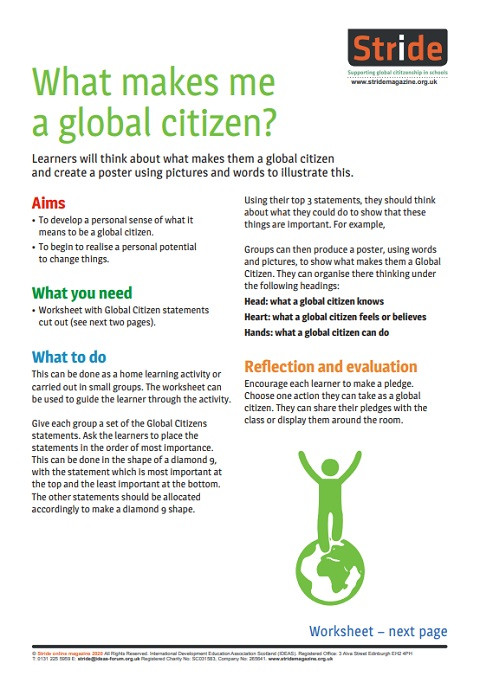 What Makes Me a Global Citizen? سنة النشر: 2020 المؤلف المؤسسي: Stride This material aims to develop a personal sense of what it means to be a global citizen and to begin to realize a personal potential to change things. Learners will think about what makes them a global citizen and create a poster using pictures and words to illustrate this.
  Citoyenneté mondiale et laïcité سنة النشر: 2018 المؤلف: Nicolas Cadène المؤلف المؤسسي: ACTISCE Patronage Laique Jules Vallès La laïcité fait, de chacune et de chacun d’entre nous, au-delà de nos appartenances ou de nos origines, des citoyennes et des citoyens à égalité de droits et de devoirs. Elle nous permet d’aller au-delà de nos différences et de les dépasser tout en les respectant. Par la volonté de vivre ensemble, notre laïcité garantit la liberté de croire ou de ne pas croire et la possibilité de l’exprimer dans les limites de la liberté d’autrui. Elle permet la pluralité dans le respect mutuel et assise sur une citoyenneté commune. Au travers de nombreux exemples dont les cas de la Belgique, la Turquie, l’Inde, le Brésil, le Mexique et le Sénégal, Nicolas Cadène nous montre en quoi la laïcité est source de liberté pour tous les peuples.
 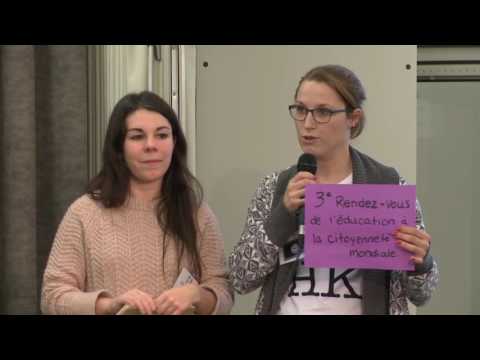 1er rendez-vous de l'éducation à la citoyenneté mondiale: Se donner une vision d'avenir en ÉCM سنة النشر: 2017 المؤلف المؤسسي: Association québécoise des organismes de coopération internationale (AQOCI) Travail en sous-groupes: « Se donner une vision d'avenir en ÉCM »
 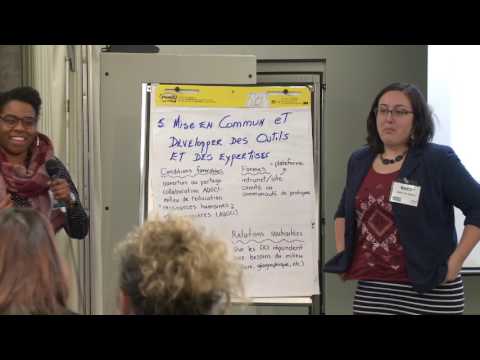 1er rendez-vous de l'éducation à la citoyenneté mondiale: Conditions favorables au changement سنة النشر: 2017 المؤلف المؤسسي: Association québécoise des organismes de coopération internationale (AQOCI) Travail en sous-groupes: «Conditions favorables au changement: de la situation actuelle à la situation souhaitée»
  La pédagogie de projet au cœur de l'éducation pour un développement durable سنة النشر: 2016 المؤلف المؤسسي: Université Virtuelle Environnement et Développement durable (UVED) Dans cette vidéo, Francine Pellaud discute des intérêts et des conditions de réussite de la pédagogie de projet, dans le cadre d'une éducation à l'environnement et au développement durable.
  Comment être citoyen du monde? سنة النشر: 2015 المؤلف: Radhi Meddeb المؤلف المؤسسي: TEDxCarthage | TEDx Talks Le monde a salué la Révolution tunisienne comme étant celle des technologies de l'information et des communications. Cela est vrai en partie, car les jeunes tunisiens ont déjoué la censure, ont relayé les images de la révolte et des protestations. Mais en même temps, l'usage de l'ordinateur et d'Internet reste aujourd'hui très en deçà des normes internationales. Plus encore, il présente des disparités régionales majeures. Des cyberbases dans l'ensemble des régions tunisiennes peuvent donner à chaque tunisien un passeport vers la modernité et la citoyenneté.
  Refugee Education: The Crossroads of Globalization (Educational Researcher; vol. 45, no. 9) سنة النشر: 2016 المؤلف: Sarah Dryden-Peterson المؤلف المؤسسي: Harvard University In this article, the author probes a question at the core of comparative education – how to realize the right to education for all and ensure opportunities to use that education for future participation in society. She does so thorough examination of refugee education from World War II to the present, including analysis of an original dataset of documents (n=214) and semi-structured interviews (n=208). The data illuminate how refugee children are caught between the global promise of universal human rights, the definition of citizenship rights within nation-states, and the realization of these sets of rights in everyday practices.
  Preparing Our Youth for an Inclusive and Sustainable World: The OECD PISA Global Competence Framework سنة النشر: 2018 المؤلف المؤسسي: Organisation for Economic Co-operation and Development (OECD) OECD Programme for International Student Assessment (PISA), the global yardstick for educational success, includes global competence in its metrics for quality, equity and effectiveness in education. The global competence assessment in PISA 2018 is composed of two parts: a cognitive assessment and a background questionnaire. The cognitive assessment is designed to elicit students' capacities to critically examine global issues; recognise outside influences on perspectives and world views; understand how to communicate with others in intercultural contexts; and identify and compare different courses of action to address global and intercultural issues. In the background questionnaire, students will be asked to report how familiar they are with global issues; how developed their linguistic and communication skills are; to what extent they hold certain attitudes, such as respect for people from different cultural backgrounds; and what opportunities they have at school to develop global competence. Answers to the school and teacher questionnaires will provide a comparative picture of how education systems are integrating global, international and intercultural perspectives throughout the curriculum and in classroom activities.
  Rethinking Learning: A Review of Social and Emotional Learning for Education Systems سنة النشر: 2020 المؤلف: Nandini Chatterjee Singh | Anantha Duraiappah المؤلف المؤسسي: Mahatma Gandhi Institute of Education for Peace and Sustainable Development (MGIEP) This publication titled ‘Rethinking Learning: A Review of Social and Emotional Learning for Education Systems’, published by the UNESCO Mahatma Gandhi Institute of Education for Peace and Sustainable Development (MGIEP) reviews the latest research on Social and Emotional Learning (SEL), its impact on student health and school climate and its transformative role in building happier classrooms. It seeks to inform and impress upon Member States the urgent need to mainstream social and emotional learning in education systems.
  Education for Global Citizenship سنة النشر: 2012 المؤلف المؤسسي: Education Above All (Qatar) This book shows that transformative education for local, national and global citizenship and peace can be implemented even under difficult conditions if there is a policy commitment to do so. Authors have provided examples and lessons learned from their own experiences as eminent practitioners in the field. The book is divided into three parts: Part One provides a brief overview of education for global citizenship; including in chapter 1, the subject matter and sub-themes; in chapter 2 the challenges of teaching for personal values and behavior development; and in chapter 3 the importance of having a clearly defined and holistic policy accepted by key stakeholders, and effective implementation.Part Two comprises chapters contributed by practitioners and specialists. Section A of Part Two presents some reflections on the challenges of teaching for values development and behavior change, and on the use of textbooks in this regard. Section B comprises four case studies that focus on or include education for citizenship and civics. Section C presents three cases focused on education for peace, together with a review of peace education in Muslim societies. Section D introduces human rights education and education designed to explore humanitarian law. Section E reviews problems of and possibilities for teaching about a conflictual past. Section F focuses on the development of national and international policy and planning for education to be supportive of peacebuilding and of respect for human rights.Finally, Part Three offers some recommendations for future action