
الموارد
استكشف مجموعة واسعة من الموارد القيمة حول تعليم المواطنة العالمية لتعميق فهمك وتعزيز البحث والمناصرة والتعليم والتعلم.
تم العثور على 3,224 نتيجة
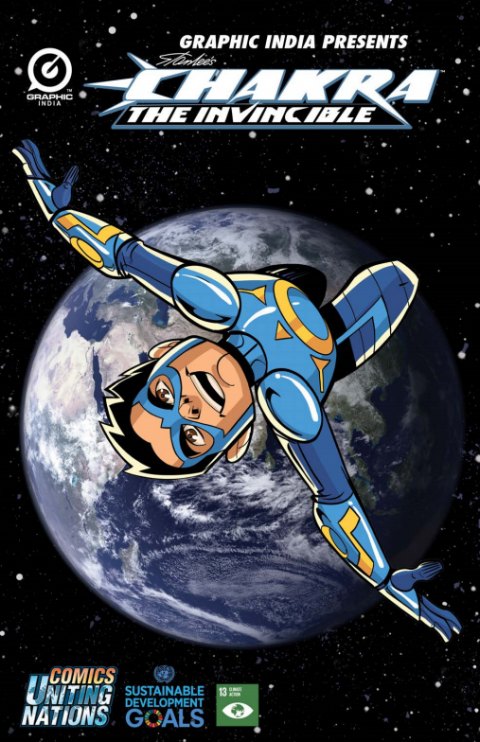 Chakra the Invincible: Climate Change سنة النشر: 2015 المؤلف: Stan Lee | Sharad Devarajan | Gotham Chopra | Ashwin Pande | Thiago Vale | Sesha Sainan Devarajan | Aditya Bidikar | Nilesh S. Mahadik | Rakesh B. Mahadik المؤلف المؤسسي: Graphic India Pte. ltd | POW Entertainment The legendary Stan Lee and Sharad Devarajan bring their character Chakra the Invincible to teach children about the global goals! Chakra and Mighty Girl learn from other children around the world how climate change is doing damage and spring into action!
 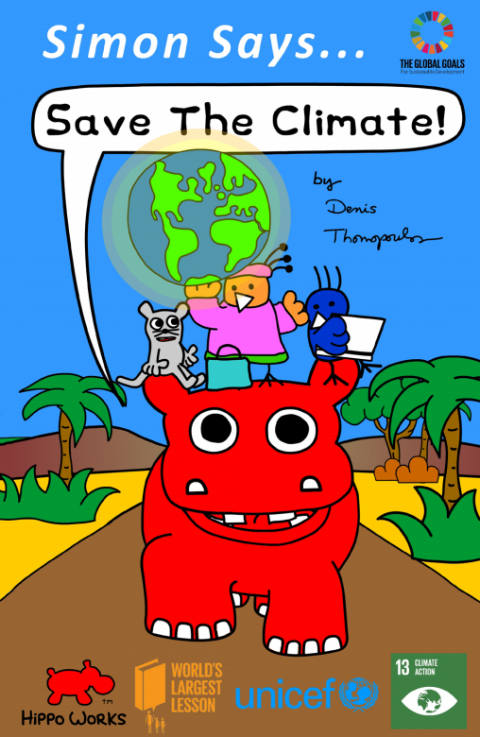 Simon says "Save the Climate" المؤلف: Denis Thomopoulos المؤلف المؤسسي: Hippo Works | United Nations Girls' Education Initiative (UNGEI) Creator Hippo-Works, invites children to go on a song-filled cartoon adventure with Simon the Hippo and friends as they learn about the world's changing climate, the role that carbon dioxide and methane play, and the good eco habits we can all develop to help. Along their way the animals find out about topics such as the Greenhouse Effect, the Food Chain, the "Three Rs" (Reducing, Reusing, Recycling), Composting, and Carbon Offsetting.
 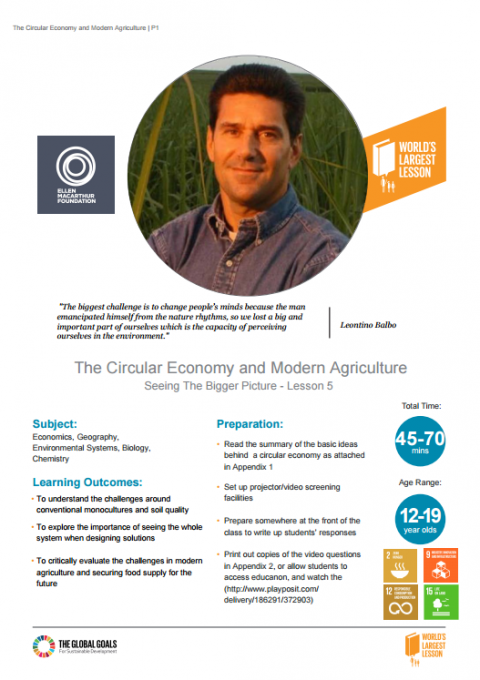 The Circular Economy and Modern Agriculture: Seeing The Bigger Picture - Lesson 5 المؤلف المؤسسي: United Nations Children's Fund (UNICEF) World’s Largest Lesson is a collaborative education project to support the announcement of the United Nations Global Goals for Sustainable Development. Learning outcomes of the project: • To understand the challenges around conventional monocultures and soil quality • To explore the importance of seeing the whole system when designing solutions • To critically evaluate the challenges in modern agriculture and securing food supply for the future
 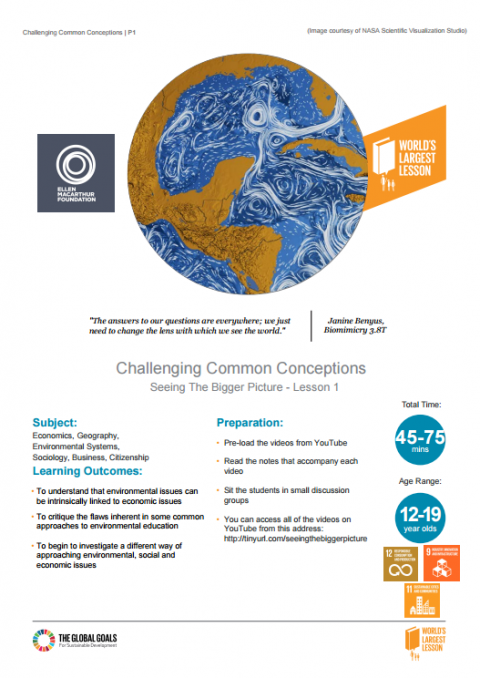 Challenging Common Conceptions: Seeing The Bigger Picture - Lesson 1 المؤلف المؤسسي: United Nations Children's Fund (UNICEF) World’s Largest Lesson is a collaborative education project to support the announcement of the United Nations Global Goals for Sustainable Development. Learning outcomes of the project: • To understand that environmental issues can be intrinsically linked to economic issues • To critique the flaws inherent in some common approaches to environmental education • To begin to investigate a different way of approaching environmental, social and economic issues
 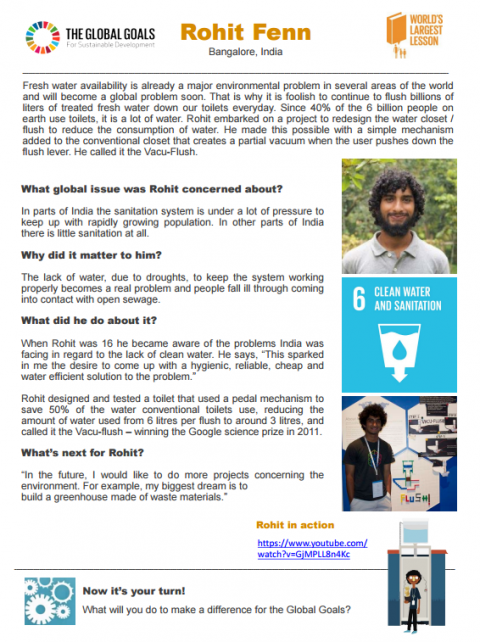 Rohit Fenn المؤلف المؤسسي: United Nations Children's Fund (UNICEF) Fresh water availability is already a major environmental problem in several areas of the world and will become a global problem soon. That is why it is foolish to continue to flush billions of liters of treated fresh water down our toilets everyday. Since 40% of the 6 billion people on earth use toilets, it is a lot of water. Rohit embarked on a project to redesign the water closet / flush to reduce the consumption of water. He made this possible with a simple mechanism added to the conventional closet that creates a partial vacuum when the user pushes down the flush lever. He called it the Vacu-Flush.
 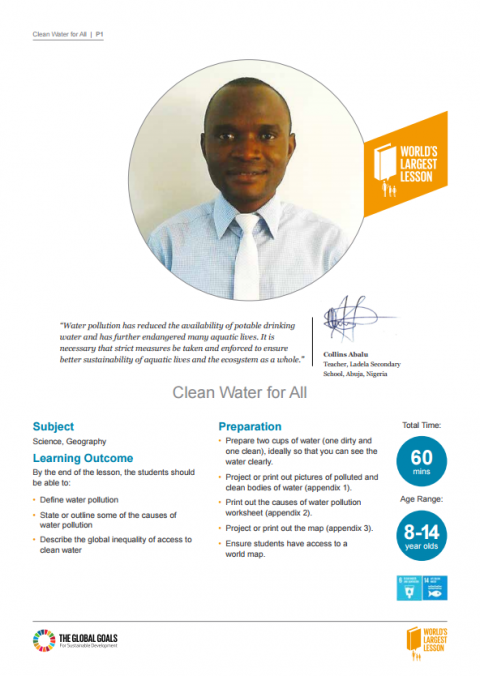 Clean Water for All المؤلف المؤسسي: United Nations Children's Fund (UNICEF) World’s Largest Lesson is a collaborative education project to support the announcement of the United Nations Global Goals for Sustainable Development. Learning outcome of the project: • Define water pollution • State or outline some of the causes of water pollution • Describe the global inequality of access to clean water
  Предлагаемая тематическая программа по образованию в области водных ресурсов в рамках Десятилетия образования в интересах устойчивого развития ООН (ДОУР, 2005-2014 ГГ.) سنة النشر: 2006 المؤلف المؤسسي: International Hydrological Programme (IHP) Water education is a very important component of UNESCO’s overall effort in water, including within the International Hydrological Programme. The UNESCO Executive Board has called for a UNESCO-wide strategy for water education at all levels. This document reviews the evolution of water education within UNESCO, and draws attention to the Draft Action Plan for the UN Decade on Education for Sustainable Development (DESD), which includes 12 Thematic Programmes one of which would be devoted to “Education for Sustainable Water Management”. The IHP would be expected to play an important role in such a UNESCO-wide effort for water education.
  Status of water education in the context of the UN Decade of Education for Sustainable Development (DESD, 2005-2014) سنة النشر: 2007 المؤلف المؤسسي: International Hydrological Programme (IHP) This document reports on the thematic programme “Education for Sustainable Water Management” of the UN Decade of Education for Sustainable Development (DESD), which is to be implemented under the leadership of UNESCO-IHP. As a follow-up to 166 EX/Decision 3.6.1 of the Executive Board of UNESCO and Resolution XVII-12 of the Intergovernmental Council of IHP, an intersectoral Working Group on Water Education was constituted and is operational. The Working Group developed a draft Work Plan, which is presented in Annex V for the endorsement of the Bureau. Situation de l'éducation relative à l'eau dans le contexte de la Décennie des Nations Unies pour l'éducation au service du développement durable (DEDD, 2005-2014) سنة النشر: 2007 المؤلف المؤسسي: International Hydrological Programme (IHP) Ce document rend compte du programme thématique «Education pour une gestion durable de l'eau» de la Décennie des Nations Unies pour l'éducation au service du développement durable (DEDD), qui sera mis en œuvre sous la direction du PHI de l'UNESCO. Conformément à la décision 166 EX / 3.6.1 du Conseil exécutif de l'UNESCO et à la Résolution XVII-12 du Conseil intergouvernemental du PHI, un groupe de travail intersectoriel sur l'éducation relative à l'eau a été créé et est opérationnel. Le groupe de travail a élaboré un projet de plan de travail qui est présenté à l'annexe V pour approbation par le Bureau. Programa temático propuesto sobre la educación relativa al agua en el marco del Decenio de las Naciones Unidas de la Educación para el Desarrollo Sostenible (2005-2014) سنة النشر: 2006 المؤلف المؤسسي: International Hydrological Programme (IHP) Water education is a very important component of UNESCO’s overall effort in water, including within the International Hydrological Programme. The UNESCO Executive Board has called for a UNESCO-wide strategy for water education at all levels. This document reviews the evolution of water education within UNESCO, and draws attention to the Draft Action Plan for the UN Decade on Education for Sustainable Development (DESD), which includes 12 Thematic Programmes one of which would be devoted to “Education for Sustainable Water Management”. The IHP would be expected to play an important role in such a UNESCO-wide effort for water education.