
الموارد
استكشف مجموعة واسعة من الموارد القيمة حول تعليم المواطنة العالمية لتعميق فهمك وتعزيز البحث والمناصرة والتعليم والتعلم.
تم العثور على 2,668 نتيجة
 La Educación para el Desarrollo (EpD) en un mundo diverso: estudio comparativo de la Educación para la Ciudadanía Global (EpCG) en Paraguay y España سنة النشر: 2017 المؤلف: Ángela Alcaide Capilla | María Jesús Martínez Usarralde المؤلف المؤسسي: University of Valencia Según el resumen de los autores: "El presente artículo pretende acometer un análisis comparado en relación a la Educación para a la Ciudadanía Global en dos contextos diferentes: España y Paraguay. Se pretende con ello reconocer los rasgos principales de esta educación, en significado y práctica, bajo la premisa de destacar la diversidad de visiones y condicionantes de la realidad, que conceden a los discursos ya existentes en la teoría una gran riqueza, abriendo su campo de conocimiento a la experiencia que de su aplicación se extrae. En sí, este es objetivo y conclusión. Con la investigación se justifica el valor que esta información tiene para el campo de estudio, a partir de entrevistas a personas expertas de las que se extrae información relevante que escapa a la retórica."
  Strategies to Exit Modernity: The Need of an Educative and Epistemological Turn to Overcome the Crisis سنة النشر: 2019 المؤلف: Mauro Rodrigo Avilés Salvador According to the author: "the crisis of modernity has led to a crisis in education; and by no means can this crisis be tackled in a unique or uniform way. Every context has to respond to the demands of change that are requested. If education is conceived as the key tool for social transformation, its role in promoting new civilization models cannot be neglected. One way of overcoming the crisis may be by reflecting about the symbol, its presence in art and religion, areas that may promote new elements for a future humanization." Then, in the article, from a critical pespective, the author enfatizes the role of Latin America a leader for a "different" kind of change, a change based on the cultural latinamerican ethos. The author quotes Edgar Morin, and mentions the need of a plural education that favours democracy, based on Human Rights. However, although he mentions universal aspects, he does not mention a planetary citizenship and he criticizes the european model. Estrategias para salir de la modernidad: la necesidad de un giro epistemológico y educativo para superar la crisis سنة النشر: 2019 المؤلف: Mauro Rodrigo Avilés Salvador Según el autor: "la crisis de la modernidad ha conllevado una crisis de la educación. Responder a esta crisis, de ninguna manera, puede ser una respuesta única o uniforme. Cada contexto debe responder a las demandas de los cambios requeridos. Si se concibe a la educación como la herramienta clave para una transformación social, no se puede desconocer su papel en la propuesta de nuevos modelos civilizatorios. Un aporte para la superación de la crisis lo constituye la reflexión sobre el símbolo, sobre su presencia en el arte y en la religión, ejes que pueden proponer nuevos elementos para una humanización del futuro." Luego, en el artículo, desde una perspectiva crítica, el autor enfatiza el rol de América Latina como propiciador de un cambio "diferente", desde el ethos cultural que caracteriza lo "latinamericano". Cita a Edgar Morin y habla de la necesidad de una educación pluaral que favorezca la democracia, basada en los Derechos Humanos. Si bien menciona aspectos universales no menciona una ciudadanía planetaria y critica el modelo europeo.
  Preparing teachers to educate for 21st century global citizenship:envisioning and enacting سنة النشر: 2014 المؤلف: Linyuan Guo المؤلف المؤسسي: Centennial College The changing educational landscape in the global context and the increasing interconnectedness and interdependence of the world have placed unprecedented demands on teacher education programs in preparing teachers to educate for 21st century global citizenship in K-12 schools. To chart the course of preparing global educators for an interconnected world, the Faculty of Education at the University of Prince Edward Island (UPEI) and UNICEF Canada have collaboratively developed an undergraduate course, entitled Educating for Global Citizenship. It focuses on preparing educators to teach for 21st century global citizenship and has been integrated into UPEI’s teacher preparation program as a compulsory course. This paper is based on a three-year study examining teacher candidates' experiences in learning to educate for global citizenship, the changes of their perceptions on global citizenship education, and the challenges and achievements they experienced in educational practices. Findings from this study indicate the unique opportunities and challenges teachers face in learning to educate for global citizenship and suggest the necessity of integrating global citizenship education in teacher education programs through a holistic approach.
  International Education Course سنة النشر: 2019 المؤلف: Juan Ignacio Martínez de Morentin | Concepción Medrano المؤلف المؤسسي: UNESCO Chair in Communication and Educational Values UNESCO understands international education as a process resulting from international understanding, cooperation, peace and global citizenship education. This results from combining three perspectives: the first, human rights--in a strict sense--the second, fundamental liberties--stressing its possibilities and requirements--and the third, the United Nations system--understanding the way in which it is committed to achieving peace.International education is education for international understanding. This understanding must impregnate all of its educational systems, actions and materials. It is not a separate course. Instead, it must be present in all courses. International education or education for international understanding is the entire programme, the motivation behind any teaching & learning process. This course explains ideas and models that UNESCO has worked with in order to clarify what it aims for in education. This is seen through the resolutions of the general conferences and the Executive Board decisions, which are UNESCO´s framework in defining international education. Curso de Educación Internacional سنة النشر: 2019 المؤلف: Juan Ignacio Martínez de Morentin | Concepción Medrano المؤلف المؤسسي: UNESCO Chair in Communication and Educational Values Para la UNESCO, la educación internacional es un proceso que desemboca en comprensión, educación para la ciudadanía, cooperación y paz internacionales.Este resultado depende de conjugar tres perspectivas: derechos humanos -sumergiéndose en su significado-, libertades fundamentales -ejercitando sus posibilidades y exigencias- y sistema de las Naciones Unidas -conociendo esa forma de comprometerse en el logro de la paz. La educación internacional es educación para la comprensión internacional.Y ha de impregnar todas las acciones y materias del sistema educativo. No es una asignatura aparte; ha de articularse con todas ellas. La educación internacional o educación para la comprensión internacional es el programa, la motivación de cualquier proceso de enseñanza/aprendizaje.Este curso muestra ideas y diseños que la UNESCO ha ido trabajando para llegar a clarificar lo que persigue en el ámbito educativo. Las resoluciones de las conferencias generales y las decisiones del Consejo Ejecutivo son mimbres utilizados por la UNESCO para definir la educación internacional.
  Identity: A Planetary Construction, a Cosmological Perspective سنة النشر: 2016 المؤلف: Norma Azucena Flores Retana In the article the author asks herself what a planetary citizenship is and how it should be promoted. She starts by questioning econocimic perspectives and ends by focusing on an ideal based on solidarity. In the article summary she states: "We live in a world that evolves and changes at a very high speed, a world that is become planetary, that is interdependant and interconnected. Some authors call it the planetary era, others a planetary consciousness. The important thing is to stop and think. Up to what extent, this new world reality, planetary, influences our individual and social identities? How can we educate ourselves in a new planetary conciousness, for a new individual and social identity?, and, which are the paths that we should follow? These are key questions which I will try to analyse in the article, recognizing ourselves not only as human beings that are individual and social, but also planetary." In the article the author provides broad answers and perspectives to the questions stated in the summary. La identidad : una construcción planetaria, una perspectiva cosmológica سنة النشر: 2016 المؤلف: Norma Azucena Flores Retana En el artículo la autora se pregunta qué es una ciudadanía planetaria y cómo debería fomentarse esta. Comienza haciendo una critica a las perspectivas econocimicistas para luego centrarse en un ideal basado en la solidaridad. En su resumen del artículo dice: "Vivimos en un mundo que evoluciona y cambia vertiginosamente, un mundo que deviene planetariamente, que es interdependiente y se mantienen interconectado. Algunos autores le llaman la era planetaria, otros le llaman la conciencia planetaria. Lo importante es detenerse y pensar ¿En qué medida, esta nueva realidad mundial, planetaria influye en la construcción de nuestra identidad individual y social?, ¿Cómo educarnos en una nueva conciencia planetaria, para una nueva identidad individual y social? y ¿Cuáles son los caminos a seguir? Estas son preguntas claves las cuales tratare de abordar en el siguiente escrito, reconociéndonos como seres humanos no solo individuales y sociales, sino sujetos planetarios. " En el artículo la autora da respuestas y perspectivas amplias a las preguntas que plantea en el resumen.
 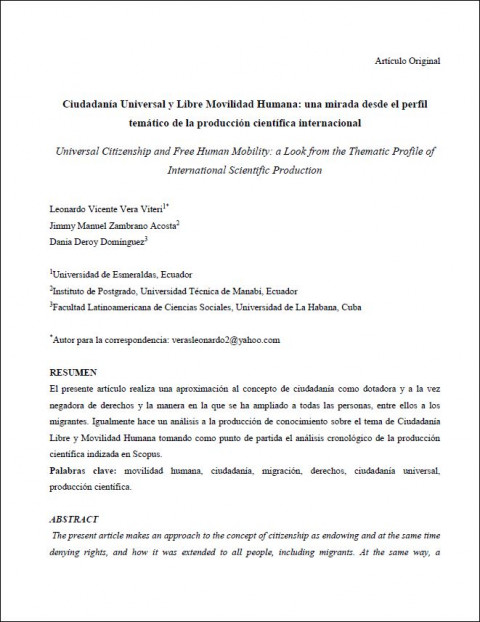 Universal Citizenship and Free Human Mobility: A Look from the Thematic Profile of International Scientific Production سنة النشر: 2019 المؤلف: Leonardo Vicente Vera Viteri, Jimmy Manuel Zambrano Acosta | Dania Deroy Dominguez In the summary the author explains that: "The present article makes an approach to the concept of citizenship as endowing and at the same time denying rights, and how it was extended to all people, including migrants. At the same way, a chronological analysis of the scientific production about Free Citizenship and Human Mobility in Scopus is carried out." In the article the author analyzes these aspects and ends by concluding that the academy may promote universal citizenship. Ciudadanía Universal y Libre Movilidad Humana: una mirada desde el perfil temático de la producción científica internaciona سنة النشر: 2019 المؤلف: Leonardo Vicente Vera Viteri, Jimmy Manuel Zambrano Acosta | Dania Deroy Dominguez En el resumen el autor explica que: "El presente artículo realiza una aproximación al concepto de ciudadanía como dotadora y a la vez negadora de derechos y la manera en la que se ha ampliado a todas las personas, entre ellos a los migrantes. Igualmente hace un análisis a la producción de conocimiento sobre el tema de Ciudadanía Libre y Movilidad Humana tomando como punto de partida el análisis cronológico de la producción científica indizada en Scopus." En el artículo el autor realiza este análisis y termina concluyendo que la academia puede fomentar la ciudadanía universal.