
الموارد
استكشف مجموعة واسعة من الموارد القيمة حول تعليم المواطنة العالمية لتعميق فهمك وتعزيز البحث والمناصرة والتعليم والتعلم.
تم العثور على 3,448 نتيجة
 World Development Report 2018 and Its Policy Implications for Education Development in China سنة النشر: 2018 المؤلف: Liu Ji 2018 comprehensively describes a crisis that is looming worldwide: Schooling does not equalize learning. Drawing on key insights from the report, this study provides a high—level summary and relates the findings to common and critical issues that China is today. Specifically, this study highlights five important policy implications for education development in China: Education quality monitoring, adaptive policies, evidence-based decision, expanding human capital investments, and building stronger ties with international organizations. 如何应对全球学习危机——世界银行((2018世界发展报告》述评 سنة النشر: 2018 المؤلف: Liu Ji 作为世界银行最重要的旗舰报告,《世界发展报告》四十年来首次以教育为题,深入探讨如何应对全球学习危机、提高教育质量、优化人力资本结构、应对人类发展重要难题。从政策理念上看,世行教育策略的革新代表着世行在人力资本政策上较大的方向性改变:由关注教育投入转向教育产出和学习结果。同时,《2018世界发展报告》总结了适用于各教育阶段的大量实证研究和国际成功政策经验,对全球教育政策具有风向标的重要意义、对我国发展新时期的教育与人才策略有积极启示。本文通过对报告结论详细梳理,结合我国国情提出五点政策建议。
  An Examination of the Ideas of Contemporary World Citizenship Education سنة النشر: 2003 المؤلف: Zhao Hui In order to grasp the ideas of contemporary world citizenship education, first of all, fundamental value orientation of citizenship education must be grasped in the tensions between nationalism and democracy; Secondly, new trend of nationalism and its influences on citizenship education under the background of globalization must be understood; and thirdly the new trends of the ideas of citizenship education must be put forward and understood in the disputes between liberalism(or neoliberalism) and republicanism(or communitarianism).
  Securitisation, Counterterrorism and the Silencing of Dissent: The Educational Implications of Prevent سنة النشر: 2016 المؤلف: Aislinn O'Donnell المؤلف المؤسسي: Society for Educational Studies | Taylor & Francis This paper outlines some of the implications of counterterrorist legislation, including Prevent, for the pedagogical relationship and for educational institutions. The concept of ‘radicalization’, central to the Prevent Strategy, is one that is contested in the field of counterterrorism, yet educators are now expected to identify and refer students ‘at risk of radicalization’. Based on the experience of teaching IRA and INLA prisoners in the Republic of Ireland, the author outlines a set of philosophical and ethical principles that ought to underpin education. It is argued that education must not be subordinated to security and intelligence agendas on pragmatic, educational and ethical grounds. Securitisation, Counterterrorism and the Silencing of Dissent: The Educational Implications of Prevent سنة النشر: 2016 المؤلف: Aislinn O'Donnell المؤلف المؤسسي: Society for Educational Studies | Taylor & Francis Le présent document décrit quelques impacts de la législation antiterroriste, y compris la prévention, sur l’approche pédagogique et les établissements d'enseignement. Le concept de « radicalisation » qui figure au cœur de la stratégie « Prévenir » est contesté dans le domaine de la lutte contre le terrorisme. Toutefois, les éducateurs sont maintenant en mesure d'identifier et d’orienter les élèves « en voie de radicalisation ». Sur la base de l'expérience de l'enseignement dispensé aux prisonniers de l'IRA et de l'INLA dans la République d'Irlande, l'auteur décrit un ensemble de principes philosophiques et éthiques qui devraient soutenir l'éducation. On fait valoir l’idée que l'éducation ne doit pas être subordonnée aux questions de sécurité et de renseignement pour des raisons pragmatiques, éducatives et éthiques.
  One in Five Children, Adolescents and Youth is Out of School (UIS Fact Sheet No. 48) سنة النشر: 2018 المؤلف المؤسسي: UNESCO Institute for Statistics (UIS) This fact sheet presents the latest UIS data on education available as of February 2018.Three years after the adoption of Sustainable Development Goal 4 (SDG 4) and the promise to provide universal primary and secondary education, there has been no progress in reducing the global number of out-of-school children, adolescents and youth. As the SDG 4–Education 2030 Steering Committee meets in Paris, the UNESCO Institute for Statistics (UIS) has released this fact sheet, highlighting trends at the global and regional levels, to inform discussions and provide stakeholders with the data needed to target policies, strategies and resources to get all children, adolescents and youth in school and learning.
  Fostering Digital Citizenship through Safe and Responsible Use of ICT: A Review of Current Status in Asia and the Pacific as of December 2014 سنة النشر: 2015 المؤلف المؤسسي: UNESCO Bangkok The publication examines various interventions to address issues concerning cybersafety, rights, and wellness. It provides a synthesis of various policy responses, programmes, and initiatives implemented by governments, international organizations, civil society, and the private sector.The report ends with a preliminary set of recommendations with regards to policy, research, education, and partnerships. It is hoped that the report can provide an insight into the current status of digital citizenship in the region and consequently highlight the importance of maintaining a conscious balance of opportunities and risks when dealing with ICT.
  A Policy Review: Building Digital Citizenship in Asia-Pacific through Safe, Effective and Responsible Use of ICT سنة النشر: 2016 المؤلف المؤسسي: UNESCO Bangkok This report is a major output of the project. The policy review described in this report took stock of national policies in 22 Member States in the Asia-Pacific region and assessed the capacity of their education sectors to foster digital citizenship among children aged 0-18.It is encouraging to note from the study that surveyed Member States’ policies to promote ICT opportunities mature alongside policies that address potential risks, at varying levels of policy maturity. However, while the surveyed Member States recognize the importance of equipping children with ICT skills and providing basic infrastructure, the findings indicate that there is much to be done for young learners (e.g. early childhood education and lower primary education) in introducing the concept of safe, effective and responsible use of ICT to their national curriculum as well as to their teacher professional development programmes.
  Global Citizenship in the English Language Classroom سنة النشر: 2008 المؤلف: Susan Hillyard | Elena Tarasheva | Clarissa Jordão | Francisco Fogaça | Esperanza Revelo Jiménez | Sabiha Khuram | Telma Gimenez | Vanessa Andeotti المؤلف المؤسسي: British Council This booklet contains a collection of papers on global citizenship in language education around the world. It provides theoretical frameworks and practical applications in different contexts.Following on from Audrey Osler and Hugh Starkey’s 'Citizenship and Language Learning: international perspectives', published in 2005, this collection aims at offering ideas and practical suggestions on how teachers around the world have tackled the teaching of English within a citizenship education perspective. There are seven chapters, from authors working in different parts of the world, such as Argentina, Bulgaria, Brazil, Colombia, and Pakistan.There are five report style chapters that deal with courses, teaching materials, research and curriculum innovation. The two remaining contributions can be seen as proposals for implementation of a global citizenship perspective in English language classrooms.The diverse interpretations teachers of English around the world have been giving to the task of promoting global citizenship in their classrooms are reflected in this collection with understandings that range from a more prescriptive approach to a transformational one. They bring the potential for new approaches to be tried out in different contexts. The aim is to inspire teachers to experiment and evaluate the results.
 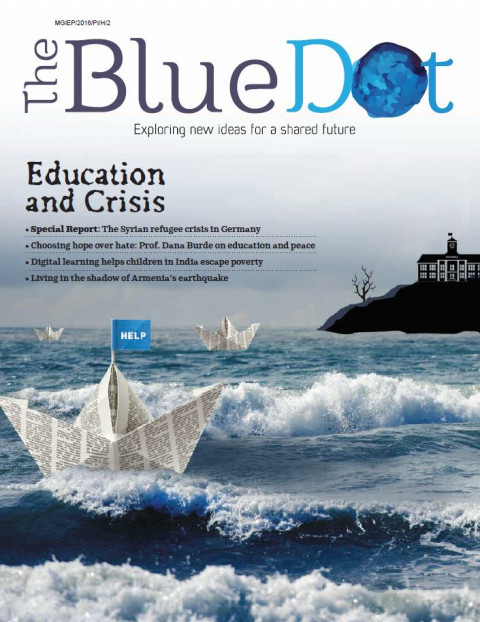 Education and Crisis (The Blue Dot Issue 3, 2016) سنة النشر: 2016 المؤلف المؤسسي: Mahatma Gandhi Institute of Education for Peace and Sustainable Development (MGIEP) In this third issue of The Blue Dot, we have chosen to focus on the often forgotten aspect of education in the context of crises. While relief efforts tend to focus on emergency responses such as providing food and shelter, more often than not rebuilding schools and ensuring that students continue to attend their classes are not considered priorities. At UNESCO MGIEP, we believe that when education is relegated to the side-lines, there is little hope for a country and its citizens to recover.In this issue, we have brought together expert contributors from academia and the field—from countries such as Afghanistan, Nepal and South Sudan—and have dedicated a large section to the ongoing civil conflict in Syria, which will soon enter its fifth year. With almost half of Syria’s population living as refugees or as internally displaced persons, an entire generation of young people risks losing out on stability and a better future. Our Syria Section explores how these young people, with a particular focus on those who have sought refuge in Germany, are faring and what their hopes are for the future.In other parts of the magazine, we focus on technology and on how modern information and communications technologies (ICTs) can help students access a better education. From impoverished communities in Calcutta using Skype to connect with teachers around the world, to new interactive platforms built for young people to discuss global issues, we hope the stories and experiences we have collected for our readers will give a new and fresh perspective on what it means for education when a crisis hits. We also hope that you enjoy our photo contest, which drew more than 100 entries from young people around the world on what “education and crisis” means to them.