
الموارد
استكشف مجموعة واسعة من الموارد القيمة حول تعليم المواطنة العالمية لتعميق فهمك وتعزيز البحث والمناصرة والتعليم والتعلم.
تم العثور على 3,448 نتيجة
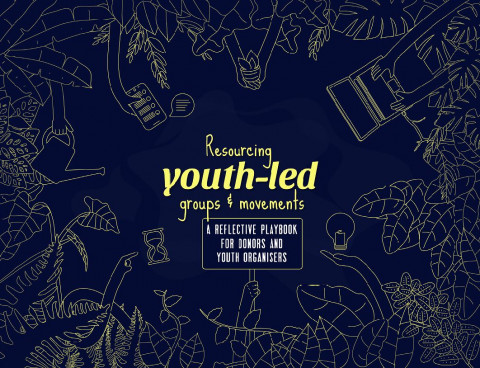 Obteniendo recursos para grupos y movimientos liderados por jóvenes: Guía de reflexión y prácticas para donantes y organizadores juveniles سنة النشر: 2020 المؤلف: Gioel Gioacchino المؤلف المؤسسي: CIVICUS | Recrear International Vous faites partie d'un mouvement social dirigé par des jeunes et vous cherchez des idées sur la façon de financer votre travail ? Ou bien un donateur, un philanthrope ou une institution qui défend le pouvoir des jeunes ? Si c'est le cas, cet espace est fait pour vous ! Vous y trouverez des outils, des liens et de nouvelles idées, tant pour les jeunes militants que pour leurs partenaires.Ce guide sur les ressources des groupes et mouvements de jeunes est le résultat d'une année de recherche. Nous avons écouté ce que des militants, des donateurs, des représentants de la jeunesse et d'autres organisations facilitatrices ont dit sur les réalités, les tendances et les solutions possibles pour mobiliser des fonds et des ressources non financières pour les jeunes militants, en particulier dans le Sud.Lisez les histoires de Lebo, Amanda, Dumiso, Priscilla, Elena, Christian et Bonnie, qui partagent leurs expériences et les défis qu'ils rencontrent dans leur travail, et dont les jeunes leaders d'Amérique latine et d'Afrique se font les porte-parole. Vous trouverez des exercices créatifs que vous pourrez utiliser, qui invitent les jeunes et les donateurs à repenser les visions du monde et les principes relatifs au financement de la société civile au 21ème siècle. L’accès aux ressources pour les groupes et mouvements dirigés par les jeunes: Un guide de réflexion destiné aux donateurs et membres d’organisations de jeunes سنة النشر: 2020 المؤلف: Gioel Gioacchino المؤلف المؤسسي: CIVICUS | Recrear International Vous faites partie d'un mouvement social dirigé par des jeunes et vous cherchez des idées sur la façon de financer votre travail ? Ou bien un donateur, un philanthrope ou une institution qui défend le pouvoir des jeunes ? Si c'est le cas, cet espace est fait pour vous ! Vous y trouverez des outils, des liens et de nouvelles idées, tant pour les jeunes militants que pour leurs partenaires.Ce guide sur les ressources des groupes et mouvements de jeunes est le résultat d'une année de recherche. Nous avons écouté ce que des militants, des donateurs, des représentants de la jeunesse et d'autres organisations facilitatrices ont dit sur les réalités, les tendances et les solutions possibles pour mobiliser des fonds et des ressources non financières pour les jeunes militants, en particulier dans le Sud.Lisez les histoires de Lebo, Amanda, Dumiso, Priscilla, Elena, Christian et Bonnie, qui partagent leurs expériences et les défis qu'ils rencontrent dans leur travail, et dont les jeunes leaders d'Amérique latine et d'Afrique se font les porte-parole. Vous trouverez des exercices créatifs que vous pourrez utiliser, qui invitent les jeunes et les donateurs à repenser les visions du monde et les principes relatifs au financement de la société civile au 21ème siècle.
  Examining the Citizenship Education in the UK from Perspective of Solidarity (Studies in Foreign Education; Vol. 46, No. 7) سنة النشر: 2019 المؤلف: Tang Kejun المؤلف المؤسسي: Northeast Normal University It is claimed to build a cohesive community in plural society because of diversity undermining social cohesion. According to communitarianism, the grounds of solidarity include shared values, loyalty and civic trust. Britain is seen as a plural society which made up of a diverse range of ethnicities, cultures nations and religions. So citizenship education are expected to place emphasis on promoting the fundamental British values national loyalty or patriotism and social trust in schools of the UK, which has caused a number of criticism. It is concluded from examining the approaches of citizenship education and its criticism that a cohesive society depends on an inclusive citizenship. 团结视域下的英国公民教育 (外国教育研究; Vol. 46, No. 7) سنة النشر: 2019 المؤلف: Tang Kejun المؤلف المؤسسي: Northeast Normal University 多元的社会因为差异性挑战了团结,因而寻求建立团结的社会就成为多元社会的基本追求。按社群主义理解,社会团结源自共享的价值观、忠诚和公民之间的信任。英国自认为是多元的社会,不仅民族多样,而且种族、宗教和文化多样。为了增进英国社会的团结,英国学校公民教育强化英国的基本价值观、国家忠诚或爱 国主义、社会信任等因素。这些做法引起诸多批评。从英国公民教育的做法及其受 到的批评可以看出,要增进社会团结,需要培养包容性的公民。
  Western Debates on Global Citizenship Education: Definition, Value and Practice (International and Comparative Education; No. 7) سنة النشر: 2019 المؤلف: Lijian | Liu Baocun المؤلف المؤسسي: Beijing Normal University In the late twentieth century, in order to deal with the opportunities and challenges came from the globalization to all the countries worldwide, the developed countries in Europe and the United States began to focus on cultivating students’ global citizenship consciousness and global citizenship practice. Since 1990s, the western debate on global civic education has been widely spread among scholars and practitioners worldwide. The global citizenship education debate focuses on global citizenship education value and practice in three aspects: the connotation of global citizenship education debate on the ability-oriented, value-oriented definition, and the comprehensive-based definition. The value debate on the global citizenship education mainly includes: patriotism and the world socialist argument, national interests and global interests, the global education debate and the civic education debate and unified culture and cultural diversity debate. The global citizenship education practice debate involves the research and development of world education and cognitive education and behavior education. 西方关于全球公民教育内涵、价值和途径的争论 (比较教育研究; No. 7) سنة النشر: 2019 المؤلف: Lijian | Liu Baocun المؤلف المؤسسي: Beijing Normal University 20世纪末期,为了应对全球化带来的挑战,欧美发达国家开始关注培养学生的全球公民意识,全球公民教育逐渐成为世界教育改革的一个热点话题。但是,关于全球公民教育的内涵、价值和途径等全球公民教育的核心问题却存在着广泛的争论。在全球公民教育的内涵上,存在能力导向和价值导向的争论 ;在全球公民教育的价值上,存在爱国主义和世界主义的争论、国家利益和全球利益的争论、全球教育和公民教育的争论、文化统一和文化多样的争论 ;在全球公民教育的途径上,存在世界研究和发展教育研究的争论、认知教学和实践教学的争论。
 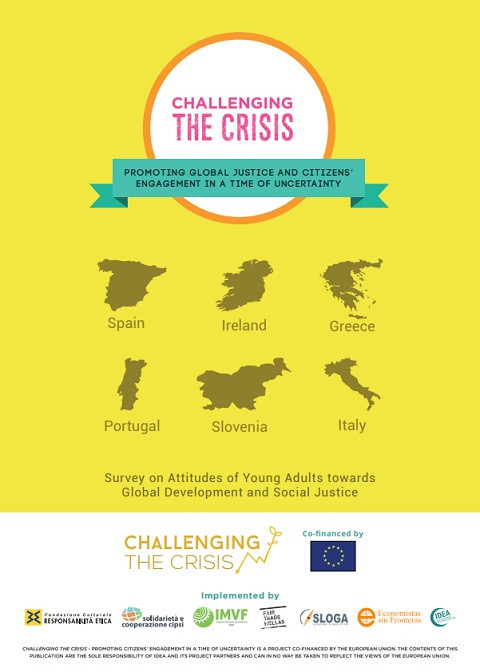 Challenging the Crisis: Promoting Global Justice and Citizens’ Engagement in a Time of Uncertainty; Survey on Attitudes of Young Adults Towards Global Development and Social Justice سنة النشر: 2015 المؤلف المؤسسي: Irish Development Education Association (IDEA) This report outlines the views of young people, aged 15-34 from Portugal, Ireland, Italy, Greece, Spain and Slovenia, on international development, and their understanding of related concepts and issues. The aim of the research was to assess whether global solidarity and development aid are priorities for European youth in a time of economic and political crisis and high unemployment.
 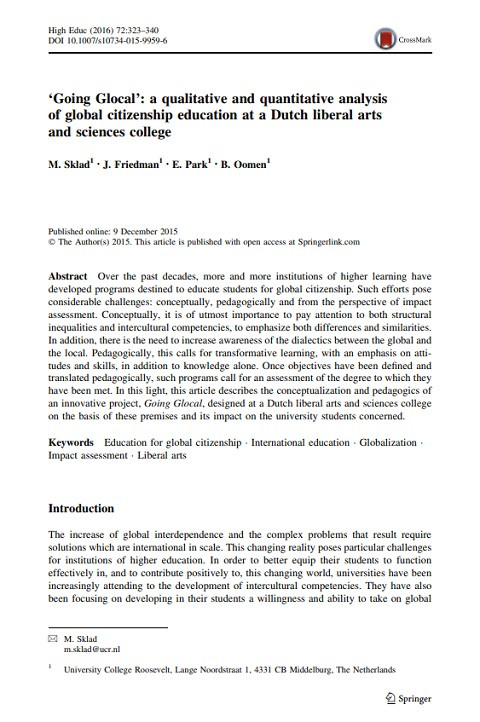 ‘Going Glocal’: A Qualitative and Quantitative Analysis of Global Citizenship Education at a Dutch Liberal Arts and Sciences College (High Education; Vol. 72, No. 3) سنة النشر: 2015 المؤلف: Marcin Skald | John Friedman | Eri Park | Barbara Oomen المؤلف المؤسسي: Springer Nature Over the past decades, more and more institutions of higher learning have developed programs destined to educate students for global citizenship. Such efforts pose considerable challenges: conceptually, pedagogically and from the perspective of impact assessment. Conceptually, it is of utmost importance to pay attention to both structural inequalities and intercultural competencies, to emphasize both differences and similarities. In addition, there is the need to increase awareness of the dialectics between the global and the local. Pedagogically, this calls for transformative learning, with an emphasis on attitudes and skills, in addition to knowledge alone. Once objectives have been defined and translated pedagogically, such programs call for an assessment of the degree to which they have been met. In this light, this article describes the conceptualization and pedagogics of an innovative project, Going Glocal, designed at a Dutch liberal arts and sciences college on the basis of these premises and its impact on the university students concerned.
 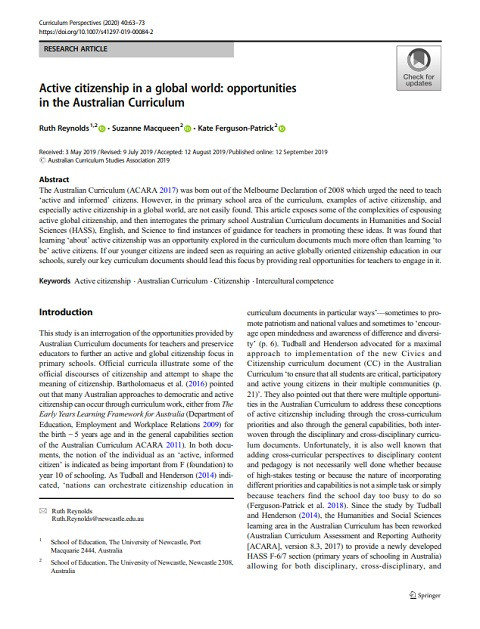 Active Citizenship in a Global World: Opportunities in the Australian Curriculum (Curriculum Perspectives; Vol. 40) سنة النشر: 2019 المؤلف: Ruth Reynolds | Kate Ferguson-Patrick | Suzanne MacQueen المؤلف المؤسسي: Australian Curriculum Studies Association (ACSA) The Australian Curriculum (ACARA 2017) was born out of the Melbourne Declaration of 2008 which urged the need to teach ‘active and informed’ citizens. However, in the primary school area of the curriculum, examples of active citizenship, and especially active citizenship in a global world, are not easily found. This article exposes some of the complexities of espousing active global citizenship, and then interrogates the primary school Australian Curriculum documents in Humanities and Social Sciences (HASS), English, and Science to find instances of guidance for teachers in promoting these ideas. It was found that learning ‘about’ active citizenship was an opportunity explored in the curriculum documents much more often than learning ‘to be’ active citizens. If our younger citizens are indeed seen as requiring an active globally oriented citizenship education in our schools, surely our key curriculum documents should lead this focus by providing real opportunities for teachers to engage in it.
 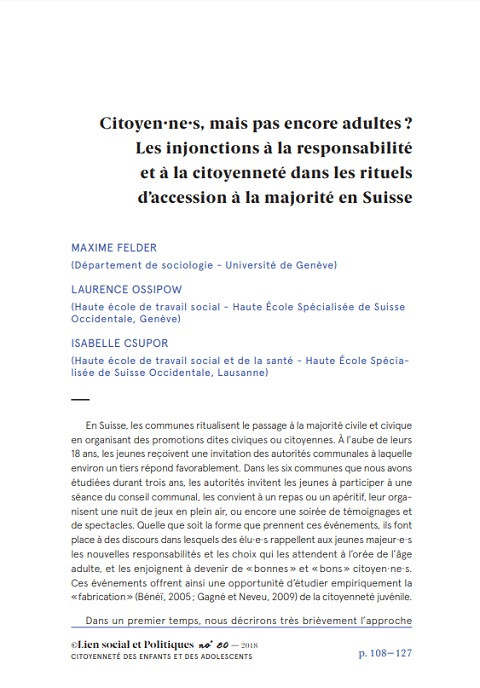 Citoyen·ne·s, mais pas encore adultes ? Les injonctions à la responsabilité et à la citoyenneté dans les rituels d’accession à la majorité en Suisse سنة النشر: 2018 المؤلف: Maxime Felder | Laurence Ossipow | Isabelle Csupor المؤلف المؤسسي: Lien social et Politiques En Suisse, les communes ritualisent le passage à la majorité civile et civique en organisant des promotions dites civiques ou citoyennes. À l’aube de leurs 18 ans, les jeunes reçoivent une invitation des autorités communales à laquelle environ un tiers répond favorablement. Dans les six communes que nous avons étudiées durant trois ans, les autorités invitent les jeunes à participer à une séance du conseil communal, les convient à un repas ou un apéritif, leur organisent une nuit de jeux en plein air, ou encore une soirée de témoignages et de spectacles. Quelle que soit la forme que prennent ces événements, ils font place à des discours dans lesquels des élu·e·s rappellent aux jeunes majeur·e·s les nouvelles responsabilités et les choix qui les attendent à l’orée de l’âge adulte, et les enjoignent à devenir de «bonnes» et «bons» citoyen·ne·s. Ces événements offrent ainsi une opportunité d’étudier empiriquement la «fabrication» (Bénéï, 2005; Gagné et Neveu, 2009) de la citoyenneté juvénile. Dans un premier temps, nous décrirons très brièvement l’approcheméthodologique et les dispositifs mis en place par les six communes étudiées. Puis, nous ferons une analyse des discours qui, outre l’appel au vote, incitent à se battre pour des droits qui permettent à la démocratie de perdurer, mais ne s’arrêtent pas à cette définition restreinte de la citoyenneté. Enfin, nous nous concentrerons sur trois tensions que révèle le croisement de ces injonctions à la citoyenneté, avec ce qu’en disent les jeunes participant·e·s.