
الموارد
استكشف مجموعة واسعة من الموارد القيمة حول تعليم المواطنة العالمية لتعميق فهمك وتعزيز البحث والمناصرة والتعليم والتعلم.
تم العثور على 517 نتيجة
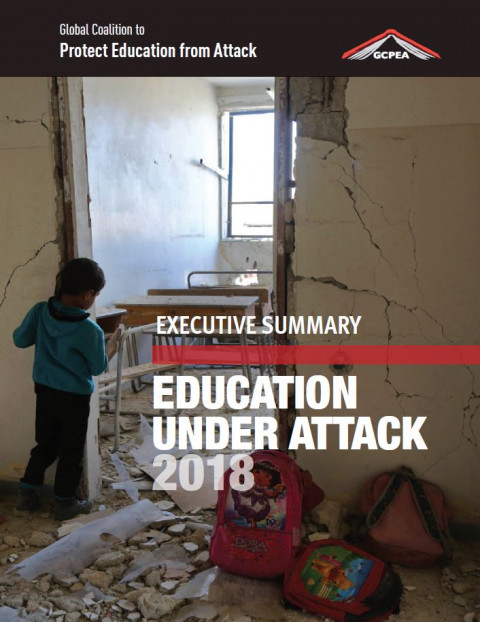 [Summary] Education Under Attack 2018; Executive Summary سنة النشر: 2018 المؤلف المؤسسي: Global Coalition to Protect Education from Attack (GCPEA) A global study of threats or use of force, either deliberate or indiscriminate, against students, teachers, academics, education support and transport staff or education officials, and against schools, universities and other education institutions carried out for political military, ideological, sectarian, ethnic or religious reasons from 2013 to 2017. [Resumen] Ataques a la Educación 2018; Resumen Ejecutivo سنة النشر: 2018 المؤلف المؤسسي: Global Coalition to Protect Education from Attack (GCPEA) Estudio global de las amenazas o instancias de uso deliberado o indiscriminado de la fuerza contra estudiantes, docentes, académicos, personal auxiliar educativo y de transporte o funcionarios de educación, y contra escuelas, universidades y otras instituciones educativas, perpetradas con fines políticos, militares, ideológicos, sectarios, étnicos o religiosos entre 2013 y 2017. [Résumé] L’education prise pour cible 2018; Un résumé de سنة النشر: 2018 المؤلف المؤسسي: Global Coalition to Protect Education from Attack (GCPEA) Une étude globale des menaces ou de l'usage de la force, délibérée ou non, contre les élèves, les enseignants, les universitaires, le personnel scolaire et des transports ou les agents de l'éducation; et contre les écoles, les universités et autres institutions éducatives, menées pour des raisons politiques, militaires, idéologiques, sectaires, ethniques ou religieuses de 2013 à 2017.
  Global Citizenship in Sub-Saharan Africa سنة النشر: 2015 المؤلف: Akemi Yonemura المؤلف المؤسسي: Éducation des Adultes et Développement Learners today are required to develop a comprehensive understanding of local, national and global challenges, so that they can influence the political, social, cultural, economic and environmental development both in their societies and their personal lives. UNESCO has been promoting education for peace and sustainable development as the overarching goal of its education programme, focusing on transformative education through Global Citizenship Education (GCED). This paper discusses GCED in Sub-Saharan Africa in the context of the post-2015 education agenda, with a particular focus on adult education. Ciudadanía mundial en el África Subsahariana سنة النشر: 2015 المؤلف: Akemi Yonemura المؤلف المؤسسي: Éducation des Adultes et Développement En la actualidad, a los alumnos se les exige desarrollar una concepción global de los problemas locales, nacionales y mundiales, para que sean capaces de influir en el desarrollo político, social, cultural y económico, tanto en su sociedad como en su vida personal. La UNESCO ha estado promoviendo la educación para la paz y el desarrollo sostenible como objetivo integral de su programa de educación, concentrándose en la educación transformativa por medio de la educación para la ciudadanía mundial (ECM). En este trabajo se analiza la ECM en el África Subsahariana (ASS), en el contexto de la agenda educativa posterior a 2015, con especial énfasis en la educación de adultos.
  The Failure of Living-Together in Rwanda: What is the Responsibility of History Textbooks? سنة النشر: 2013 المؤلف: Éric Mutabazi المؤلف المؤسسي: McGill University. Faculty of Education Rwanda, landlocked in the Great Lakes region in Central Africa, has known war and massacres resulting in the 1994 genocide. Many critics and researchers have attempted to explain the reasons behind the inhuman and monstrous massacres that ravaged this country. While political, historical and economical factors are more often invoked to justify these horrible events, this article seeks to draw attention to the responsibility of history textbooks in the failure of living-together in pre-genocide Rwanda. Our analysis of textbook content reveals that certain values transmitted through the teaching of Rwanda’s history has generated injustice, inequality, victimisation, suffering, etc., at school and in society. We attempt to demonstrate how textbook content contributed to the failure of living-together in Rwanda and we propose alternative perspectives to guide the development of content that can contribute to peace, unity and living-together in post-genocide Rwanda. Échec du vivre-ensemble au Rwanda : quelle est la responsabilité des manuels scolaires d’histoire ? سنة النشر: 2013 المؤلف: Éric Mutabazi المؤلف المؤسسي: McGill University. Faculty of Education Le Rwanda, enclavé dans la région des Grands Lacs en Afrique centrale, a connu la guerre et les massacres aboutissant au génocide de 1994. Plusieurs penseurs et chercheurs ont tenté d’expliquer les raisons de ces massacres inhumains et monstrueux qui ont ravagé ce pays. Alors que les facteurs politiques, historiques et économiques sont plus souvent évoqués pour justifier ces horribles événements, cette contribution consiste à dégager la responsabilité des manuels scolaires d’histoire dans l’échec du vivre-ensemble au Rwanda avant le génocide. Notre analyse des contenus des manuels scolaires révèle que certaines valeurs transmises à travers l’enseignement de l’histoire du Rwanda ont généré toutes sortes d’injustices, d’inégalités, de victimisation, de souffrances, etc., à l’école et dans la société. Nous essaierons de montrer en quoi le contenu des manuels a contribué à l’échec du vivre-ensemble au Rwanda et nous proposerons des perspectives qui pourraient guider l’élaboration du nouveau contenu contribuant à la paix, à l’unité et au vivre-ensemble au Rwanda après le génocide.
  Global Citizenship in a Digital World (The MILID Yearbook, 2014) سنة النشر: 2014 المؤلف: Sherri Hope Culver | Paulette Kerr المؤلف المؤسسي: International Clearinghouse on Children, Youth and Media (Sweden) | NORDICOM | University of Gothenburg The theme of the 2014 Yearbook is Global Citizenship in a Digital World. Global citizenship assumes ease of participation in global spaces in which persons are media and information literate and are equipped with competencies and attitudes to deal with the multi-faceted nature of a mediated world in which information is no longer bound by space or time. The unprecedented access to and use of media and Internet technologies for communication and collaboration especially among youth, suggest that effective strategies must be found to enable active critical inquiry and effective media production. The proliferation of mediated spaces throughout education environments, as well as personal and professional environments, does not in itself guarantee that citizens will consider their role as global citizens as they create and consume media. This awareness must be cultivated, encouraged and taught.The 2014 MILID Yearbook brings together a range of reviewed articles, which articulate the theme of global citizenship from varied perspectives and regions of the world. The articles represent different expressions on media and information literacy from researchers and practitioners who offer bold new strategies, share research findings and best practices, and share musings and reflections.
  Media and Information Literacy for the Sustainable Development Goals (The MILID Yearbook 2015) سنة النشر: 2015 المؤلف: Jagtar Singh | Alton Grizzle | Sin Joan Yee | Sherri Hope Culver المؤلف المؤسسي: International Clearinghouse on Children, Youth and Media (Sweden) In the year 2000, governments and development partners all over the world agreed on eight global development targets called the Millennium Development Goals (MDGs). The year 2015 is a pivotal year as it marks the end of the period during which the MDGs were to be reached and the year in which new global development targets are to be set. These new targets are referred to as the Post-2015 Sustainable Development Goals (SDGs). This process is in its highest gear with ongoing debates and consultative meetings/initiatives globally both online and offline. While much progress has been made, achievement of the MDGs has been mixed across countries. The centrality of information and communication to development is irrefutable. The MILID Yearbook provides a case for media and information literacy (MIL) as a tool for open and inclusive sustainable development.The 2015 edition of the MILID Yearbook displays how media and information literacy can be helpful in facilitating progress and achievement of the sustainable development goals. It is sincerely hoped that the articles in this yearbook will go a long way to sensitize the stakeholders about the role and value of MIL in sustainable development of one and all across frontiers.
 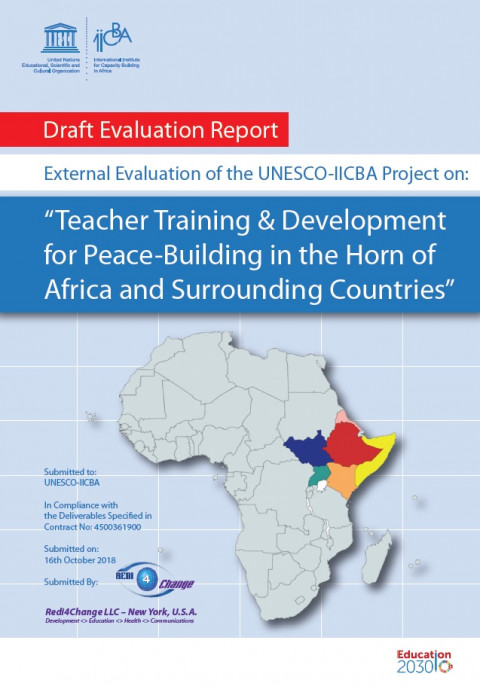 [Draft Evaluation Report] External Evaluation of the UNESCO-IICBA Project on: “Teacher Training & Development for Peace-Building in the Horn of Africa and Surrounding Countries” سنة النشر: 2018 المؤلف المؤسسي: UNESCO International Institute for Capacity-Building in Africa (IICBA) The project on “Teacher Training and Development for Peace-Building in the Horn of Africa and Surrounding Countries” was designed by UNESCO-IICBA and financed by the Government of Japan. The project benefitted six conflict-affected countries; Ethiopia, Eritrea, Somalia, Kenya, Uganda, and South Sudan by building on the mandate and niche expertise of UNESCO-IICBA in teacher education, as well as benefiting from the empathetic insights and financing of the Government of Japan.This evaluation report analyses the design, implementation, and consolidation of the project to assess the likelihood that it can facilitate peace education as an effective and integral part of the national education systems. The project’s short timeframe and modest financing mean that the evaluation could not credibly deal with its outcomes and impact; but efforts are made to gauge the uptake and sustainability of this project as a vehicle for promoting peace education and so help to prevent violent conflict and cultivate a culture of peace in the countries concerned.