
الموارد
استكشف مجموعة واسعة من الموارد القيمة حول تعليم المواطنة العالمية لتعميق فهمك وتعزيز البحث والمناصرة والتعليم والتعلم.
تم العثور على 3,396 نتيجة
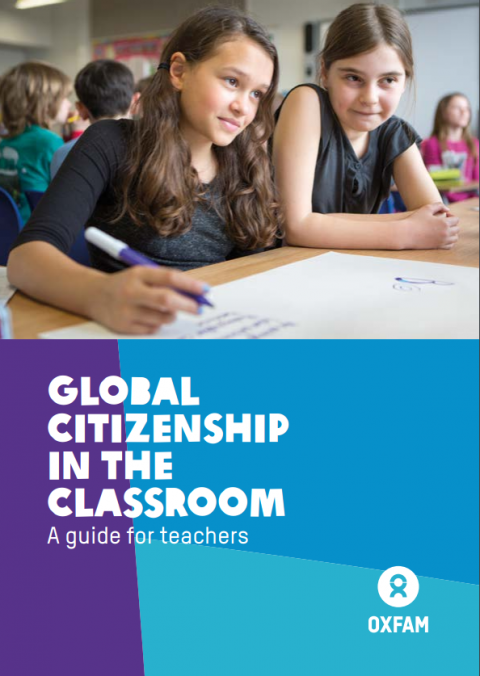 Global Citizenship in the Classroom: A guide for teachers سنة النشر: 2015 المؤلف المؤسسي: Oxfam GB A practical and reflective guide full of practical tools and ideas that can be applied to almost any topic to develop learner participation and global learning.
 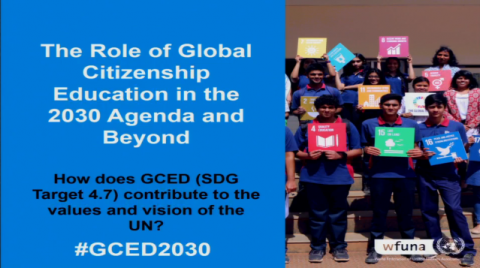 2017 UN Global Citizenship Education Seminar سنة النشر: 2017 المؤلف المؤسسي: United Nations (UN) 2017 UN GCED SeminarThe Role of Global Citizenship Education in the 2030 Agenda and Beyond: How does global citizenship education (SDG Target 4.7) contribute to the values and vision of the United Nations? 2017联合国全球公民教育研讨会 سنة النشر: 2017 المؤلف المؤسسي: United Nations (UN) 2017联合国全球公民教育研讨会全球公民教育在2030年议程及其后的作用:全球公民教育(可持续发展目标4.7)如何促进联合国的价值观和愿景?
  Educar para una ciudadanía global: construir un mundo justo desde la escuela سنة النشر: 2009 المؤلف: Colette Grech | Roderick Mallia | William Grech المؤلف المؤسسي: Conectando Mundos Consortium (Cidac, inizjamed, Intermon Oxfam, Ucodep) This publication is based on an initiative about the development education, intercultural education, popular education, the education of values, human rights education, education for sustainability, education for peace, education for gender equality, etc. The pedagogical proposal of Global Citizenship Education aspires to integrate in a coherent and challenging vision all these themes, keeping them in a close relationship with one another and taking into consideration the (increasing) interdependence of human beings living in a planet whose sustainability is under threat. This book is the fruit of a process that was triggered off by the joint effort of four European development NGOs, namely Cidac, Inizjamed, Intermón Oxfam and Ucodep within the frame of a project co-financed by the European Commission. These organisations set for themselves the objective to promote the acknowledgment and the inclusion of the contents and the methodology of Global Citizenship Education in the formal educational contexts in their respective countries, in order to kick-start a process of change in attitudes, values, and the beliefs of the pupils. Thanks to the initiative and efforts of the above-mentioned four organisations, and through various meetings and seminars carried out over the last three years in Spain, Italy, Portugal and Malta, groups of educators have been able to come face-to-face with each other, exchange experiences and reflect on the role of formal education with respect to the challenges of our times. Among the other experiences, the publication contains that of a key moment in the process. This took place in July 2008 in Cortona, a small and beautiful Tuscan city close to the border with Umbria, and in which many educators shared the benefit of what was the first international encounter of educators for global citizenship. The Cortona experience, in which around ninety teachers coming from Spain, Portugal, Malta, Italy, the Dominican Republic and Costa Rica have participated, was one of the stages – the starting point, in fact – of a process and a relationship that it is our aim to develop at the regional, national and international levels. In this publication, therefore, one can find theoretical cues put forward at Cortona that encourage educators to share their experiences and to compare the work done by different groups.This publication has two parts. The first part contains contributions of a theoretical type, whereas the second part concentrates on the educational experiences of the participants in the Cortona meeting.
 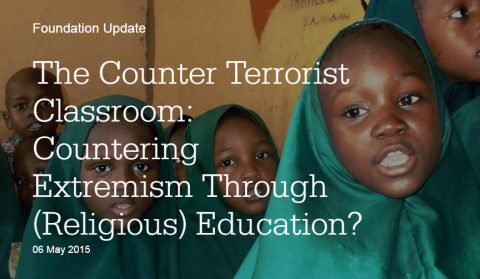 The Counter Terrorist Classroom: Countering Extremism Through (Religious) Education? سنة النشر: 2015 المؤلف: Liam Gearon The article identifies international cases– from the United States, Europe, and the United Nations– of an emergent interface of religion, education and security. This is manifest in the uses of religion in education to counter religious extremism, the notional “counter terrorist classroom”. To avoid an over-association of extremism with religion, the article provides some historical reminders that the post-Enlightenment centuries were marked by political extremism, particularly in the phenomenon that came to be known as totalitarianism. The Counter Terrorist Classroom: Countering Extremism Through (Religious) Education? سنة النشر: 2015 المؤلف: Liam Gearon Cet article identifie des cas d’interaction croissante entre les sphères du religieux, de l’éducation et le domaine sécuritaire - aux États-Unis, en Europe, et au sein des Nations Unies. Par exemple, l’intégration du religieux dans l’éducation afin de lutter contre l’extrémisme religieux, la théorique « lutte contre le terrorisme au sein des salles de classe ». Pour éviter une trop forte association entre extrémisme et religion, l’auteur procède à quelques rappels historiques et souligne le fait qu’à la fin du siècle des Lumières et jusqu’à aujourd’hui, les sociétés ont été marquées par diverses formes d’extrémisme politique, comme le montre notamment l’exemple les totalitarismes du XXe siècle. Countering Terrorism through Education of Populations: The Case of African Countries سنة النشر: 2011 المؤلف: Simon M. Lelo Terrorism has become a major concern of current governments. African countries are also involved in counter- terrorism but, due to several internal security and development problems, their effective participation in the combat against terrorism is very limited. They need capacity and skills in order to participate actively in countering terrorism. Education is one of the most appropriate ways for preparing African countries to prevent terrorism. Education provides not only knowledge but also capacity to make informed decisions, strategies and policies. The international community should help African countries to strengthen their education through specialized and general training programmes. Countering Terrorism through Education of Populations: The Case of African Countries سنة النشر: 2011 المؤلف: Simon M. Lelo Le terrorisme est devenu un enjeu de premier ordre pour les gouvernements actuels. Les pays africains prennent également part à la lutte contre le terrorisme ; cependant, à cause de problèmes de sécurité nationale et de développement, leur participation effective dans le combat contre le terrorisme reste très limitée. Ces pays manquent de moyen pour pouvoir y participer de manière plus active. Ainsi, l'éducation doit être privilégiée afin de soutenir les efforts de prévention dans les pays africains. L’éducation n'apporte pas seulement des connaissances aux apprenants, elle permet également de prendre des décisions, et de mettre en place des stratégies et des mesures de manière informée. La communauté internationale doit aider les pays africains à renforcer leurs systèmes éducatifs à travers divers programmes de formation.
  2016 UN Global Citizenship Education Seminar سنة النشر: 2016 المؤلف المؤسسي: United Nations (UN) 2016 UN Global Citizenship Education SeminarSeminar on “Global Citizenship Education: An emerging agenda for peace and preventing violent extremism and promoting sustainable development and human dignity”. This seminar was co-organized by the Permanent Missions of Andorra, Croatia, Jordan and the Republic of Korea; and the Asia-Pacific Centre of Education for International Understanding (APCEIU), the United Nations Educational, Scientific and Cultural Organization/Global Education First Initiative (UNESCO/GEFI), the United Nations Academic Impact (UNAI), the UN-Women, InterPress Service, and the Coalition for Global Citizenship 2030.
  Beyond Bali Education Package سنة النشر: 2012 المؤلف: Lily Taylor | Saul Karnovsky The Beyond Bali Project funded by Building Community Resilience (BCR) aims to develop and produce an education resource for secondary school students (years 8/9) on the Bali bombings and the Bali Peace Park. The resource is designed to build social resilience to violent extremism by: - providing students with the skills and tools to critically analyze and challenge violent extremism, its causes and consequences - raising awareness and education on the social impacts of violent extremism - encouraging students to think about how societies can resist the influence of violent extremism - engaging students through activities and discussion about the Bali Peace Park as social resistance to terrorism.