
الموارد
استكشف مجموعة واسعة من الموارد القيمة حول تعليم المواطنة العالمية لتعميق فهمك وتعزيز البحث والمناصرة والتعليم والتعلم.
تم العثور على 517 نتيجة
 [Summary] SDG 4 Data Digest 2018: Data to Nurture Learning; Executive Summary سنة النشر: 2018 المؤلف المؤسسي: UNESCO Institute for Statistics (UIS) The 2018 edition of the SDG 4 Data Digest: Data to Nurture Learning builds on last year’s report, which proposed a conceptual framework and tools to help countries improve the quality of their data and fulfil their reporting requirements. In this report, we present the wide range of national and cross-national learning assessments currently underway and the assessment experiences of practitioners in the field. The report draws on these experiences to present pragmatic approaches that can help countries monitor progress and make the best possible use of data for policymaking purposes. [Resumen] Compendio 2018 de Datos sobre el ODS 4: Estadísticas para Fomentar el Aprendizaje; resumen سنة النشر: 2018 المؤلف المؤسسي: UNESCO Institute for Statistics (UIS) La edición del Compendio 2018 de Datos sobre el ODS 4: Estadísticas para Fomentar el Aprendizaje apoya y expande el contenido del informe del año precedente, que proponía a los países un marco conceptual y un conjunto de herramientas para mejorar la calidad de sus estadísticas y cumplir con las obligaciones en materia de informes. En este documento, presentamos una amplia gama de evaluaciones de aprendizaje nacionales e internacionales que se realizan actualmente, así como las experiencias en evaluaciones de expertos en la materia. En el informe se elabora sobre esas experiencias para ofrecer soluciones pragmáticas que ayuden a monitorear el progreso y a lograr el mejor uso posible de los datos con miras a la formulación de políticas.
  Disinformation and Peacebuilding in Sub-Saharan Africa : Security Implications of AI-Altered Information Environments : Research Report سنة النشر: 2024 المؤلف: Eduardo Albrecht | Eleonore Fournier-Tombs | Rebecca Brubake المؤلف المؤسسي: United Nations University This report aims to further explore the way in which AI technologies as they currently stand impact peace and conflict, and what methods might be used to mitigate their adverse effects - through the development of better tools and the inclusion of peace and conflict considerations in AI governance frameworks. The report proposes the following recommendations: 1. More funding and support should be provided to civil society organization efforts to expand media literacy and fact-checking initiatives using AI tools to enhance capabilities. 2. Governments need to work with civil society to develop and implement comprehensive, transparent legal frameworks combating disinformation. These legislative measures need to support digital and media literacy campaigns and fact-checking organizations. 3. Social media companies need to expand investment and research into understanding local information environments, so they can better identify and respond to instances of disinformation in all contexts in which they operate and enhance transparency. 4. Peacebuilding organizations need to carefully consider local media ecosystems and information environments when conducting conflict analyses, and factor these dynamics into their projects' frameworks.
  National Consultation on the Situation of Prisons in Senegal: Improvement of the Condition of Detention, Social Integration and Prevention of Violent Extremism through Education, 23-24 May 2017, Dakar, Senegal: Report سنة النشر: 2017 المؤلف المؤسسي: UNESCO Dakar Sustainable Development Goal (SDG) 4 on education highlights the need to include our society’s most vulnerable and most margined members, such as prisoners, in order to ensure that all learners acquire the knowledge, skills, values and attitudes that are needed to build just, peaceful, and sustainable societies.The situation in Senegalese prisons is of a major concern given the overall condition of detention as well as the context of insecurity that characterizes the sector. In 2016, the country had 37 penal institutions for a total prison population of 9,422 prisoners (including pre-trial detainees and remand prisoners), of which approximately 200 were minors.1 Despite the efforts to humanize the prisons by adopting the name, “House of Arrest and Corrections” [Maison d'arrêt et de correction (MAC)] instead of the term "prison," and improving the living conditions in prisons, the fate of prisoners is not satisfactory. The reintegration promoted by Senegal's correctional facilities has largely consisted of a series of education programs, such as literacy and painting, developed by a number of organizations, but the space provided by prison administration, line Ministries, and NGOs are limited and the impact so far has been insufficient. A prison is not just a building, but it is also an instrument of rehabilitation to regain a place in society. This obviously requires the development of training, education and vocational guidance to support smooth reintegration into society.In this context, UNESCO's Dakar Regional Multi-Sectoral Office organized, in partnership with the Senegal National Commission for UNESCO and experts, a “National Consultation on the Situation of Prisons in Senegal: Improvement of the Condition of Detention, Social Integration, and Prevention of Violent Extremism through Education” in Dakar, Senegal, from 23 to 24 May 2017.
  Capacity Building Workshop on the Prevention of Violent Extremism through Education in West Africa and the Sahel: Final Report سنة النشر: 2017 المؤلف المؤسسي: UNESCO Dakar | Institut de la Francophonie pour l'éducation et la formation (IFEF) The capacity building workshop for the countries of West Africa and the Sahel, was organized in close collaboration with IICBA and APCEIU from 9 to 11 May 2017 in Dakar. The following countries participated in the meeting: Côte d’Ivoire, Cameroon, Guinea‐Bissau, Liberia, Mali, Mauritania, Niger, Senegal, Sierra Leone and The Gambia.This workshop was organized on the basis of a long‐standing partnership between UNESCO and the International Organization of La Francophonie (OIF), which strengthens its action on PVE. The regional workshop on capacity building for the prevention of violent extremism through education mainly used UNESCO materials and those for youth promoted by OIF. This workshop is a follow‐up to a similar initiative for education stakeholders of East and Southern Africa, organized in Addis Ababa in February 2017 by UNESCO through its International Institute for Capacity Building in Africa (IICBA).The overall objective of the workshop was to guide the countries of West Africa and the Sahel towards the Prevention of Violent Extremism (PVE). This includes familiarization with key issues, challenges, and opportunities identified to implement and further stimulate the implementation of the PVE strategy at the country level.
  Education and Disability: Analysis of Data from 49 Countries (UIS Information Paper No. 49) سنة النشر: 2018 المؤلف المؤسسي: UNESCO Institute for Statistics (UIS) Sustainable Development Goal (SDG) 4 calls for “inclusive and quality education for all”. Persons with a disability are among the population groups most likely to suffer from exclusion from education but data that permit an analysis of the links between disability and education remain scarce.This paper examines educational disparities linked to disability based on data from 49 countries and territories for five education indicators: Proportion of 15- to 29-year-olds who ever attended school Out-of-school rate (primary school age, lower secondary school age) Completion rate (primary education, lower secondary education) Mean years of schooling of the population 25 years and older Adult literacy rate (population 15 years and older)
 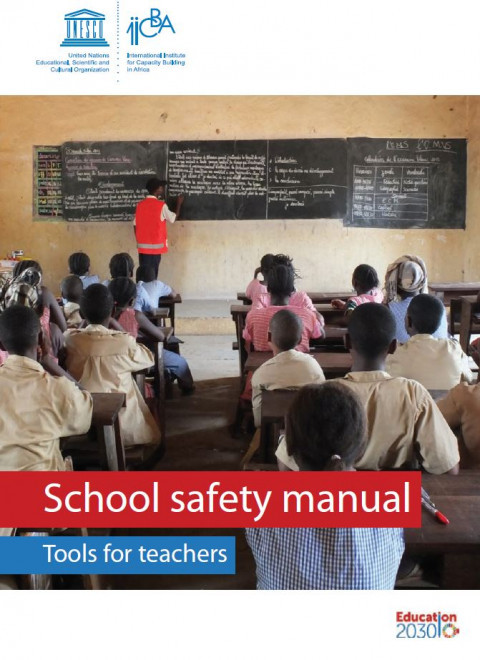 School Safety Manual: Tools for Teachers سنة النشر: 2017 المؤلف المؤسسي: UNESCO International Institute for Capacity-Building in Africa (IICBA) This manual was produced as part of the Teacher Training and Development for Peace-building in the Horn of Africa and Surrounding Countries project and aims to introduce teachers to the knowledge and skills needed for the establishment, maintenance and sustainment of basic school safety. As more children are enrolling in school in Africa, creating a safe and peaceful environment must be a top priority of teachers and educational institutions.The responsibility of schools to provide a safe environment for their students has been affirmed in the United Nations (UN) Sustainable Development Goal (SDG) four on Education.
 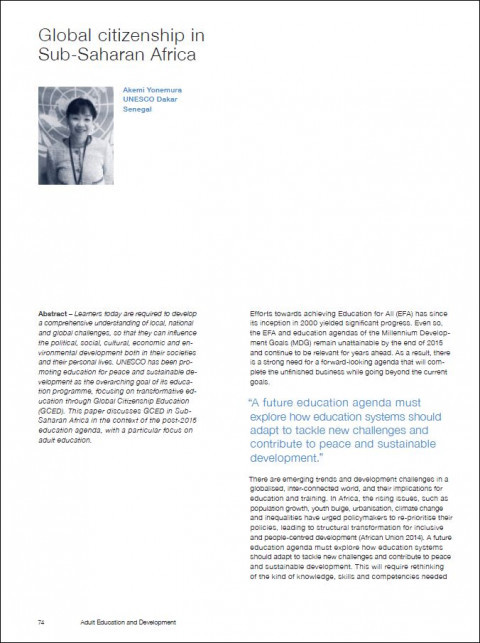 La citoyenneté mondiale en Afrique subsaharienne سنة النشر: 2015 المؤلف: Akemi Yonemura المؤلف المؤسسي: Éducation des Adultes et Développement Les apprenants doivent aujourd’hui bien comprendre les défis locaux, nationaux et mondiaux afin de pouvoir exercer une infl uence sur le développement politique, social, culturel, économique et environnemental, tant au sein de leurs sociétés que dans la vie privée. L’UNESCO a fait la promotion de l’éducation pour la paix et le développement durable en tant qu’objectifs fondamentaux de son programme d’éducation, se concentrant pour cela sur une éducation transformatrice par le biais de l’éducation à la citoyenneté mondiale (ECM). Cet article se penche sur l’ECM en Afrique subsaharienne dans le contexte du calendrier de l’éducation pour l’après-2015, et s’intéresse tout particulièrement à l’éducation des adultes.
  Dakar Office: Annual Report 2017 سنة النشر: 2018 المؤلف المؤسسي: UNESCO Dakar Across the globe, the 2030 Agenda remains the unifying tool of the international community in the construction of a prosperous, peaceful, and sustainable world for all. The 17 Sustainable Development Goals are the expression of a shared global and transformative vision to change the world and improve the well-being of all peoples. UNESCO plays a transformative role in the implementation of this agenda, thanks to its education, culture, sciences and communication and information programmes.This annual report underlines the drive and spirit of our team in promoting innovation to uphold the 2030 and 2063 Agendas. It is a resounding testament to the unwavering forts of our team in 2017, and the depth of their commitment to advance the ideals and objectives of UNESCO.The 2017 Annual Report of the UNESCO Regional Office covers seven countries in the region: Burkina Faso, Cabo Verde, Guinea-Bissau, Niger, Senegal, The Gambia as well as Mali, supported by the national office in Bamako.
 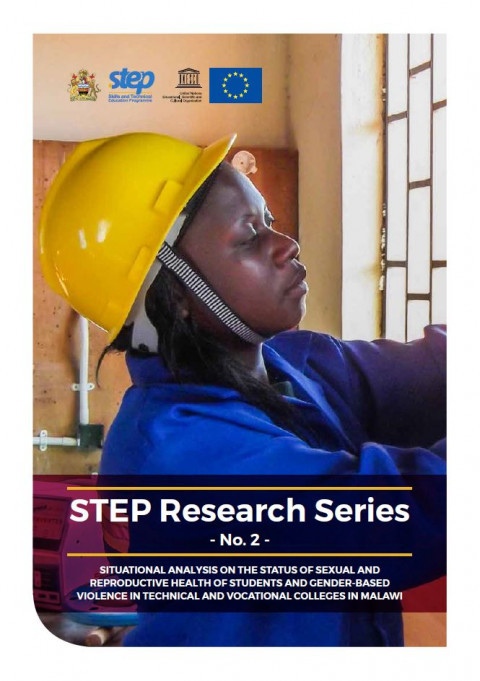 Situational Analysis on the Status of Sexual and Reproductive Health of Students and Gender-based Violence in Technical and Vocational Colleges in Malawi (STEP Research Series No. 2) سنة النشر: 2017 المؤلف المؤسسي: Skills and Technical Education Programme (STEP) Funded by the EU and implemented by UNESCO in collaboration with the Government of Malawi, the Skills and Technical Education Programme (STEP) is dedicated to reinforcing Technical, Entrepreneurial and Vocational Education and Training (TEVET) in Malawi.The programme will run from 2016-2020 and aims to improve TEVET at post-secondary level with a focus on equal access to enrolment, with particular emphasis on female learners; improving quality in the sector; and the establishment of clear governance structures. The STEP Research Series presents the highlights of the research undertaken by the programme.The situational analysis on the status of sexual and reproductive health of students and gender-based violence in technical and vocational colleges in Malawi is the second report in the STEP Research Series.