
الموارد
استكشف مجموعة واسعة من الموارد القيمة حول تعليم المواطنة العالمية لتعميق فهمك وتعزيز البحث والمناصرة والتعليم والتعلم.
تم العثور على 26 نتيجة
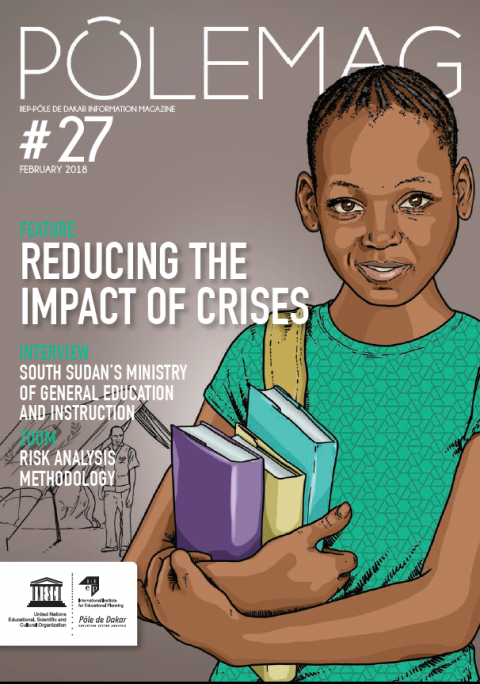 PôleMag n° 27: IIEP Pôle de Dakar information magazine, February 2018 سنة النشر: 2018 المؤلف المؤسسي: UNESCO IIEP Regional Office for Africa Strengthening the resilience of education systems through planning that is adapted for crisis situations is a priority for IIEP. Together with our main partners, the institute has developed strategic orientations and tools dedicated to educational planning that is adapted to crisis situations. Based on our experience on this theme in Africa, we are also working with UNICEF to develop a new methodology to analyse risks and vulnerabilities. Mitigating the impact of crises calls for strengthening relationships with partners. Planning adapted to vulnerabilities should facilitate dialogue between development and humanitarian actors so that intervention plans are coordinated and aligned with government priorities. A dollar invested in risk reduction could save up to seven dollars in rebuilding costs. Taking the risks into account in the analysis and planning of education systems is therefore a wise investment. PôleMag: la lettre d'information du Pôle de Dakar سنة النشر: 2018 المؤلف المؤسسي: UNESCO IIEP Regional Office for Africa Crise politique, crise sanitaire, crise climatique, les systèmes éducatifs sont rarement suffisamment préparés à faire face aux situations d’urgence.Et si la fréquence des menaces est inconnue, les effets sont généralement dévastateurs pour l’école, conduisant à une rupture des apprentissages, voire à l’abandon scolaire pur et simple. Dans le monde, 75 millions d’enfants vivant dans un pays affecté par une crise ont besoin d’un soutien éducatif1.Comment faire face aux crises ? Comment améliorer les capacités des systèmes à réduire leurs impacts ? Renforcer la résilience des systèmes éducatifs par une planification adaptée aux situations de crise est une priorité de l’IIPE. Notre institut a développé, avec ses principaux partenaires, des orientations stratégiques et des outils dédiés à la planification de l’éducation adaptés aux situations de crises. Forts de notre expérience sur cette thématique en Afrique, nous travaillons également en collaboration avec l’UNICEF au développement d’une nouvelle méthodologie dédiée à l’analyse des risques et vulnérabilités.Atténuer l’impact des crises appelle à renforcer les relations avec les partenaires. Une planification adaptée aux vulnérabilités doit faciliter le dialogue entre les acteurs du développement et ceux de l’humanitaire afin que les plans d’interventions soient coordonnés et alignés sur les priorités gouvernementales des plans sectoriels. Un dollar investi dans la réduction des risques pourrait épargner jusqu’à 7 dollars en coût de reconstruction. Prendre en compte les risques dans l’analyse et la planification des systèmes éducatifs est donc un investissement judicieux.
 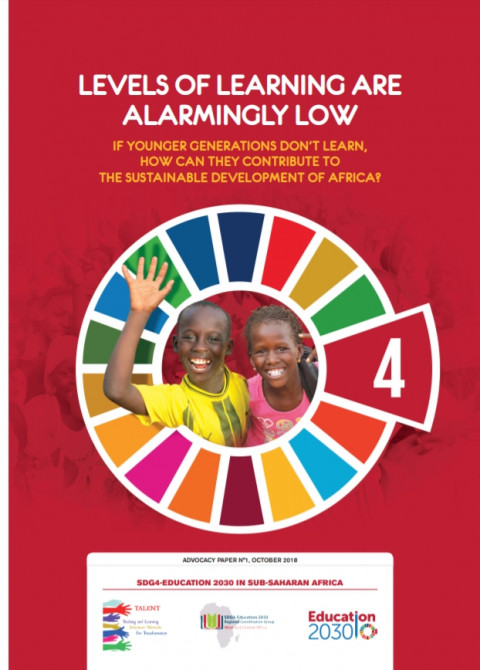 Levels of learning are alarmingly low: if younger generations don't learn, how can they contribute to the sustainable development of Africa? سنة النشر: 2018 المؤلف المؤسسي: UNESCO Dakar | Regional Coordination Group on SDG 4-Education 2030 in West and Central Africa | Teaching and Learning Educators’ Network for Transformation With the adoption of The 2030 Agenda for Sustainable Development, UN member states and partner organizations have agreed to ensure inclusive and equitable quality education and promote lifelong learning opportunities for all by 2030. Building on the unfinished agendas of the Millennium Development Goals and Education for All, quality education and learning are at the very core of both SDG4 and CESA 16-25 (see box 1). Five of the seven SDG4 targets are specifically designed with the intention of addressing the global learning crisis. Moreover, CESA 16-25 specifically calls on African Union member states to address issues of quality and equity in education, particularly at the pre-primary level, a neglected area in terms of investment and policy, and at the primary level where geographical disparities indicate that girls and women, the poorest and those leaving in remote areas are still left behind. The next question is whether these international and regional commitments have been translated into national policies and strategies that can address the alarmingly low levels of learning. Les niveaux d'apprentissage sont alarmants: si les jeunes générations n'apprennent pas, peuvent-elles contribuer au développement durable de l'Afrique? سنة النشر: 2018 المؤلف المؤسسي: UNESCO Dakar | Regional Coordination Group on SDG 4-Education 2030 in West and Central Africa | Teaching and Learning Educators’ Network for Transformation Avec l’adoption de le Programme pour le développement durable à l’horizon 2030, les États membres de l’ONU et les organisations partenaires ont convenu d’assurer, d’ici 2030, une éducation inclusive et équitable de qualité et de promouvoir des possibilités d’apprentissage tout au long de la vie pour tous. S’appuyant sur les programmes inachevés des Objectifs du Millénaire pour le développement et de l’Éducation pour tous, l’éducation et les apprentissages de qualité sont au cœur même de l’ODD4 et de la CESA 16-25 (voir l’encadré 1 dans la section suivante). En effet, cinq des sept cibles de l’ODD4 sont spécifiquement formulées pour s’attaquer à la crise mondiale de l’apprentissage. En outre, la CESA 16-25 appelle spécifiquement les États membres de l’Union Africaine à aborder les questions de qualité et d’équité dans l’éducation, en particulier au niveau pré-primaire, un domaine négligé en termes d’investissements et de politiques, et au niveau primaire où les disparités géographiques laissent sur le côté les filles et les femmes, les plus pauvres et ceux qui vivent dans les zones reculées. La question est désormais de savoir si ces engagements internationaux et régionaux ont été traduits en politiques et stratégies nationalesqui peuvent s’attaquer aux niveaux alarmants des résultats d’apprentissage.
  National Consultation on the Situation of Prisons in Senegal: Improvement of the Condition of Detention, Social Integration and Prevention of Violent Extremism through Education, 23-24 May 2017, Dakar, Senegal: Report سنة النشر: 2017 المؤلف المؤسسي: UNESCO Dakar Sustainable Development Goal (SDG) 4 on education highlights the need to include our society’s most vulnerable and most margined members, such as prisoners, in order to ensure that all learners acquire the knowledge, skills, values and attitudes that are needed to build just, peaceful, and sustainable societies.The situation in Senegalese prisons is of a major concern given the overall condition of detention as well as the context of insecurity that characterizes the sector. In 2016, the country had 37 penal institutions for a total prison population of 9,422 prisoners (including pre-trial detainees and remand prisoners), of which approximately 200 were minors.1 Despite the efforts to humanize the prisons by adopting the name, “House of Arrest and Corrections” [Maison d'arrêt et de correction (MAC)] instead of the term "prison," and improving the living conditions in prisons, the fate of prisoners is not satisfactory. The reintegration promoted by Senegal's correctional facilities has largely consisted of a series of education programs, such as literacy and painting, developed by a number of organizations, but the space provided by prison administration, line Ministries, and NGOs are limited and the impact so far has been insufficient. A prison is not just a building, but it is also an instrument of rehabilitation to regain a place in society. This obviously requires the development of training, education and vocational guidance to support smooth reintegration into society.In this context, UNESCO's Dakar Regional Multi-Sectoral Office organized, in partnership with the Senegal National Commission for UNESCO and experts, a “National Consultation on the Situation of Prisons in Senegal: Improvement of the Condition of Detention, Social Integration, and Prevention of Violent Extremism through Education” in Dakar, Senegal, from 23 to 24 May 2017.
  Capacity Building Workshop on the Prevention of Violent Extremism through Education in West Africa and the Sahel: Final Report سنة النشر: 2017 المؤلف المؤسسي: UNESCO Dakar | Institut de la Francophonie pour l'éducation et la formation (IFEF) The capacity building workshop for the countries of West Africa and the Sahel, was organized in close collaboration with IICBA and APCEIU from 9 to 11 May 2017 in Dakar. The following countries participated in the meeting: Côte d’Ivoire, Cameroon, Guinea‐Bissau, Liberia, Mali, Mauritania, Niger, Senegal, Sierra Leone and The Gambia.This workshop was organized on the basis of a long‐standing partnership between UNESCO and the International Organization of La Francophonie (OIF), which strengthens its action on PVE. The regional workshop on capacity building for the prevention of violent extremism through education mainly used UNESCO materials and those for youth promoted by OIF. This workshop is a follow‐up to a similar initiative for education stakeholders of East and Southern Africa, organized in Addis Ababa in February 2017 by UNESCO through its International Institute for Capacity Building in Africa (IICBA).The overall objective of the workshop was to guide the countries of West Africa and the Sahel towards the Prevention of Violent Extremism (PVE). This includes familiarization with key issues, challenges, and opportunities identified to implement and further stimulate the implementation of the PVE strategy at the country level.
  Dakar Office: Annual Report 2017 سنة النشر: 2018 المؤلف المؤسسي: UNESCO Dakar Across the globe, the 2030 Agenda remains the unifying tool of the international community in the construction of a prosperous, peaceful, and sustainable world for all. The 17 Sustainable Development Goals are the expression of a shared global and transformative vision to change the world and improve the well-being of all peoples. UNESCO plays a transformative role in the implementation of this agenda, thanks to its education, culture, sciences and communication and information programmes.This annual report underlines the drive and spirit of our team in promoting innovation to uphold the 2030 and 2063 Agendas. It is a resounding testament to the unwavering forts of our team in 2017, and the depth of their commitment to advance the ideals and objectives of UNESCO.The 2017 Annual Report of the UNESCO Regional Office covers seven countries in the region: Burkina Faso, Cabo Verde, Guinea-Bissau, Niger, Senegal, The Gambia as well as Mali, supported by the national office in Bamako.
  Acteurs et partenariats dans le secteur de la formation professionnelle سنة النشر: 2019 المؤلف المؤسسي: UNESCO IIEP Regional Office for Africa | Institut de la Francophonie pour l'éducation et la formation (IFEF) Une des voies reconnues pour améliorer l'efficacité des systèmes de formation professionnelle est le développement de partenariats entre acteurs publics, acteurs privés et société civile. Mais qu'entend-t-on précisément par partenariats ? Et sous quelles formes sont-ils les plus efficaces ? La diversité des contextes nationaux et locaux montre combien le domaine de la formation professionnelle est complexe et multidimensionnel. Dès lors, il est important de clarifier les types de partenariats à mettre en place, les domaines d'interventions des acteurs, ainsi que leurs rôles respectifs. Pour cette étude, l'IIPE-Pôle de Dakar et l'IFEF ont associé leur expertise dans le but d'appréhender les processus-clés de la formation professionnelle et d'offrir un portrait global des différents types de partenariats envisageables.
 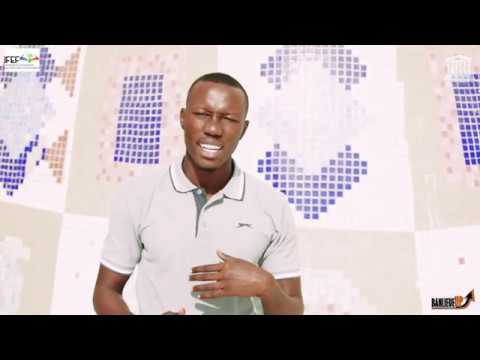 Formation pilote sur la paix et la citoyenneté mondiale سنة النشر: 2020 المؤلف المؤسسي: UNESCO Dakar Du 6 au 8 décembre 2019, une formation sur l'éducation pour la paix et la citoyenneté mondiale des adolescents s’est tenue à Guédiawaye, dans la banlieue de Dakar, à destination des jeunes du Sénégal et de la sous-région.
  Quality TVET for the Successful Training to Employment Transition of Africa’s Youth سنة النشر: 2020 المؤلف المؤسسي: UNESCO International Institute for Educational Planning (IIEP) | Agence luxembourgeoise pour la coopération au développement (LuxDev) | Institut de la Francophonie pour l'éducation et la formation (IFEF) This report constitutes the analytical synthesis of the 2nd Regional Workshop for Exchange between Vocational Training Actors in Africa and their Mutual Strengthening, held in Nairobi from 18-20 June 2019, on the theme of “Quality TVET for the successful training to employment transition of Africa’s youth”.