
الموارد
استكشف مجموعة واسعة من الموارد القيمة حول تعليم المواطنة العالمية لتعميق فهمك وتعزيز البحث والمناصرة والتعليم والتعلم.
تم العثور على 28 نتيجة
 An Experimental Study of Constructing Maker Teaching Model (Educational Journal ; Vol.49, No.2) سنة النشر: 2021 المؤلف: 沈翠莲 Makers studying at university are the main powerful pioneers for developing innovative knowledge society. This research aimed to construct a feasible model of maker teaching, to explore the differences of learning perception of the maker instructional model, and to develop the subsequent process of product creation. Nonequivalent pretest-posttest designs of the quasi-experimental research was employed. Research participants included 132 college students from three classes of creativity-related courses, who participated a 6-week experiment. They were divided into the experimental group and two control groups. A questionnaire was employed to test their differences of learning perception. Results found that: (a) for the maker instructional model, CEO-I2M2E2-SF, a collaborative constructive relationship should be built between instructor and makers; (b) in terms of the performances of learning perception under the maker instructional model, significant differences were found in the dimensions of creativity, creative problem solving, and maker instructional design; (c) there were educational and marketing values in the subsequent process of product creation by makers. 建构大学创各教学模式的实验研究 (教育学报; Vol.49, No.2) سنة النشر: 2021 المؤلف: 沈翠莲 创客是大学教育为了发展未来创新知识社会的主力。本研究旨在:建构大学实践创客教学设计的可行模式,探析创客教学设计模式的学习知觉差异,发展创客产出创意作品的后续研发历程。研究方法采取准实验研究的不等组前后测设计,研究对象为开设在大学创意课程的三班共132位大学生,经由6周教学实验,并以「大学生参与教学设计表现想像创意作品的实验效益调查问卷」施测,分析教学实验前后的学习知觉差异。研究提出以下结论:(1)大学创客教学设计模式需要师生共构共变;(2)大学创客教学模式的学习知觉,在创造力、创意问题解决和创客教学设计上获得显着验证;(3)大学创客教学设计课堂作品接力研发为商品,具有教育意义和市场价值。
  Imagining the Classroom Full of Learning in the Future: Effective Teaching With Social Constructive Learning (Educational Journal ; Vol.48, No.2) سنة النشر: 2020 المؤلف: 洪瑜佩 This article used an observation scale, together with literature exploration and film observation, to imagine the future classroom. From literature review, it was found that constructivist teaching helps students acquire new knowledge and develop cognition through connecting new and old knowledge. Teaching with the social constructivism approach regards learning as the result of interaction with society and culture. This article aimed to explore the social constructivist teaching context, as well as to observe which aspects and connotations teachers should pay attention to in curriculum arrangement. The researcher amended the observation scale designed by Good & Lavigne (2018) with five steps: (a) raising questions;(b) collaboration and suggestions; (c) assessment and discussions; (d) application to scenarios; and (e) summarizing knowledge. Teachers’ teaching was observed and assessed based on the five steps. The following results were found: (a) students should have the responsibilities of learning;(b) teachers must have good questioning and guidance skills; (c) teachers need to incorporate learning into real-life situations; (d) students’ cognition must be reviewed and monitored frequently. The researcher believes that a classroom full of learning is not imaginary. Teachers already have the ability to construct effective classrooms and should treat students as the learning agent. 想像未来充满学习的教室──以社会建构学习谈有效教学 (教育学报; Vol.48, No.2) سنة النشر: 2020 المؤلف: 洪瑜佩 本文采用观察量表分析,透过文献探讨和影片观察,提出未来课堂教室的想像。从文献中发现建构主义的教学是透过连结新知识与旧知识,帮助学生获得新知、发展认知,而社会建构主义的教学则认为学习是与社会、文化互动所得的结果。本文目的是探究社会建构主义的教学情境建构,观察教师的课程安排有哪些该注意的面向和内涵。研究者从good & lavigne(2018)设计的观察量表修正成一份由提出问题、协作建议、评估讨论、应用情境、总结知识五步骤的量表,看待教师的社会建构主义教学,发现以下特征:(1)将学习责任逐步交还给学生;(2)教师须具备良好的提问与引导技巧;(3)将学习加入生活情境脉络之中;(4)必须时时刻刻检视学生的认知。研究者认为充满学习的教室并非想像,现场教师已有能力建构有效教学的教室,应将学习主体还给学生。
  An Exploration of Citizenship Identity and Civic Awareness: An Analysis of Moral and Civic Education Primary School Textbooks in Macao (Educational Journal ; Vol.48, No.1) سنة النشر: 2018 المؤلف: 黄素君 | 黄乐源 | 谢均才 This article aims to explore the discourses of citizenship identity and civic awareness embedded in the series of Moral and Civic Education primary school textbooks in Macao. The study reveals that: (a) the personal and collective level of civic awareness is the dominant discourse in the textbooks; (b) the textbooks give an important weighting to the cultivation of the character of citizens as well as the importance of individual self-discipline and collective value; (c) patriotic education and civic education intertwine in order to cultivate a patriotic Chinese citizen; (d) “respect” is the key concept in cultivating the global citizen in the textbooks. The citizenship presented in the textbooks emphasizes the formation of national identity, and a form of responsibility-driven civic awareness. In essence, the cultivation of citizenship identity and civic awareness still demonstrates a passive and self-disciplined view. This article suggests that curriculum design should emphasize on the cultivation of fairness and critical thinking in order to fulfill a comprehensive mission and function of citizenship education. 公民身分与意识初探:澳门小学《品德与公民》教科书分析 (教育学报; Vol.46, No.2) سنة النشر: 2018 المؤلف: 黄素君 | 黄乐源 | 谢均才 本文旨在探究澳门小学《品德与公民》教科书中有关「公民身分」及「公民意识」的论述及内涵。透过文本分析发现:(1)个体及集体层次的公民身分意识成为教材中的显性话语;(2)教科书相当重视公民品德之养成,强调个体的自我规训及集体价值;(3)爱国教育与公民教育互相渗透,培养具有爱国意识的中国公民;(4)呈现出以尊重为主色调的世界公民养成。总体而言,教科书所呈现的公民身分强调国族认同,公民意识以责任为取向,本质上仍然是被动、带有自我规训的公民观。本文建议课程设计须重视公平与批判思考的公民素养,以发挥培育良好公民的功能和使命。
  The Development of Asian Primary Students’ Global Citizenship Literacy Scales: An Exploratory Study of Taiwan Primary Student (Educational Journal ; Vol.45, No.1) سنة النشر: 2017 المؤلف: 吴时省 | 蔡清华 This study aimed to develop an instrument to measure the effect of Taiwan’s policy on global education. Four constructs were developed, namely rights and responsibilities of global citizenship, competencies of global citizenship, participation of global citizenship, and reflection of global citizenship. The instrument was tested with a sample of 1,112 elementary school students in Taiwan. Content validity was established. Exploratory factor analysis and confirmatory factor analysis confirmed construct validity. All the indexes were satisfied except the convergent validity. 亚洲小学生全球公民素养量表之发展:以台湾小学生为探索个案 (教育学报; Vol.45, No.1) سنة النشر: 2017 المؤلف: 吴时省 | 蔡清华 本研究主要目的在发展一份全球公民素养量表,作为台湾过去这些年来对于小学阶段全球教育努力成果的检视。透过文献分析,研究者归纳出全球公民素养四个构念,分别为「全球公民权利与义务」、「全球公民能力」、「全球公民参与」、「全球公民反思」,并根据这四个构念进行量表的编制和信效度的检核。研究样本为台湾各地小学生,总计1,112名。量表整体信度为.868,与各个效标工具的相关亦都至少达到.05显着水准;模式的考验方面,除了内在品质的聚敛效度稍嫌不理想外,其余结果都达到预期。
 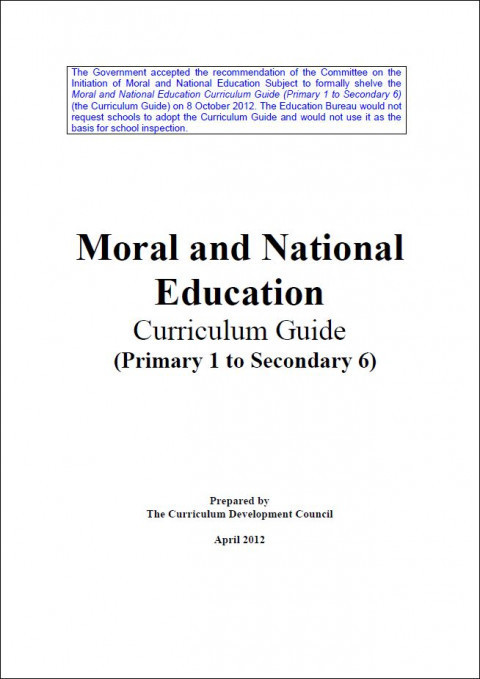 Moral and National Education Curriculum Guide (Primary 1 to Secondary 6) سنة النشر: 2012 المؤلف المؤسسي: Curriculum Development Council (Hong Kong) Cultivating students’ moral and national qualities has always been one of the main objectives of school education in Hong Kong. Since the return of sovereignty, promoting national education and enhancing students’ understanding of their country and national identity have become a common goal of primary and secondary schools. Moral and Civic Education (MCE) was made one of the Four Key Tasks in the curriculum reform undertaken by the Education and Manpower Bureau (Education Bureau) in 2001. To develop students’ positive values and attitudes has become an integral part of the curriculum framework for primary and secondary schools since then.In response to growing calls for enhancing the moral and national qualities of our youth, the Education Bureau (EDB) introduced the “Revised Moral and Civic Education Curriculum Framework” in 2008 and the contents of national education in relevant Key Learning Areas (KLAs) and subjects were enriched to strengthen the implementation of moral and national education.A considerable number of primary and secondary schools in Hong Kong have been actively promoting moral and national education. Apart from classroom learning and teaching, elements of MNE are also incorporated into related learning experiences/activities such as Mainland exchange programmes, visits, service learning and project learning. Students are provided with comprehensive and diversified learning experiences so as to cultivate their moral and national qualities. Building on the above favourable conditions and strengths in the curriculum, the Chief Executive stated in the “Policy Address 2010-11” in October 2010 that the Curriculum Development Council (CDC) would be invited to review the curriculum framework of moral and civic education at primary and secondary levels. To strengthen national education, the “Moral and National Education” (MNE) subject would be introduced to cultivate students’ moral and national qualities in a systematic and sustainable manner.The “Moral and National Education Curriculum Guide (Primary 1 to Secondary 6)”, prepared by the CDC of Hong Kong, sets out the aims and rationale of the curriculum and illustrates the curriculum framework, curriculum planning, learning and teaching, assessments and the use of learning and teaching resources to assist teachers in their preparation and implementation of this subject. The CDC of Hong Kong is an advisory body for the HKSAR Government on matters relating to curriculum development from pre-primary to senior secondary levels. Its members include school heads/principals, in-service teachers, parents, employers, and scholars in post-secondary institutions, professionals from relevant sectors or organisations, representatives from the Hong Kong Examinations and Assessment Authority and the Vocational Training Council of Hong Kong, and personnel of relevant departments of the EDB. Guide Pédagogique d'enseignement Moral et National (primaire1 à secondaire6) سنة النشر: 2012 المؤلف المؤسسي: Curriculum Development Council (Hong Kong) Cultivant qualités morales et nationales des étudiants a toujours été l'un des principaux objectifs de l'enseignement scolaire à Hong Kong. Depuis le retour de la souveraineté, la promotion de l'éducation nationale et l'amélioration de la compréhension des élèves de leur pays et l'identité nationale sont devenus un objectif commun des écoles primaires et secondaires. L’Éducation Morale et Civique(EMC) a été l'une des quatre tâches clés de la réforme du curriculum entrepris par le Bureau de l'éducation et de la main-d'œuvre (Bureau de l'éducation) en 2001. Pour développer des valeurs et des attitudes positives des élèves est devenue une partie intégrante du cadre des programmes d'études pour les écoles primaires et secondaires depuis. En réponse aux appels de plus en plus pour améliorer les qualités morales et nationales de notre jeunesse, le Bureau de l'éducation (DBE) a présenté le «Cadre éducation morale et civique Curriculum" en 2008 et le contenu de l'éducation nationale dans les zones d'apprentissage clés pertinents (UCK) et les sujets ont été enrichis pour renforcer la mise en œuvre de l'éducation morale et nationale. Un nombre considérable d'écoles primaires et secondaires à Hong Kong ont été activement la promotion de l'éducation morale et nationale. En dehors de l'apprentissage en classe et de l'enseignement, des éléments de MNE sont également incorporés dans les expériences d'apprentissage / activités connexes telles que des programmes d'échange continentale, les visites, l'apprentissage du service et de l'apprentissage du projet. Les étudiants sont fournis avec des expériences globales et diversifiées d'apprentissage de façon à cultiver leurs qualités morales et nationales. Se fondant sur les conditions et les forces favorables ci-dessus dans le programme, le directeur général a déclaré dans le "Adresse politique 2010-11" en Octobre 2010 que le Conseil de Développement du /curriculum (CDC) serait invité à examiner le cadre des programmes de l'éducation morale et civique au niveaux primaire et secondaire. Pour renforcer l'éducation nationale, le (MNE) sujet «enseignement moral et national" serait introduit à cultiver des qualités morales et nationales des étudiants d'une manière systématique et durable.Le «enseignement moral et national Curriculum Guide (primaire 1 à secondaire 6)", préparé par le CDC de Hong Kong, définit les objectifs et la justification du programme et illustre le cadre des programmes d'études, de la planification des programmes d'études, l'apprentissage et l'enseignement,évaluations et l'utilisation des ressources d'apprentissage et d'enseignement pour aider les enseignants dans leur préparation et la mise en œuvre de ce sujet. La CDC de Hong Kong est un organe consultatif pour le gouvernement de la RASHK sur les questions relatives à l'élaboration des programmes de pré-primaire au deuxième cycle du secondaire. Ses membres comprennent des chefs d'établissement / directeurs, les enseignants, les parents, les employeurs et les chercheurs en service dans les institutions post-secondaires, les professionnels des secteurs concernés ou des organisations, des représentants des examens et de l'évaluation Autorité Hong Kong et le Conseil de la formation professionnelle de Hong Kong, et le personnel des services compétents de l'EDB.