
الموارد
استكشف مجموعة واسعة من الموارد القيمة حول تعليم المواطنة العالمية لتعميق فهمك وتعزيز البحث والمناصرة والتعليم والتعلم.
تم العثور على 62 نتيجة
 Institut Mahatma Gandhi d'éducation pour la paix et le développement durable: une initiative conjointe de l'UNESCO et le gouvernement de l'Inde سنة النشر: 2013 المؤلف المؤسسي: Mahatma Gandhi Institute of Education for Peace and Sustainable Development (MGIEP) L'Organisation des Nations Unies pour l'éducation, la science et la culture (UNESCO) et le Gouvernement de l'Inde se lancent dans un nouveau partenariat majeur pour créer l'Institut Mahatma Gandhi d'éducation pour la paix et le développement durable. Grâce à la recherche et le renforcement des capacités, l'Institut vise à développer et promouvoir de nouvelles approches de l'éducation, l'autonomisation des apprenants pour transformer leur vie et construire un monde plus pacifique et durable. Basé à New Delhi, ce sera le premier Institut de l'UNESCO spécialisé de l'éducation en Inde, et la première dans la région Asie-Pacifique. Il est particulièrement approprié que l'Institut est hébergé par l'Inde, le lieu de naissance du Mahatma Gandhi et un pays qui a pris un engagement important à l'éducation au cours des dernières décennies. Mahatma Gandhi Institute of Education for Peace and Sustainable Development: UNESCO's first category 1 Institute in the Asia-Pacific سنة النشر: 2014 المؤلف المؤسسي: Mahatma Gandhi Institute of Education for Peace and Sustainable Development (MGIEP) The Mahatma Gandhi Institute of Education for Peace and Sustainable Development (MGIEP) is UNESCO’s first Category 1 Institute in the Asia-Pacific. The Institute will be a key strategic player in UNESCO’s work towards quality Education for All and the transformative shift envisioned for the Post 2015 agenda. Established in cooperation with the Government of India, MGIEP has been created to play a leading role in research, knowledge sharing, capacity building and policy formulation in the area of peace and sustainability education. The Institute aims to promote, assimilate and generate high quality research to lead the intellectual and policy discourse for education and global citizenship in the region. It was named after Mahatma Gandhi, as a tribute to his ideas of non-violence and sustainable living. The President of India and the Director-General of UNESCO jointly announced the establishment of the Institute in November, 2012. It is located in New Delhi. Mahatma Gandhi Institute of Education for Peace and Sustainable Development: UNESCO's first category 1 Institute in the Asia-Pacific سنة النشر: 2014 المؤلف المؤسسي: Mahatma Gandhi Institute of Education for Peace and Sustainable Development (MGIEP) L'Institut Mahatma Gandhi d'éducation pour la paix et le développement durable (MGIEP) est la première catégorie de l'UNESCO 1 Institut dans la région Asie-Pacifique. L'Institut sera un acteur stratégique clé dans le travail de l'UNESCO à l'éducation de qualité pour tous et le changement de transformation envisagé pour le programme post 2015. Fondée en coopération avec le Gouvernement de l'Inde, MGIEP a été créé pour jouer un rôle de premier plan dans la recherche, le partage des connaissances, le renforcement des capacités et la formulation des politiques dans le domaine de l'éducation de la paix et de la durabilité. L'Institut vise à promouvoir, d'assimiler et de générer des recherches de haute qualité pour diriger le discours intellectuel et politique de l'éducation et la citoyenneté mondiale dans la région. Il a été nommé d'après le Mahatma Gandhi, comme un hommage à ses idées de non-violence et de vie durable. Le Président de l'Inde et le Directeur général de l'UNESCO ont annoncé conjointement la mise en place de l'Institut en Novembre 2012. Il est situé à New Delhi. Mahatma Gandhi Institute of Education for Peace and Sustainable Development: UNESCO's first category 1 institute in the Asia-Pacific brochure سنة النشر: 2014 المؤلف المؤسسي: Mahatma Gandhi Institute of Education for Peace and Sustainable Development (MGIEP) The Mahatma Gandhi Institute of Education for Peace and Sustainable Development (MGIEP) is UNESCO’s first Category 1 Institute in the Asia-Pacific. The Institute will be a key strategic player in UNESCO’s work towards quality Education for All and the transformative shift envisioned for the Post 2015 agenda. Established in cooperation with the Government of India, MGIEP has been created to play a leading role in research, knowledge sharing, capacity building and policy formulation in the area of peace and sustainability education. The Institute aims to promote, assimilate and generate high quality research to lead the intellectual and policy discourse for education and global citizenship in the region. It was named after Mahatma Gandhi, as a tribute to his ideas of non-violence and sustainable living. The President of India and the Director-General of UNESCO jointly announced the establishment of the Institute in November, 2012. It is located in New Delhi. Institut Mahatma Gandhi d'Éducation pour la Paix et le Développement Durable: UNESCO premier institut de catégorie 1 dans la brochure Asie-Pacifique سنة النشر: 2014 المؤلف المؤسسي: Mahatma Gandhi Institute of Education for Peace and Sustainable Development (MGIEP) L'Institut Mahatma Gandhi d'éducation pour la paix et le développement durable (MGIEP) est la première catégorie de l'UNESCO 1 Institut dans la région Asie-Pacifique. L'Institut sera un acteur stratégique clé dans le travail de l'UNESCO à l'éducation de qualité pour tous et le changement de transformation envisagé pour le programme post 2015. Fondée en coopération avec le Gouvernement de l'Inde, MGIEP a été créé pour jouer un rôle de premier plan dans la recherche, le partage des connaissances, le renforcement des capacités et la formulation des politiques dans le domaine de l'éducation de la paix et de la durabilité. L'Institut vise à promouvoir, d'assimiler et de générer des recherches de haute qualité pour diriger le discours intellectuel et politique de l'éducation et la citoyenneté mondiale dans la région. Il a été nommé d'après le Mahatma Gandhi, comme un hommage à ses idées de non-violence et de vie durable. Le Président de l'Inde et le Directeur général de l'UNESCO ont annoncé conjointement la mise en place de l'Institut en Novembre 2012. Il est situé à New Delhi.
  One World, One People, One Future: Imagine a World that Understands, Embraces & Practices Peace and Sustainable Development سنة النشر: 2014 المؤلف المؤسسي: Mahatma Gandhi Institute of Education for Peace and Sustainable Development (MGIEP) One World, One People, One Future: Imagine a World that Understands, Embraces & Practices Peace and Sustainable Development
  The Elusive and Exclusive Global Citizen سنة النشر: 2015 المؤلف: Jill Koyama المؤلف المؤسسي: Mahatma Gandhi Institute of Education for Peace and Sustainable Development (MGIEP) In this paper, the author interrogate the notion of global citizenship, both as an aspiration and an improbable practice, by situating it within contemporary understandings of citizenship and globalization.It is a conceptualization that suffers from the dangers inherent in the term “citizenship” and misconceptions of the terms “global,” and it is rooted in the West’s long engagement in normative undertakings in non-Western countries. The writer refute ideas of the autonomous and agentic global citizen. he encourage a rethinking of global citizenship and global citizenship education (GCE) and offer recommendations for redirecting attention to contemporary global stratifications and issues of human rights to address the issues of social justice and inequality that, due to the problematic definition of global citizenship, are currently inadequately covered in existing GCE curricula.
  Peace education: framework for teacher education, 2005 سنة النشر: 2005 المؤلف المؤسسي: UNESCO New Delhi UNESCO has taken a commendable initiative in promoting peace education. It has generated some important literature and educational material on peace education. ‘Learning the Way of Peace: A Teacher’s Guide to Peace Education’ is a pioneering work. It is because of UNESCO’s initiative that this material on peace education for teacher education has been developed. It would be useful to read this document in conjunction with “Learning the Way of Peace.” Éducation à la Paix: cadre pour la formation des enseignants 2005 سنة النشر: 2005 المؤلف المؤسسي: UNESCO New Delhi L'UNESCO a pris une initiative louable dans la promotion de l'éducation de la paix. Il a généré une certaine littérature importante et du matériel éducatif sur l'éducation de la paix. «Apprendre la Voie de la Paix: Guide de l'Enseignant à l'Éducation de la Paix» est un travail de pionnier. Il est à cause de l'initiative de l'UNESCO que ce matériel sur l'éducation de la paix pour la formation des enseignants a été mis au point. Il serait utile de lire ce document en collaboration avec «Apprendre le Chemin de la Paix. »
 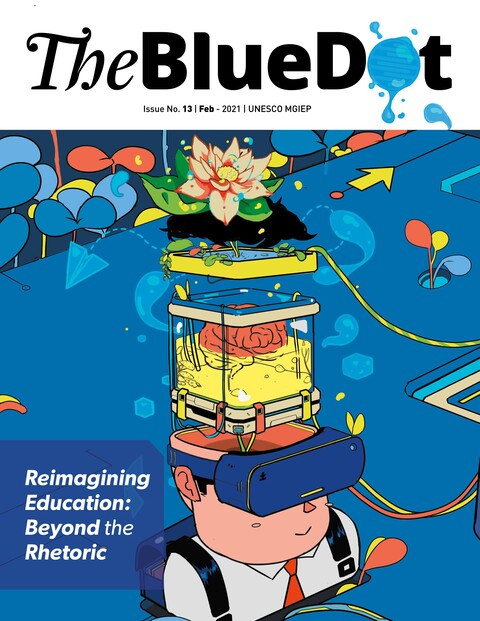 Reimagining Education: Beyond the Rhetoric (The Blue Dot; No.13, 2021) سنة النشر: 2021 المؤلف المؤسسي: Mahatma Gandhi Institute of Education for Peace and Sustainable Development (MGIEP) The events of the year 2020, driven predominantly by the COVID-19 pandemic, have forced governments, policymakers, educators and organisations to rethink the purpose, structure and modality of existing education systems. Even while the world is struggling with climate change, decreased empathy, violent extremism, xenophobia and an increase in mental health issues in children, with a recent report by WHO highlighting that 800,000 people between the ages of 15-29 are dying by suicide ever year, globally1 , the COVID-19 virus singlehandedly shut down access to face-to-face school education for roughly half of the world’s student population. These ongoing and unexpected challenges bring to light the urgent need for education systems to be more adaptable, responsive, and resilient to future shocks and disasters. We can work to transform education in many ways, such as by translating our understanding of how the brain learns from the research laboratory to the classroom and leveraging the power of technology to ensure that learning can reach every child who hungers to learn. It is time we reimagine education to ensure learning continues with minimal disruption but also empowers students as compassionate human beings, prepared for an unpredictable future, but also as global citizens seeking a peaceful and kinder world. The purpose of education needs to change from being instrumental (based on human capital) to one that is constitutive (human-flourishing), accessible to all and structured such that learning can happen anytime and anywhere and always.