
الموارد
استكشف مجموعة واسعة من الموارد القيمة حول تعليم المواطنة العالمية لتعميق فهمك وتعزيز البحث والمناصرة والتعليم والتعلم.
تم العثور على 1,322 نتيجة
 Pack européen pour la visite du Mémorial et du Musée d'Auschwitz-Birkenau - Pistes pédagogiques pour enseignants et éducateurs (2012) سنة النشر: 2011 المؤلف المؤسسي: Conseil de l'Europe | Auschwitz-Birkenau Memorial and Museum | Poland. Ministry of Education Taking groups of students to the Auschwitz-Birkenau Memorial and Museum is a heavy responsibility, but it is a major contribution to citizenship if it fosters understanding of what Auschwitz stands for, particularly when the last survivors are at the end of their lives. This pack is designed for teachers wishing to organize student visits to authentic places of remembrance, and for the guides, academics and others who work every day with young people at Auschwitz. To avoid the risk of inappropriate reactions or the failure to benefit from a large investment in travel and accommodation, considerable preparation and discussion is necessary before the visit and serious reflection afterwards. This pack offers insights into the complexities of human behaviour so that students can have a better understanding of what it means to be a citizen. The young people who visit Auschwitz in the next few years will be witnesses of the last witnesses. Their generation will be the last to hear the survivors speaking on the spot. The Council of Europe, the Polish Ministry of Education and the Auschwitz-Birkenau Memorial and Museum are jointly sponsoring this project aimed at preventing crimes against humanity through Holocaust remembrance teaching. (By the Council of Europe)
  Digital Citizenship Education Project (DCE): 10 Domains سنة النشر: 2018 المؤلف المؤسسي: Council of Europe The aim of the DCE project launched by the Council of Europe’s Education Policy Division is to empower children to participate actively in digital society. This involves providing them with an education that develops a sense of critical analysis and the effective use of digital technologies while fostering a notion of citizenship based on respect for human rights and democratic culture. Éducation à la citoyenneté numérique (ECN): Les 10 thématiques سنة النشر: 2018 المؤلف المؤسسي: Conseil de l'Europe Le projet ECN de la Division des Politiques Educatives du Conseil de l’Europe a pour objectif de permettre aux enfants de participer activement et de manière autonome à la société numérique. Ceci passe par une éducation qui développe un sens d’analyse critique et l’utilisation efficace des technologies numériques intégrant une notion de citoyenneté fondée sur le respect des droits de l’homme et la culture démocratique.
  Digital Citizenship... and Your Child What Every Parent Needs to Know and Do سنة النشر: 2019 المؤلف المؤسسي: Council of Europe The Council of Europe has created this guide to help you: better understand digital citizenship, and how it shapes online behaviour discuss digital citizenship with your children take steps to help your children master the competences digital citizenship is built on encourage your children’s school to play its role in educating competent young digital citizens. La citoyenneté numérique... et votre enfant: Ce que tout parent a besoin de savoir et de faire سنة النشر: 2019 المؤلف المؤسسي: Conseil de l'Europe Le Conseil de l’Europe a préparé le présent guide pour vous aider : à mieux comprendre la citoyenneté numérique et ses effets sur les comportements en ligne; à parler de la citoyenneté numérique avec vos enfants; à agir pour aider vos enfants à maîtriser les compétences indispensables à la citoyenneté numérique; à encourager les établissements scolaires de vos enfants à s’associer avec compétence à l’éducation à la citoyenneté numérique.
  Bookmarks: A Manual for Combating Hate Speech Online Through Human Rights Education سنة النشر: 2020 المؤلف: Ellie Keen | Mara Georgescu المؤلف المؤسسي: Council of Europe The work of the Council of Europe for democracy is strongly based on education: education in schools, and education as a lifelong learning process of practising democracy, such as in non-formal learning activities. Human rights education and education for democratic citizenship form an integral part of what we have to secure to make democracy sustainable. Hate speech is one of the most worrying forms of racism and discrimination prevailing across Europe and amplified by the Internet and social media.Hate speech online is the visible tip of the iceberg of intolerance and ethnocentrism. Young people are directly concerned as agents and victims of online abuse of human rights; Europe needs young people to care and look after human rights, the life insurance for democracy.Bookmarks was originally published to support the No Hate Speech Movement youth campaign of the Council of Europe for human rights online. Bookmarks is useful for educators wanting to address hate speech online from a human rights perspective, both inside and outside the formal education system. The manual is designed for working with learners aged 13 to 18 but the activities can be adapted to other age ranges.This edition of Bookmarks reflects the end of the coordination of the youth campaign by the Council Europe. The campaign may be officially over, but the education and awarenessraising to counter hate speech and promote human rights values remain an urgent task for young people of all ages. Connexions: Manuel pour la lutte contre le discours de haine en ligne par l’éducation aux droits humains سنة النشر: 2020 المؤلف: Ellie Keen | Mara Georgescu المؤلف المؤسسي: Conseil de l'Europe L’action du Conseil de l’Europe en faveur de la démocratie est fortement axée sur l’éducation : l’éducation à l’école, mais aussi l’éducation en tant que pratique de la démocratie tout au long de la vie, comme dans le cadre des activités d’apprentissage non formel. L’éducation aux droits humains et l’éducation à la citoyenneté démocratique font partie intégrante du socle que nous devons bâtir pour faire de la démocratie une réalité durable.Le discours de haine est l’une des formes les plus inquiétantes de racisme et de discrimination qui sévit aujourd’hui en Europe, amplifiée par Internet et par les médias sociaux. Le discours de haine en ligne n’est que la partie visible de l’iceberg de l’intolérance et de l’ethnocentrisme. Les jeunes sont directement concernés, en tant qu’acteurs et victimes d’atteintes aux droits humains en ligne. L’Europe a besoin que les jeunes veillent aux droits de l’homme et les protègent : c’est là l’assurance-vie de la démocratie.Connexions a été créé dans le cadre du Mouvement contre le discours de haine, autrement dit, la campagne de la jeunesse du Conseil de l’Europe pour les droits humains en ligne. C’est un outil précieux pour les éducateurs qui souhaitent aborder le discours de haine en ligne sous l’angle des droits de l’homme, tant dans le système éducatif formel que dans le cadre de l’éducation informelle. Ce manuel a été conçu pour travailler avec des apprenants de 13 à 18 ans, mais les activités proposées peuvent être adaptées à d’autres groupes d’âge.Cette édition de Connexions a été révisée après que le Conseil de l’Europe a mis fin à la coordination de la campagne de jeunesse liée au Mouvement contre le discours de haine. Bien que la campagne ait pris officiellement fin, il importe de poursuivre l’éducation et la sensibilisation des jeunes pour combattre le discours de haine et promouvoir les valeurs liées aux droits humains.
  T-KIT 4: Intercultural Learning سنة النشر: 2018 المؤلف: Oana Nestian Sandu | Nadine Lyamouri-Bajja المؤلف المؤسسي: Council of Europe | European Commission Intercultural learning is an important topic for the priorities of both the European Commission and the Council of Europe, and of their partnership in the field of youth.Intercultural learning is an educational approach that can lead to social transformation, so that people from different cultural backgrounds can develop positive relations based on the values and principles of human rights and on seeing cultural differences as positive things. It is a form of political and social education that needs to pay attention not only to intercultural relations, but also to different understandings of culture and diversity, power relations, distribution of resources, political and social context, human rights, discrimination, history and daily interactions among different groups.This T-Kit was developed for the context of youth work and non-formal education with young people, both of which support the personal development, social integration and active citizenship of young people. Educators and youth workers have an important role in addressing intercultural learning in their work with young people. They can stimulate young people’s learning in their daily lives, so that they can question and extend their perception, develop competences to interact positively with people from different cultural backgrounds and embrace the values of diversity, equality and dignity. In today’s Europe, these values and skills are fundamental for young people and for society as a whole in order to continue building peace and mutual understanding.
 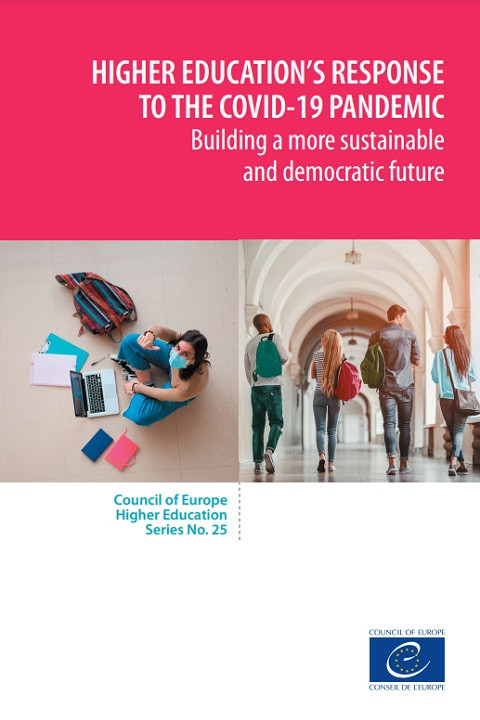 Higher Education's Response to the COVID-19 Pandemic: Building a More Sustainable and Democratic Future (Council of Europe Higher Education Series; No. 25) سنة النشر: 2021 المؤلف: Sjur Bergan | Tony Gallagher | Ira Harkavy | Ronaldo Munck | Hilligje van’t Land المؤلف المؤسسي: Council of Europe Public health was the immediate concern when the Covid-19 pandemic struck in Asia, then in Europe and other parts of the world. The response of our education systems is no less vital. Higher education has played a major role in responding to the pandemic and it must help shape a better, more equitable and just post-Covid-19 world. This book explores the various responses of higher education to the pandemic across Europe and North America, with contributions also from Africa, Asia and South America.The book describes the various ways in which higher education is facing the Covid-19 pandemic. It is designed to help universities, specifically their staff and students as well as their partners, contribute to a more sustainable and democratic future.
 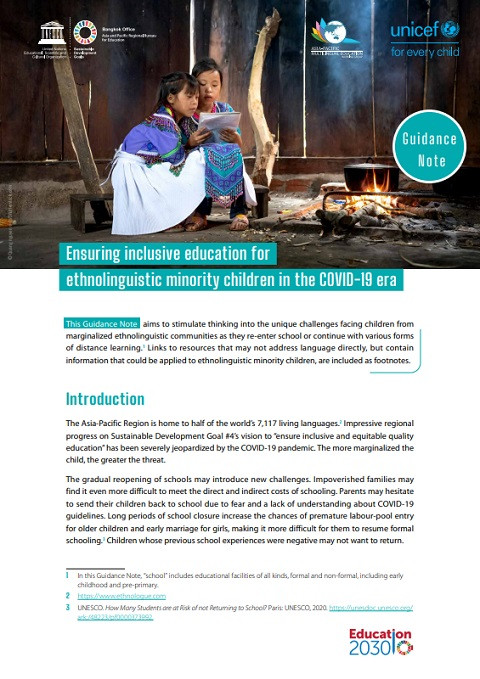 Ensuring Inclusive Education for Ethnolinguistic Minority Children in the COVID-19 Era: Guidance Note سنة النشر: 2021 المؤلف المؤسسي: UNESCO Bangkok This Guidance Note aims to stimulate thinking into the unique challenges facing children from marginalized ethnolinguistic communities as they re-enter school or continue with various forms of distance learning. Links to resources that may not address language directly, but contain information that could be applied to ethnolinguistic minority children, are included as footnotes.