
الموارد
استكشف مجموعة واسعة من الموارد القيمة حول تعليم المواطنة العالمية لتعميق فهمك وتعزيز البحث والمناصرة والتعليم والتعلم.
تم العثور على 2,781 نتيجة
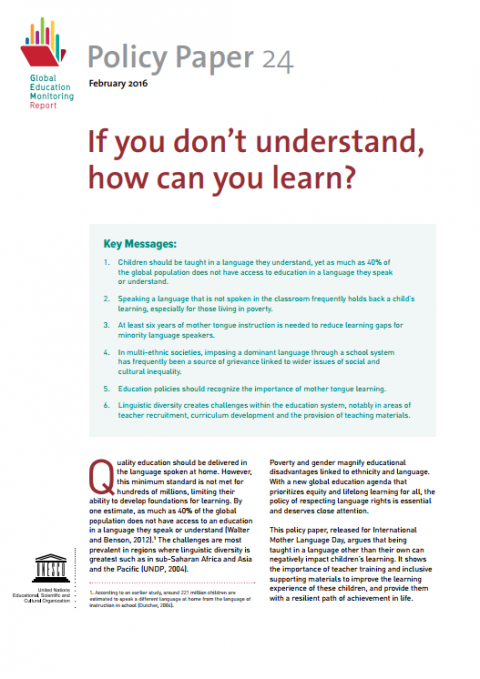 If you don't understand, how can you learn? سنة النشر: 2016 المؤلف المؤسسي: UNESCO Key Messages:1. Children should be taught in a language they understand, yet as much as 40% of the global population does not have access to education in a language they speak or understand.2. Speaking a language that is not spoken in the classroom frequently holds back a child’s learning, especially for those living in poverty.3. At least six years of mother tongue instruction is needed to reduce learning gaps for minority language speakers.4. In multi-ethnic societies, imposing a dominant language through a school system has frequently been a source of grievance linked to wider issues of social and cultural inequality.5. Education policies should recognize the importance of mother tongue learning. 6. Linguistic diversity creates challenges within the education system, notably in areas of teacher recruitment, curriculum development and the provision of teaching materials. Comment apprendre, quand on ne comprend pas? سنة النشر: 2016 المؤلف المؤسسي: Organisation des Nations Unies pour l'éducation, la science et la culture (UNESCO) Key Messages:1. Children should be taught in a language they understand, yet as much as 40% of the global population does not have access to education in a language they speak or understand.2. Speaking a language that is not spoken in the classroom frequently holds back a child’s learning, especially for those living in poverty.3. At least six years of mother tongue instruction is needed to reduce learning gaps for minority language speakers.4. In multi-ethnic societies, imposing a dominant language through a school system has frequently been a source of grievance linked to wider issues of social and cultural inequality.5. Education policies should recognize the importance of mother tongue learning. 6. Linguistic diversity creates challenges within the education system, notably in areas of teacher recruitment, curriculum development and the provision of teaching materials. Si no entiendes, ¿cómo puedes aprender? سنة النشر: 2016 المؤلف المؤسسي: Organización de las Naciones Unidas para la Educación, la Ciencia y la Cultura (UNESCO) Key Messages:1. Children should be taught in a language they understand, yet as much as 40% of the global population does not have access to education in a language they speak or understand.2. Speaking a language that is not spoken in the classroom frequently holds back a child’s learning, especially for those living in poverty.3. At least six years of mother tongue instruction is needed to reduce learning gaps for minority language speakers.4. In multi-ethnic societies, imposing a dominant language through a school system has frequently been a source of grievance linked to wider issues of social and cultural inequality.5. Education policies should recognize the importance of mother tongue learning. 6. Linguistic diversity creates challenges within the education system, notably in areas of teacher recruitment, curriculum development and the provision of teaching materials. Как вы можете учиться, если вы не понимаете? سنة النشر: 2016 المؤلف المؤسسي: Организация Объединенных Наций по вопросам образования, науки и культуры (UNESCO) Key Messages:1. Children should be taught in a language they understand, yet as much as 40% of the global population does not have access to education in a language they speak or understand.2. Speaking a language that is not spoken in the classroom frequently holds back a child’s learning, especially for those living in poverty.3. At least six years of mother tongue instruction is needed to reduce learning gaps for minority language speakers.4. In multi-ethnic societies, imposing a dominant language through a school system has frequently been a source of grievance linked to wider issues of social and cultural inequality.5. Education policies should recognize the importance of mother tongue learning. 6. Linguistic diversity creates challenges within the education system, notably in areas of teacher recruitment, curriculum development and the provision of teaching materials.
  L'éducation aux droits de l'homme dans les systèmes scolaires d'Europe, d'Asie centrale et en Amérique du Nord: un recueil de bonnes pratiques سنة النشر: 2009 المؤلف المؤسسي: Conseil de l'Europe | Organisation des Nations Unies pour l'éducation, la science et la culture (UNESCO) | UN. Office of the United Nations High Commissioner for Human Rights (UN. OHCHR) | OSCE. Office for Democratic Institutions and Human Rights (ODIHR) “L'Éducation aux Droits de l'Homme dans les systèmes scolaires de l'Europe, l'Asie centrale et en Amérique du Nord: Un Recueil de Bonnes Pratiques" est une compilation de 101 exemples de bonnes pratiques dans l'éducation aux droits de l'homme dans les écoles primaires, les écoles secondaires et les établissements de formation des enseignants de l'Organisation pour Sécurité et la Coopération dans la zone Europe (OSCE), qui est également couvert par l'Organisation des Nations Unies pour l'éducation, la science et la culture (UNESCO), le Bureau du Haut Commissariat des Nations Unies aux Droits de l'Homme (HCDH) et, en partie, la situation géographique mandat du Conseil de l'Europe (CoE). Le terme «éducation aux droits de l'homme» est souvent utilisé dans cette ressource dans un sens plus large, pour inclure également l'éducation à la citoyenneté démocratique et l'éducation pour le respect et la compréhension mutuelle, qui sont toutes basées sur les normes des droits humains internationalement convenus. Ces trois domaines sont considérés comme interconnectés et essentiel dans les systèmes éducatifs afin de préparer les jeunes à être des participants actifs, responsables et dans leur communautés, ainsi qu'aux niveaux national et mondial. L'éducation aux droits de l'homme a été défini comme l'éducation, la formation et de l'information visant à la construction d'une culture universelle des droits de l'homme. Une formation approfondie dans les droits de l'homme fournit non seulement des connaissances sur les droits humains et les mécanismes qui les protègent, mais confère également les compétences nécessaires pour promouvoir, défendre et appliquer les droits de l'homme dans la vie quotidienne. L'éducation à la citoyenneté démocratique met l'aCECnt sur les pratiques et les activités visant à aider les jeunes et les adultes à jouer un rôle actif dans la vie démocratique et à exercer leurs droits et responsabilités dans la société de l'éducation. L'éducation pour le respect et la compréhension mutuelle met en évidence le respect de soi, respect des autres, et l'amélioration des relations entre les gens de différentes traditions culturelles. Ce livre vise à soutenir l'enseignement de qualité dans ces domaines et d'inspirer les décideurs éducatifs (ceux qui travaillent dans les ministères de l'éducation et les conseils scolaires locaux) et les administrateurs, les enseignants, les formateurs d'enseignants, les éducateurs non formels et tous les autres acteurs intéressés, ainsi que pour faciliter la mise en réseau et l'échange d'expériences entre les professionnels de l'éducation.
  Education 2030: Incheon Declaration and Framework for Action for the Implementation of Sustainable Development Goal 4: Ensure Inclusive and Equitable Quality Education and Promote Lifelong Learning Opportunities for All سنة النشر: 2016 المؤلف المؤسسي: UNESCO The Incheon Declaration articulates the collective vision and commitment of the international community on global education. The 2030 Framework for Action provides guidance for the implementation of Sustainable Development Goal 4. Education 2030: Déclaration d'Incheon et Cadre d'action pour la mise en oeuvre de l'Objectif de développement durable 4: Assurer à tous une éducation équitable, inclusive et de qualité et des possibilités d'apprentissage tout au long de la vie سنة النشر: 2016 المؤلف المؤسسي: Organisation des Nations Unies pour l'éducation, la science et la culture (UNESCO) La Déclaration d’Incheon présente la vision collective et l’engagement de la communauté internationale envers l’éducation mondiale. Le Cadre d’action 2030 fournit des directives pour l’attente de l’Objectif de développement durable 4. Educación 2030: Declaración de Incheon y Marco de Acción para la realización del Objetivo de Desarrollo Sostenible 4: Garantizar une aducación inclusiva y equitativa de calidad y promover oportunidades de aprendizaje permanente para todos سنة النشر: 2016 المؤلف المؤسسي: Organización de las Naciones Unidas para la Educación, la Ciencia y la Cultura (UNESCO) The Incheon Declaration articulates the collective vision and commitment of the international community on global education. The 2030 Framework for Action provides guidance for the implementation of Sustainable Development Goal 4. 2030年教育:仁川宣言和行动框架实现可持续发展目标4——确保包容和公平的优质教育,让全民终身享有学习机会 سنة النشر: 2016 المؤلف المؤسسي: 联合国教科文组织 (UNESCO) 《仁川宣言》阐明了国际社会在全球教育方面的集体愿景和承诺。“2030年行动框架”为可持续发展目标4的实施提供了指导。
  Collection des meilleures pratiques en éducation pour une citoyenneté mondiale en Afrique centrale سنة النشر: 2015 المؤلف المؤسسي: UNESCO This collection of best practices in human rights education in Central Africa and Ethiopia was prepared in order to respond to UNESCO’s demand to promote such initiatives and to ensure a multiplier effect considering human rights education in the region. The objective is to support the concept of UNESCO’s ‘Global Citizenship Education’ in the field of human rights education in identifying its best practices. In order to identify the best practices, UNESCO’s activities in the field of human rights education in the region were mapped out. This mapping out has shown big differences in implementing the initiatives focused on achieving global citizenship education through human rights education, particularly in primary and secondary education, as indicated in the first phase of the World Programme for human rights education. Nevertheless, various initiatives collected are either conducted/supported by UNESCO or not, in terms of three themes: citizenship education, intercultural dialogue, and the peace and security which are considered to be relevant to Africa in general and particularly to Central Africa, in order to address the main theme of global citizenship education. The selected best practices deal with the tertiary level and are in line with the second phase of the World Programme for human rights education, covering the period between 2009 and 2014 and focusing on higher and vocational education. The practices include 1) citizenship education which supports the principles set out in the Universal Declaration of Human Rights and which is reiterated in the two phases of the World Programme for human rights education, 2) the intercultural dialogue which supports education for understanding and evaluating unity in diversity, and which fits well with the objectives of the UN Decade of Education for Sustainable Development proclaimed by the UN General Assembly and managed by UNESCO, and 3) education for peace and security.It is obvious that many linkages exist among the three subjects mentioned above. Therefore, the examples presented in this collection can affect one or several problems. Each example is presented with the following sequence: identification, background, implementation, and results.