
الموارد
استكشف مجموعة واسعة من الموارد القيمة حول تعليم المواطنة العالمية لتعميق فهمك وتعزيز البحث والمناصرة والتعليم والتعلم.
تم العثور على 3,433 نتيجة
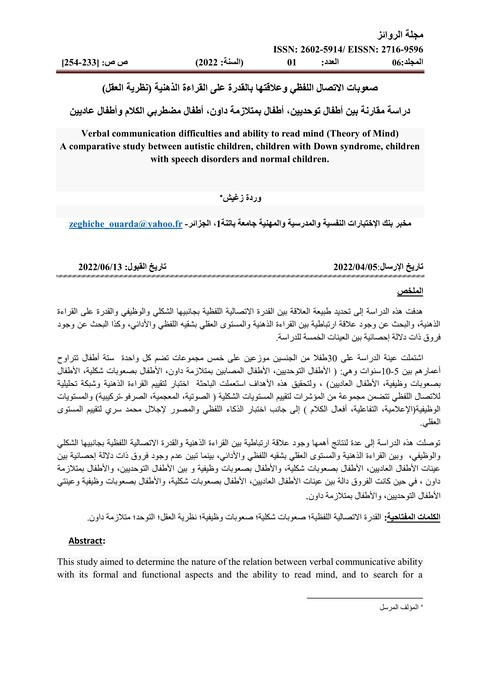 صعوبات الاتصال اللفظي وعلاقتها بالقدرة على القراءة الذهنية (نظرية العقل): دراسة مقارنة بين أطفال توحديين، أطفال بمتلازمة داون، أطفال مضطربي الكلام وأطفال عاديين (مجلة الروائز; Vol.6, No.1) سنة النشر: 2022 المؤلف: Zaghish Warda المؤلف المؤسسي: Batna 1 University هدفت هذه الدراسة إلى تحديد طبيعة العلاقة بين القدرة الاتصالية اللفظية بجانبيها الشكلي والوظيفي والقدرة على القراءة الذهنية، والبحث عن وجود علاقة ارتباطية بين القراءة الذهنية والمستوى العقلي بشقيه اللفظي والأدائي، وكذا البحث عن وجود فروق ذات دلالة إحصائية بين العينات الخمسة للدراسة.اشتملت عينة الدراسة على 30طفلا من الجنسين موزعين على خمس مجموعات تضم كل واحدة ستة أطفال تتراوح أعمارهم بين 5-10سنوات وهي: ( الأطفال التوحديين، الأطفال المصابين بمتلازمة داون، الأطفال بصعوبات شكلية، الأطفال بصعوبات وظيفية، الأطفال العاديين) ، ولتحقيق هذه الأهداف استعملت الباحثة اختبار لتقييم القراءة الذهنية وشبكة تحليلية للاتصال اللفظي تتضمن مجموعة من المؤشرات لتقييم المستويات الشكلية ( الصوتية، المعجمية، الصرفو-تركيبية) والمستويات الوظيفية(الإعلامية، التفاعلية، أفعال الكلام ) إلى جانب اختبار الذكاء اللفظي والمصور لإجلال محمد سري لتقييم المستوى العقلي.توصلت هذه الدراسة إلى عدة لنتائج أهمها وجود علاقة ارتباطية بين القراءة الذهنية والقدرة الاتصالية اللفظية بجانبيها الشكلي والوظيفي، وبين القراءة الذهنية والمستوى العقلي بشقيه اللفظي والأدائي، بينما تبين عدم وجود فروق ذات دلالة إحصائية بين عينات الأطفال العاديين، الأطفال بصعوبات شكلية، والأطفال بصعوبات وظيفية و بين الأطفال التوحديين، والأطفال بمتلازمة داون ، في حين كانت الفروق دالة بين عينات الأطفال العاديين، الأطفال بصعوبات شكلية، والأطفال بصعوبات وظيفية.
  A Theory of Justice (Arabic Edition) سنة النشر: 2011 المؤلف: John Rawls المؤلف المؤسسي: Syria. Ministry of Culture This is a book translated by Laila Al Taweel for the American author John Rawls, in which he reviewed justice by examining the institutions and laws that govern it. John asserts that justice is a major component of this universe and cannot be ignored in any way, or even surpassed even in the interests of society's well-being. This translated book is a reference in the Arab world for understanding justice. نظرية في العدالة سنة النشر: 2011 المؤلف: John Rawls المؤلف المؤسسي: Syria. Ministry of Culture هذا كتاب مترجم للامريكي جون رولز، والذي استعرض فيه العدالة من خلال تطرقه للمؤسسات والقوانين التي تحكمها. يؤكد جون أن العدالة مكون رئيسي من هذا الكون ولا يمكن تجاهلها بأي حال، أو تجاوزها حتى لصالح رفاهية المجتمع. يمثل هذا الكتاب المترجم مرجعا في الوطن العربي لفهم العدالة.
  Justice in Matters Involving Children in Conflict with the Law: Model Law on Juvenile Justice and Related Commentary سنة النشر: 2013 المؤلف المؤسسي: UN. Office on Drugs and Crime (UNODC) This Model Law and the related Commentary are designed to provide legal guidance to States in the process of juvenile justice reform and assist them in drafting juvenile justice legislation. It translates compelling international juvenile justice standards and norms into a national context and aims at harmonizing national legislation with international requirements. International standards and norms in the area of juvenile justice are detailed. Правосудие: Вопросы, Касающиеся Детей, Находящихся в Конфликте с Законом سنة النشر: 2013 المؤلف المؤسسي: UN. Office on Drugs and Crime (UNODC) Данный Типовой Закон и соответствующие комментарии являются руководством для проведения реформы правосудия по делам несовершеннолетних в различных странах и призван помочь в создании законодательства по делам несовершеннолетних. Данный Типовой Закон объединяет международные нормы и стандарты законодательства по делам несовершеннолетних, которые необходимо привести в соответствие с национальным законодательством с тем, чтобы гармонизировать национальное и международное законодательства. Данная работа детально описывает международные стандарты и нормы законодательства по делам несовершеннолетних.
  Peace education: framework for teacher education, 2005 سنة النشر: 2005 المؤلف المؤسسي: UNESCO New Delhi UNESCO has taken a commendable initiative in promoting peace education. It has generated some important literature and educational material on peace education. ‘Learning the Way of Peace: A Teacher’s Guide to Peace Education’ is a pioneering work. It is because of UNESCO’s initiative that this material on peace education for teacher education has been developed. It would be useful to read this document in conjunction with “Learning the Way of Peace.” Éducation à la Paix: cadre pour la formation des enseignants 2005 سنة النشر: 2005 المؤلف المؤسسي: UNESCO New Delhi L'UNESCO a pris une initiative louable dans la promotion de l'éducation de la paix. Il a généré une certaine littérature importante et du matériel éducatif sur l'éducation de la paix. «Apprendre la Voie de la Paix: Guide de l'Enseignant à l'Éducation de la Paix» est un travail de pionnier. Il est à cause de l'initiative de l'UNESCO que ce matériel sur l'éducation de la paix pour la formation des enseignants a été mis au point. Il serait utile de lire ce document en collaboration avec «Apprendre le Chemin de la Paix. »
 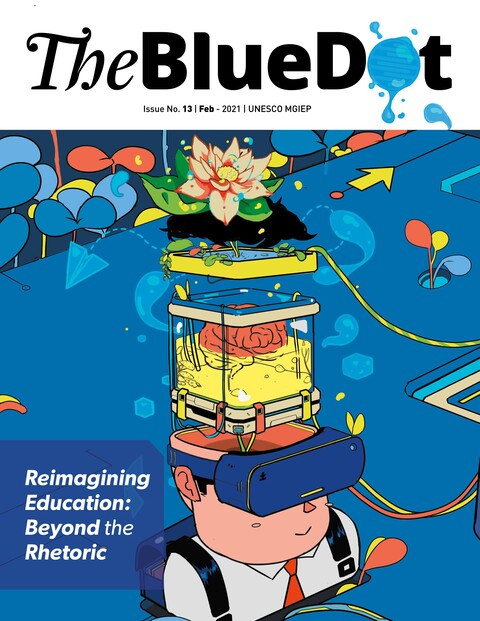 Reimagining Education: Beyond the Rhetoric (The Blue Dot; No.13, 2021) سنة النشر: 2021 المؤلف المؤسسي: Mahatma Gandhi Institute of Education for Peace and Sustainable Development (MGIEP) The events of the year 2020, driven predominantly by the COVID-19 pandemic, have forced governments, policymakers, educators and organisations to rethink the purpose, structure and modality of existing education systems. Even while the world is struggling with climate change, decreased empathy, violent extremism, xenophobia and an increase in mental health issues in children, with a recent report by WHO highlighting that 800,000 people between the ages of 15-29 are dying by suicide ever year, globally1 , the COVID-19 virus singlehandedly shut down access to face-to-face school education for roughly half of the world’s student population. These ongoing and unexpected challenges bring to light the urgent need for education systems to be more adaptable, responsive, and resilient to future shocks and disasters. We can work to transform education in many ways, such as by translating our understanding of how the brain learns from the research laboratory to the classroom and leveraging the power of technology to ensure that learning can reach every child who hungers to learn. It is time we reimagine education to ensure learning continues with minimal disruption but also empowers students as compassionate human beings, prepared for an unpredictable future, but also as global citizens seeking a peaceful and kinder world. The purpose of education needs to change from being instrumental (based on human capital) to one that is constitutive (human-flourishing), accessible to all and structured such that learning can happen anytime and anywhere and always.
  Education for conflict prevention and peacebuilding: meeting the global challenges of the 21st century سنة النشر: 2012 المؤلف: Phyllis Kotite المؤلف المؤسسي: UNESCO International Institute for Educational Planning (IIEP) The 21st century is witnessing global concern over the interrelated effects of climate change, the economic crisis, energy depletion, food and water shortages, natural disasters and conflicts all of which have devastating effects on humanity and the future of the planet. These events impact education systems and can impair the ability of governments to provide quality education for their citizens. However, when governments and ministries of education analyse and anticipate the risk of such events through careful planning, education can play an important role in preventing violent conflict, and in supporting peacebuilding efforts. An estimated 1.5 billion people live in countries affected by repeated cycles of political and other forms of violence, and the same population is often affected by hunger and poverty. Furthermore, such countries have difficulty meeting development goals. For example, no low-income fragile or conflict-affected country has yet achieved a single MDG (World Bank, 2011). In 2010 world military expenditures reached US$1.6 trillion as a result of fifteen ongoing conflicts (SIPRI, 2011). Yet, it is estimated that only US$16 billion is needed to fill the education gap to reach the EFA goals (UNESCO, 2011b: 11). This paper argues that we have the knowledge, legal instruments and mechanisms to prevent conflict and to transfer resources to sustainable development and education to meet the challenges of the 21st century. The paper describes a range of conflict prevention initiatives and examines the role of policy-makers, youth, women, and the media in maintaining and restoring peace as part of a holistic vision of education. International institutions, governments and civil society are increasingly developing conflict prevention mechanisms and utilizing political and economic incentives to avoid conflicts. They are also creating new technology for sustainable development, adaptation to climate change and renewable forms of energy. Educational planning must therefore go beyond traditional mechanisms. It must take into consideration the unpredictable nature of our times; be flexible and rapid in implementation and responsive to local needs. Training and research in sustainable development; and skills for peaceful inter-human relations, good governance, the prevention of conflict and peacebuilding are priorities elaborated in the paper. In addition, specific recommendations are highlighted such as: capacity development for conflict prevention within the education sector and other ministries, analysing the root causes of conflict and the role that education can play in mitigating tensions. This paper is an elaboration of Chapter 1.2 of the IIEP-UNESCO Guidebook for Planning Education in Emergencies and Reconstruction (IIEP-UNESCO, 2010). A brief treatment of additional global challenges (e.g. water scarcity, food insufficiency, energy depletion and economic instability), which are beyond the educational focus of this paper, may be found in Annex I. Education for conflict prevention and peacebuilding: meeting the global challenges of the 21st century سنة النشر: 2012 المؤلف: Phyllis Kotite المؤلف المؤسسي: UNESCO International Institute for Educational Planning (IIEP) Le 21ème siècle est témoin de préoccupation mondiale sur les effets interdépendants du changement climatique, la crise économique, l'épuisement de l'énergie, la pénurie de nourriture et d'eau, les catastrophes naturelles et les conflits qui ont tous des effets dévastateurs sur l'humanité et l'avenir de la planète. Ces événements influent sur les systèmes d'éducation et peuvent nuire à la capacité des gouvernements à fournir une éducation de qualité pour leurs citoyens. Toutefois, lorsque les gouvernements et les ministères de l'éducation analysent et anticipent le risque de ces événements à travers une planification minutieuse, l'éducation peut jouer un rôle important dans la prévention des conflits violents, et à soutenir les efforts de consolidation de la paix. On estime que 1,5 milliard de personnes vivent dans des pays touchés par des cycles répétés de formes politiques et autres de la violence, et la même population est souvent affectée par la faim et la pauvreté. En outre, ces pays ont des difficultés à atteindre les objectifs de développement. Par exemple, aucun pays à faible revenu fragiles ou touchés par un conflit n'a encore atteint un seul OMD (Banque mondiale, 2011). En 2010 dépenses militaires mondiales ont atteint US $ 1,6 trillions en raison de quinze conflits en cours (SIPRI, 2011). Pourtant, on estime que seulement 16 milliards $ US est nécessaire pour combler le déficit de l'éducation pour atteindre les objectifs de l'EPT (UNESCO, 2011b: 11). Ce document fait valoir que nous avons les connaissances, les instruments juridiques et des mécanismes de prévention des conflits et de transférer des ressources pour le développement durable et l'éducation pour relever les défis du 21e siècle. Le document décrit une série d'initiatives de prévention des conflits et examine le rôle des décideurs politiques, les jeunes, les femmes et les médias dans le maintien et le rétablissement de la paix dans le cadre d'une vision holistique de l'éducation. Les institutions internationales, les gouvernements et la société civile sont de plus en plus de développer des mécanismes de prévention des conflits et de l'utilisation des incitations politiques et économiques pour éviter les conflits. Ils créent également une nouvelle technologie pour le développement durable, l'adaptation aux changements climatiques et les énergies renouvelables. Planification de l'éducation doit donc aller au-delà des mécanismes traditionnels. Il doit prendre en considération la nature imprévisible de notre temps; être flexible et rapide et répondre aux besoins locaux. Formation et recherche dans le développement durable; et les compétences pour les relations inter-humaines pacifiques, la bonne gouvernance, la prévention des conflits et de consolidation de la paix sont des priorités élaborées dans le document. En outre, des recommandations spécifiques sont mis en évidence, tels que: le renforcement des capacités de prévention des conflits dans le secteur de l'éducation et d'autres ministères, l'analyse des causes profondes des conflits et le rôle que l'éducation peut jouer pour atténuer les tensions. Ce document est une élaboration du Chapitre 1.2 du Guide de l'IIPE-UNESCO pour l'Éducation de la Planification en situation d'Urgence et de Reconstruction (IIPE-UNESCO, 2010).