
الموارد
استكشف مجموعة واسعة من الموارد القيمة حول تعليم المواطنة العالمية لتعميق فهمك وتعزيز البحث والمناصرة والتعليم والتعلم.
تم العثور على 2,668 نتيجة
 Informe de síntesis sobre la aplicación por los Estados Miembros de la Recomendación de 1974 sobre la Educación para la Comprensión, la Cooperación y la Paz Internacionales y la Educación relativa a los Derechos Humanos y las Libertades Fundamentales سنة النشر: 2013 المؤلف المؤسسي: Organización de las Naciones Unidas para la Educación, la Ciencia y la Cultura (UNESCO) Background: In accordance with 34 C/Resolution 87, 177 EX/Decision 35 (I) and 184 EX/Decision 20, the Executive Board has monitored the implementation of the 1974 Recommendation concerning Education for International Understanding, Cooperation and Peace and Education relating to Human Rights and Fundamental Freedoms. Pursuant to 192 EX/Decision 20 (III), the Director-General hereby submits the consolidated report on the implementation by Member States of the Recommendation.Purpose: This document reports on the results of the Fifth Consultation on the Implementation of the Recommendation concerning Education for International Understanding, Cooperation and Peace and Education relating to Human Rights and Fundamental Freedoms (covering the period 2009-2012). The analysis was prepared on the basis of 55 national reports from Member States received by the Secretariat. Сводный доклад о выполнении Рекомендации 1974 г. о воспитании в духе международного взаимопонимания, сотрудничества и мира и о воспитании в духе уважения прав человека и основных свобод سنة النشر: 2013 المؤلف المؤسسي: Организация Объединенных Наций по вопросам образования, науки и культуры (UNESCO) Background: In accordance with 34 C/Resolution 87, 177 EX/Decision 35 (I) and 184 EX/Decision 20, the Executive Board has monitored the implementation of the 1974 Recommendation concerning Education for International Understanding, Cooperation and Peace and Education relating to Human Rights and Fundamental Freedoms. Pursuant to 192 EX/Decision 20 (III), the Director-General hereby submits the consolidated report on the implementation by Member States of the Recommendation.Purpose: This document reports on the results of the Fifth Consultation on the Implementation of the Recommendation concerning Education for International Understanding, Cooperation and Peace and Education relating to Human Rights and Fundamental Freedoms (covering the period 2009-2012). The analysis was prepared on the basis of 55 national reports from Member States received by the Secretariat. التقرير الجامع عن تنفيذ توصية عام ١٩٧٤ بشأن التربية من أجل التفاهم والتعاون والسلام على الصعيد الدولي والتربية في مجال حقوق الإنسان وحرياته الأساسية سنة النشر: 2013 المؤلف المؤسسي: منظمة الأمم المتحدة للتربية والعلم والثقافة (UNESCO) Background: In accordance with 34 C/Resolution 87, 177 EX/Decision 35 (I) and 184 EX/Decision 20, the Executive Board has monitored the implementation of the 1974 Recommendation concerning Education for International Understanding, Cooperation and Peace and Education relating to Human Rights and Fundamental Freedoms. Pursuant to 192 EX/Decision 20 (III), the Director-General hereby submits the consolidated report on the implementation by Member States of the Recommendation.Purpose: This document reports on the results of the Fifth Consultation on the Implementation of the Recommendation concerning Education for International Understanding, Cooperation and Peace and Education relating to Human Rights and Fundamental Freedoms (covering the period 2009-2012). The analysis was prepared on the basis of 55 national reports from Member States received by the Secretariat. 关于1974年《关于促进国际了解、合作与和平的教育以及关于人权与基本自由的教育的建议书》执行情况的综合报告 سنة النشر: 2013 المؤلف المؤسسي: 联合国教科文组织 (UNESCO) Background: In accordance with 34 C/Resolution 87, 177 EX/Decision 35 (I) and 184 EX/Decision 20, the Executive Board has monitored the implementation of the 1974 Recommendation concerning Education for International Understanding, Cooperation and Peace and Education relating to Human Rights and Fundamental Freedoms. Pursuant to 192 EX/Decision 20 (III), the Director-General hereby submits the consolidated report on the implementation by Member States of the Recommendation.Purpose: This document reports on the results of the Fifth Consultation on the Implementation of the Recommendation concerning Education for International Understanding, Cooperation and Peace and Education relating to Human Rights and Fundamental Freedoms (covering the period 2009-2012). The analysis was prepared on the basis of 55 national reports from Member States received by the Secretariat.
  Review of the Evidence on Sexuality Education: Report to Inform the Update of the UNESCO International Technical Guidance on Sexuality Education سنة النشر: 2018 المؤلف: Paul Montgomery | Wendy Knerr المؤلف المؤسسي: UNESCO UNESCO published the International Technical Guidance on Sexuality Education (ITGSE): An evidence-informed approach for schools, teachers and health educators, in 2009. It put forward the rationale for sexuality education, technical advice on characteristics of effective programmes, and topics and learning objectives to be covered in a ‘basic minimum package’ of sexuality education for children and young people aged 5–18+. Since the publication, UNESCO, several UNAIDS cosponsors and other international partners have advocated for ‘comprehensive sexuality education’ (CSE) for all adolescents and youth, and as an essential component of quality education.With the passage of time and the expanded understanding of the role of CSE, UNESCO sought to review the ITGSE with the aim of updating its content to reflect the evidence and lessons learned from implementing sexuality education programmes since 2009. UNESCO sought the technical services of a consultant team to conduct an evidence review to inform the update.This review would involve research on new evidence and good practice in sexuality education including evidence on the effectiveness of CSE and lessons documented through the implementation of sexuality education programmes to highlight benchmarks of quality CSE content and modalities of delivery. The research was also intended to make recommendations as to the: adequacy of existing content; presence of any gaps in this content; and evidence-based recommendations on how such content gaps can be addressed in the updated ITGSE.
 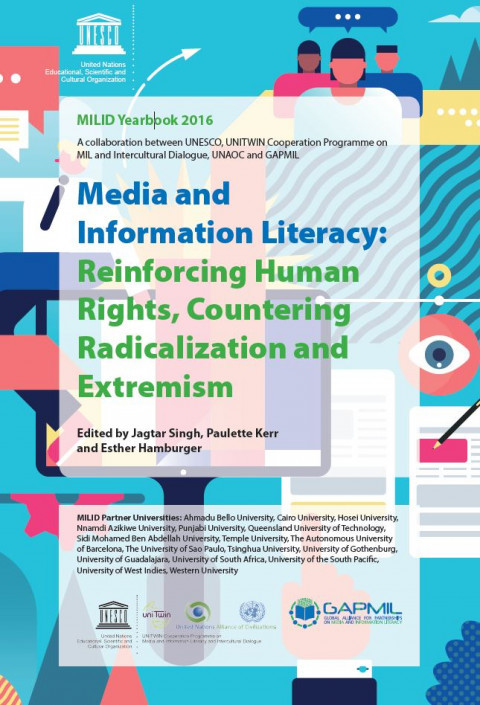 Media and Information Literacy: Reinforcing Human Rights, Countering Radicalization and Extremism (The MILID Yearbook, 2016) سنة النشر: 2016 المؤلف: Jagtar Singh | Paulette Kerr | Esther Hamburger المؤلف المؤسسي: UNESCO | Alliance of Civilizations Media and Information Literacy (MIL) is a strong tool, cutting across educational, cultural and social contexts. It can help overcome disinformation, stereotypes and intolerance conveyed through some media and in online spaces. Here, stimulating critical empathy is one of the vital components and there are many stakeholders that have a role to play in this dimension of MIL.This year’s edition is focused on a highly relevant theme of “Media and Information Literacy: Reinforcing Human Rights, Countering Radicalization and Extremism”. It is a relevant reference point to initiate discussion and offer perspectives to stakeholders seeking to apply MIL as a tool to counter violent extremism. There is evident need for evidence-based research, assessment and evaluation that can provide insight into the impact of media and information literacy on societies. UNESCO trusts that this publication will contribute to ongoing scholarship and debate on these key topics.For media and other information providers to serve their purpose, we need critical minds in the public, which means to develop MIL programmes at the national, regional and international levels.
 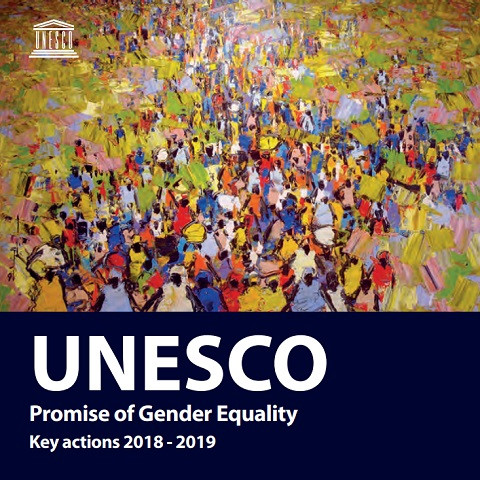 UNESCO: Promise of Gender Equality; Key Actions of 2018 and 2019 سنة النشر: 2020 المؤلف المؤسسي: UNESCO This is the first UNESCO Annual Report on Gender Equality that highlights the key initiatives implemented in 2018-2019. The advancement of gender equality through education, the sciences, culture, information and communication, at the heart of UNESCO’s mandate, aims to equip both women and men to address the challenges of sustainable development in a fast-changing world. UNESCO: La Promesse de l’Egalité des genres; Actions clés de 2018 - 2019 سنة النشر: 2020 المؤلف المؤسسي: Organisation des Nations Unies pour l'éducation, la science et la culture (UNESCO) Ceci est le premier rapport annuel de l’UNESCO sur l’égalité des genres qui met en lumière quelques-unes des initiatives clés mises en place en 2018 - 2019. Les progrès en matière d’égalité des genres par l’éducation, les sciences, la culture, l’information et la communication, au cœur des activités de l’UNESCO, visent à donner aux femmes et aux hommes les moyens de relever les défis du développement durable dans un monde en perpétuelle mutation.
 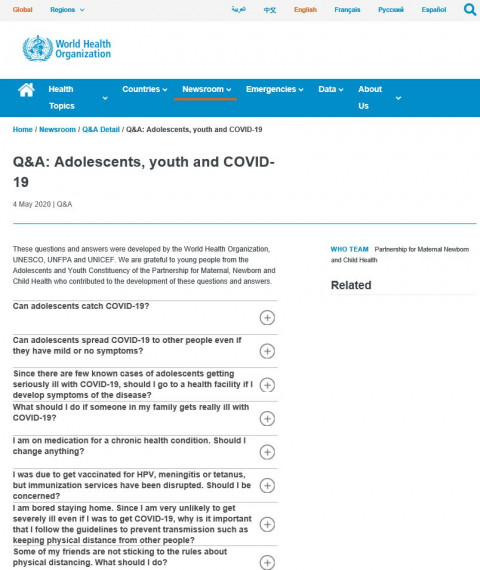 Q&A: Adolescents, Youth and COVID-19 سنة النشر: 2020 المؤلف المؤسسي: World Health Organization (WHO) | UNESCO | United Nations Population Fund (UNFPA) | United Nations Children's Fund (UNICEF) As part of UNESCO’s work in promoting better health and well-being for all children and young people, it has contributed to the development of a practical guide in a ‘questions and answers’ (Q&A) format on children and adolescents and COVID-19. This work was led by the World Health Organization, in collaboration with the Adolescents and Youth Constituency of the Partnership for Maternal, Newborn and Child Health, UNESCO, UNFPA, and UNICEF.The Q&A provide children and adolescents with accurate, non-judgmental information and advice around COVID-19, including how to help stop the spread of the virus, what to do if they develop symptoms of the disease, and how to best manage their health and well-being during the confinement period and after. It considers children and young people as critical actors in the response to COVID-19, not as passive beneficiaries.
  UNESCO's work on education for peace and non-violence: building peace through education سنة النشر: 2008 المؤلف المؤسسي: UNESCO The promotion of peace through education is at the heart of UNESCO’s mission. As stated in its constitution of 1945, UNESCO advances international peace and the common welfare of humanity through educational, scientific and cultural relations between peoples of the world. Though the world has changed over the past sixty years and continues to change at an ever increasing rate, UNESCO’s mission - a commitment to promoting universal values of peace and nonviolence, human rights and social justice, intercultural dialogue and mutual understanding – persists with growing urgency. UNESCO’s approach to educating for peace is multidimensional, in that it links education with a range of activities that address the root causes of violence, from human security to sustainable development. The goal of UNESCO’s education programmes and partnerships is the development of comprehensive systems of education that embrace the values of human rights, intercultural understanding and tolerance. Education for peace and non-violence promotes the knowledge, skills, attitudes and behaviours that reflect and inspire these values. As the lead agency within the UN system for the International Decade for a Culture of Peace and Non-Violence for the Children of the World, 2001- 2010, UNESCO is responsible for coordinating and directly implementing activities that promote the objectives of the Decade through education, the sciences, culture, communication and information. The culture of peace is defined as a set of values, attitudes, modes of behaviour and ways of life that reject violence and aim to prevent conflicts by tackling their root causes through dialogue and negotiation between individuals, groups and nations. UNESCO promotes the culture of peace through an intersectoral platform. This platform involves all five sectors of UNESCO: education, natural sciences, social and human sciences, culture, and communication and information. It seeks to mainstream intercultural dialogue in policies and actions with the aim of promoting mutual understanding, tolerance and respect, all of which are considered to be creative forces for a sustainable future. The intersectoral platform will also develop tools based on good practices in intercultural dialogue.