
الموارد
استكشف مجموعة واسعة من الموارد القيمة حول تعليم المواطنة العالمية لتعميق فهمك وتعزيز البحث والمناصرة والتعليم والتعلم.
تم العثور على 3,396 نتيجة
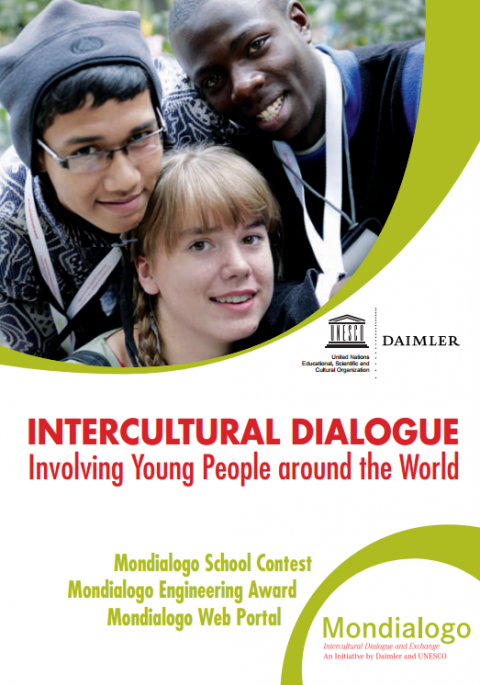 Le dialogue interculturel: la participation des jeunes à travers le monde سنة النشر: 2010 المؤلف: Elizabeth Khawajkie المؤلف المؤسسي: Organisation des Nations Unies pour l'éducation, la science et la culture (UNESCO) | DAIMLER Il est à espérer que cet examen permettra de mettre en évidence la raison pour laquelle il y a un appel persistant pour la poursuite de ces efforts, comme Mondialogo, qui a favorisé de manière efficace le dialogue entre les cultures et les peuples, le respect mutuel et la compréhension. Le voyage Mondialogo, commencé comme un exercice exploratoire, a pris fin avec des expériences convaincantes et souvent en mouvement.
 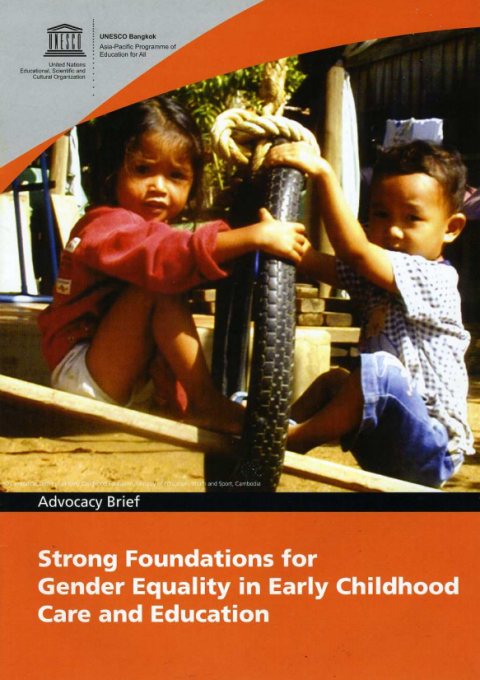 Strong foundations for gender equality in early childhood care and education: advocacy brief سنة النشر: 2007 المؤلف المؤسسي: UNESCO The term Early Childhood Care and Education (ECCE) refers to services for children from birth to eight years of age. These include educating parents in how to care for their children and help them learn, as well as providing community-run and formal preschool programmes for pre-primary school-aged boys and girls. Given the varying needs of children from birth to eight years, educators have found it best to have different policies and strategies for children below and above three years of age. This brief focuses on the gender issues in the services provided for children who are three years of age or older in the Asia-Pacific region. Its scope is informed by UNESCO's commitment to holistic pre-primary services for this age group. The goal is to provide early childhood education that helps girls and boys succeed in primary school and in learning throughout their lives. The brief starts by looking into the growth of ECCE in the Asia-Pacific region and what is driving this growth. It explores why gender responsiveness is important in early childhood education, gives practical examples of what this looks like, and discusses the challenges of providing ECCE that equally values and benefits each girl and each boy. Flowing from this, the brief concludes with recommendations on how to make ECCE more gender responsive De solides fondations pour l'égalité des sexes dans les soins de la petite enfance et de l'éducation: le plaidoyer bref سنة النشر: 2007 المؤلف المؤسسي: Organisation des Nations Unies pour l'éducation, la science et la culture (UNESCO) Le terme de l’éducation et la protection de la petite enfance (EPPE) fait référence aux services pour les enfants de la naissance à huit ans. Ceux-ci incluent l'éducation des parents dans la façon de prendre soin de leurs enfants et de les aider à apprendre, ainsi que de fournir des programmes formels préscolaires gérés par la communauté et pour les garçons et les filles d'âge scolaire pré-primaire. Compte tenu des divers besoins des enfants de la naissance à huit ans, les éducateurs ont trouvé préférable d'avoir des politiques et des stratégies pour les enfants de moins et de plus de trois ans. Ce bref se concentre sur les questions de genre dans les services fournis aux enfants qui sont de trois ans ou plus dans la région Asie-Pacifique. Son champ d'application est informé par l'engagement de l'UNESCO aux services pré-primaires holistiques pour ce groupe d'âge. L'objectif est de fournir une éducation de la petite enfance qui aide les filles et les garçons à réussir à l'école primaire et dans l'apprentissage tout au long de leur vie. Les brèves commence par la recherche dans la croissance de l'EPPE dans la région Asie-Pacifique et ce qui est le moteur de cette croissance. Il explore pourquoi le genre de réaction est important dans l'éducation de la petite enfance, donne des exemples concrets de ce que cela ressemble, et examine les défis de fournir EPPE que de façon égale les valeurs et les avantages de chaque fille et chaque garçon. Découlant de cela, le mémoire se termine par des recommandations sur la façon de rendre sensible EPPE plus le sexe.
  Report on the survey on the implementation of the road map for arts education سنة النشر: 2010 المؤلف المؤسسي: UNESCO The Road Map for Arts Education is a reference document that aims to explore the role of arts education in meeting the need for creativity and cultural awareness in the 21st Century, while placing emphasis on the strategies required to introduce or promote arts education in the learning environment. Within this conceptual framework, all UNESCO Member States interested in initiating or developing arts education practices can mould their own national policy guidelines, adapted to their socio-cultural specificities. With the Road Map, UNESCO advocates the essential role of arts education within societies, to create a common ground of understanding for all stakeholders. The development of the Road Map for Arts Education was a lengthy and comprehensive consultation process. The document was first elaborated by a group of experts and UNESCO, then presented at the First World Conference on Arts Education (Lisbon, 2006) and later revised and updated, following recommendations from NGOs and Member States. The Road Map was finally distributed to the UNESCO Member States in November 2007 in English and French and then translated into Spanish and Russian following popular demand. More than a year after this distribution, UNESCO launched a wide-ranging survey in order to assess the implementation of the Road Map in its 193 Member States. Through its National Commissions, the Organization relayed this document to Ministries of both Education and Culture. The aim of this exercise was threefold: to learn whether the Road Map was being applied and to what extent it was influencing policy decisions at national level; to act as a reminder of the importance of the UNESCO reference document and encourage its use; finally, to assess the situation of arts education in the responding countries. Thus, this survey not only acted as a catalyst for the implementation of the Road Map, but also provided precious knowledge on arts education around the world. The Member States’ responses also contributed greatly to the Second World Conference on Arts Education (Seoul, May 2010), inspiring one of its main themes and the topics for a number of workshops. They also encouraged a more integral participation of these States in the conference through preparatory consultations.
  Considerations on the follow-up of the United Nations International Year for the Rapprochement of Cultures with regard to implementation of the Kyiv Statement towards Mutual Understanding and Dialogue سنة النشر: 2011 المؤلف المؤسسي: UNESCO As one of the co-initiators of the International Year for the Rapprochement of Cultures, Ukraine proposed to initiate a general discussion regarding the protection of monuments and sites with religious or spiritual meaning (hereinafter referred to as religious2 and sacred3 properties) at the international level. This discussion was timely and in line with one of the four themes, selected to build an action plan for the Year in the fields of UNESCO’s competence, namely to promote reciprocal knowledge of cultural, ethnic, linguistic and religious diversity. 2. This initiative, having constituted one of the essential elements of the International Year of Rapprochement of Cultures, is aimed at enhancing protection and management of religious properties. It stems from the appeal of the Ukrainian authorities, launched at the 35th session of the UNESCO General Conference (2009), inviting all Member States to participate in the International Seminar “The Role of religious communities in the management of World Heritage properties” (2-5 November 2010). This announcement was welcomed by UNESCO within the framework of the Year. Numerous Member States expressing their support for the proposal designated representatives to participate in this Seminar. The elaboration of the Kyiv Statement (as one of the main outcomes of the Seminar) and its adoption in close cooperation with representatives of religious communities contributes to the creation of a culture of dialogue. Considérations sur le Suivi de l'Année Internationale du Rapprochement des Cultures Proclamée par les Nations Unies, Relatives à la mise en Oeuvre de la Déclaration de Kiev en vue de la Compréhension Mutuelle et du Dialogues سنة النشر: 2011 المؤلف المؤسسي: Organisation des Nations Unies pour l'éducation, la science et la culture (UNESCO) En tant que l’un des co-initiateurs de l’Année internationale du rapprochement des cultures, l’Ukraine a proposé d’engager un débat général sur la protection des monuments et des sites possédant une signification religieuse ou spirituelle (ci-après désignés comme biens religieux2 et sacrés3) au niveau international. Ce débat intervenait en temps opportun et correspondait à l’un des quatre thèmes retenus pour l’élaboration d’un plan d’action pour l’Année dans les domaines de compétence de l’UNESCO, à savoir la promotion d’une connaissance réciproque de la diversité culturelle, ethnique, linguistique et religieuse. Stratégie de l'UNESCO pour la seconde moitié de la décennie de l'éducation au service du développement durable سنة النشر: 2010 المؤلف المؤسسي: Organisation des Nations Unies pour l'éducation, la science et la culture (UNESCO) The UNESCO Strategy for the Second Half of the United Nations (UN) Decade of Education for Sustainable Development (DESD) draws on the findings and lessons learnt from the first phase of the DESD monitoring and evaluation (M&E) process (as reflected in the 2009 DESD M&E report Learning for a Sustainable World: Review of Contexts and Structures for Education for Sustainable Development. It also builds on the UNESCO World Conference on ESD and the Bonn Declaration as well as on the outcomes of other key international ESD meetings. The Bonn Declaration gives particular emphasis to the importance of education for the global development agenda and underlines the essential contribution of ESD to shaping the purpose, content and quality of all education. The UNESCO strategy will be implemented in line with the International Implementation Scheme (IIS), which, along with the Bonn Declaration, will provide the global strategic framework for UNESCO and its DESD partners during the second half of the Decade. The Strategy takes into account key DESD regional challenges and opportunities. It is also shaped by the shared vision of education emerging from the four 2008-2009 UNESCO international education conferences: one of education systems that encourage equity and inclusion, quality learning, flexibility and innovation. While UNESCO puts highest emphasis on achieving Education for All (EFA), the Organization’s actions in education extend beyond this, to pay explicit attention to inclusion, social cohesion and social justice, to lifelong learning and to the crucial role of higher education and research. The overall goal of the UNESCO Strategy for the Second Half of the DESD is to support Member States and other stakeholders in addressing global sustainable development challenges at regional, national and global level through ESD, thus addressing the challenges of learning for bringing about a more sustainable world. Décennie des Nations Unies pour L'Education au Service du Développement Durable (DEDD 2005-2014): les deux premières années سنة النشر: 2007 المؤلف المؤسسي: Organisation des Nations Unies pour l'éducation, la science et la culture (UNESCO) The implementation of the DESD has made considerable progress since its international launch in March 2005. Apart from regional and national launches, progress has been achieved in both institutional and programmatic areas at international, regional and national levels. The objective of this report is not solely to highlight and showcase to Member States all that has been achieved in the two years since the international launch. The report also takes stock of on-going UNESCO initiatives, established prior to the Decade, which are providing major contributions to the implementation of the DESD, and thus cannot be by-passed. Equally important are the recommendations to remedy problems in the implementation of the DESD and strengthen those measures that are working efficiently. Contemporary issues in human rights education سنة النشر: 2011 المؤلف المؤسسي: UNESCO The format of this publication presents the main strands concerning the role of human rights education as well as the key elements for its implementation. Each strand addresses current issues and challenges faced when incorporating a culture for human rights, also illustrating the collective importance of human rights education as a fundamental base for a peaceful and just society. Under each strand, a list of examples inspired by country initiatives is proposed. Enjeux contemporains éducation aux droits humains سنة النشر: 2011 المؤلف المؤسسي: Organisation des Nations Unies pour l'éducation, la science et la culture (UNESCO) Le format de cette publication présente les principaux volets concernant le rôle de l'éducation des droits de l'homme ainsi que les éléments clés de sa mise en œuvre. Chaque adresses de brins enjeux et les défis actuels auxquels sont confrontés lors de l'incorporation d'une culture des droits de l'homme, illustrant également l'importance collective de l'éducation aux droits de l'homme comme base fondamentale pour une société juste et pacifique. Sous chaque brin, une liste d'exemples inspirés par des initiatives de pays est proposé.