
الموارد
استكشف مجموعة واسعة من الموارد القيمة حول تعليم المواطنة العالمية لتعميق فهمك وتعزيز البحث والمناصرة والتعليم والتعلم.
تم العثور على 2,781 نتيجة
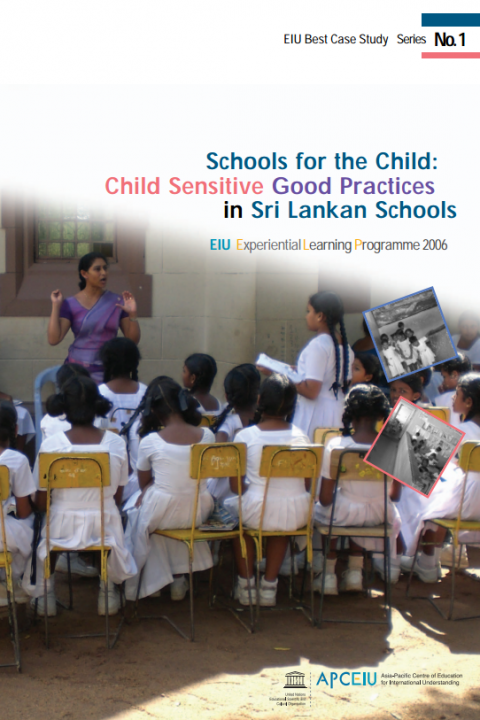 EIU Best Practices Series No. 1: Schools for the Child: Child Sensitive Good Practices in Sri Lankan Schools سنة النشر: 2006 المؤلف المؤسسي: APCEIU This monograph is one of APCEIU's EIU Best Practices Series, which aims to encourage educators, scholars, and activists to implement and share local initiatives on EIU. The Series No.1 is a research study undertaken to identify positive practices that can foster peace education in post-conflict communities of Sri Lanka. Specifically, three schools are observed to understand how the model of peace education and multiculturalism can be promoted through educator’s creativity, dedication, and vision, curriculum revision, eco-friendly school environment, and use of external and community resources. The study showcases that culturally sensitive and mindful pedagogical practices are needed to generate understanding of peace.
 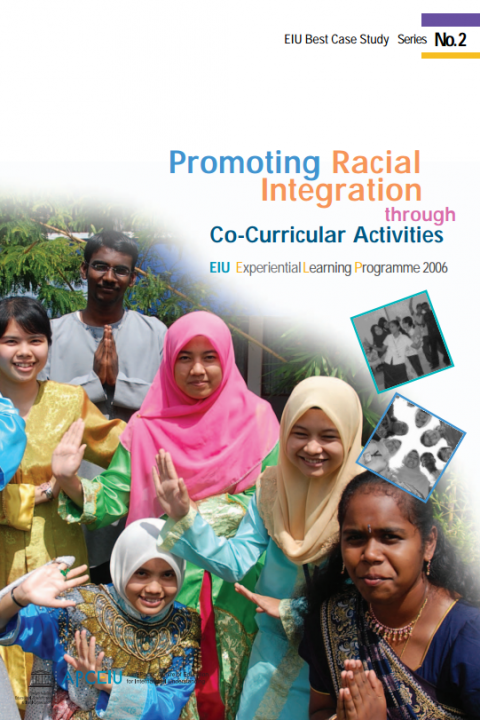 EIU Best Practices Series No. 2: Promoting Racial Integration through Co-Curricular Activities سنة النشر: 2006 المؤلف المؤسسي: APCEIU This monograph is one of APCEIU's EIU Best Practices Series, which aims to encourage educators, scholars, and activists to implement and share local initiatives on EIU. The Series No.2 introduces a program in which Malaysian students of varied racial and ethnic backgrounds engaged in a dancing co-curricular activity to understand and embrace other cultures. Students were tasked to prepare cultural dances, while learning local history and customs. The successful program shows that racial integration can be promoted as a co-curricular activity, encouraging students to respect and overcome differences to create a harmonious community.
  EIU Best Practices Series No. 6: Practical Research on Current Issues: Studies on Global Perspectives in Schools in Japan سنة النشر: 2007 المؤلف المؤسسي: APCEIU This monograph is one of APCEIU's EIU Best Practices Series, which aims to encourage educators, scholars, and activists to implement and share local initiatives on EIU. The Series No.6 is a research undertaken on two schools of Japan and Korea, in which students were tasked to conduct research on bilateral conflict issues and devise suggestions for peaceful resolution. Besides classroom discussions and presentations, student exchange visit further allowed active learning and engaging of issues, historical awareness and perception, and mutual understanding as global citizens.
 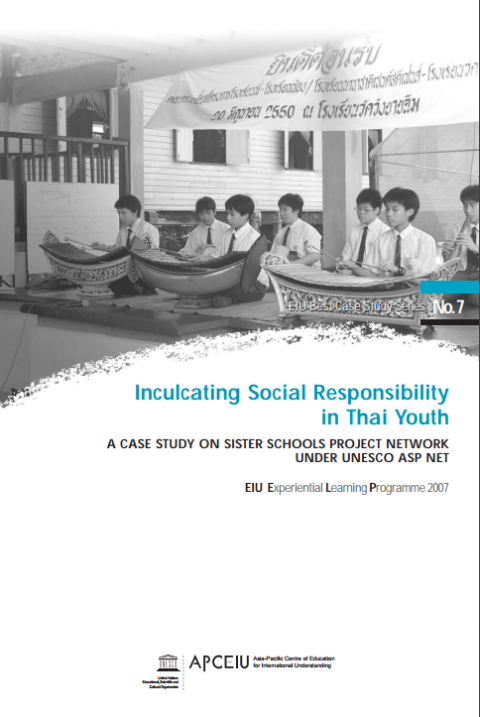 EIU Best Practices Series No. 7: Inculcating School Responsibility in Thai Youth: A Case Study on Sister Schools Project Network under UNESCO ASPNet سنة النشر: 2007 المؤلف المؤسسي: APCEIU This monograph is one of APCEIU's EIU Best Practices Series, which aims to encourage educators, scholars, and activists to implement and share local initiatives on EIU. The Series No.7 is a case study of two Thai schools within the Sister Schools Project Network, which is under the UNESCO ASP NET and UNESCO Club. As schools visited other schools in the network, students became involved in fundraising to support one another, thereby naturally acquiring invaluable team building skills, intercultural understanding, and social responsibility. This case shows that sister school network system can foster values of sharing, caring, and loving, despite socio-economic disparity among students.
  EIU Best Practices Series No. 9: Integrating Sacred Natural Sites Concept into Environmental Education سنة النشر: 2008 المؤلف المؤسسي: APCEIU This monograph is one of APCEIU's EIU Best Practices Series, which aims to encourage educators, scholars, and activists to implement and share local initiatives on EIU. The Series No.9 introduces research on how educational content on sacred natural sites in Mongolia can lead to understanding of environment and sustainable development. Interviews and surveys conducted by local community teachers and students living in the Orkhon Valley Cultural Landscape, a World Heritage Site, indicate the importance of education in raising awareness of environmental and heritage protection.
 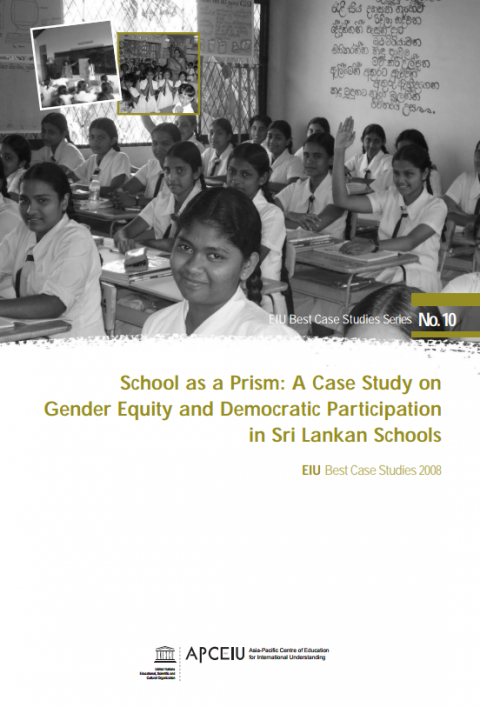 EIU Best Practices Series No. 10: School as a Prism: A Case Study on Gender Equity and Democratic Participation in Sri Lanka Schools سنة النشر: 2008 المؤلف المؤسسي: APCEIU This report is one of the APCEIU's EIU Best Practices Series, which aims to encourage educators, scholars, and activists to implement and share local initiatives on EIU. The Series No.10 introduces a study of nine schools in Sri Lanka, which has been conducted to analyze current practices of gender education and provide suggestions for improvement. Upon careful assessment of documentary surveys, interviews, self-reports, and historical data analysis, the result indicates that gender equality and democratic participation are substantially provided and prioritized in Sri Lankan schools, in lieu of EIU theme of social justice. As common challenges still exist, the research notes the need to further examine learning patterns of boys and girls, classroom-specific gender issues, and good practices that promote role of women in democratic participation.
  GCED Curriculum Development and Integration Project (Sri Lanka): 2021 Final Report سنة النشر: 2021 المؤلف المؤسسي: National Institute of Education (Sri Lanka) | APCEIU This resource is a compiled documentation of the final outcomes of the Sri Lankan National Institute of Education (NIE) and APCEIU’s joint partnership to develop the GCED curriculum, particularly for the secondary school level. The report includes the materials created and used to evaluate, monitor, and execute the GCED curriculum, as well as the documentation of the process of its creation. It is written in both English and Sinhalese. In the compilation, you may find:- Introduction to the project (ENG)- Annexure of evaluative materials (ENG, SNH)- GCED Framework (ENG)- GCED Learning ModulesGrade 6 English (ENG)Grade 6 Sound Test (SNH)Grade 8 (SNH)Grade 8 English World of Work (ENG)Grade 8 School Try Out (SNH)
  GCED Curriculum Development and Integration Project (Lebanon): 2021 Final Report سنة النشر: 2021 المؤلف المؤسسي: Center for Educational Research and Development (CRDP) | APCEIU This resource is a compiled documentation of the final outcomes of the Center for Educational Research and Development (CRDP), Lebanon and APCEIU’s joint partnership to develop the GCED curriculum across both primary and secondary school levels. The report includes the materials created and used to evaluate, monitor, and execute the GCED curriculum, as well as the documentation of the process of its creation. It is written in both English and Arabic.In the compilation, you may find:- Report on the Implementation of the Project Stages- Digital Activities for GCED Integration in the Civics and National Education Curriculum: Grade 1 - 12 (ARA)- Digital Activities for GCED Integration in the Civics and National Education Curriculum: Grade 1 - 12 (ENG)- Teacher’s Guide: Grade 1 - 12 (ARA)- Teacher’s Guide: Grade 1 - 12 (ENG)- Training of Trainers (TOT): TOT Materials (ENG; ARA)- The Project of Training the Trainers on Global Citizenship Education and Integrating it into the Pre-university Educational Curricula: Preamble (ENG)- Technical Cards (ENG; ARA)
  다문화가정대상국가와의 교육교류사업 후속활동 길라잡이 سنة النشر: 2023 المؤلف المؤسسي: APCEIU The Asia-Pacific Teacher Exchange for Global Education(APTE) is a bilateral teacher exchange programme between the Republic of Korea and Asia-Pacific countries, hosted by the Ministry of Education of the Republic of Korea (MOE ROK) and implemented by the Asia-Pacific Centre of Education for International Understanding under the auspices of UNESCO (APCEIU), in collaboration with the Ministries of Education of the partner countries. Since 2012, the Office of International Teacher Exchange of APCEIU has been playing a pivotal role in implementing APTE. APCEIU prepared this book in the hope of spreading the fruits of teachers’ efforts and the seeds of peace in them, which were nurtured on the ground of APTE, to a broader world. <Contents>IntroductionI. Understanding follow-up activitiesII. Types of follow-up activities and model examples1. Types of follow-up activities2. Model examples of follow-up activities- [Real-Time Online Video Class] Starting online international education exchange- [Visiting / Invitational Program] An insight into international exchange programme- [Club-Oriented Inter-School Exchange] Follow-up exchange with invention club activity- [Inter-School Cooperative Agreement] Precious ties- [Participation In Various Support Programs] Heart of Korea, multicultural values: overcoming the limits of the classroomIII. Follow-up activity operation1. The nine-step preparation process for independent operation of educational exchange2. Procedures for independent operation of international exchangeIV. Annex1. Asia-Pacific Teacher Exchange for Global Education2. UNESCO APCEIU: Asia-Pacific Centre of Education for International Understanding under the auspices of UNESCO3. Reference programs for follow-up activities 다문화가정대상국가와의 교육교류사업 후속활동 길라잡이 سنة النشر: 2023 المؤلف المؤسسي: 유네스코 아시아태평양 국제이해교육원 다문화가정대상국가와의 교육교류사업(APTE: Asia-Pacific Teacher Exchange for Global Education)은 대한민국 교육부가 주최하고 유네스코 아시아태평양 국제이해교육원이 주관하며, 교류 대상국 교육부가 현지 협력주체로서 함께하는 한국 아태지역 국가 양자 간 교육교류사업입니다. 아태교육원 국제교사교류실은 2012년부터 2022년 현재까지 10년간 APTE 사업 시행을 담당하고 있습니다. 지난 10년간 APTE 사업이라는 터전에서 선생님들께서 맺으신 열매와 그 속에 담긴 평화의 씨앗이 더 널리 퍼지길 기대하며 이 책자를 제작합니다. 목차:머리말I. 후속활동의 이해II. 후속활동 유형 및 우수 사례1. 후속활동 유형 소개2. 후속활동 우수 사례 - [온라인 실시간 화상수업 사례] 온라인 국제교육교류 시작하기 - [방문 및 초청 프로그램 운영 사례] 국제교류프로그램에 대한 고찰 - [동아리 중심 학교 간 교류 사례] 발명 동아리 활동과 함께한 후속교류사업 - [학교 간 협약 체결 사례] 소중한 인연들 - [각종 지원사업 참가 사례] 한마음, 다가치 교실의 경계를 넘다III. 후속활동 운영 방법1. 교육교류 자체 운영을 위한 9단계 준비 과정2. 국제교류 자체 운영의 절차IV. 붙임1. 다문화가정대상국가와의 교육교류사업 소개2. 유네스코아시아태평양국제이해교육원 소개3. 후속교류 시 참고 프로그램