
الموارد
استكشف مجموعة واسعة من الموارد القيمة حول تعليم المواطنة العالمية لتعميق فهمك وتعزيز البحث والمناصرة والتعليم والتعلم.
تم العثور على 2,668 نتيجة
 Facing the facts: the case for comprehensive sexuality education سنة النشر: 2019 المؤلف: Global Education Monitoring Report Team المؤلف المؤسسي: UNESCO Comprehensive sexuality education is an essential part of a good quality education that helps prepare young people for a fulfilling life in a changing world. It improves sexual and reproductive health outcomes, promotes safe and gender equitable learning environments, and improves education access and achievement. This paper, produced jointly with the Section for Health and Education at UNESCO, discusses how governments can overcome social resistance and operational constraints to scale up these programmes as part of their commitment to SDG 4, the global education goal. Regarder la réalité en face: pourquoi faut-il promouvoir l'éducation complète à la sexualité سنة النشر: 2019 المؤلف: Global Education Monitoring Report Team المؤلف المؤسسي: Organisation des Nations Unies pour l'éducation, la science et la culture (UNESCO) L'éducation complète à la sexualité est un élément indispensable d'une éducation de qualité qui aide les jeunes à s'épanouir dans un monde en mutation. Elle améliore les résultats en matière de santé sexuelle et reproductive, crée les conditions d'un apprentissage sûr et équitable du point de vue du genre, élargit l'accès à l'éducation et améliore les résultats scolaires. Ce document d'orientation, préparé avec la section de la santé et de l'éducation de l'UNESCO, explique comment les gouvernements peuvent surmonter les résistances sociales et les contraintes opérationnelles pour amplifier ces programmes, conformément à leur engagement envers l'ODD 4, l'objectif mondial d'éducation. Encarar los hechos: el caso de la educación integral en sexualidad سنة النشر: 2019 المؤلف: Global Education Monitoring Report Team المؤلف المؤسسي: Organización de las Naciones Unidas para la Educación, la Ciencia y la Cultura (UNESCO) La educación integral en sexualidad forma parte esencial de una educación de buena calidad que ayude a preparar a las y los jóvenes para llevar una vida plena en un mundo en evolución. Dicha educación mejora la salud sexual y reproductiva, promueve entornos de aprendizaje seguros y equitativos en cuanto al género y favorece el acceso a la educación y el rendimiento escolar. En este documento, elaborado conjuntamente con la Sección de la Salud y la Educación de la UNESCO, se analiza cómo los gobiernos pueden superar la resistencia social y las limitaciones operativas para ampliar estos programas en el marco de su compromiso con el ODS 4, el objetivo mundial relativo a la educación.
  Making evaluation work for the achievement of SDG 4 target 5: equality and inclusion in Education سنة النشر: 2019 المؤلف المؤسسي: UNESCO The adoption of the Sustainable Development Goals (SDGs) and the Education 2030 Framework for Action has placed gender parity, equality and inclusion in education at the heart of the international development agenda and is specifically formulated in SDG 4 Target 5. Now, as never before, relevant and contextualised evidence, driven in part by robust evaluation data, is needed to track and strengthen progress on educational equity. To this end, a group of international organisations, led by UNESCO, have combined efforts to explore how their education evaluations can better support Member States to strengthen progress on gender parity, equality and inclusion in education. The following report synthesises evidence from publicly available independent evaluations from 13 organisations, highlighting evidence gaps and summarising ‘what works’ for whom and in what contexts for advancing gender equality and equity for vulnerable groups. The study also reports on responses to the synthesis from national stakeholders in five countries: Ghana, Guatemala, Lebanon, Nepal and Peru. The report culminates in a discussion and recommendations, which outline the need for greater coordination and collaboration in four key areas to further enhance the contribution of evaluations to global and country level progress on SDG 4 Target 5.
 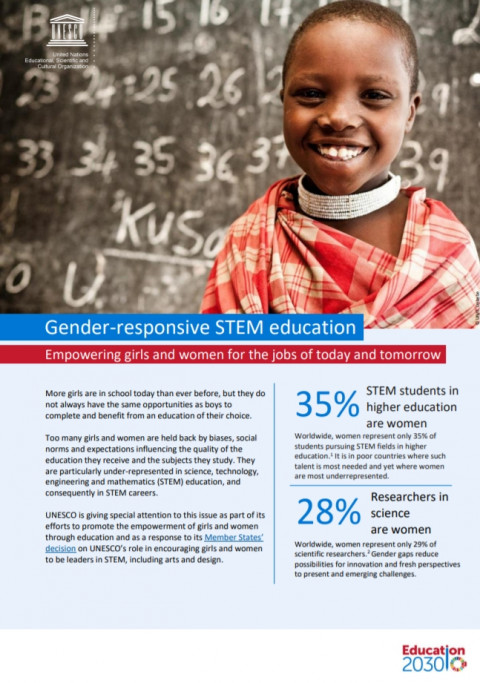 Gender-responsive STEM education: Empowering girls and women for the jobs of today and tomorrow سنة النشر: 2019 المؤلف المؤسسي: UNESCO More girls are in school today than ever before, but they do not always have the same opportunities as boys to complete and benefit from an education of their choice. Too many girls and women are held back by biases, social norms and expectations influencing the quality of the education they receive and the subjects they study. They are particularly under-represented in science, technology, engineering and mathematics (STEM) education, and consequently in STEM careers. UNESCO is giving special attention to this issue as part of its efforts to promote the empowerment of girls and women through education and as a response to its Member States’decisionon UNESCO’s role in encouraging girls and women to be leaders in STEM, including arts and design.
  LES OUTILS DU PLURALISME CULTUREL سنة النشر: 2015 المؤلف المؤسسي: Organisation des Nations Unies pour l'éducation, la science et la culture (UNESCO) Face aux formes persistantes de xénophobie et d’exclusion sociale, face aux actes spectaculaires d’intolérance dont nos sociétés peuvent être le théâtre, la Convention de l’UNESCO de 2005, par laquelle les États parties s’engagent à développer des politiques publiques pour la promotion et la protection de la diversité des expressions culturelles, s’avère plus que jamais actuelle : elle incite à mieux prendre en compte le rôle de la culture au profit du partage, du respect et de la reconnaissance de l’autre, au-delà des appartenances sociales et culturelles.A l’occasion du 10e anniversaire de la Convention de 2005 de l’UNESCO, désormais ratifiée par 138 États et l’Union européenne et dans le cadre de la Décennie internationale du rapprochement des cultures (2013-2022, ONU), la Commission nationale française pour l’UNESCO, en partenariat avec le Secrétariat de l’Organisation et avec le soutien du ministère français de la Culture et de la Communication, a organisé deux conférences internationales au siège de l’UNESCO.Première de ces deux conférences internationales, Les outils du pluralisme culturel, le vendredi 2 octobre 2015 à l’UNESCO, pendant la Semaine des Cultures Étrangères organisée par le Forum des Instituts Culturels Étrangers à Paris, a offert un état des lieux, à un niveau européen élargi, des initiatives de promotion de la diversité des expressions culturelles comme outils du vivre-ensemble.
 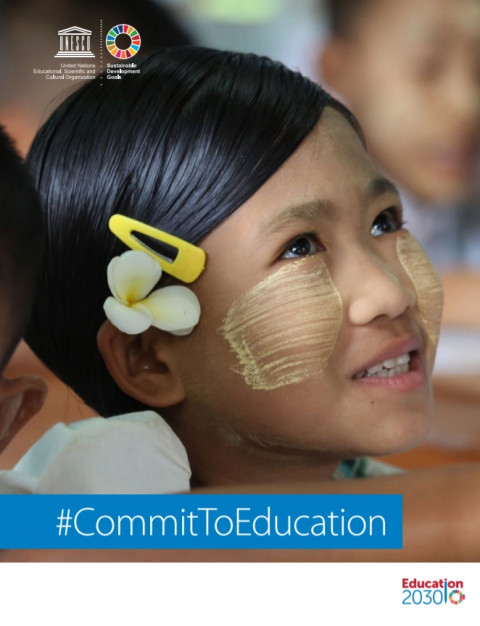 #CommitToEducation سنة النشر: 2019 المؤلف المؤسسي: UNESCO In December 2018, building on a series of regional consultations, the education community struck a common chord at the Global Education Meeting in Brussels, the first gathering of its kind since the adoption of the 2030 Agenda. Ministers, representatives of government, multilateral organizations, civil society and other stakeholders agreed on a set of priorities for collective action. These include an overarching focus on the right to inclusive quality education; eradicating illiteracy; including migrants, displaced persons, refugees and stateless persons in education; quality gender-responsive education and training; strengthened education for global citizenship and sustainable development; more flexible and open learning systems providing a broader range of knowledge, skills and competences at all levels; qualified teachers and domestic and international resource mobilization. This set the ground for the first review of SDG 4 by the July 2019 High level Political Forum, the UN apex platform for the follow-up and review of Agenda 2030. As the UN agency responsible for the coordination of SDG 4, mandated by the World Education Forum in Incheon (Republic of Korea, 2015), UNESCO provided an analysis of where the world stands on SDG 4, how countries have taken up the goal in their policies, and made recommendations to act better, differently and collaboratively.
  United Nations Strategy and Plan of Action on Hate Speech سنة النشر: 2019 المؤلف المؤسسي: United Nations (UN) In response to the alarming trend of rising hate speech around the world, Secretary-General António Guterres launched the United Nations Strategy and Plan of Action on Hate Speech, on 18 June 2019.Seeking to enhance the UN’s response to the global phenomenon of hate speech, this strategy is the outcome of close collaboration between 16 entities under the UN Working Group on Hate Speech and is coordinated by the United Nations Special Adviser on the Prevention of Genocide.The Strategy makes a firm commitment to step up coordinated action to tackle hate speech, both at global and national levels. Stratégie et Plan d’action des Nations Unies pour la lutte contre les discours de haine سنة النشر: 2019 المؤلف المؤسسي: United Nations (UN) En réponse à l’alarmante montée de la xénophobie, du racisme et de l’intolérance, de la misogynie violente, de l’antisémitisme et de l’islamophobie dans le monde actuellement, le 18 juin 2019, le Secrétaire général, Antonio Guterres, a lancé la Stratégie et le Plan d’action des Nations Unies pour la lutte contre les discours de haine. Cette démarche part du constat qu’au cours des 75 dernières années, les discours de haine ont été annonciateurs des crimes atroces qui les ont suivis, génocide compris, comme au Rwanda, en Bosnie ou au Cambodge.La Stratégie et le Plan d’action des Nations Unies pour la lutte contre les discours de haine offrent au système des Nations Unies des orientations stratégiques pour lutter contre les discours de haine aux niveaux national et mondial. Y est précisé également comment le Secrétariat de l’ONU peut seconder les coordinateurs résidents des Nations Unies dans leur action face aux discours de haine.Les objectifs sont doubles : il s’agit premièrement de renforcer les efforts déployés par les entités des Nations Unies pour s’attaquer aux causes profondes et aux éléments moteurs des discours de haine, et deuxièmement, d’aider le système des Nations Unies à répondre efficacement aux conséquences sociétales des discours de haine. La estrategia y plan de acción de las Naciones Unidas para la lucha contra el discurso de odio سنة النشر: 2019 المؤلف المؤسسي: United Nations (UN) En respuesta a la alarmante tendencia del aumento del discurso del odio por todo el mundo, el Secretario General, António Guterres, presentó la Estrategia y Plan de Acción de las Naciones Unidas para la lucha contra el Discurso de Odio, el 18 de junio de 2019.Con el objetivo de mejorar la respuesta de la ONU ante el fenómeno del discurso de odio, esta estrategia es el resultado de la estrecha colaboración entre 16 entidades dentro del Grupo de Trabajo de la ONU para la lucha contra el Discurso de Odio y está coordinada por la Asesora Especial de las Naciones Unidas para la Prevención del Genocidio.La Estrategia se compromete firmemente a intensificar la acción coordinada para hacer frente al discurso del odio, tanto a escala mundial como nacional.