
الموارد
استكشف مجموعة واسعة من الموارد القيمة حول تعليم المواطنة العالمية لتعميق فهمك وتعزيز البحث والمناصرة والتعليم والتعلم.
تم العثور على 3,448 نتيجة
 Controversial Issues - Teachers' attitudes and practices in the context of citizenship education سنة النشر: 2004 المؤلف: Christopher Oultona | Vanessa Dayb | Justin Dillon | Marcus Graced A survey of the literature suggests that the principles and methods relating to the teaching of controversial issues are themselves controversial. This irony is more relevant to teachers now than ever before. This paper explores the issue of teachers' readiness to use controversial issues in the classroom, and reports on research involving focus groups and questionnaires. We suggest that many teachers are under‐prepared and feel constrained in their ability to handle this aspect of their work. Controversial Issues - Teachers' attitudes and practices in the context of citizenship education سنة النشر: 2004 المؤلف: Christopher Oultona | Vanessa Dayb | Justin Dillon | Marcus Graced Une analyse de la littérature portant sur cette question montre que les principes et les méthodes relatifs à l'enseignement des questions controversées sont eux-mêmes controversés. Cette situation absurde concerne plus que jamais les enseignants. Cet article porte sur la formation des enseignants à l’utilisation des questions controversées dans la salle de classe, et publie les résultats de la recherche effectuée auprès des groupes cibles et par le biais de questionnaire. Il s’avère que de nombreux enseignants sont loin d’être formés et qu’ils ne sont pas prêts à gérer cet aspect de leur travail.
  Terrorism, Religious and Ethnic Intolerance Issues in the Syllabuses and Textbooks of Bengali and English Medium and Madrasah Education in Bangladesh an Appraisal سنة النشر: 2014 المؤلف: NM Sajjadul Hoque The author argues that education is a catalyst for social change and a powerful instrument for overcoming social and security problems. In other words, the author believes that syllabuses and textbooks of both the general and madrasa education streams of Bangladesh have a significant role in educating people to counter terrorism as well as religious and ethnic intolerance. This paper attempts, however, by reviewing the current syllabuses and textbooks of general and madrasa education streams, and also by assessing peoples’ opinions in Bangladesh, to know whether the syllabuses and text books are adequately addressing, or not, the issues of terrorism and religious and ethnic intolerance. Terrorism, Religious and Ethnic Intolerance Issues in the Syllabuses and Textbooks of Bengali and English Medium and Madrasah Education in Bangladesh an Appraisal سنة النشر: 2014 المؤلف: NM Sajjadul Hoque L'auteur fait valoir que l'éducation est un catalyseur du changement social et un instrument puissant pour surmonter les problèmes sociaux liés à la sécurité. En d'autres termes, l'auteur estime que les programmes et les manuels scolaires de l’enseignement général et de la madrasa au Bangladesh ont un rôle important à jouer dans la lutte contre le terrorisme, l'intolérance religieuse et ethnique, à travers l'éducation. Ce document s’efforce, toutefois, d’examiner, si les programmes et les manuels abordent de manière adéquate, ou non, les questions du terrorisme et de l'intolérance religieuse et ethnique. L’auteur évalue les programmes actuels et les manuels en cours d’utilisation dans les établissements d’enseignement général et dans les madrasas, ainsi que les points de vue des Bangladeshis.
 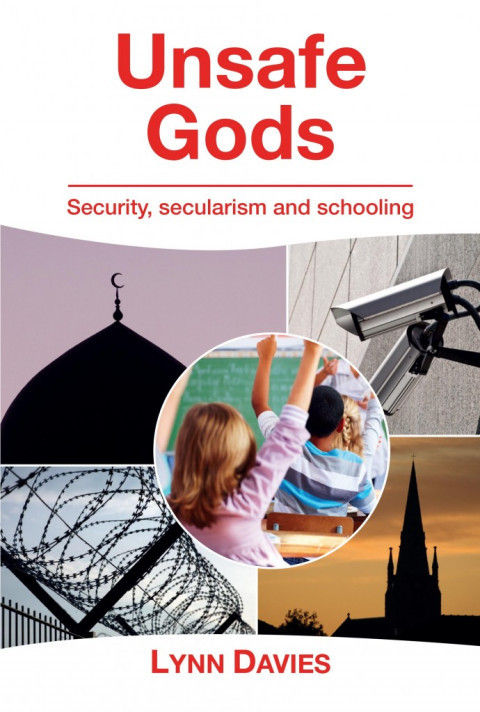 Unsafe Gods: Security, secularism and schooling سنة النشر: 2014 المؤلف: Lynn Davies This book makes the compelling argument that religion can be complicit in conflict and that a new secularism is vital to foster security. Using insights from complexity science, it shows how dynamic secularism can be used to accommodate diverse faiths and beliefs within worldly politics. Exploration of the interplay of religion and education in the context of security and notions of safe schools offers new understandings of how religions learn – or instead remain frozen accidents that hinder societies from adapting to change. The book shows how turbulence and amplification underscore the necessity for an education that is critical even of patriarchal religious texts and that recognizes the power of satire and humour. Unsafe Gods: Security, secularism and schooling سنة النشر: 2014 المؤلف: Lynn Davies Ce livre avance l'idée forte que la religion étant un facteur de conflictualité, une sécularisation plus poussée est vitale pour renforcer la sécurité. En mobilisant une approche inspirée des sciences de la complexité, il montre comment une sécularisation dynamique peut être appliquée à des systèmes politiques du monde entier afin de permettre la cohabitation de plusieurs religions et croyances. L'analyse des effets de l'interaction entre la religion et l'éducation en matière de sécurité et des dispositifs "safe schools" permet de comprendre la façon dont les religions s'adaptent, ou au contraire restent figées, empêchant les sociétés de s’adapter aux changements. Le livre montre que la conflictualité croissante souligne la nécessité de mettre en place une éducation centrée autour d'un regard critique, même à l'égard des textes religieux fondateurs, et qui reconnaisse l'intérêt de la satire et de l'humour.
  Breaking Historical Silence through Cross-cultural collaboration: Latvian curriculum writers and United States Holocaust Memorial Museum fellows In response to the need for Holocaust curricula in Latvia, Latvians and Americans worked collaboratively to overcome the historical silence surrounding this event. During their project, Latvian curriculum writers worked with teachers and scholars at the United States Holocaust Memorial Museum. This descriptive analysis of the Latvians' experience with Museum Fellows revealed opportunities to learn from each other the complexities of teaching the Holocaust in a country viewed by some as collaborators and still somewhat anti-Semitic. Findings included depth of guidance, values, and limits of innovative teaching methods, cross-cultural benefits, and continued collaboration. Recommendations for future efforts by post-Communist countries and American partners to develop curriculum on teaching a most complex and contentious aspect of history such as the Holocaust conclude the study. (By the author)
  Israeli Youth Pilgrimages to Poland. Rationale and Polemics The article, based on material collected as part of a project evaluating the pilgrimage trips to Poland by Israeli adolescents as part of the Holocaust curriculum, attempts to provide the reader with the background for these trips. In this context, the authors discuss the evolving national agenda in Israel, and the transition from experiencing independence to experiencing the Holocaust. The authors of the article stress that in the wake of the profound social changes that took place in Israeli society, the memory of the Holocaust gained new significance among the country’s national priorities. While a policy known as “the great silence” regarding the Holocaust prevailed among the first generation after statehood, the Holocaust has now become a factor that shaped the national ethos. In 1979, for the first time, the Ministry of Education commissioned two curricula dealing exclusively with the Holocaust. The article notes that the Holocaust and its lessons can be examined from three different perspectives: The first focuses on presenting the universal significance of the Holocaust and perceiving it as parallel to other cases of genocide. The second focuses on presenting the national significance of the Holocaust as a unique and unparalleled case of the Jewish People. The perception held by this approach is actually “the whole world is against us.” The third perspective is a synthesis of these two approaches. In this article, the authors note that the longstanding debate in Israeli society over the various methods for instilling the Holocaust and the journeys to Poland by adolescents expresses these three perspectives. (By the author)
  “We did also save people”: A Study of Holocaust Education in Romania After Decades of Historical Silence سنة النشر: 2008 المؤلف: Thomas Misco This research study seeks to understand the current state of Holocaust education in Romanian classrooms and the variety of forces that influence its treatment. By identifying obstacles, challenges, and successes, this study provides a generative knowledge base for curriculum proposals, symposia, and other initiatives that seek to disrupt reticence on this topic. Given the wide range of possible influences on Holocaust instruction, this study employs ethnographic methods to seek out constructed meanings among students, teachers, subject matter, and numerous forces within the milieu. The findings reveal some promise for addressing this history in schools, including teacher autonomy, institutional support, and teacher trainings. Yet Romania faces a number of challenges, such as the legacy of communism, the role of Antonescu in the curriculum, few opportunities to address controversies, limited instructional time, and other institutional and community forces. Holocaust education is a relatively new phenomenon in Romania and understanding its evolution can inform other societies and cultures that are working to introduce Holocaust studies or controversial issues into their curricula. As more post-Soviet and post-communist states attempt to build pluralistic, tolerant and open-minded societies, their treatment of historical silences and the renegotiation of their past become critical features for the development of democratic citizens. (By the author) Globalising the school curriculum: gender, EFA and global citizenship education (RECOUP working paper 17) سنة النشر: 2008 المؤلف: Harriet Marshall | Madeleine Arnot المؤلف المؤسسي: Research Consortium on Educational Outcomes and Poverty (RECOUP) This paper aims to bring the school curriculum into the analysis of gender, education and development. There is a marked absence of discussion both in the academic field of development studies and in the political domain of educational policy making around Education for All about what is required of the school curriculum so that it could help promote gender equality. All too often national school curricula reproduce gender inequalities in the public and private sphere and sustain hegemonic male regimes on a national and global scale (Arnot, 2002). Curriculum research, however, can challenge these social messages embedded in curricular formations as well as raise deeper questions about whose forms of knowledge should be transmitted through official forms of schooling. Critical sociological research, for example, recognises the importance of the rules governing the access and redistribution of knowledge, and also the politics behind the selection, organisation and evaluation of legitimate knowledge through formal national educational institutions within developing economies and the impact these have on indigenous social stratifications. It can also critically assess new global interventions into the school curriculum whether in the name of economic progress, human rights or social justice. These global developments are controversial not least because of the challenge they represent to what has been considered the prerogative of national governments – to transmit its own selection of educational knowledge to its citizens, using its own contextualised pedagogic style. The study of national curricula therefore offers the possibility of exploring the equity dimensions of global–national and local educational interfaces and policy agendas. The paper has limited but hopefully valuable ambitions. It aims to initiate discussion of the curriculum in relation to gender, education and development by exploring the global significance of recent interventions on gender, and in particular girls’ education. The first section briefly considers the implications of globalisation as a transformative process on the development of educational knowledge and queries whether the school curricula could address persistent worldwide gender disparities, inequalities and female subjugation. In the second section, we focus specifically on whether new global declarations around gender equality such as those analysed in the UNESCO Education for All Global Monitoring Reports imply certain roles for the school curriculum. The final section addresses the possibilities for gender equality implied by recent interest global citizenship education – a new curriculum subject and approach that promises much. We consider in a preliminary way whether these new developments represent a move towards forms of educational knowledge that are critical rather than legitimating and ‘normalising’ in relation to gender inequalities.