
الموارد
استكشف مجموعة واسعة من الموارد القيمة حول تعليم المواطنة العالمية لتعميق فهمك وتعزيز البحث والمناصرة والتعليم والتعلم.
تم العثور على 2,776 نتيجة
 Futures of Education: learning to become سنة النشر: 2019 المؤلف المؤسسي: UNESCO UNESCO’s Futures of Education initiative aims to rethink education and shape the future. The initiative is catalyzing a global debate on how knowledge, education and learning need to be reimagined in a world of increasing complexity, uncertainty, and precarity. Looking to 2050 and beyond, the Futures of Education initiative seeks to reimagine how education and knowledge can contribute to the global common good. The initiative will catalyze a global debate on how knowledge and learning can shape the future of humanity and the planet. L'avenir de l'éducation: apprendre à devenir سنة النشر: 2019 المؤلف المؤسسي: UNESCO L’initiative de l’UNESCO intitulée L’avenir de l’éducation vise à repenser l’éducation et à façonner l’avenir, en lançant un débat mondial sur la manière de réinventer le savoir, l’éducation et l’apprentissage dans un monde de plus en plus complexe, incertain et précaire. Le savoir et l’apprentissage sont les plus riches ressources renouvelables dont dispose l’humanité, pour relever les défis et frayer des voies nouvelles. Or, l’éducation fait bien plus que s’adapter à un monde changeant. L’éducation transforme le monde.
 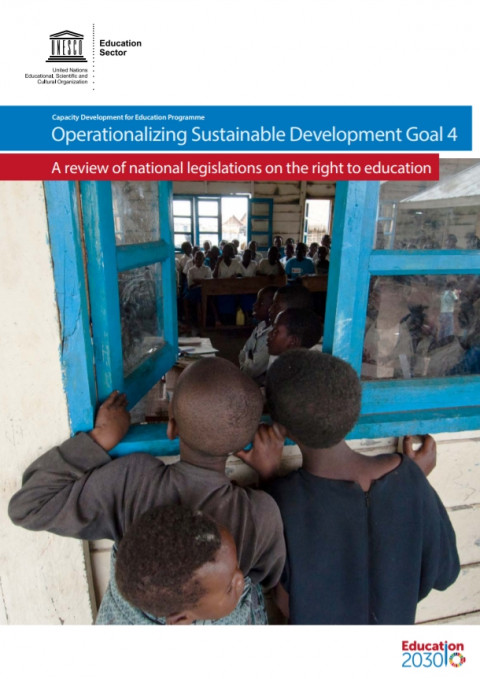 Operationalizing Sustainable Development Goal 4: a review of national legislations on the right to education سنة النشر: 2017 المؤلف: Santini, Delphine المؤلف المؤسسي: UNESCO As part of a wider Capacity Development for Education (CapED) Programme on operationalizing SDG4 at the country level, this paper examines the instrumental role that legislation on the right to education can play in view of achieving the SDG4 targets in Least Developed Countries. It does it by reviewing national legal frameworks relating to the right to education in 11 countries, suggesting some lessons of global interest, both for policy-making and normative work. Opérationnaliser l'Objectif de développement durable 4: examen des législations nationales sur le droit à l'éducation سنة النشر: 2017 المؤلف: Santini, Delphine المؤلف المؤسسي: UNESCO Dans le cadre du Programme de développement des capacités pour l’éducation (CapED) sur l’opérationnalisation de l’ODD 4 au niveau des pays, ce document examine le rôle déterminant de la législation relative au droit à l’éducation en vue d’atteindre les cibles de l’ODD 4 dans les pays les moins avancés. Les cadres juridiques nationaux relatifs au droit à l’éducation dans 11 pays sont passés en revue, tout en suggérant quelques recommandations de portée plus globale, à la fois pour l’élaboration de politiques et le renforcement du travail normatif.
  Intercultural dialogue and cultural diversity سنة النشر: 2007 المؤلف المؤسسي: UNESCO The collection of materials of the Central Asian round table is devoted to sharing best practices in intercultural dialogue and to the UNESCO Universal Declaration on Cultural Diversity.The work highlights issues on the exchange of best practices in the field of intercultural dialogue, popularization of the UNESCO Universal Declaration on cultural diversity, the creation of a “Central Asian platform to strengthen cultural cooperation and dialogue ”, to strengthen UNESCO Chairs in Central Asia. Межкультурный диалог и культурное разнообразие سنة النشر: 2007 المؤلف المؤسسي: Организация Объединенных Наций по вопросам образования, науки и культуры (UNESCO) Сборник материалов Центральноазиатского круглого стола посвящен обмену передовым опытом в области межкультурного диалога и попу- ляризации Всеобщей декларации ЮНЕСКО о культурном разнообразии.В работе освещаются вопросы по обмену передовым опытом в области межкультурного диалога, популяризации Всеобщей декларации ЮНЕСКО о культурном разнообразии, созданию “Центральноазиатской платформы для укрепления культурного сотрудничества и диалога”, укреплению сотрудничества кафедр ЮНЕСКО в Центральной Азии.
  Facing the facts: the case for comprehensive sexuality education سنة النشر: 2019 المؤلف: Global Education Monitoring Report Team المؤلف المؤسسي: UNESCO Comprehensive sexuality education is an essential part of a good quality education that helps prepare young people for a fulfilling life in a changing world. It improves sexual and reproductive health outcomes, promotes safe and gender equitable learning environments, and improves education access and achievement. This paper, produced jointly with the Section for Health and Education at UNESCO, discusses how governments can overcome social resistance and operational constraints to scale up these programmes as part of their commitment to SDG 4, the global education goal. Regarder la réalité en face: pourquoi faut-il promouvoir l'éducation complète à la sexualité سنة النشر: 2019 المؤلف: Global Education Monitoring Report Team المؤلف المؤسسي: Organisation des Nations Unies pour l'éducation, la science et la culture (UNESCO) L'éducation complète à la sexualité est un élément indispensable d'une éducation de qualité qui aide les jeunes à s'épanouir dans un monde en mutation. Elle améliore les résultats en matière de santé sexuelle et reproductive, crée les conditions d'un apprentissage sûr et équitable du point de vue du genre, élargit l'accès à l'éducation et améliore les résultats scolaires. Ce document d'orientation, préparé avec la section de la santé et de l'éducation de l'UNESCO, explique comment les gouvernements peuvent surmonter les résistances sociales et les contraintes opérationnelles pour amplifier ces programmes, conformément à leur engagement envers l'ODD 4, l'objectif mondial d'éducation. Encarar los hechos: el caso de la educación integral en sexualidad سنة النشر: 2019 المؤلف: Global Education Monitoring Report Team المؤلف المؤسسي: Organización de las Naciones Unidas para la Educación, la Ciencia y la Cultura (UNESCO) La educación integral en sexualidad forma parte esencial de una educación de buena calidad que ayude a preparar a las y los jóvenes para llevar una vida plena en un mundo en evolución. Dicha educación mejora la salud sexual y reproductiva, promueve entornos de aprendizaje seguros y equitativos en cuanto al género y favorece el acceso a la educación y el rendimiento escolar. En este documento, elaborado conjuntamente con la Sección de la Salud y la Educación de la UNESCO, se analiza cómo los gobiernos pueden superar la resistencia social y las limitaciones operativas para ampliar estos programas en el marco de su compromiso con el ODS 4, el objetivo mundial relativo a la educación.
 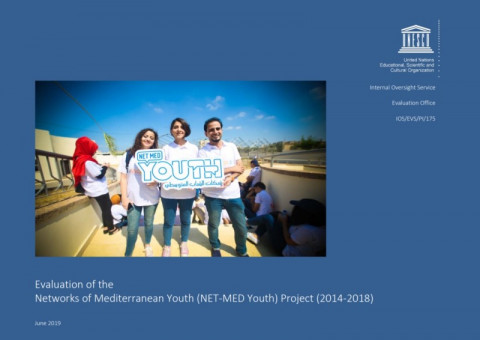 Evaluation of the Networks of Mediterranean Youth (NET-MED Youth) Project (2014-2018) سنة النشر: 2019 المؤلف: Maksymilian Fras | Yael Ohana | Kimiko Hibri Pedersen | Christophe Dietrich | Mamoun Besaiso المؤلف المؤسسي: UNESCO The Networks of Mediterranean Youth (NET-MED Youth) Project is a regional project funded by the European Union and implemented by UNESCO from 2014 until 2018. It followed a comprehensive approach through interdisciplinary activities in different thematic areas aimed at advancing youth legal and policy frameworks, enhancing youth representation in media, and reinforcing youth employability and skills in response to the challenges experienced by young women and men in the region regarding their transition to full autonomous citizenship in the civic, political, economic, social and cultural spheres. NET-MED Youth contributed to the creation of an enabling environment for young women and men from nine of the Southern countries of the European Neighbourhood Policy (i.e. Algeria, Israel, Jordan, Lebanon, Libya, Morocco, Palestine, Syria and Tunisia) to develop their competencies, to exercise their rights and meaningfully engage as active citizens in the development and implementation of national strategies on youth. The evaluation found that, overall, the NET-MED Youth Project was a successful initiative and created a momentum for Youth empowerment in the respective beneficiary countries. Its high relevance in the context of the Agenda 2030 resulted not least from UNESCO’s longstanding experience and good practices in working with youth organizations and youth-related stakeholders through youth engagement as partners and beneficiaries. The Project thus constituted a significant contribution to the UNESCO Operational Strategy on Youth 2014-2021. Gender equality was a central concern of NET-MED Youth, and systematically embedded throughout all activities as a transversal feature. In line with the Agenda 2030 commitment of leaving no one behind, several activities focused on issues of disadvantaged or traditionally underserved groups, such as youth with disabilities. Challenges identified are mainly related to the often difficult and in some countries unstable political environments. Together with the needs-based and rather context-specific approach in each country, this also affected to some extent the full implementation of the regional perspective. Furthermore, in the absence of a coherent and explicit longer-term exit strategy, the structures and results achieved risk not to be maintained, or scaled up over time, despite the strong local commitment and ownership created over the project duration. Through successfully incorporating youth aspirations in its design and implementation, the NET-MED Youth Project represented a new and innovative approach to youth engagement and empowerment in an interdisciplinary fashion, and should thus be considered as a basis for new thinking on which to build in the future. The high potential for replication of the NET-MED Youth Project, as a continuation or as an example of good practice for a comprehensive and interdisciplinary approach is thus to be further explored.