
الموارد
استكشف مجموعة واسعة من الموارد القيمة حول تعليم المواطنة العالمية لتعميق فهمك وتعزيز البحث والمناصرة والتعليم والتعلم.
تم العثور على 3,446 نتيجة
 SDG-4: Flexible Learning Pathways in Higher Education – from Policy to Practice: An International Comparative Analysis سنة النشر: 2022 المؤلف: Michaela Martin | Uliana Furiv المؤلف المؤسسي: UNESCO International Institute for Educational Planning (IIEP) Higher education systems across the world are currently faced with a massive influx of learners with more diverse needs. They are expected to respond to this growing diversity through a more flexible learning offer and pathways that allow all learners, including those from disadvantaged groups, to access, progress through, and complete, higher education.To enhance knowledge on how to provide increased flexibility in higher education, IIEP–UNESCO undertook an international research project on SDG-4: Planning for Flexible Learning Pathways (FLPs) in Higher Education. The project included a stocktaking of policies, instruments, and practices, an international survey among UNESCO Member States, and eight in-depth country studies on Chile, Finland, India, Jamaica, Malaysia, Morocco, South Africa, and the UK.This book presents the findings from the research, including a cross-country analysis of available FLP policies and practices, and how they enhance equitable higher education systems. It also presents a series of country experiences with innovative approaches to alternative entry, flexible progression, and governance systems in support of FLPs.
  Learner-Centred Teaching in Technical and Vocational Education and Training: Perspectives and Reviews of Six Asia-Pacific Countries سنة النشر: 2023 المؤلف المؤسسي: UNESCO Bangkok Learner-centred Teaching in Technical and Vocational Education and Training: Perspectives and Reviews of Six Asia-Pacific Countries A learner-centred approach to teaching in Technical and Vocational Education and Training (TVET) is based on learner engagement, autonomy and outcome-based activities to support professional development. This report analyses the status of learner-centred TVET teaching in six selected countries across Asia and the Pacific, including China, Republic of Korea, Samoa, Sri Lanka, Thailand, and Uzbekistan. The countries were selected because of their geographic diversity, access to national experts, and potential around learner-centred TVET.The first part of the study is a review of the theoretical background on the learner-centred approach and TVET teaching with an international scope. A total of 25 indicators were used to assess three components of TVET teaching in the region. The analysis includes 17 examples corresponding to the selected indicators. The findings showcase lessons learned and recommendations for countries to self-assess their TVET teaching strategies. These examples will help to inform future projects and capacity building in each sub-region of Asia-Pacific.As a result, seven proposals are identified and discussed to promote the development of learner-centred TVET teaching in the region. These proposals include: 1) supporting national reform of the pedagogy based on the results of pilot projects; 2) increasing two-way communication between students and teachers; 3) producing learning materials adapted to learner-centred methods; 4) using technology in the learning process; 5) implementing competency-based learning to support the learner-centred pedagogy; 6) integrating transversal and core skills; and 7) developing teachers’ capacities by employing a learner-centred approach. These proposals (on reform, teaching method, use of materials, etc.) also address gender dimensions throughout the planning, implementation and review process. Conclusions from the study provide lessons learned as well as proposals for further research and implementation of learner-centred TVET teaching in Asia-Pacific.
  Communication Strategy and Addressing the Phenomenon of Child Abduction in Algeria سنة النشر: 2023 المؤلف: Saeed Abdul Razzaq The study aimed to identify the role of the communication strategy in treating one of the communication strategy of the General Directorate of National Security in the process of protecting children, and the role of various communication tools and activities in treating and reducing the phenomenon of abduction of children in Algeria . We found that the communication strategy of the Directorate General of National Security plays an important role in the process of reducing the risk of child abduction in Algeria through the preventive communication strategy aimed at protecting children from abduction. الاستراتيجية الاتصالية ومعالجة ظاهرة اختطاف الأطفال في الجزائر سنة النشر: 2023 المؤلف: Saeed Abdul Razzaq هدفت الدراسة إلى معرفة دور الاستراتيجية الاتصالية في معالجة احدى الظواهر الاجتماعية المتمثلة في ظاهرة اختطاف الأطفال في الجزائر، من خلال عرض الاستراتيجية الاتصالية الخاصة بالمديرية العامة للأمن الوطني في عملية حماية الأطفال، ودور الوسائل والأنشطة الاتصالية المختلفة في معالجة والحد من ظاهرة اختطاف الأطفال في الجزائر. وقد وتوصلنا من خلال دراستنا أن للاستراتيجية الاتصالية للمديرية العامة للأمن الوطني دور مهم في عملية الحد من خطورة ظاهرة اختطاف الأطفال في الجزائر عبر الاستراتيجية الاتصالية الوقائية التي تهدف لحماية الأطفال من الاختطاف.
  Global Education Monitoring Report 2019: Gender Report: Building Bridges for Gender Equality سنة النشر: 2019 المؤلف المؤسسي: Global Education Monitoring Report Team Achieving gender equality in education participation, in the teaching and learning process and in access to social and economic opportunities that education can facilitate are key interlinked ambitions in two of the Sustainable Development Goals (SDGs) in the 2030 Agenda for Sustainable Development: SDG 4 on education and SDG 5 on gender equality. These aims are also key to the Education 2030 Framework for Action, which calls on countries to adopt strategies that not only cover access to education for all but also address substantive gender equality issues: ‘supporting gender-sensitive policies, planning and learning environments; mainstreaming gender issues in teacher training and curricula; and eliminating gender-based discrimination and violence in schools’. The 2019 Gender Report is based on a monitoring framework first introduced in the 2016 Global Education Monitoring Report.In addition to focusing on gender parity in education participation, attainment and learning achievement, the framework examines broad social and economic contexts (gender norms and institutions) and key education system characteristics (laws and policies, teaching and learning practices, learning environments, and resources). The framework also looks at the relationship between education and selected social and economic outcomes. For instance, a move towards parity in education attainment may increase women’s labour force participation rates, but low levels of labour force participation feed into existing norms and may constrain expansion of education opportunities for women.
  International Higher Education: Shifting Mobilities, Policy Challenges, and New Initiatives سنة النشر: 2018 المؤلف: Rajika Bhandari | Chelsea Robles | Christine Farrugia المؤلف المؤسسي: Global Education Monitoring Report Team | Institute of International Education (USA). Center for Academic Mobility Research and Impact Cross-border mobility in higher education, while still referring to a minority of people, is a large phenomenon that is increasingly taking new forms, extending from students and faculty member mobility to the movement of educational programs and institutions, including the spread of online courses facilitated by improvements in technology. It is also a phenomenon with major implications in facilitating the flow and exchange of ideas and knowledge, improving practices, generating resources for receiving countries, and attracting talent. For that reason, the internationalization of higher education puts pressure on countries to develop a strategy that would maximize the education, political and economic benefits while minimizing the costs.Based on an in-depth review of research and existing data, this paper examines key issues in the internationalization of higher education, assesses broad consequences, and discusses a selection of the latest trends. The paper also provides an overview of the key policy challenges and options facing governments in low, middle and high income countries as they seek to internationalize their higher education sectors while also sending their top talent overseas to acquire a global education.
  Beyond commitments 2019: how countries implement SDG 4 سنة النشر: 2019 المؤلف المؤسسي: Global Education Monitoring Report Team Almost one-third of the time set to achieve the Sustainable Development Goals (SDGs) has elapsed. The 2019 High-level Political Forum (HLPF), the global SDG follow-up and review mechanism, represents a major stock-taking moment for countries, especially as regards SDG 4, the education goal, which is being reviewed for the first time. The international community relies primarily on quantitative measures to assess progress towards the SDGs. Acompanion publication by the UNESCO Institute for Statistics and the Global Education Monitoring Report for the 2019 HLPF, titled ‘Meeting commitments: Are countries on track to achieve SDG 4?’, shows that there are major challenges ahead. But increasingly, member states demand more than quantitative information. They ask for guidance on how to respond when their education systems do not reach their targets. To respond to this demand, this publication has the following purposes: Understand countries’ perceptions of SDG 4 based on responses to a questionnaire prepared for this publication, which asked countries to report on their flagship SDG 4 policies Distil those perceptions into a framework of the types of national policies that are best aligned with SDG 4 and whose implementation should be monitored Communicate the framework succinctly and provide a complementary input for the review of SDG 4 at the 2019 HLPF Provide an opportunity for countries to engage in dialogue on how they approach SDG 4. An analysis of the questionnaires submitted by 72 governments shows that most countries refer to SDG 4 as a framework in which they place their education planning. A core recommendation is that countries should align their education plans and policies with their international commitments.
  Early Childhood Development and Early Learning for Children in Crisis and Conflict سنة النشر: 2018 المؤلف: Kolleen Bouchane المؤلف المؤسسي: Global Education Monitoring Report Team There is an urgent need for a comprehensive response, including early learning and family support programs, to the rapidly growing population of young children worldwide living in crisis and conflict. Substantial evidence from neuroscience to economics indicates that the early years of a child’s life lay the foundation for long-term health, learning and behavior. The first months and years are not only a critical period in an individual child’s lifelong capacity for learning, but weak learning foundations of children can compromise the long-term development of nations. Yet a review of Refugee and Humanitarian Response Plans conducted for this paper revealed that only 9 percent of plans included the essential elements of early learning. Relative to health and nutrition programming, early education and parenting interventions were more likely to be omitted from the Response Plans.The rationale for focusing new attention on the educational needs of young children living in fragile conditions is strong: there is a broad body of scientific evidence; the international legal framework of the United Nations Convention of the Rights of the Child asserts that all children have the right to health, education, legal registration, and protection from violence and separation from parents, beginning at birth; and the Sustainable Development Goals for all will be not reached without a focus on the earliest years of life in crisis and conflict situations. This background paper presents the case for increased attention and investment in early childhood in conflict and crisis contexts, with focused attention on early learning and family support. The scale of the problem, current science and evidence, current global standards and principles, and case studies are all discussed and priority recommendations are offered.
 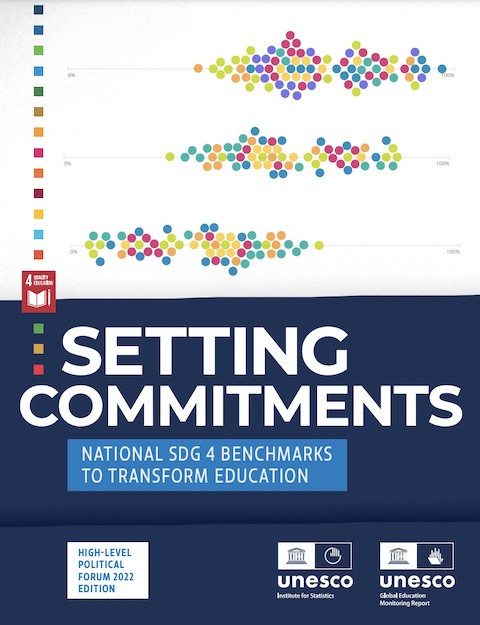 Setting Commitments: National SDG 4 Benchmarks to Transform Education سنة النشر: 2022 المؤلف المؤسسي: Global Education Monitoring Report Team | UNESCO Institute for Statistics (UIS) This publication provides an overview of the transformative agenda being established by countries, as they set SDG 4 benchmarks for education progress to take ownership of the 2030 Agenda for Sustainable Development. Inspired by the UN Secretary-General’s 2014 call for countries to embrace ‘a culture of shared responsibility’ based on ‘benchmarking for progress’, paragraph 28 of the Education 2030 Framework for Action also called on countries to establish ‘appropriate intermediate benchmarks for addressing the accountability deficit associated with longer-term targets’. This report outlines the steps taken by countries to set these commitments for 2025 and 2030 against seven indicators and is timed to feed into the second review of SDG 4 at the High-level Political Forum.The SDG 4 benchmark values now defined for almost nine in ten countries lay out their nationally determined contributions to the common education goal, using a concept embraced by the climate change sector. Twelve countries’ experiences of approaching the challenge of setting benchmarks based on their education sector plans are included, serving as inspiration for other countries to reflect on their own contributions and the task of developing appropriate policy responses in line with their own ambitions for the next decade, especially in the context of recovery from COVID-19.This publication proposes a way forward for monitoring progress towards the national SDG 4 benchmarks. This way of monitoring will be context-specific, recognizing countries’ starting points, helping link their national with regional and global education agendas.The benchmarks could be a basis for a compact in which countries commit to increasing their ambition, and, in return, the international community offers a program of support. In other words, a system of political accountability associated to political commitments with a support mechanism to accomplish the task. Rapport mondial de suivi de l'éducation 2019: rapport sur l'égalité des genres: Bâtir des ponts pour promouvoir l'égalité des genres سنة النشر: 2019 المؤلف المؤسسي: Global Education Monitoring Report Team La réalisation de l’égalité des genres dans la participation à l’éducation, les processus d’enseignement et d’apprentissage et l’accès aux possibilités sociales et économiques offertes par l’éducation est une ambition majeure portée par deux des Objectifs du Programme de développement durable à l’horizon 2030: l’ODD 4 relatif à l’éducation et l’ODD 5 relatif à l’égalité des sexes. Cette ambition occupe également une place centrale dans le Cadre d’action Éducation 2030, qui appelle les pays à ne pas se limiter à l’accès à l’éducation pour tous dans les stratégies qu’ils adoptent mais à aborder également les questions de fonds relatives à l’égalité des genres: «nous prenons l’engagement de soutenir les politiques, la planification et les environnements d’apprentissage attentifs au genre, d’intégrer les questions de genre dans la formation des enseignants et dans les programmes d’enseignement, ainsi que d’éliminer les discriminations et la violence fondées sur le genre à l’école». Le Rapport 2019 sur l’égalité des genres s’appuie sur le cadre de mesure qui a été utilisé pour la première fois dans l’édition 2016 du Rapport mondial de suivi sur l’éducation.Tout en examinant en priorité la parité entre les genres dans la participation à l’éducation et les résultats et les acquis scolaires, le cadre analyse des données sociales et économiques (normes et institutions liées au genre) ainsi que les principales caractéristiques des systèmes éducatifs (lois et politiques, pratiques d’enseignement et d’apprentissage, environnements d’apprentissage et ressources). Le cadre s’intéresse en outre aux rapports entre l’éducation et certains résultats sociaux et économiques précis. Ainsi, une plus grande parité au niveau des résultats scolaires peut accroître le taux de participation des femmes au marché du travail tandis qu’une faible participation féminine au marché du travail renforce les normes existantes et freine le développement des possibilités d’éducation des femmes.