
الموارد
استكشف مجموعة واسعة من الموارد القيمة حول تعليم المواطنة العالمية لتعميق فهمك وتعزيز البحث والمناصرة والتعليم والتعلم.
تم العثور على 3,448 نتيجة
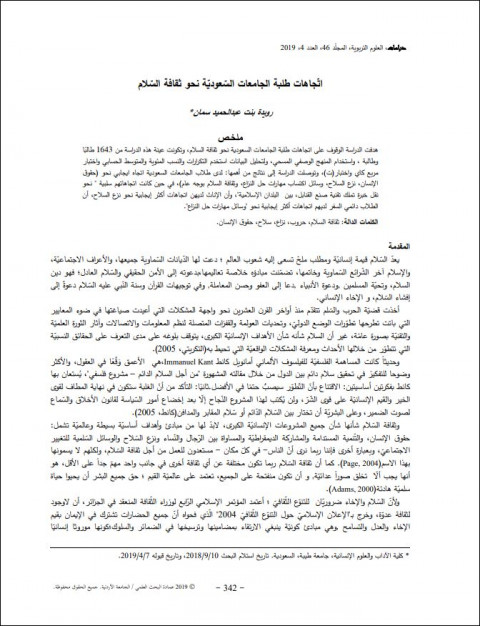 Saudi University Students’ Attitude Towards a Culture of Peace سنة النشر: 2019 المؤلف: Rowaidah Abdulhameed Saman المؤلف المؤسسي: University of Jordan The aim of this study is to identify the attitudes of Saudi Universities’ students towards peace culture. The descriptive surveying approach was used on a sample of 1643 students. The frequency, percentages, arithmetic mean, Kay-box test, and T-test were used in the analysis. The results showed that Saudi students have a positive attitude towards (human rights, disarmament, conflict resolution skills, peace culture) while their attitudes were negative towards transferring bomb-making experience to Islamic countries. Also, females had more positive attitudes towards disarmament than male students. اتّجاهات طلبة الجامعات السّعوديّة نحو ثقافة السّلام سنة النشر: 2019 المؤلف: Rowaidah Abdulhameed Saman المؤلف المؤسسي: University of Jordan هدفت الدراسة الوقوف على اتجاهات طلبة الجامعات السعودية نحو ثقافة السلام، وتكونت عينة هذه الدراسة من 1643 طالبا وطالبة، واستخدام المنهج الوصفي المسحي، ولتحليل البيانات استخدم التكرارات والنسب المئوية والمتوسط الحسابي واختبار مربع كاي واختبار (ت)، وتوصلت الدراسة إلى نتائج من أهمها: لدى طلاب الجامعات السعودية اتجاه إيجابي نحو (حقوق الإنسان، نزع السلاح، وسائل اكتساب مهارات حل النزاع، وثقافة السلام بوجه عام)، في حين كانت اتجاهاتهم سلبية "نحو نقل خبرة تملك تقنية صنع القنابل، بين البلدان الإسلامية"، وأن الإناث لديهن اتجاهات أكثر إيجابية نحو نزع السلاح، أن الطلاب دائمي السفر لديهم اتجاهات أكثر إيجابية نحو "وسائل مهارات حل النزاع".
  The Role of Education Towards Enhancing the Peaceful Coexistence Culture and Devoting the Citizenship Values of Postmodern Society سنة النشر: 2019 المؤلف: Lilia Bensouilah المؤلف المؤسسي: Research & Development of Human Resources Center REMAH This study aims to examine the role of education in creation the peaceful coexistence culture, promote opportunities for cosmopolitan openness to the other, preserve mutual respect and legitimize culture of difference, tolerance and pluralism of religions, beliefs and ideologies away from all manifestations of intolerance, hatred and destructive conflicts that violate human rights. دور التعليم في تعزيز ثقافة التعايش السلمي وتكريس قيم المواطنة في سياق مجتمع ما بعد الحداثة سنة النشر: 2019 المؤلف: Lilia Bensouilah المؤلف المؤسسي: Research & Development of Human Resources Center REMAH تركز الورقة على تحليل دور التعليم وبحث المجهودات العالمية والمساعي الدولية في سياق مجتمعي لما بعد الحداثة نحو تعزيز ثقافة التعايش السلمي وتكريس قيم المواطنة بما يتوافق مع المنظور الحقوقي الإنساني، وما ينبثق عنه من احترام وتقبل لتعددية واختلاف المذاهب والأديان والأيديول وجيات والثقافات بعيدا عن كل مظاهر التعصب الفكري المذهبي والعرقي والذي يمكن أن يهيأ بيئة محفزة لنشوب النزاعات المسلحة والصراعات المدمرة المنتهكة الكيان الحقوقي للبشرية قاطبة.
 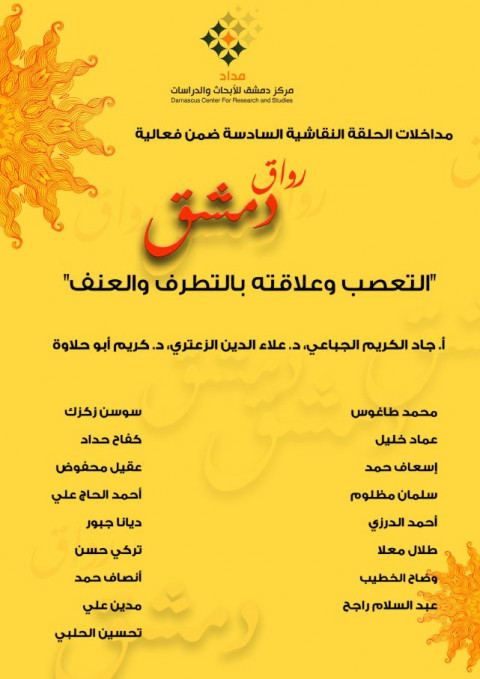 Intolerance and Its Relationship to Extremism and Violence سنة النشر: 2017 المؤلف: Jad Al-Karim Al-Jabaei | Aladdin Zaatari | Karim Abu Halawa المؤلف المؤسسي: Damascus Center for Research and Studies This document is a set of research papers discussing intolerance and its relationship to extremism and violence. In this production, the researchers tried to shed light on one of the issues facing societies, which is intolerance. التعصب وعلاقته بالتطرف والعنف سنة النشر: 2017 المؤلف: Jad Al-Karim Al-Jabaei | Aladdin Zaatari | Karim Abu Halawa المؤلف المؤسسي: Damascus Center for Research and Studies مجموعة من الأوراق البحثية تناقش التعصب وعلاقته بالتطرف والعنف. حاول الباحثون في هذا الانتاج تسليط الضوء على واحد من القضايا التي تواجه المجتمعات وهو التعصب.
 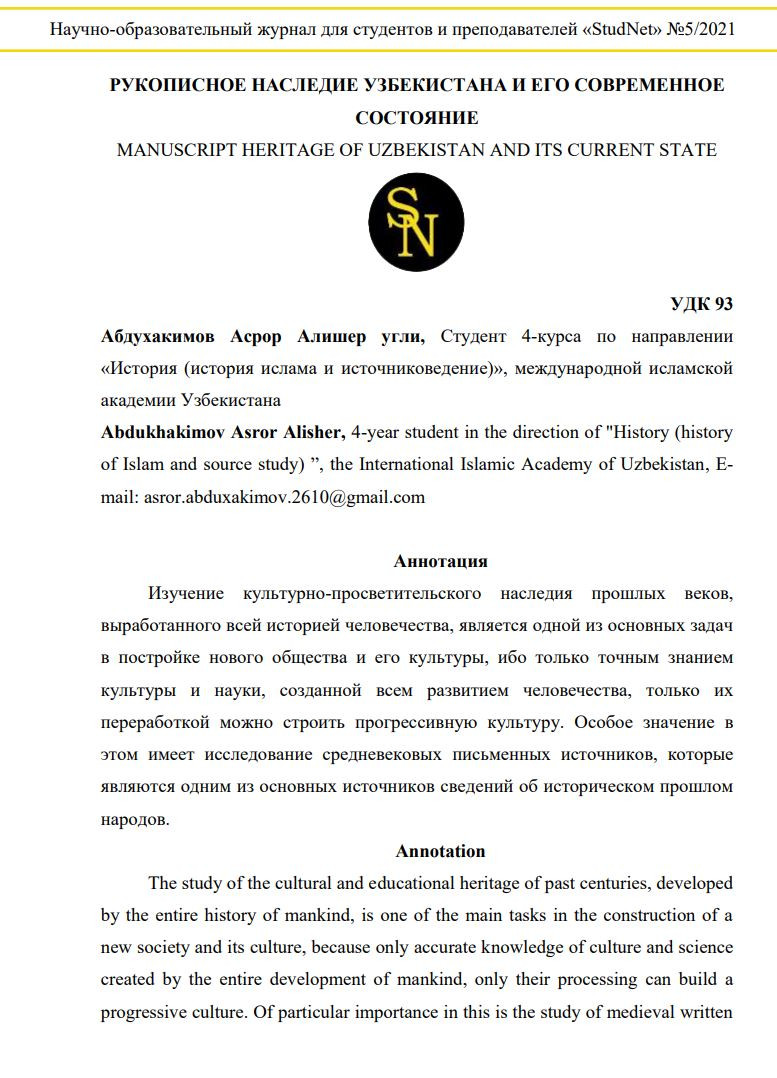 Manuscript Heritage of Uzbekistan and Its Current State سنة النشر: 2021 المؤلف: Asror Abdukhakimov The study of the cultural and educational heritage of past centuries, developed by the entire history of mankind, is one of the main tasks in the construction of a new society and its culture, because only accurate knowledge of culture and science created by the entire development of mankind, and their processing can build a progressive culture. Of particular importance in this is the study of medieval written sources, which are one of the main sources of information about the historical past of people. Рукописное наследие Узбекистана и его современное состояние سنة النشر: 2021 المؤلف: Asror Abdukhakimov Изучение культурно-просветительского наследия прошлых веков, выработанного всей историей человечества, является одной из основных задач в постройке нового общества и его культуры, ибо только точным знанием культуры и науки, созданной всем развитием человечества, только их переработкой можно строить прогрессивную культуру. Особое значение в этом имеет исследование средневековых письменных источников, которые являются одним из основных источников сведений об историческом прошлом народов.
  Backtalk: The Participatory Film and Its Residency in the Space of Cultural Violence and Creative Education towards a Conceptual Understanding of Peace سنة النشر: 2017 المؤلف: Ruchika Gurung المؤلف المؤسسي: Mahatma Gandhi Institute of Education for Peace and Sustainable Development (MGIEP) Cultural violence is defined as the beliefs, attitudes and values that justify structural and direct violence (Galtung 1990). It dulls us into seeing exploitation and repression as normal or in not actively witnessing it, and the media plays a vital role in its dissemination. Media and in particular film studies occupies a space through which notions of culture, ideology, peace and violence are negotiated.While the observational approach to film is well established in education, participatory filmmaking as an educational tool is what this paper addresses, with reference to concepts of cultural violence and peace education.This paper uses Brantmeier’s (2011) five stage model, that encourages social and cultural change towards a future that is nonviolent, sustainable and renewable, and Bery’s (2003) conceptualisation of empowerment to propose that participatory film functions as a transformative creative process and challenges notions of identity and culture while helping learners describe the world around them (Zembylas & Bekerman 2013).Through analysing existing cases in the field of participatory video (Schwab-Cartas & Mitchell 2014), the author argue that participatory film functions as a tool for creative education practices that promotes a more hands-on approach to raising awareness about cultural violence and engaging with identity formation, and as a creative tool for knowledge creation and dissemination.
  Education for international understanding: toward a culture of peace (SangSaeng vol1. autumn 2001) سنة النشر: 2001 المؤلف: Swee-Hin Toh المؤلف المؤسسي: APCEIU Over the past several decades of political, economic, social and cultural changes and developments throughout the world, the idea of education for international understanding (EIU) has evolved through the work of innumerable educators, researchers, institutions and organizations. Initially, the focus in school and tertiary programs tended to emphasize the need to increase the level of knowledge about other nations, societies and cultures as a key means to promote better, more “peaceful” international (economic and political) and intercultural relations. Especially in universities of the “North,” area studies of different regions and countries expanded and found their way into school-based curricula. In part, EIU was deemed important and helpful in the development of human resources needed to implement foreign aid programs. It was also a response to the increased internationalization of campuses due to the growing numbers of foreign/overseas students. By the 60s, however, a variety of social and political forces and movements were beginning to impact on this earlier focus of EIU. First, it was no longer viewed only in terms of understanding the relations between “nations” or “societies” across political and economic boundaries. EIU would need also to look closely at local and internal issues, and at problems of one’s own society that might significantly influence the direction and nature of international relations. Furthermore, conceptual perspectives on EIU began to reflect a spectrum of frameworks of understanding and analysis, from “conservative” and “liberal” to more “critical” paradigms. Underpinning the critical approaches was a questioning of the power inequities characterizing the international order of nation-states, and the need to overcome such gaps if the original vision of “world peace” was to be fulfilled. Third, the evolving theory and practice of EIU took on a host of societal, international and increasingly global issues deemed urgent at all levels of life.