
الموارد
استكشف مجموعة واسعة من الموارد القيمة حول تعليم المواطنة العالمية لتعميق فهمك وتعزيز البحث والمناصرة والتعليم والتعلم.
تم العثور على 882 نتيجة
 Gender Equality and Empowerment of Women and Girls in the UK: Meeting the Challenge of the Sustainable Development Goals سنة النشر: 2016 المؤلف: Holly Dustin | Helen Mott | Nicola Waterworth | Gillian Cowell | Janet Veitch المؤلف المؤسسي: British Council This research provides the first stocktake of gender equality in the UK from the perspective of the UN’s Sustainable Development Goals (SDGs), the 17 goals adopted by world leaders in 2015 in order to end poverty, protect the planet and ensure prosperity for all.It focuses on the UK’s successes towards achieving gender equality, as well as gaps and priorities for further action in five key areas: participation, power and leadership; education; economy; justice and violence against women and girls and culture (including arts, sports and technology). There are many examples of good practice from the UK, such as strong legislation, data gathering and structures. However, the research also concludes that women and girls continue to lag behind men and boys on key rights, opportunities and well-being, with men over-represented in almost all positions of power and decision-making. It also explores the impact of international linkages and collaboration to determine whether as the UK’s cultural relations organisation, there is a role for the British Council in this.
  Transformative Education: Bridging Education for Change سنة النشر: 2021 المؤلف: Jana Arbeiter | Maja Bučar المؤلف المؤسسي: Bridge 47 This publication suggests that improvements in the areas of coordination, cooperation, awareness raising and capability development are needed, as outlined in the recommendations below. Policies and strategies at national, regional and global level should adopt overarching visions for transformative education in the form of overarching strategies for SDG Target 4.7. Mechanisms for coordination and collaboration between the different components of SDG Target 4.7 should be established at national, regional and global levels. Awareness of the role of transformative education and SDG Target 4.7 in contributing to more just and sustainable futures should be raised jointly between the different components of SDG Target 4.7. Opportunities for capacity building and upskilling of practitioners and learners linked to transformative education should be enabled and created at national, regional and global levels.
  School-Related Gender-Based Violence Measurement Toolkit سنة النشر: 2020 المؤلف: Dexis Consulting Group المؤلف المؤسسي: United States Agency for International Development (USAID) This toolkit delivers practical guidance and resources for measuring the prevalence and extent of students’ experiences of school-related gender-based violence (SRGBV), and provides methods for assessing key risk factors and drivers of SRGBV. This toolkit contains a conceptual framework for measuring SRGBV, a school- based survey for measuring experiences of SRGBV, risk factors, and drivers, as well as practical guidance for implementing the survey.
  Ending Violence in Schools : An Investment Case سنة النشر: 2021 المؤلف: Quentin Wodon | Chloë Fèvre | Chata Malé | Ada Nayihouba | Hoa Nguyen المؤلف المؤسسي: World Bank Preventing violence in and through school is a prerequisite for girls and boys getting the education they need and deserve, and acquiring the skills, knowledge and values that provide the foundations for strong and inclusive societies. This report demonstrates that violence in and around schools negatively impacts educational outcomes, and society pays a heavy price as a result (with an estimate of $11 trillion in lost lifetime earnings). Cost-benefit analyses suggest that implementing interventions to prevent violence in and through schools from early childhood to secondary education is a smart economic investment. Rigorously evaluated programs and policies aimed at preventing violence at different levels of the education system show that action is feasible. The benefits of investing in preventing violence in and through schools is likely to far outweigh the costs.
 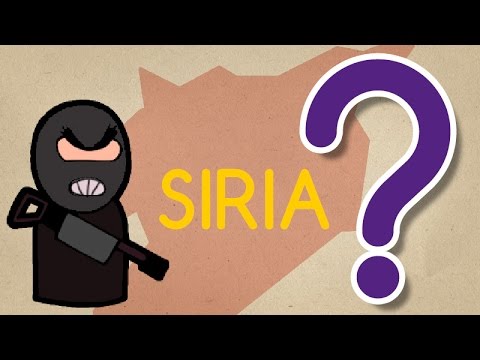 Why There Is War in Syria? سنة النشر: 2015 المؤلف المؤسسي: CuriosaMente What is happening in Syria? What is the cause of the conflict in Syria? This video explains the situation in this region formerly known as Mesopotamia. ¿Porqué hay guerra en Siria? سنة النشر: 2015 المؤلف المؤسسي: CuriosaMente ¿Qué está sucediendo en siria? ¿A qué se debe el conflicto en Siria? Este video explica la situación en esta región conocida anteriormente como Mesopotamia.
 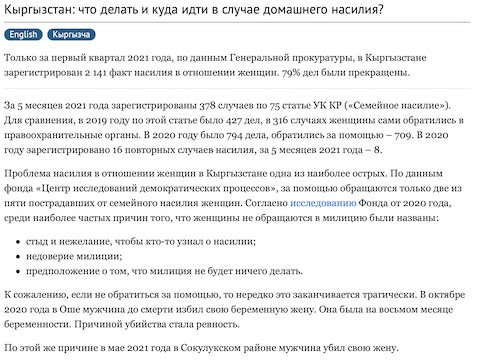 Kyrgyzstan: What to Do and Where to Go in Case of Domestic Violence? سنة النشر: 2021 المؤلف: Mehrinisa Sulaimanovna المؤلف المؤسسي: Central Asian Bureau for Analytical Reporting (CABAR) The problem of violence against women in Kyrgyzstan is one of the most relevant. According to the Centre for Democratic Processes Studies Fund, only two of five female victims of domestic violence call for help. Кыргызстан: Что делать и куда идти в случае домашнего насилия?? سنة النشر: 2021 المؤلف: Mehrinisa Sulaimanovna المؤلف المؤسسي: Central Asian Bureau for Analytical Reporting (CABAR) Проблема насилия в отношении женщин в Кыргызстане одна из наиболее острых. По данным фонда «Центр исследований демократических процессов», за помощью обращаются только две из пяти пострадавших от семейного насилия женщин.
 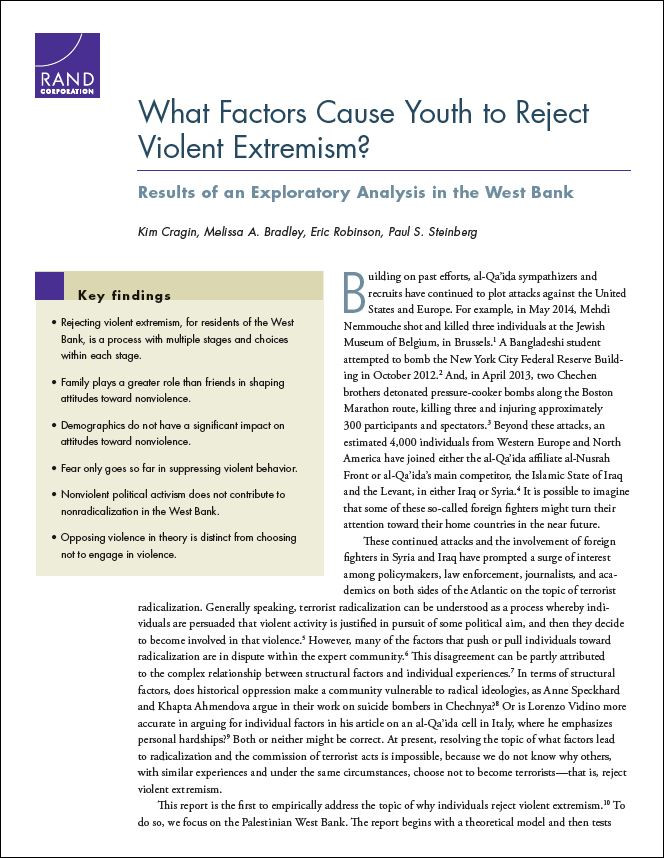 ما هي العوامل التي تدفع الشباب إلى رفض التطرف العنيف؟: نتائج تحليل استكشا في تم إجراؤه في الضفة الغربية سنة النشر: 2015 المؤلف: Kim Cragin | Melissa A. Bradley | Eric Robinson | Paul S. Steinberg المؤلف المؤسسي: RAND Corporation أدت الهجمات الإرهابية المستمرة وتورط مقاتلين أجانب في سوريا والعراق إلى زيادة الاهتمام بين صانعي السياسات وإنفاذ القانون والصحفيين والأكاديميين على جانبي المحيط الأطلسي بشأن موضوع التطرف الإرهابي. العديد من العوامل التي تدفع الأفراد أو تدفعهم نحو التطرف محل نزاع داخل مجتمع الخبراء. بدلاً من فحص العوامل التي تؤدي إلى التطرف وارتكاب أعمال إرهابية ، يتخذ هذا التقرير مقاربة جديدة. ما هي العوامل التي تدفع الشباب إلى رفض التطرف العنيف؟ نتائج التحليل الاستكشافي في الضفة الغربية تعالج بشكل تجريبي موضوع لماذا يرفض الشباب التطرف العنيف. للقيام بذلك ، يركز المؤلفون على الضفة الغربية الفلسطينية. يبدأ التقرير بنموذج نظري ثم يختبر هذا النموذج بالبيانات التي تم جمعها من خلال المقابلات والمسح المنظم. في هذه الدراسة ، تم إجراء عشر مقابلات شبه منظمة مع سياسيين من حماس وفتح في عام 2012. إلى جانب هذه المقابلات ، أجرى المؤلفون مسحًا على 600 شاب (تتراوح أعمارهم بين 18 و 30 عامًا) يعيشون في الخليل وجنين ورام الله.تظهر النتائج الشاملة لهذا الجهد أن (1) رفض التطرف العنيف ، بالنسبة لسكان الضفة الغربية ، هو عملية ذات مراحل وخيارات متعددة في كل مرحلة. (2) تلعب الأسرة دورًا أكبر من دور الأصدقاء في تشكيل المواقف تجاه اللاعنف ؛ (3) الديموغرافيات ليس لها تأثير كبير على المواقف تجاه اللاعنف. و (4) تختلف مناهضة العنف نظريًا عن اختيار عدم الانخراط في العنف. What Factors Cause Youth to Reject Violent Extremism?: Results of an Exploratory Analysis in the West Bank سنة النشر: 2015 المؤلف: Kim Cragin | Melissa A. Bradley | Eric Robinson | Paul S. Steinberg المؤلف المؤسسي: RAND Corporation Continued terrorist attacks and the involvement of foreign fighters in Syria and Iraq have prompted a surge of interest among policymakers, law enforcement, journalists, and academics on both sides of the Atlantic on the topic of terrorist radicalization. Many of the factors that push or pull individuals toward radicalization are in dispute within the expert community. Instead of examining the factors that lead to radicalization and the commission of terrorist acts, this report takes a new approach. What Factors Cause Youth to Reject Violent Extremism? Results of an Exploratory Analysis in the West Bank empirically addresses the topic of why youth reject violent extremism. To do this, the authors focus on the Palestinian West Bank. The report begins with a theoretical model and then tests this model with data gathered through structured interviews and a survey. For this study, ten semistructured interviews were conducted with politicians from Hamas and Fatah in 2012. Along with these interviews, the authors conducted a survey among 600 youth (ages 18–30) who lived in Hebron, Jenin, and Ramallah.The overarching findings from this effort demonstrate that (1) rejecting violent extremism, for residents of the West Bank, is a process with multiple stages and choices within each stage; (2) family plays a greater role than friends in shaping attitudes toward nonviolence; (3) demographics do not have a significant impact on attitudes toward nonviolence; and (4) opposing violence in theory is distinct from choosing not to engage in violence.