
الموارد
استكشف مجموعة واسعة من الموارد القيمة حول تعليم المواطنة العالمية لتعميق فهمك وتعزيز البحث والمناصرة والتعليم والتعلم.
تم العثور على 1,471 نتيجة
 Nuestra diversidad creativa: informe de la comisión mundial de cultura y desarrollo, versión resumida سنة النشر: 1996 المؤلف المؤسسي: World Commission on Culture and Development This report is designed to address a diversified audience across the world that ranges from community activists, field workers, artists and scholars to government officials and politicians. We want it to inform the world’s opinion leaders and to guide its policy-makers. We want it to capture the attention of the world’s intellectual and artistic communities, as well as the general public. We aim to have shown them how culture shapes all our thinking, imagining and behaviour. It is the transmission of behaviour as well as a dynamic source for change, creativity, freedom and the awakening of innovative opportunities. For groups and societies, culture is energy, inspiration and empowerment, as well as the knowledge and acknowledgment of diversity: if cultural diversity is ‘behind us, around us and before us”, as Claude L&i-Strauss put it, we must learn how to let it lead not to the clash of cultures, but to their fruitful coexistence and to intercultural harmony. Just as in the tasks of building peace and consolidating democratic values, an indivisible set of goals, so too economic and political rights cannot be realized separately from social and cultural rights. The challenge to humanity is to adopt new ways of thinking, new ways of acting, new ways of organizing itself in society, in short, new ways of living. The challenge is also to promote different paths of development, informed by a recognition of how cultural factors shape the way in which societies conceive their own futures and choose the means to attain these futures. I have for some time been concerned with the “culture of peace”. There is now considerable evidence that neglect of human development has been one of the principal causes of wars and internal armed conflicts, and that these, in turn, retard human development. With government complicity and with the intention of raising export receipts, private businesses continue to sell advanced military technology, nuclear materials and equipment for the production of bacteriological and chemical warfare. The concept of state sovereignty which still prevails today has increasingly come under scrutiny. In the area of peace-keeping, the distinction between external aggression and internal oppression is often unrealistic. The predominant threat to stability are violent conflicts within countries and not between them. There is an urgent need to strengthen international human rights law. Many of the most serious troubles come from within states – either because of ethnic strife or repressive measures by governments. Conditions that lead to tyranny and large-scale violations of human rights at home sooner or later are likely to spill over into a search for enemies abroad. The temptation of repressive states to export internal difficulties is great. Consider the Soviet Union’s invasion of Hungary and Czechoslovakia after it had used domestic oppression and the persistent refusal - for many years - of the previous South African governments to grant independence to Namibia. An ounce of prevention is better than a ton of punishment.
 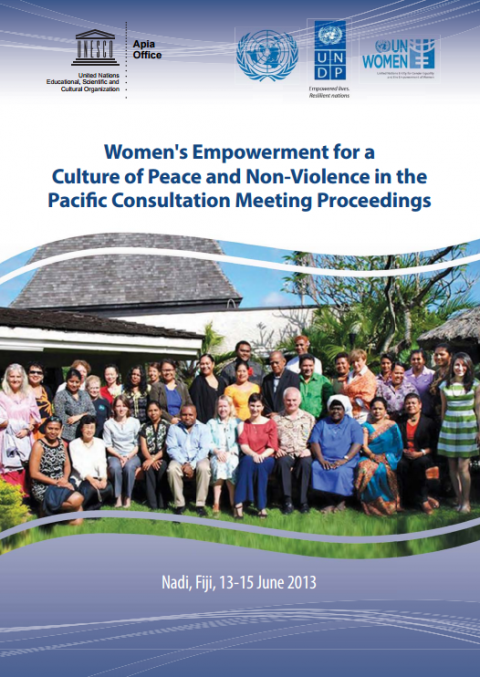 Women's empowerment for a culture of peace and non-violence in the pacific consultation meeting proceedings سنة النشر: 2013 المؤلف المؤسسي: UNESCO Apia The Consultation on Women’s Empowerment for a Culture of Peace and Non Violence in the Pacific was held in Nadi, Fiji, from 13 to 15 June 2013. The consultation was an interagency collaboration between the United Nations Educational, Scientific and Cultural Organization (UNESCO), the United Nations Entity for Gender Equality and the Empowerment of Women (UN WOMEN) and the United Nations Development Programme (UNDP) Pacific Centre as part of the United Nations strategy “Delivering as One”. This collaboration focused on efforts to design, promote and strengthen a culture of peace in the Pacific at the country and regional levels. The consultation brought together 30 senior representatives, including development professionals and community members, from governments, regional organizations, women’s organizations, faith-based groups, academic institutions and development partners from the Cook Islands, Fiji, Kiribati, Palau, Papua New Guinea, Samoa, Solomon Islands, Tonga and Vanuatu. The consultation ended with an agreement on a range of actions that could be adopted at the local, national and regional levels to promote increased dialogue between leaders and policy makers on the contributions that culture and heritage can make to addressing issues of gender inequality and reducing GBV. The outcome statement identifies the importance of building positive cultural models, using a range of key factors, including female leaders, faith-based leaders and traditional leaders as well as political leaders and parties. The statement also emphasized education as a means of promoting a culture of peace and non-violence. The consultation’s outcome statement noted that the school curriculum should place a stronger emphasis on values, gender equality, sexual and reproductive health and rights, and the building of positive cultural models. The follow up actions identified include increasing public awareness on achieving equality for Pacific women, including women at the grassroots level, in bringing peace to conflict-affected communities; targeting young people as the next generation of leaders; using the arts and cultural and sports events to break down gender stereotypes; actions relating to economic empowerment, access to justice and service delivery; and intangible cultural heritage capacity building incorporating substantive gender equality components. L'autonomisation des femmes pour une culture de paix et de non-violence dans la procédure de réunion de consultation pacifique سنة النشر: 2013 المؤلف المؤسسي: UNESCO Apia La Consultation sur l'Autonomisation des Femmes pour une Culture de la Paix et de la Non-Violence dans le Pacifique a eu lieu à Nadi, Fidji, du 13 au 15 Juin 2013. La consultation a été une collaboration interinstitutions entre la culture (UNESCO) Organisation des Nations Unies pour l'éducation, la science et l'Entité des Nations Unies pour l'égalité des sexes et l'autonomisation des femmes (ONU Femmes) et le Programme des Nations Unies pour le développement (PNUD) Centre du Pacifique dans le cadre de la stratégie des Nations Unies «Delivering as One». Cette collaboration a porté sur les efforts pour concevoir, promouvoir et renforcer une culture de paix dans le Pacifique au niveau national et régional. La consultation a réuni 30 représentants de haut niveau, y compris les professionnels du développement et des membres de la communauté, des gouvernements, des organisations régionales, des organisations de femmes, les groupes religieux, les institutions académiques et les partenaires de développement des îles Cook, Fidji, Kiribati, Palau, Papouasie-Nouvelle-Guinée, Samoa , Îles Salomon, Tonga et Vanuatu. La consultation a pris fin avec un accord sur une série d'actions qui pourraient être adoptées aux niveaux local, national et régional pour promouvoir le dialogue accru entre les dirigeants et les décideurs politiques sur les contributions que la culture et le patrimoine peuvent apporter à résoudre les problèmes d'inégalité entre les sexes et la réduction de GBV . L'énoncé de résultat souligne l'importance de la construction de modèles culturels positifs, en utilisant une gamme de facteurs clés, y compris les femmes leaders, des dirigeants religieux et les chefs traditionnels ainsi que des dirigeants et partis politiques. La déclaration a également souligné l'éducation comme un moyen de promouvoir une culture de paix et de non-violence. La déclaration des résultats de la consultation a noté que le programme scolaire devrait mettre davantage l'aCECnt sur les valeurs, l'égalité des sexes, la santé et les droits sexuels et de la reproduction, et la construction de modèles culturels positifs. Les actions de suivi identifiées comprennent la sensibilisation du public sur la réalisation de l'égalité pour les femmes du Pacifique, y compris les femmes au niveau local, pour ramener la paix dans les communautés touchées par le conflit; ciblant les jeunes comme la prochaine génération de leaders; en utilisant les arts et et des événements culturels de sport pour briser les stéréotypes de genre; les actions relatives à l'autonomisation économique, l'accès à la justice et la prestation des services; et immatériel renforcement des capacités du patrimoine culturel incorporant fond composantes égalité entre les sexes. Address by Irina Bokova, Director-General of UNESCO, on the occasion of the Mahatma Gandhi Institute of Education for Peace and Sustainable Development; New Delhi, 11 November 2012 سنة النشر: 2012 المؤلف المؤسسي: UNESCO. Director-General, 2009-2017 (Bokova, I.G.) This address was presented by Irina Bokova, Director-General of UNESCO on the occasion of the Mahatma Gandhi Institute of Education for Peace and Sustainable Development. Discours de Mme Irina Bokova, Directrice générale de l'UNESCO, à l'occasion de l'Institut Mahatma Gandhi d'éducation pour la paix et le développement durable; New Delhi, le 11 Novembre 2012 سنة النشر: 2012 المؤلف المؤسسي: UNESCO. Director-General, 2009-2017 (Bokova, I.G.) Cette adresse a été présentée par Irina Bokova, Directrice générale de l'UNESCO à l'occasion de l'Institut Mahatma Gandhi d'éducation pour la paix et le développement durable. Address by Irina Bokova, Director-General of UNESCO, on the occasion of the Inaugural Lecture on: Diverse Societies, Inclusive Democracies: New Skills for a Sustainable World, Organized by the Mahatma Gandhi Institute of Education for Peace سنة النشر: 2014 المؤلف المؤسسي: UNESCO. Director-General, 2009-2017 (Bokova, I.G.) This document is the address of Irina Bokova, Director-General of UNESCO, on the occasion of the inaugural lecture on: Diverse Societies, Inclusive Democracies: New Skills for a Sustainable World, organized by the Mahatma Gandhi Institute of Education for Peace in Delhi, India, 25 November 2014. She insisted the importance of social integration, the human rights for all and education for sustainable development. Address by Irina Bokova, Director-General of UNESCO, on the occasion of the Inaugural Lecture on: Diverse Societies, Inclusive Democracies: New Skills for a Sustainable World, Organized by the Mahatma Gandhi Institute of Education for Peace سنة النشر: 2014 المؤلف المؤسسي: UNESCO. Director-General, 2009-2017 (Bokova, I.G.) Ce document est le discours de Irina Bokova, Directrice générale de l'UNESCO, à l'occasion de la conférence inaugurale sur: les sociétés diversifiées, les démocraties inclusives: De nouvelles compétences pour un monde durable, organisé par l'Institut Mahatma Gandhi d'Éducation pour la Paix à Delhi, Inde, le 25 Novembre 2014. Elle a insisté sur l'importance de l'intégration sociale, le droit de l'homme pour tous et éudcation pour le développement durable. 이리나 보코바 유네스코 사무총장의 취임 기념 공개 강연: 다양한 사회, 포괄적 민주주의: 지속가능한 세계를 위한 새로운 기술, ‘마하트마 간디 평화와 지속가능발전 교육연구소’(Mahatma Gandhi Institute of Education for Peace and Sustainable Development)주최, 2014년 11월 25일 인도, 델리. سنة النشر: 2014 المؤلف المؤسسي: UNESCO. Director-General, 2009-2017 (Bokova, I.G.) 이 문서는 2014년 11월 25일, 인도 델리에서 ‘다양한 사회, 포괄적 민주주의: 지속가능한 세계를 위한 새로운 기술’을 주제로 ‘마하트마 간디 평화와 지속가능발전 교육연구소’(Mahatma Gandhi Institute of Education for Peace and Sustainable Development)가 주최한 이리나 보코바 유엔 사무총장의 취임 기념 공개 강연의 내용이다. 여기에서 그녀는 사회 통합의 중요성과 모든 사람을 위한 인권, 지속가능한 발전을 위한 교육을 주장했다.
  Cultural aspects in Christian and Islamic religions سنة النشر: 2011 المؤلف المؤسسي: UNESCO Beirut | Université Saint Joseph de Beyrouth This book allows the readers the opportunity to know about the cultural aspects related to religions, mainly in Lebanon and the Near East, their meaning and their aim. This knowledge will help the reader, firstly, to grasp the meaning of these various aspects, whether they concern him directly or the people who live in the same country, with whom he shares common space and living. Secondly, the book contributes to the Lebanese understanding one another’s behaviors and their own behavior concerning these aspects. Therefore, the book also contributes to the Lebanese looking at one another with more trust before starting to criticize. This book includes chapters that cover most of the different cultural aspects in Christian and Islamic religions. The first chapter deals with time, passing through each month of the year and its days, in a chronological manner. The second chapter delves into religious occasions in the Christian then Islamic religions. It explains the meaning of Holidays and remembrances of God and their particular aspects as well as the religious reasons of each. This chapter includes a part about al-‘awliya’ and Saints who are mentioned in some of the Lebanese daily rituals. Chapter three delves into the individual’s life stages from birth to religious vows, to marriage and death. The aspects that go with these stages constitute an important part in the life of the Lebanese. This chapter details the aspects and traditions of all these stages in which people take part, thus creating a common ground in a multi-religious society. Chapter four deals with religious practices, acts of worship, and legal prescriptions. It describes them and deals with their spiritual meaning to individuals who express their faith when practicing them. Prayer, Mass, and Pilgrimage, among others, are religious practices that are detailed in a way to make the reader understand what they mean to those who perform them. Chapter five leads us into religious places and their meaning, from churches to mosques and monasteries, khalwat and husayniyyat, all of which have different and divergent meanings to visitors. Yet, they all show the importance given by man to the place when expressing his faith and his relation with the Creator. Chapter six takes us to religious habits and customs, such as the clothes worn by religious dignitaries, their symbolism and meaning. It also deals with some general habits and customs. The reader may find that some chapters overlap. In fact, we have tried to make each part related to the others yet independent from them. This method facilitates the reading and understanding of any subject on its own without the need to refer to prior or subsequent parts. Finally, those who had any – minor or major – contribution in this book – despite the lacks that some readers might see – hope that they have offered a useful work in the process of discovering others who are different and who hold rich traditions as well human and spiritual values.
  ПОЛОЖЕНИЕ С ПРАВАМИ ЧЕЛОВЕКА В МИРЕ АПРЕЛЬ 2024 سنة النشر: 2024 المؤلف المؤسسي: Amnesty International Le Rapport d’Amnesty International décrit la situation des droits humains dans le monde en 2023 dans 155 pays différents. Les équipes de journalistes et d’enquêteurs de l'ONG peignent un portrait plutôt sombre, avec notamment un recul du droit des femmes, les conséquences dramatiques du réchauffement climatique sur les populations les plus vulnérables, le recul du droit de manifester, ou encore la prolifération de la haine en ligne dans le monde. La multiplication des conflits armés et le choc du 7 octobre ont également eu des conséquences dramatiques. Cependant, quelques bonnes nouvelles sont aussi à noter, avec des avancées pour les droits des personnes LGBTI par exemple. Amnesty International Report describes the human rights situation worldwide in 2023 in 155 different countries. TheNGO's teams of journalists and investigators paint a rather gloomy picture, with, in particular, a decline in women's rights, the dramatic consequences of global warming on the most vulnerable populations, a decline in the right to protest, and the proliferation of online hate around the world. The multiplication of armed conflicts and the shock of October 7 have also had dramatic consequences. However, there is some good news too, with advances in LGBTI rights for example.