
الموارد
استكشف مجموعة واسعة من الموارد القيمة حول تعليم المواطنة العالمية لتعميق فهمك وتعزيز البحث والمناصرة والتعليم والتعلم.
تم العثور على 28 نتيجة
 Life and Society Curriculum Guide (Secondary 1-3) سنة النشر: 2010 المؤلف المؤسسي: Curriculum Development Council (Hong Kong) The 21st century is a rapidly-developing era in which students face social, economic and political changes, which also bring diverse and complicated values. These have created opportunities and challenges on students’ personal development, learning and future careers. Schools have to provide an appropriate curriculum to cater for the needs of students on their personal growth and future development so Life and Society (S1-3) has been drawn up for this very purpose.With the advent of the first decade of the Millennium, Hong Kong has been experiencing rapid changes on the economic, social and political fronts. Facts such as greater economic integration with the mainland (particularly with the Pan-Pearl River Delta Region), opportunities and challenges brought about by rapid economic growth on the mainland, increasing global economic interdependence, greater social diversity and Hong Kong’s move towards universal suffrage for the selection of the Chief Executive and the Legislative Council will bring the next generation face to face with new social, economic and political landscapes as well as new ideologies. In a curriculum document prepared by the Curriculum Development Council the following statements were written: “…contemporary society has undergone significant changes and rapid development…” and “students…need to have an in-depth understanding of themselves, the local community, the nation and the world if they are to become confident, informed and responsible persons.”1 With the second decade just around the corner, schools must ensure that students become knowledgeable with these trends so that they can participate fully in the development of the society in the future.The introduction of Liberal Studies as a core subject in the senior secondary curriculum requires junior secondary students to acquire solid foundation knowledge on Personal Development and Interpersonal Relationships, Hong Kong Today, Modern China and Globalization, etc. The current S1-3 EPA and Social Studies were developed during the last century to meet educational needs at that time but they do not provide the essential learning experiences students need for tomorrow. Life and Society (S1-3) integrates and updates the curriculum for these two subjects and provides a broader perspective on life and society. It effectively supports progress in Liberal Studies and other PSHE subjects at senior secondary level.The open and flexible curriculum framework of the Personal, Social and Humanities Education Key Learning Area (hereafter “PSHE KLA”) enables schools to adopt different modes of curriculum organization to achieve the learning targets stated in Personal, Social and Humanities Education Key Learning Area Curriculum Guide (hereafter “PSHE KLA Guide”) (pp. 23-24). This curriculum framework has been implemented in schools for almost decade. In order to facilitate further development of the PSHE curriculum framework, a set of essential learning elements has been developed in Life and Society (S1-3) to serve as a frame of reference, against which schools can analyse and assess their own school-based curricula. This set of essential learning elements is a guide of schools to plan and make decisions on their curricula. Vie et Société Programme d'études (secondaire1-3) سنة النشر: 2010 المؤلف المؤسسي: Curriculum Development Council (Hong Kong) Le 21ème siècle est une époque qui se développe rapidement dans lequel les élèves sont confrontés à des changements sociaux, économiques et politiques, qui apportent également des valeurs diverses et complexes. Celles-ci ont créé des opportunités et des défis sur le développement personnel des élèves, l'apprentissage et les carrières futures. Les écoles doivent fournir un programme approprié pour répondre aux besoins des étudiants sur leur croissance personnelle et le développement futur de manière Vie et société (S1-3) a été élaboré à cet effet très.Avec l'avènement de la première décennie du millénaire, Hong Kong a connu des changements rapides sur le plan économique, social et politique. Les faits tels qu'une plus grande intégration économique avec le continent (en particulier avec le delta de la rivière région Pan-Pearl), les opportunités et les défis posés par la croissance rapide de l'économie sur le continent, ce qui augmente l'interdépendance économique mondiale, une plus grande diversité sociale et le mouvement de Hong Kong vers le suffrage universel pour la sélection du chef de la direction et le Conseil législatif apportera le visage de la prochaine génération pour faire face à de nouveaux paysages sociaux, économiques et politiques, ainsi que de nouvelles idéologies. Dans un document de programme préparé par le Curriculum Development Council les déclarations suivantes ont été écrites: «... la société contemporaine a subi des changements importants et le développement rapide ...» et «étudiants ... besoin d'avoir une compréhension en profondeur d'eux-mêmes, la communauté locale, la nation et le monde si elles doivent devenir confiants, informés et responsables. "1 avec la deuxième décennie juste autour du coin, les écoles doivent veiller à ce que les élèves deviennent informés de ces tendances afin qu'ils puissent participer pleinement au développement de la société dans le avenir.L'introduction d'études libérales comme un sujet central dans le programme du secondaire supérieur, les élèves du premier cycle secondaire d'acquérir des connaissances de base solide pour le développement personnel et les relations interpersonnelles, Hong Kong Aujourd'hui, la Chine moderne et la mondialisation, etc. Les études actuelles S1-3 EPT et sociales ont été mis au point au cours du siècle dernier pour répondre aux besoins éducatifs à ce moment-là, mais ils ne fournissent pas les expériences d'apprentissage essentielles les élèves ont besoin pour demain. Vie et société (S1-3) intègre et met à jour le programme d'études pour ces deux sujets et fournit une perspective plus large sur la vie et la société. Il prend en charge efficacement les progrès réalisés dans les études libérales et d'autres sujets PSHE au niveau secondaire supérieur.Le cadre du Personnel, Social et Sciences Humaines Zone Clé pour les Apprentissages (ci-après « PSSH ZCA ») programme ouvert et flexible permet aux écoles d'adopter différents modes d'organisation du programme pour atteindre les objectifs d'apprentissage énoncés dans le Guide Pédagogique de Personnel, Social et Sciences Humaines Zone Clé pour les Apprentissages Curriculum Guide (ci-après «Guide de PSSH ZCA") (pp. 23-24). Ce cadre de programme a été mis en place dans les écoles pour presque dix ans. basée école Afin de faciliter la poursuite du développement du cadre du curriculum PSSH, un ensemble d'éléments essentiels d'apprentissage a été développé dans la vie et la société (S1-3) pour servir de cadre de référence, contre laquelle les écoles peuvent analyser et d'évaluer leur propre programmes. Cet ensemble d'éléments essentiels d'apprentissage est un guide des écoles à planifier et à prendre des décisions sur leurs programmes. 生活与社会课程指引(中一至中三) سنة النشر: 2010 المؤلف المؤسسي: Curriculum Development Council (Hong Kong) The 21st century is a rapidly-developing era in which students face social, economic and political changes, which also bring diverse and complicated values. These have created opportunities and challenges on students’ personal development, learning and future careers. Schools have to provide an appropriate curriculum to cater for the needs of students on their personal growth and future development so Life and Society (S1-3) has been drawn up for this very purpose.With the advent of the first decade of the Millennium, Hong Kong has been experiencing rapid changes on the economic, social and political fronts. Facts such as greater economic integration with the mainland (particularly with the Pan-Pearl River Delta Region), opportunities and challenges brought about by rapid economic growth on the mainland, increasing global economic interdependence, greater social diversity and Hong Kong’s move towards universal suffrage for the selection of the Chief Executive and the Legislative Council will bring the next generation face to face with new social, economic and political landscapes as well as new ideologies. In a curriculum document prepared by the Curriculum Development Council the following statements were written: “…contemporary society has undergone significant changes and rapid development…” and “students…need to have an in-depth understanding of themselves, the local community, the nation and the world if they are to become confident, informed and responsible persons.”1 With the second decade just around the corner, schools must ensure that students become knowledgeable with these trends so that they can participate fully in the development of the society in the future.The introduction of Liberal Studies as a core subject in the senior secondary curriculum requires junior secondary students to acquire solid foundation knowledge on Personal Development and Interpersonal Relationships, Hong Kong Today, Modern China and Globalization, etc. The current S1-3 EPA and Social Studies were developed during the last century to meet educational needs at that time but they do not provide the essential learning experiences students need for tomorrow. Life and Society (S1-3) integrates and updates the curriculum for these two subjects and provides a broader perspective on life and society. It effectively supports progress in Liberal Studies and other PSHE subjects at senior secondary level.The open and flexible curriculum framework of the Personal, Social and Humanities Education Key Learning Area (hereafter “PSHE KLA”) enables schools to adopt different modes of curriculum organization to achieve the learning targets stated in Personal, Social and Humanities Education Key Learning Area Curriculum Guide (hereafter “PSHE KLA Guide”) (pp. 23-24). This curriculum framework has been implemented in schools for almost decade. In order to facilitate further development of the PSHE curriculum framework, a set of essential learning elements has been developed in Life and Society (S1-3) to serve as a frame of reference, against which schools can analyse and assess their own school-based curricula. This set of essential learning elements is a guide of schools to plan and make decisions on their curricula. Basic education curriculum guide: building on strengths (Primary 1 - Secondary 3) سنة النشر: 2002 المؤلف المؤسسي: Curriculum Development Council (Hong Kong) The Basic Education Curriculum Guide – Building on Strengths is prepared by the Curriculum Development Council (CDC) to advise school supervisors, school heads/principals, teachers, parents and those concerned on how to realise both the aims of education (EC, 2000) and the recommendations made in the report on Learning to Learn – The Way Forward in Curriculum Development (CDC, 2001) for life-long learning and the whole-persons development of students. This Guide replaces the Guide to the Primary 1 to 6 Curriculum (CDC, 1993) and the part on junior secondary level of the Guide to the Secondary 1 to 5 Curriculum (CDC, 1993). It aims to provide:• Recommendations of a central curriculum for schools and time allocation which all schools to adopt at primary and junior secondary levels• Suggestions for actions in school curriculum planning, learning and teaching and assessment to improve the quality of education, and for school-based adaptations to build on the strengths of Hong Kong schools as well as to meet the needs of students• Illustrative examples in authentic school contexts• Opportunities for reflection by school heads/principals, teachers and related parties Guide de Programme d'Éducation de Base: construire sur les forces (primaire 1 - secondaire 3) سنة النشر: 2002 المؤلف المؤسسي: Curriculum Development Council (Hong Kong) Guide de Programme d'Éducation de ㅠase - Construire sur les Forces est préparé par le Curriculum Development Council (CDC) pour conseiller les superviseurs scolaires, les directeurs d'école / directeurs, les enseignants, les parents et les personnes concernées sur la façon de réaliser les objectifs de l'éducation (EC, 2000) et les recommandations formulées dans le rapport sur Apprendre à apprendre - Aller de l'avant dans le développement du curriculum (CDC, 2001) pour l'apprentissage à vie et le développement des personnes sistes des étudiants. Ce guide remplace la <cite> Guide du primaire 1 à 6 Curriculum (CDC, 1993) et la partie au niveau secondaire du premier cycle de la balise <cite> Guide du secondaire 1 à 5 Curriculum (CDC, 1993). Il vise à fournir: • Les recommandations d'un programme central pour les écoles et la répartition du temps qui toutes les écoles adoptent à des niveaux primaire et secondaire juniors • Suggestions pour des actions dans la planification des programmes scolaires, l'apprentissage et l'enseignement et l'évaluation pour améliorer la qualité de l'éducation, et pour adaptations scolaires pour construire sur les points forts des écoles de Hong Kong, ainsi que pour répondre aux besoins des élèves • des exemples illustratifs dans des contextes scolaires authentiques • Possibilités de réflexion par les chefs d'établissement / directeurs, les enseignants et les parties liées 基础教育课程指引——各尽所能 发挥所长 (小一至中三) سنة النشر: 2002 المؤلف المؤسسي: Curriculum Development Council (Hong Kong) The Basic Education Curriculum Guide – Building on Strengths is prepared by the Curriculum Development Council (CDC) to advise school supervisors, school heads/principals, teachers, parents and those concerned on how to realise both the aims of education (EC, 2000) and the recommendations made in the report on Learning to Learn – The Way Forward in Curriculum Development (CDC, 2001) for life-long learning and the whole-persons development of students. This Guide replaces the Guide to the Primary 1 to 6 Curriculum (CDC, 1993) and the part on junior secondary level of the Guide to the Secondary 1 to 5 Curriculum (CDC, 1993). It aims to provide:• Recommendations of a central curriculum for schools and time allocation which all schools to adopt at primary and junior secondary levels• Suggestions for actions in school curriculum planning, learning and teaching and assessment to improve the quality of education, and for school-based adaptations to build on the strengths of Hong Kong schools as well as to meet the needs of students• Illustrative examples in authentic school contexts• Opportunities for reflection by school heads/principals, teachers and related parties
 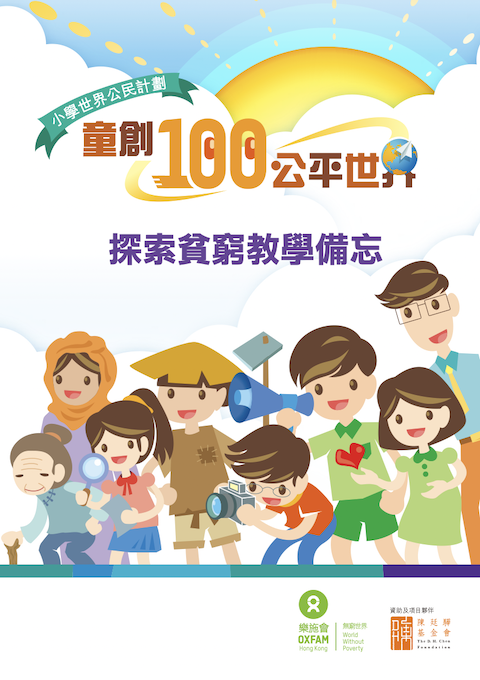 Achieving 100 for a Fair Wolrd: Exploring the Teaching Notes on Poverty سنة النشر: 2019 المؤلف المؤسسي: Oxfam Hong Kong This material provides some poverty concepts and related activities for teachers to refer to and continue to explore new and improved methods of creating a fair world. 樂施會童創100公平世界:探索貧窮教學備忘 سنة النشر: 2019 المؤلف المؤسسي: Oxfam Hong Kong 這本備忘提供一些貧窮 概念和相關活動讓老師參考,延續創造公 平世界的探勘。