
الموارد
استكشف مجموعة واسعة من الموارد القيمة حول تعليم المواطنة العالمية لتعميق فهمك وتعزيز البحث والمناصرة والتعليم والتعلم.
تم العثور على 3,446 نتيجة
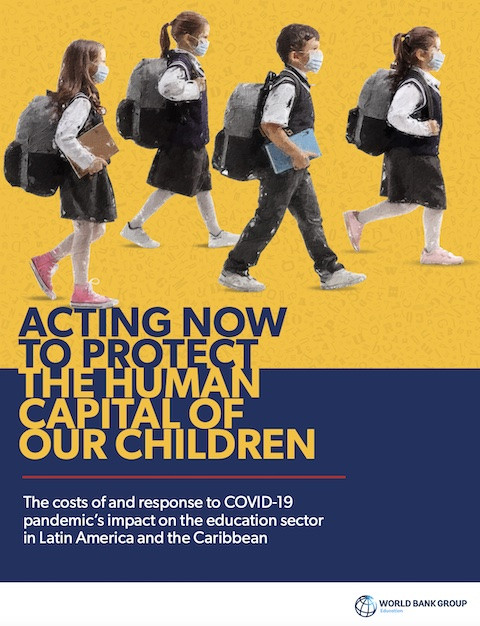 Acting Now to Protect the Human Capital of Our Children: The Costs of and Response to COVID-19 Pandemic’s Impact on the Education Sector in Latin America and the Caribbean سنة النشر: 2021 المؤلف المؤسسي: World Bank The sanitary and economic shocks caused by the COVID-19 pandemic brought about the most significant disruption in the history of the education sector in Latin America and the Caribbean region, leading to school closures at all levels and affecting over 170 million students throughout the region. Despite the tremendous efforts made by countries to mitigate the lack of in-person education through remote learning, education is taking a serious hit and outcomes are plummeting in the region. Learning poverty by the end of primary education could increase by more than 20 percent. Over 2 in 3 lower secondary education students could fall below minimum proficiency levels, and learning losses will be substantially larger for the most disadvantaged students. There is no time to lose. All countries must act now to make sure schools are ready to reopen safely and effectively country-wide so as to speed up the recovery process from the dramatic effects of the pandemic. They can leverage many emerging lessons and evidence, and must protect public funding for education, to enable this reopening process. While education systems face a challenge like no other, this exceptionally difficult situation also opens a window of opportunity to build back better their education systems to become more effective, equitable and resilient. Actuemos ya para proteger el capital human de nuestros ninos: Los costos y la respuesta ante el impacto de la pandemia de COVID-19 en el sector educativo de América Latina y el Caribe سنة النشر: 2021 المؤلف المؤسسي: World Bank El doble shock, sanitario y económico, generado por la pandemia COVID-19 provocó, sin duda alguna, la mayor disrupción en la historia del sector educativo en la región de América Latina y el Caribe, llevando al cierre masivo de escuelas en todos los niveles educativos y afectando a más de 170 millones de estudiantes en toda la región. A pesar de los enormes esfuerzos realizados por los países para tratar de mitigar la falta de educación presencial a través de sistemas de educación a distancia, el impacto sobre la educación está siendo demasiado alto y los aprendizajes se están desplomando en la región. La “pobreza de aprendizaje” al final de la educación primaria podría aumentar en más del 20 por ciento. Más de 2 de cada 3 estudiantes de educación secundaria podrían caer por debajo de los niveles mínimos de rendimiento esperados, y las pérdidas de aprendizaje serán sustancialmente mayores para los estudiantes más desfavorecidos. Realmente no hay tiempo que perder. Todos los países deberían actuar ya mismo para asegurarse que las escuelas estén listas para reabrir de manera segura y eficaz en todo el país a fin de acelerar el proceso de recuperación de los dramáticos efectos de la pandemia. Hay muchas lecciones y evidencias de experiencias positivas que van emergiendo y que pueden ser aprovechadas por los países, los cuales también deben asegurarse de proteger el financiamiento público de la educación, para facilitar este proceso de reapertura. Aun cuando los sistemas educativos de toda la región enfrentan un desafío jamás experimentado, esta situación excepcionalmente difícil también abre una ventana de oportunidad para poder ayudar a reconstruir los sistemas educativos para lograr que sean más efectivos, más equitativos y más resilientes.
  Internationalization of Tertiary Education in the Middle East and North Africa سنة النشر: 2020 المؤلف: Giulia Marchesini المؤلف المؤسسي: World Bank Conceived in order to provide a crucial baseline in research on internationalization in MENA, this report draws on available data to respond to both a real need for regional analysis and a direct demand from stakeholders, including tertiary education institutions in the region. Encouraging internationalization to be mainstreamed throughout MENA is the objective that this report seeks to achieve by way of stimulating regional policy dialogue on the subject. The report presents some global trends in internationalization and details its main benefits, before providing an overview of the current status of internationalization in the MENA region, including an in-depth analysis of student mobility. In its reflections on the way forward for the region, the report situates its recommendations in the context of COVID-19, within which, despite serious challenges due to a lack of attractiveness of the region, MENA may find a key opportunity. It suggests that adapting to the “new normal” through the deeper implementation of internationalization “at home” – a dimension that does not require physical mobility and, being implemented within domestic environments, has a much wider reach – may help enable the region to make strides towards catching up on the internationalization agenda. Internationalisation de l’enseignement supérieur dans la région Moyen-Orient Afrique du Nord سنة النشر: 2020 المؤلف: Giulia Marchesini | Lise Barbotte | Paul Cahu | Aurelia Hoffmann | Holly Johnstone | Mirna Mehrez | Marco Pasqualini | Francisco Marmolejo المؤلف المؤسسي: World Bank Ce rapport s'appuie sur les données disponibles pour répondre à la fois à un réel besoin d'analyse régionale et à une demande directe des parties prenantes, y compris des établissements d'enseignement supérieur de la région MENA. Encourager le développement de l’internationalisation à travers la région MENA est l'objectif que ce rapport cherche à atteindre, en stimulant un dialogue régional sur les politiques publiques autour de ce sujet. Le rapport présente quelques tendances mondiales de l'internationalisation et détaille ses principaux avantages, avant de donner un aperçu de l'état actuel de l'internationalisation dans la région MENA, y compris une analyse approfondie de la mobilité étudiante. Parmi les recommandations proposées pour le développement de l’internationalisation, le contexte de la COVID-19 est vu, pour la région MENA, comme une fenêtre d’opportunité pour pallier au manque d'attractivité de la région dans ce domaine. Mettre l’accent sur l'internationalisation « à domicile » - une dimension qui ne nécessite pas de mobilité physique et qui se développe dans le cadre domestique, et a donc une portée plus large - pour s’adapter à la « nouvelle normalité » peut aider la région à rattraper son retard sur le plan de l’internationalisation.
 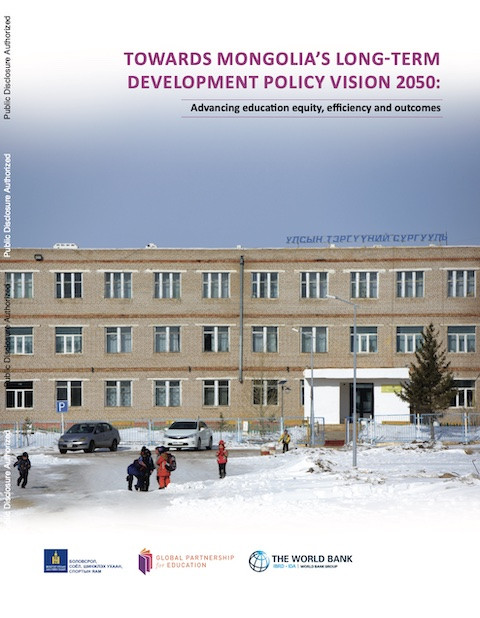 Towards Mongolia’s Long-Term Development Policy Vision 2050: Advancing Education Equity, Efficiency and Outcomes سنة النشر: 2020 المؤلف المؤسسي: Mongolia Ministry of Education, Culture, Science and Sports | World Bank This report seeks to synthesize and analyze education outcomes with a view of identifying the main priorities for strengthening the education sector in support of Mongolia’s Sustainable Development Vision 2050. The report highlights data and findings generated from a series of source reports (see bibliography) related to the goals and targets set out in the Vision 2050. The report is composed of six thematic chapters: Access; Equity; Internal Efficiency, Education Cost and Finance; External Efficiency; Management. Each chapter will include an overview of the current situation and recent development with a focus on, key achievements and persistent challenges. As a synthesis report, the information on each topic is not exhaustive but rather seeks to present key findings. Specific activities highlighted in the Vision 2050 have been included at the beginning of each chapter and a complete mapping by activity is annexed (Annex 1. Vision 2050 Chapter mapping). This synthesis report draws on conclusions, finding, data and surveys produced in collaboration with MECSS by the Asian Development Bank, the Global Partnership for Education and the World Bank. The synthesis also draws from key UNESCO reports. The scope, research, and focus of the source reports differ, and precise findings are, on occasions, incongruent however the overall conclusions are fundamentally compatible. Whereas most of the source reports focus on one or two key stages, the synthesis report seeks to extract cross-cutting and/or recurring challenges that have an impact, positive or negative, on equity, efficiency and outcomes which ultimately may contribute to the implementation of Vision 2050. Mongolia’s State Education Policy (2014-2024) states: ‘Education is the main key factor of each citizen’s lifelong support and guarantee of life quality, and of the State’s societal and economical, science and technological development, and guarantee of national independence and security. Mongolian State shall develop education as a leading sector in society’.
  Achieving SDG4 Through a Human Rights Based Approach to Education: World Development Report 2018 Background Paper سنة النشر: 2018 المؤلف: Kate Moriarty المؤلف المؤسسي: World Bank Quality education is a critical dimension for the achievement of sustainable development. The renewed political commitment set out in sustainable development goal 4 (SDG4) is an opportunity to ensure strong coherence between education policy and the right to education first articulated more than 70 years ago. This paper presents the results of a desk-based study on a human rights-based approach to education (HRBAE) in the context of SDG4. It explores the ways in which such an approach can guide policy, planning, and the delivery of education in observance with agreed international frameworks providing for the right to education. The paper argues that the human rights conventions on the right to education are not passive instruments designed to remain only at the level of discourse but, as legal obligations, require action from the state and should be central in the development of education services, including in the context of large scale displacement and crisis. This paper outlines the legally binding commitments of the right to education. It considers how these can be applied practically through a HRBA-E to address the continuing barriers to access and completion of quality education and learning.
  Foundations for Building Forward Better: An Education Reform Path for Lebanon سنة النشر: 2021 المؤلف المؤسسي: World Bank Human capital development is a critical determinant of economic growth, equity, and prosperity, but outcomes in this domain are worryingly low inLebanon, risking the future of generations of children. Lebanese children lag behind their peers in human capital development—measured accordingto the World Bank (2020c) Human Capital Index—suggesting that the future productivity of the labor force and the country’s trajectory for equitablegrowth is at risk (World Bank 2020b). The Human Capital Index indicates that children born in Lebanon today will reach, on average, only 52 percentof their potential productivity when they grow up. This is lower than the average estimates for the Middle East and North Africa (MENA) region(57 percent) and upper-middle-income countries (56 percent). Lebanon’s poor performance on the Human Capital Index is largely attributed to theeducation outcomes calculated for the index. If actual years of schooling, which average approximately 10.2 years in Lebanon, are adjusted for actual learning, effective years of schooling are 40 percent less—on average, only 6.3 years of actual learning (World Bank 2020b). The most recent school closures were due to the COVID-19 pandemic, with schools being closed over 75 percent of the school year between January 2020 and February 2021.1 This will likely lead to a further and significant decrease in learning: effectively, students are facing a lost year of learning (Azevedo et al. 2021).
  Segundo compendio de prácticas ejemplares en materia de educación para el desarrollo sostenible سنة النشر: 2009 المؤلف المؤسسي: UNESCO Associated Schools Project Network (ASPnet) This second collection of ASPnet good practices for quality education takes stock of some of the contributions being made by UNESCO Associated Schools in support of the United Nations Decade of Education for Sustainable Development (DESD). Second recueil de bonnes pratiques: l'éducation pour le développement durable سنة النشر: 2009 المؤلف المؤسسي: UNESCO Associated Schools Project Network (ASPnet) This second collection of ASPnet good practices for quality education takes stock of some of the contributions being made by UNESCO Associated Schools in support of the United Nations Decade of Education for Sustainable Development (DESD).
  Holocaust Education in a Global Context سنة النشر: 2014 المؤلف: Karel Fracapane | Matthias Haß المؤلف المؤسسي: UNESCO | Topography of Terror Foundation (Germany) International interest in Holocaust education has reached new heights in recent years. This historic event has long been central to cultures of remembrance in those countries where the genocide of the Jewish people occurred. But other parts of the world have now begun to recognize the history of the Holocaust as an effective means to teach about mass violence and to promote human rights and civic duty, testifying to the emergence of this pivotal historical event as a universal frame of reference. In this new, globalized context, how is the Holocaust represented and taught? How do teachers handle this excessively complex and emotionally loaded subject in fast-changing multicultural European societies still haunted by the crimes perpetrated by the Nazis and their collaborators? Why and how is it taught in other areas of the world that have only little if any connection with the history of the Jewish people? Holocaust Education in a Global Context will explore these questions.