
الموارد
استكشف مجموعة واسعة من الموارد القيمة حول تعليم المواطنة العالمية لتعميق فهمك وتعزيز البحث والمناصرة والتعليم والتعلم.
تم العثور على 3,446 نتيجة
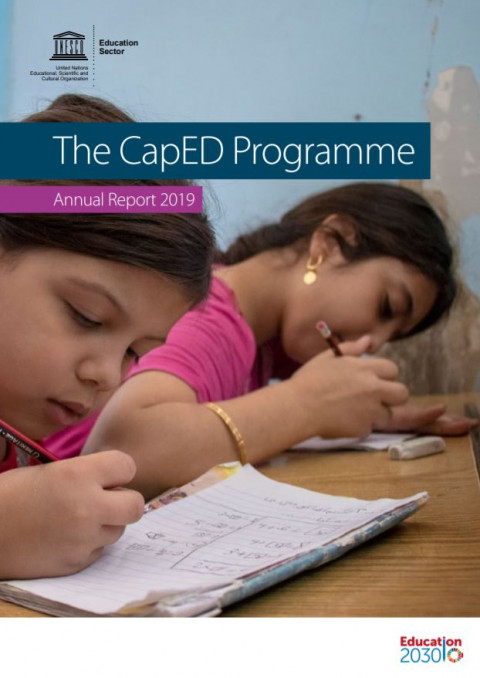 The CapED Programme: Annual Report 2019 سنة النشر: 2020 المؤلف المؤسسي: UNESCO UNESCO is the United Nation’s specialized agency for education and is mandated to lead and coordinate progress towards Sustainable Development Goal 4 – “Ensure inclusive and equitable quality education and promote lifelong learning opportunities for all”.The CapED Programme is central to delivering on this mandate through capacity development. It mobilizes UNESCO’s worldwide network of specialized Institutes and offices and works with partners to assist countries as they develop and implement national plans to deliver on SDG4 commitments.The Annual Report 2019 provides information on achievements and progress made in the 26 countries where CapED is operational. Programme CapED: rapport annuel 2019 سنة النشر: 2020 المؤلف المؤسسي: Organisation des Nations Unies pour l'éducation, la science et la culture (UNESCO) Institution spécialisée des Nations Unies pour l'éducation, l'UNESCO est chargée de conduire et de coordonner les efforts entrepris pour atteindre l'Objectif de développement durable 4 : « Assurer l'accès de tous à une éducation de qualité, sur un pied d'égalité, et promouvoir les possibilités d'apprentissage tout au long de la vie ».Le Programme CapED de développement des capacités pour l'éducation joue un rôle central dans l'exercice de ce mandat. Il mobilise le réseau mondial des instituts spécialisés et des bureaux de l'UNESCO et, en collaboration avec ses partenaires, aide les pays à élaborer et mettre en oeuvre leurs plans nationaux afin d'honorer les engagements qu'ils ont pris au titre de l'ODD 4.Le Rapport annuel 2019 met en lumière les résultats obtenus et les progrès accomplis dans les 26 pays où le Programme CapED intervient.
  Using Civic Participation and Civic Reasoning to Shape Our Future and Education (Background Paper for the Futures of Education Initiative) سنة النشر: 2020 المؤلف: Sarah M. Stitzlein المؤلف المؤسسي: UNESCO Actualizing a preferred future relies on citizens who are prepared to effectively engage perhaps the most fundamental civic question: ‘What should we do?’ (Levine, 2016; Dishon & Ben-Porath, 2018). It is a question that arises when people face a problem, must reach a decision, or must figure out how to flourish together as a group. This question is closely tied to the key question posed by the International Commission on the Futures of Education: ‘What do we want to become?’ Engaging both questions is a useful way for us to envision education in the future. These questions push us to consider not only what we merely can do, but also what is right for us to do in light of our responsibilities to others.Civic reasoning is the sort of reasoning we do as we answer the question, ‘What should we do?’ Civic discourse is a means or method by which people engage in civic reasoning. Efforts to envision improved education and futures should foreground civic reasoning and discourse as both a means and ends of citizen participation. They are important for the ways in which they directly engage citizens and for their products, which lead to future civic action and better futures.
 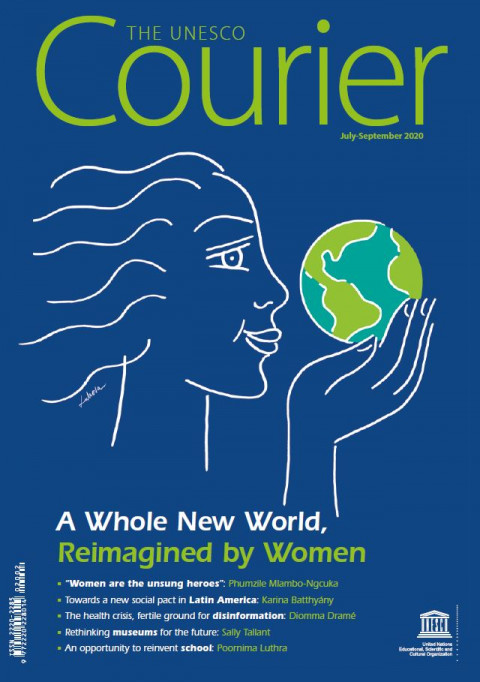 Les femmes prennent la parole (Le Courrier de l’UNESCO no. 2, Juillet-septembre 2020) سنة النشر: 2020 المؤلف المؤسسي: Organisation des Nations Unies pour l'éducation, la science et la culture (UNESCO) Politologues, journalistes, sociologues, chercheuses, écrivaines ou enseignantes dessinent les contours de l’après-pandémie, qu’il s’agisse de l’avenir des musées, des mutations de l’école, des dérives de l’information ou encore des enjeux de la recherche.Ce numéro trace un portrait en creux de notre époque, souligne les lignes de fracture que la crise sanitaire a mises à nu et montre l’ampleur des défis à relever. Il souligne aussi le potentiel de coopération scientifique, culturelle, éducative que cet événement inédit a révélé. Si les réflexions, le désir de changement et les mouvements d’entraide qui se sont manifestés ne restent pas sans lendemain, le monde pourrait réellement devenir plus solidaire, plus durable et plus égalitaire.
  Textbooks and Inclusive Education: Background Paper Prepared for the 2020 Global Education Monitoring Report, Inclusion and Education سنة النشر: 2020 المؤلف: Eckhardt Fuchs | Marcus Otto | Simiao Yu المؤلف المؤسسي: UNESCO | Global Education Monitoring Report Team This report, based on an analysis of a sample of textbooks from 28 countries, shows that the subject of inclusion has become increasingly significant in terms of both structure and subject matter, and particularly in the contexts of human rights and citizenship. Social diversity is also increasingly taken into account and reflected upon, albeit with varying emphasis on the differing dimensions of diversity, given that genuinely intersectional perspectives via which these are linked only occur in isolated and rudimentary cases. With regard to inclusiveness in the gender-related dimension, the overall picture of the textbook sample under analysis here is a heterogeneous one; further, the incorporation of LGTBQIA+ perspectives remains insufficient. Nevertheless, the textbooks examined here do show increasing critical reflection on the social discrimination of different groups, and, ultimately, we do observe a significant trend towards a more pronounced consideration and representation of different social groups and minorities.
 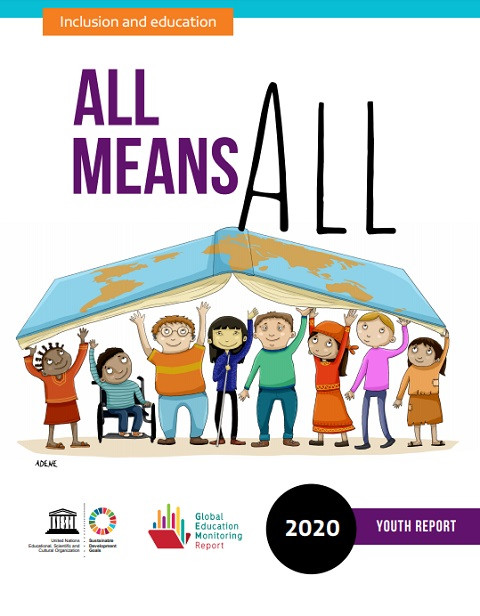 Youth Report 2020: Inclusion and Education; All Means All سنة النشر: 2020 المؤلف المؤسسي: UNESCO | Global Education Monitoring Report Team This Youth Report is designed to help you learn about the social, economic and cultural factors that cause vulnerable children, youth and adults to be discriminated against and marginalized in education. It tells the stories of the people who fight to ensure that everyone is included in education, and of those who fought to uphold their own right to education. It brings to life the recommendations of the 2020 Global Education Monitoring Report: Inclusion and education: All means all and calls on youth and teachers to share and discuss the stories and messages, to use them in campaigns and as a teaching tool in class. An open letter to education ministers is included calling, for education systems to be built back more inclusive after the school closures during Covid-19. A Whole New World, Reimagined by Women (The UNESCO Courier no. 2, July-September 2020) سنة النشر: 2020 المؤلف المؤسسي: UNESCO In this issue, the UNESCO Courier gives women a voice. Political scientists, journalists, sociologists, researchers, writers, and teachers have drawn the contours of the post-pandemic era – whether it is the future of museums, changes in schools, the rise of disinformation, or the challenges of scientific research.This issue paints a sobering picture of our times – highlights the fault-lines exposed by the health crisis, and shows the magnitude of the challenges ahead. It also underlines the potential for scientific, cultural and educational co-operation that this unprecedented event has revealed. If the reflections, the desire for change, and the movements of mutual aid that have emerged are not short-lived, the world really could become a more united, more sustainable and more egalitarian place.
 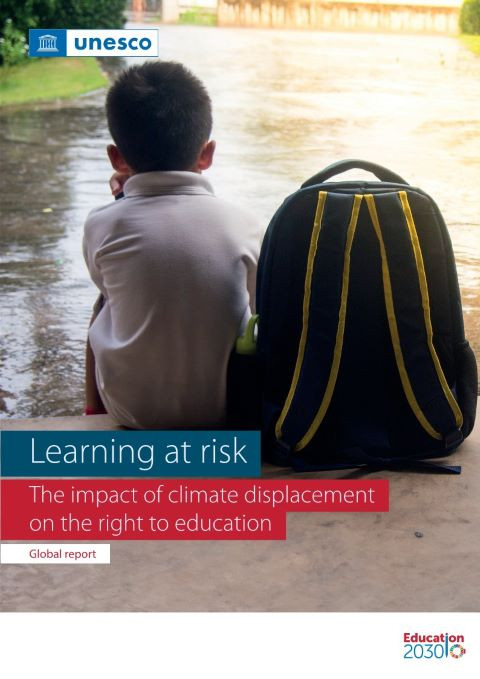 Learning at Risk: the Impact of Climate Displacement on the Right to Education; Global Report سنة النشر: 2023 المؤلف المؤسسي: UNESCO How climate displacement the impacts the right to education The growing impacts of climate change and displacement on education can no longer be ignored. The increasing number of people displaced due to climate change faces unique vulnerabilities, especially in terms of access to education. This challenge is not only attributed to the often limited political and legal recognition of these displaced persons, but also stems from the global community’s lack of awareness of the diverse obstacles they encounter in seeking access to education. This global report, which concludes the “Initiative on the impact of climate change and displacement on the right to education”, aims to provide guidance to policy-makers worldwide on how to better respect, protect and fulfil the right to education of climate-displaced people. It provides an overview of climate-induced barriers to education, and global policy guidance on how to ensure the protection of the right to education of these populations. The report will inform UNESCO’s Initiative on “The evolving right to education within a lifelong learning perspective” which is investigating how the right to education, as enshrined in international normative instruments, could be strengthened to meet modern needs in our rapidly changing societies.
  Dialogue for Prevention سنة النشر: 2025 المؤلف المؤسسي: UNESCO In an era where geopolitical power struggles disrupt traditional peacebuilding, where identity and misinformation fuel divisions, and where trust in institutions is eroding, UNESCO’s Intercultural Dialogue for Conflict Transformation briefs series presents an adaptable, culturally grounded, and people-centred approach to peacebuilding. With 1.5 billion people living in contexts with low intercultural dialogue where global challenges such as absolute poverty, terrorism and forced displacement are more prevalent, this four-part series draws on firsthand experience, country case studies, and expert analysis to demonstrate the transformative potential of dialogue in fragile and conflict-sensitive settings. The Dialogue for Prevention brief, developed with the Auschwitz Institute for the Prevention of Genocide and Mass Atrocities, explores the powerful role intercultural dialogue can play in preventing large-scale identity-based violence, particularly in the upstream and downstream phases of conflict. Grounded in the idea that dialogue can bridge divides and foster mutual understanding, the brief argues that enabling environments for intercultural dialogue—marked by stability, inclusive governance, freedom of expression, horizontal equality, and social cohesion—also mitigate key risk factors for atrocity violence. Drawing on diverse examples from Cambodia, Colombia, Italy, and Kenya, it showcases creative, context specific applications of dialogue. Through practical guidance, the brief equips policymakers, practitioners and civil society seeking to embed dialogue into prevention strategies.
  Dialogue for Social Cohesion سنة النشر: 2025 المؤلف: Isaure Vicarini | Euan Mackway-Jones المؤلف المؤسسي: UNESCO In an era where geopolitical power struggles disrupt traditional peacebuilding, where identity and misinformation fuel divisions, and where trust in institutions is eroding, UNESCO’s Intercultural Dialogue for Conflict Transformation briefs series presents an adaptable, culturally grounded, and people-centred approach to peacebuilding. With 89% of conflicts worldwide occurring in countries with limited capacity for intercultural dialogue, this four-part series draws on firsthand experience, country case studies, and expert analysis to demonstrate the transformative potential of dialogue in fragile and conflict-sensitive settings. The Dialogue for Social Cohesion brief—developed in collaboration with the Berghof Foundation and Search for Common Ground—bridges theory and practice to explore the horizontal (community-to-community) and vertical (citizen-to-state) dimensions of social cohesion and highlights how inclusive dialogue can support both. Case studies from Afghanistan, Germany, Somalia, and South Sudan illustrate how dialogue—whether through theatre, education, local governance, or environmental peacebuilding—can cultivate mutual understanding and trust, bridge identity-based divides, and restore, step by step, the social fabric in fractured societies. Through actionable recommendations, this brief equips practitioners, policymakers, and civil society with the essential guidance needed to tailor and embed dialogue in their respective contexts, helping to ensure that peace processes are inclusive, locally driven, and enduring.