
الموارد
استكشف مجموعة واسعة من الموارد القيمة حول تعليم المواطنة العالمية لتعميق فهمك وتعزيز البحث والمناصرة والتعليم والتعلم.
تم العثور على 3,441 نتيجة
 Dialogue for Social Cohesion سنة النشر: 2025 المؤلف: Isaure Vicarini | Euan Mackway-Jones المؤلف المؤسسي: UNESCO In an era where geopolitical power struggles disrupt traditional peacebuilding, where identity and misinformation fuel divisions, and where trust in institutions is eroding, UNESCO’s Intercultural Dialogue for Conflict Transformation briefs series presents an adaptable, culturally grounded, and people-centred approach to peacebuilding. With 89% of conflicts worldwide occurring in countries with limited capacity for intercultural dialogue, this four-part series draws on firsthand experience, country case studies, and expert analysis to demonstrate the transformative potential of dialogue in fragile and conflict-sensitive settings. The Dialogue for Social Cohesion brief—developed in collaboration with the Berghof Foundation and Search for Common Ground—bridges theory and practice to explore the horizontal (community-to-community) and vertical (citizen-to-state) dimensions of social cohesion and highlights how inclusive dialogue can support both. Case studies from Afghanistan, Germany, Somalia, and South Sudan illustrate how dialogue—whether through theatre, education, local governance, or environmental peacebuilding—can cultivate mutual understanding and trust, bridge identity-based divides, and restore, step by step, the social fabric in fractured societies. Through actionable recommendations, this brief equips practitioners, policymakers, and civil society with the essential guidance needed to tailor and embed dialogue in their respective contexts, helping to ensure that peace processes are inclusive, locally driven, and enduring.
  AI and the Future of Education: Disruptions, Dilemmas and Directions سنة النشر: 2025 المؤلف المؤسسي: UNESCO Artificial intelligence (AI) is reshaping the way we learn, teach and make sense of the world around us, but it is doing so unequally. While one-third of humanity remains offline, access to the most cutting-edge AI models is reserved for those with subscriptions, infrastructure and linguistic advantage.These disparities not only restrict who can use AI, but also determine whose knowledge, values and languages dominate the systems that increasingly influence education.This anthology explores the philosophical, ethical and pedagogical dilemmas posed by disruptive influence of AI in education. Bringing together insights from global thinkers, leaders and changemakers, the collection challenges assumptions, surfaces frictions, provokes contestation, and sparks audacious new visions for equitable human-machine co-creation.Covering themes from dismantling outdated assessment systems to cultivating an ethics of care, the 21 think pieces in this volume take a step towards building a global commons for dialogue and action, a shared space to think together, debate across differences, and reimagine inclusive education in the age of AI.Building on UNESCO’s Recommendation on the Ethics of AI, its Guidance on Generative AI in Education and Research and its twin AI competency frameworks for teachers and students, such a global commons can direct collective sense-making and bold reimagination around curricula, pedagogy, governance and policy with human rights, justice and inclusion at its core.
  Fostering Women's Leadership سنة النشر: 2024 المؤلف: Mariagrazia Squicciarini | Anna Rita Manca | Garance Sarlat المؤلف المؤسسي: UNESCO No (leadership) share no gain (for societies and economies)! Leveraging UNESCO’s unique Gender-Based Resilience Framework, this report explores the role of women in leadership positions in both decision-making and high-tech, including in artificial intelligence-related innovations. It further highlights progress towards the G20 Brisbane Target, aimed to accelerate progress on gender equality by reducing the gender gap in labour market participation rates by 25% by 2025. Women remain underrepresented in decision-making, holding only about 26% of seats in national parliaments worldwide on average. In the world of work, female labour participation continues to lag behind men’s, at 47% for women against 72% for men on average. Despite progress by G20 members towards the Brisbane Target, a 2% average gap in absolute terms remained to be filled in 2022. In the high-tech world, women make up only 30% of AI professionals, and even less of leaders. Female inventors in AI account for about 37% of patents filed in 2022-23.
  Asia-Pacific Migration Report 2024: Assessing Implementation of the Global Compact for Migration سنة النشر: 2024 المؤلف المؤسسي: UN. Economic and Social Commission for Asia and the Pacific (UN. ESCAP) | International Labour Organization (ILO) | International Organization for Migration (IOM) | UN. Office of the United Nations High Commissioner for Human Rights (UN. OHCHR) | United Nations Centre for Human Settlement Programme (UN Habitat) | United Nations Entity for Gender Equality and the Empowerment of Women (UN Women) | United Nations Development Programme (UNDP) | UNESCO | UN. Office of the United Nations High Commissioner for Refugees (UNHCR) | UN. Office on Drugs and Crime (UNODC) | World Bank This report aims to assess the state of GCM implementation in the region, its progress and its challenges since the first Asia-Pacific Regional Review of Implementation of the Global Compact for Migration in 2021, in which a Chair’s summary was adopted. Chapters 2 to 5 each consider clusters of GCM objectives, as presented in General Assembly resolution 73/326 and following the same groupings as in the Asia-Pacific Migration Report (APMR) 2020. These chapters open with a summary of the discussions from the first regional review of the GCM, held in 2021, drawing from the Chair’s summary. Chapter 6 provides overarching recommendations to support and accelerate GCM implementation in Asia and the Pacific. At the end of the report are annexes with information on the GCM objectives and guiding principles, references to migration in Voluntary National Reviews to the High-Level Political Forum on Sustainable Development, and GCM pledges at the level of the State or City, Municipality and Local Authority.
 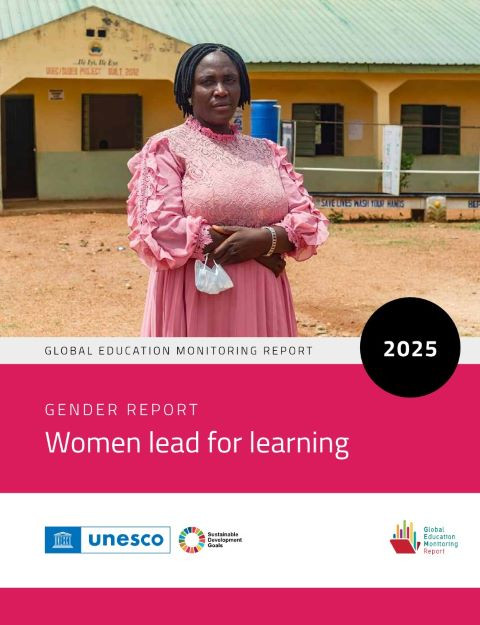 Global Education Monitoring Report 2025: Gender Report: Women Lead for Learning سنة النشر: 2025 المؤلف المؤسسي: UNESCO Barriers to gender equality in education leadership positions can and need to be overcome This gender edition, which is part of the 2024/5 Global Education Monitoring Report on leadership in education, addresses the remaining obstacles for women in their efforts to climb up the leadership ladder in education. Although the teaching profession has been feminized, there are considerable gender gaps in school management, education administration and political leadership positions, a situation illuminated in detail with examples from all over the world. Gender disparity in education leadership is the result of entrenched stereotypes and biases – conscious or unconscious – on the one hand and on the other institutional processes or professional development mechanisms that are insufficiently supportive. Research suggests that women leaders display some differences relative to men in their approaches to education leadership, for example the extent to which they emphasize collaboration, build relationships with the community and retain a focus on learning. While there is little to suggest that these differences are universal or immutable, the evidence points to the fact that the lack of equitable opportunities translates to less talent and fewer diverse approaches to leadership, which are a loss to education systems – not to mention the obvious need for equity. This is particularly evident in parts of the world where gender disparities remain large. This gender edition calls on countries to take a much closer look at gender disparity in education leadership and adopt measures to raise awareness, improve mechanisms and strengthen capacities to address discrimination and bias and thus encourage women who aspire to such careers to pursue them. Gender disparity in education leadership is the result of entrenched stereotypes and biases – conscious or unconscious – on the one hand and on the other institutional processes or professional development mechanisms that are insufficiently supportive. Research suggests that women leaders display some differences relative to men in their approaches to education leadership, for example the extent to which they emphasize collaboration, build relationships with the community and retain a focus on learning. While there is little to suggest that these differences are universal or immutable, the evidence points to the fact that the lack of equitable opportunities translates to less talent and fewer diverse approaches to leadership, which are a loss to education systems – not to mention the obvious need for equity. This is particularly evident in parts of the world where gender disparities remain large. This gender edition calls on countries to take a much closer look at gender disparity in education leadership and adopt measures to raise awareness, improve mechanisms and strengthen capacities to address discrimination and bias and thus encourage women who aspire to such careers to pursue them.
  The Representation of Jews, Judaism and Antisemitism in School Textbooks and Curricula in Europe سنة النشر: 2025 المؤلف المؤسسي: UNESCO Jewish communities have been integral to Europe’s social fabric for centuries, preserving rich religious and cultural traditions while facing recurring periods of exclusion, persecution, and resilience. School textbooks are important vantage points to understand how this history and heritage is represented, (de)constructed and embedded into a shared historical and cultural memory. They are also important practical tools used daily by students, teachers, and parents.This comprehensive research, carried out by UNESCO in collaboration with the Georg-Eckert-Institute and supported by funding from the European Commission, examines the ways in which Jewish culture, history, life, and anti-Jewish prejudice are represented in secondary school materials across eight European nations.The publication highlights opportunities within curricula to address Jewish experiences and antisemitism, reviews how these themes are incorporated into textbooks, and analyzes the narratives and portrayals that arise. The study also looks at the use of visual sources and assesses whether Jewish viewpoints and agency are sufficiently reflected. The findings highlight both recurring stereotypes and promising practices. By showcasing these contrasts, the study provides targeted recommendations to guide the creation of more inclusive educational materials.
  School Leadership Roles and Standards: Observations from the International Study of Teacher Leadership سنة النشر: 2024 المؤلف: Charles F. Webber | Dorothy Andrews | C.P. van der Vyver | Clelia Pineda-Báez | Janet M. Okoko | Edith J. Cisneros-Cohernour | José Gabriel Domínguez-Castillo | Mohammed Elmeski | Molly P. Fuller | Joan M. Conway | Cristina Moral-Santaella | Gloria Gratacós | Samira Idelcadi المؤلف المؤسسي: UNESCO | Global Education Monitoring Report Team This paper was commissioned by the Global Education Monitoring Report as background information to assist in drafting the 2024/5 GEM Report, Leadership in education. This report summarizes the findings of the International Study of Teacher Leadership(ISTL), conducted in 12 countries. The researchers share descriptions of the increasing interest in teacher leadershipas a factor in student learning and school improvement. ISTL researchers focus primarily on classroom-based teachers who—in collaboration with formal school leaders, parents, community members, and colleagues—impact school-wide decision making and pedagogical practices. The report offers insights related to teacher leader behaviours, the complexity of teacher leadership, how teacher leaders learn to lead, and the importance of contextual factors that support and impede teachers who provide informal leadership to schools and the communities they serve. The researchers compare cross-cultural requirements of good leadership and offer contextually situated analyses of leadership visions and goals, the impact of teacher leadership on educational outcomes, necessary preconditions for effective leadership, and policies that develop teacher leadership. The researchers also describe the readiness of school communities to embrace teacher leadership, described variously as parallel leadership, shared leadership, and distributed leadership. The report argues for a shift from considering standards for teacher leadership—too often based on the assumption that leadership is consistent across cultural and organizational settings—to the more flexible and contextualized conceptualization of leadership dimensions such as purpose, self-awareness, intentionality, and culture building. The ISTL researchers also argue that teacher leadership is but one component of an integrated approach to educational governance that addresses the complexities of teaching and learning in relation to rapid socioeconomic change, global migration, political tensions, and the emergence of new technologies. The ISTL also reinforces the ongoing importance of classroom teachers in the achievement of educational objectives. The ISTL team concludes this report with a set of research recommendations.
  World Trends in Freedom of Expression and Media Development: Special Digital Focus 2015 سنة النشر: 2017 المؤلف: Iginio Gagliardone | Danit Gal | Thiago Alves Pinto | Gabriela Martinez Sainz المؤلف المؤسسي: UNESCO Given the success of the first World Trends report and the need for additional research, UNESCO led a second edition in the series, focusing in depth on selected digital-era trends. World Trends in Freedom of Expression and Media Development – Special Digital Focus 2015 provides a substantive analysis of key areas identified in the first World Trends as particularly relevant for further study, namely the issues of: online hate speech, protection of journalism sources, and the role of internet intermediaries in fostering freedom of expression, as well as continued focus on the safety of journalists. It also builds on issues raised in the 2015 UNESCO study titled Keystones to foster inclusive Knowledge Societies. Tendencias mundiales en libertad de expresión y desarrollo de los medios: consideración prioritaria del ámbito digital 2015 سنة النشر: 2017 المؤلف: Iginio Gagliardone | Danit Gal | Thiago Alves Pinto | Gabriela Martinez Sainz المؤلف المؤسسي: UNESCO Dado el éxito del primer informe de Tendencias Mundiales y la necesidad de una investigación ulterior, la UNESCO emprendió una segunda edición en la serie, en la que se hace hincapié en determinadas tendencias de la era digital. Tendencias Mundiales en Libertad de Expresión y Desarrollo de los Medios - Consideración prioritaria del ámbito digital 2015 proporciona un análisis significativo de las áreas clave identificadas en la primera edición del informe como de especial relevancia para un estudio ulterior, y en concreto, de la incitación al odio en Internet, la protección de las fuentes periodísticas, y el papel de los intermediarios de Internet en el fomento de la libertad de expresión, así como de la atención prioritaria continuada a la seguridad de los periodistas. Se basa asimismo en los asuntos planteados en el estudio de 2015 de la UNESCO titulado Keystones to foster inclusive Knowledge Societies (Claves para promover unas sociedades del conocimiento integradoras). Tendances mondiales en matière de liberté d'expression et de développement des médias: regards sur le numérique, 2015 سنة النشر: 2017 المؤلف: Iginio Gagliardone | Danit Gal | Thiago Alves Pinto | Gabriela Martinez Sainz المؤلف المؤسسي: UNESCO Étant donné le succès du premier rapport Tendances mondiales et les besoins d’effectuer des recherches supplémentaires, l’UNESCO a lancé une deuxième édition de la série, qui cette fois approfondit son travail sur une sélection de tendances propres à l’ère numérique. Tendances mondiales en matière de liberté d’expression et de développement des médias – Regards sur le numérique 2015 fournit une analyse substantielle des principaux domaines identifiés dans la première édition comme pouvant faire l’objet de recherches complémentaires, notamment les questions du discours de haine en ligne, de la protection des sources des journalistes et du rôle des intermédiaires de l’Internet dans la promotion de la liberté d’expression, et elle s’intéresse également, tout comme la première, à la sécurité des journalistes. Elle traite également des questions soulevées dans l’étude intitulée Des clés pour la promotion de sociétés du savoir inclusives, publiée en 2015 par l’UNESCO.