
الموارد
استكشف مجموعة واسعة من الموارد القيمة حول تعليم المواطنة العالمية لتعميق فهمك وتعزيز البحث والمناصرة والتعليم والتعلم.
تم العثور على 1,405 نتيجة
 Le rapprochement des cultures; feuille de route سنة النشر: 2016 المؤلف المؤسسي: UNESCO Today, the sheer compression of the world is bringing people and their cultures into the same space with intense speed, rendering new levels and forms of human interaction and interdependence. Population growth and migration are increasing in scale and complexity, and technology and media are bringing people together in ways never before thought possible. As a result, new creative expressions, innovation and immense opportunities have been generated and developed. While these phenomena have brought people together across geographic spaces, it has concurrently exposed a widening moral gap in our societies and the extent to which our societies are ill-equipped to effectively manage and overcome the challenges that continue to arise. Often in parallel with developmental progress, retrogressive patterns have emerged that present persistent threats to peace-building and social cohesion. Recurrent cycles of deadlock and conflict undermine governance and legislation at international, national and local levels preventing long-term peace and development. The litany of polarization within our societies often defined along the lines of ‘identity’ – religious, cultural, ethnic, or otherwise – are increasingly manifested in prejudice, intolerance, racism, xenophobia, discrimination, radicalization and extreme violence. The challenges are often multidimensional and interrelated, and their impacts cross conventional borders, thus revealing a pervading vulnerability at global level and the accompanying need for a global response. From a policy and governance perspective, this has rendered new levels of complexity in addressing challenges. It has also reinforced the need for a more inclusive and participatory notion of development, including integrated approaches that tackle the issues at hand as well as their foundations. The Decade has come into being in an era marked by increased divisiveness, and learning to live together in the 21st century presents a new frontier for managing cultural diversity. Respect for the inherent dignity of all persons underpins the values of the Decade and is one of the core pillars of the UN system, to ensure that all people have equal rights and opportunities to shape their future. These principles are reflected in the values of many cultures around the world. Intercultural dialogue denotes an open process of exchange and respect between individuals and groups of different cultures, points of view and aspirations. In such a way, the respect for and exercise and enjoyment of human rights and fundamental freedoms are not only key inroads to dialogue, but they are integral to its process. Ultimately they are crucial to sustaining the rapprochement of cultures as the central aspiration of the Decade. El acercamiento de las culturas; Hoja de ruta سنة النشر: 2016 المؤلف المؤسسي: UNESCO Today, the sheer compression of the world is bringing people and their cultures into the same space with intense speed, rendering new levels and forms of human interaction and interdependence. Population growth and migration are increasing in scale and complexity, and technology and media are bringing people together in ways never before thought possible. As a result, new creative expressions, innovation and immense opportunities have been generated and developed. While these phenomena have brought people together across geographic spaces, it has concurrently exposed a widening moral gap in our societies and the extent to which our societies are ill-equipped to effectively manage and overcome the challenges that continue to arise. Often in parallel with developmental progress, retrogressive patterns have emerged that present persistent threats to peace-building and social cohesion. Recurrent cycles of deadlock and conflict undermine governance and legislation at international, national and local levels preventing long-term peace and development. The litany of polarization within our societies often defined along the lines of ‘identity’ – religious, cultural, ethnic, or otherwise – are increasingly manifested in prejudice, intolerance, racism, xenophobia, discrimination, radicalization and extreme violence. The challenges are often multidimensional and interrelated, and their impacts cross conventional borders, thus revealing a pervading vulnerability at global level and the accompanying need for a global response. From a policy and governance perspective, this has rendered new levels of complexity in addressing challenges. It has also reinforced the need for a more inclusive and participatory notion of development, including integrated approaches that tackle the issues at hand as well as their foundations. The Decade has come into being in an era marked by increased divisiveness, and learning to live together in the 21st century presents a new frontier for managing cultural diversity. Respect for the inherent dignity of all persons underpins the values of the Decade and is one of the core pillars of the UN system, to ensure that all people have equal rights and opportunities to shape their future. These principles are reflected in the values of many cultures around the world. Intercultural dialogue denotes an open process of exchange and respect between individuals and groups of different cultures, points of view and aspirations. In such a way, the respect for and exercise and enjoyment of human rights and fundamental freedoms are not only key inroads to dialogue, but they are integral to its process. Ultimately they are crucial to sustaining the rapprochement of cultures as the central aspiration of the Decade. UNESCO GCED eNewsletter Issue 3 سنة النشر: 2016 المؤلف المؤسسي: UNESCO Feature: Expanding partenrships around Global Citizenship EducationUNESCO – IEA partnershipPresident Park Geun-hye announces initiatives to widen prtnership with UNESCOUNESCO and the United States promote education to prevent violent extremismUNESCO signs partnership with Asia Society to advance Global Citizenship EducationInternational Mother Language DayUNESCO Category 2 Institute on mother languages established in BangladeshUCLA establishes new UNESCO Chair in Global Learning and Global Citizenship EducationWorkshop in Abidjan focuses on learning to live together through history educationLeading French network of rural vocational institutions puts Global Citizenship Education firstSub-regional Workshop on Global Citizenship Education in Central AsiaRabat Conference on Democratic Citizenship and Human Rights Education: Trends and Innovation from CSOsConference on Global Citizenship Education in SudanConference on Global Citizenship Education in SharjahFocus on: ongoing UNESCO school initiative: the Happy Schools ProjectCurriculum development and review for democratic citizenship and human rights educationKey TweetsUpcoming Events التعليم للجميع في أمريكا اللاتينية والكاريبي، ليما، بيرو، 30-31 تشرين الأول/أكتوبر 2014 : بيان ليما سنة النشر: 2014 المؤلف المؤسسي: منظمة الأمم المتحدة للتربية والعلم والثقافة (UNESCO) The Ministers of Education of Latin America and the Carribean (LAC), high-level government officials, UN agencies, representatives of civil society organizations and development partners, gathered at th meeting on "Education for All (EFA) in Latin America and the Carribean: Assessment of progress and post-2015 challenges", in Lima, Peru, from 30 to 31 October 2014. Having deliberated on progress towards EFA in the region, the Muscat Agreement adopted at the Global EFA Meeting (GEM) in Muscat, Oman, 12-14 May 2014, and the outcome document of the UN General Assembly Open Working Group for Sustainable Development Goals, and having examined the unfinished EFA tasks in the region, as well as the challenges and priorities that will configure the post-2015 education agenda for the region, the Lima Statement was adopted.
 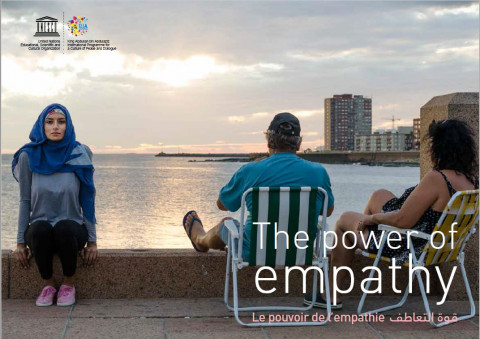 The Power of Empathy سنة النشر: 2017 المؤلف المؤسسي: UNESCO This photobook is a tribute to the power of empathy and solidarity felt and expressed by young people. Its photographs and stories were selected from the response to the global youth contest “If I were…”, launched by UNESCO on social media in Arabic, English, French and Spanish in early 2017. UNESCO received some 837 submissions, from 117 countries, covering a wide variety of issues and experiences.Despite the gravity of the themes addressed in these beautiful pictures, hope emerges from the testaments of the young photographers which demonstrate not only a sensitivity to the situations of “others”, but, moreover, a resolve to help people recover and protect their rights and dignity. Le Pouvoir de l'empathie سنة النشر: 2017 المؤلف المؤسسي: UNESCO This photobook is a tribute to the power of empathy and solidarity felt and expressed by young people. Its photographs and stories were selected from the response to the global youth contest “If I were…”, launched by UNESCO on social media in Arabic, English, French and Spanish in early 2017. UNESCO received some 837 submissions, from 117 countries, covering a wide variety of issues and experiences.Despite the gravity of the themes addressed in these beautiful pictures, hope emerges from the testaments of the young photographers which demonstrate not only a sensitivity to the situations of “others”, but, moreover, a resolve to help people recover and protect their rights and dignity. Cet ouvrage de photos rend hommage au pouvoir de l’empathie et aux sentiments de solidarité ressentis et exprimés par des jeunes. Les photographies et les textes qu’il contient ont été sélectionnés dans le cadre du concours mondial de la jeunesse « Et si j’étais… », lancé sur les réseaux sociaux de l’UNESCO en anglais, en arabe, en espagnol et en français, début 2017. L’UNESCO a reçu 837 candidatures de 117 pays, couvrant un large champ de questions et d’expériences. Malgré la gravité des thèmes abordés par chacune de ces superbes images, l’espoir se fait jour à mesure que les témoignages des jeunes photographes révèlent non seulement leur sensibilité à l’égard de la situation d’autrui, mais surtout une volonté d’aider les autres à recouvrer et à protéger leurs droits, leur dignité et la justice
  A Teacher's Guide on the Prevention of Violent Extremism سنة النشر: 2016 المؤلف المؤسسي: UNESCO The Guide aims to support teachers in offering young people relevant and timely learning opportunities to develop knowledge, skills and attitudes that build their resilience to violent extremist propaganda. It focuses on providing practical advice on when and how to discuss the issue of violent extremism and on creating a classroom climate that is inclusive and conducive to respectful dialogue, open discussions and critical thinking. Guide du personnel enseignant pour la prévention de l’extrémisme violent سنة النشر: 2016 المؤلف المؤسسي: Organisation des Nations Unies pour l'éducation, la science et la culture (UNESCO) Ce Guide a pour objectif d’aider les enseignants à offrir aux jeunes des possibilités d’apprentissage pertinentes et opportunes pour développer les connaissances, compétences et attitudes nécessaires pour renforcer leur résilience face à la propagande violente extrémiste. Il contient des conseils pratiques pour aborder la question de l'extrémisme en classe de manière pertinente et au moment adéquat, ainsi que sur les conditions à mettre en place pour créer un climat inclusif et propice au respect mutuel, à des discussions ouvertes et à l'exercice d'une pensée critique.
  Education for Sustainable Development: Partners in Action سنة النشر: 2017 المؤلف المؤسسي: UNESCO This brochure illustrates key findings and achievements from a monitoring exercise conducted by UNESCO at the halfway point of the initial phase of the GAP. Key partners reported on their progress as of 2016 for 10 indicators -- two in each Priority Action Area -- and toward their target for 2019 which was set as part of their initial commitment.The data summarised here show remarkable progress and suggest that GAP Key Partners and other stakeholders are acting as catalysts for a wide range of ESD efforts. A clear learning agenda has emerged that will inform the second part of the programme and help ensure that ESD evolves, stays relevant and adds value to the full spectrum of Sustainable Development Goals.
 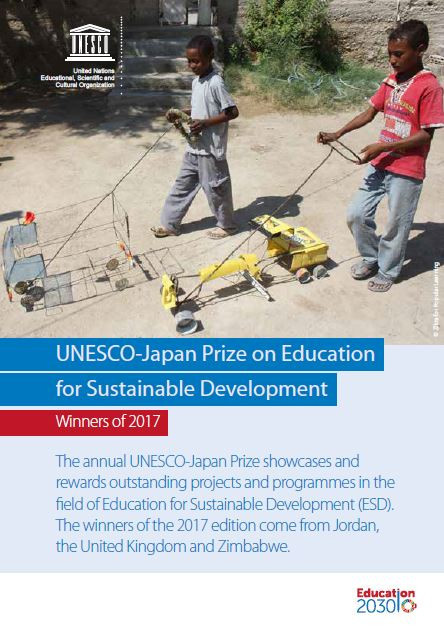 Prix UNESCO-Japon D'éducation en vue du Développement Durable: Lauréats de 2017 سنة النشر: 2017 المؤلف المؤسسي: UNESCO L’année 2017 marque la troisième édition du Prix UNESCO-Japon. Les lauréats ont été sélectionnés parmi plus de 100 candidatures présentées par des gouvernements d’États membres de l’UNESCO et par des organisations non gouvernementales en partenariat officiel avec l'UNESCO. Les candidatures ont été évaluées par un jury indépendant composé de cinq experts internationaux de l’EDD, qui ont recommandé les trois lauréats à la Directrice générale de l’UNESCO.Parmi les lauréats de cette année figurent une école, une entreprise et une organisation à but non lucratif oeuvrant à la promotion de l’EDD, respectivement à l’échelle locale, régionale et internationale : l’école primaire Sihlengeni (République du Zimbabwe) ; l’entreprise sociale Zikra (Royaume hachémite de Jordanie) ; et le projet Hard Rain (Royaume-Uni de Grande-Bretagne et d'Irlande du Nord). Chaque lauréat recevra une récompense d’un montant de 50,000 dollars des États-Unis.La Directrice générale de l’UNESCO et le Ministre de l’éducation japonais remettront le Prix aux trois lauréats au cours d’une cérémonie qui se tiendra le 3 novembre 2017 au Siège de l’UNESCO à Paris, lors de la 39e session de la Conférence générale.