
الموارد
استكشف مجموعة واسعة من الموارد القيمة حول تعليم المواطنة العالمية لتعميق فهمك وتعزيز البحث والمناصرة والتعليم والتعلم.
تم العثور على 883 نتيجة
 Education and Countering Violent Extremism: a case study of schools in Pakistan سنة النشر: 2015 المؤلف: Hussain-Mohiud-Din Qadri Cet article analyse le rôle de l'éducation dans la lutte contre l'extrémisme violent en prenant pour exemple le système éducatif pakistanais. Il développe une approche historique de la croissance du secteur éducatif, en analysant en détail le système précédant la partition du pays.
  The Time Period of the Holocaust in the Beliefs of Primary School Children – Children’s Perspectives and the Thematization of the Holocaust and National Socialism in Primary-School Instruction (in General Subjects) سنة النشر: 2012 المؤلف: Andrea Becher The original title: Die Zeit des Holocaust in Vorstellungen von Grundschulkindern – Perspektiven von Kindern und die Thematisierung von Holocaust und Nationalsozialismus im (Sach-)Unterricht der Grundschule(In I. Enzenbach, C. Klätte, & D. Pech, (Eds.). Kinder und Zeitgeschichte: Jüdische Geschichte und Gegenwart, Nationalsozialismus und Antisemitismus, Supplement, 8, pp. 101–120) This is a summary of a study of German primary school children’s beliefs about the Holocaust, based on interviews conducted in two classes in 2005. The author finds that the children almost exclusively focus on Hitler; that one can find “latent anti-Semitic fragments” in their statements; that, even without formal education, the pupils still possess knowledge about the Holocaust; and their main source of information about Nazi Germany seems to be family members. However, the family narratives mainly touch upon everyday-life and avoid the topic of the Holocaust. From these findings, the author argues that one could and should teach the Holocaust already in the German primary school. The above abstract is taken from the International Holocaust Remembrance Alliance Education Research Project. Please also consult the full list of abstracts in 15 languages and the accompanying publication Research in Teaching and Learning about the Holocaust: A Dialogue Beyond Borders. Ed: IHRA, Monique Eckmann, Doyle Stevick, Jolanta Ambrosewicz-Jacobs, 2017, Metropol Verlag.
  “Just Don’t Moralize!” Emotional Processes in the Pedagogical Engagement with National Socialism سنة النشر: 2008 المؤلف: Gudrun Brockhaus The original title: “Bloß nicht moralisieren!” Emotionale Prozesse in der pädagogischen Auseinandersetzung mit dem Nationalsozialismus(Einsichten und Perspektiven, Bayerische Zeitschrift für Politik und Geschichte, 1(8), pp. 28–33.) The article is a critical reflection on the outcomes of an empirical study (Kühner 2008; Kühner et al. 2008), based on a psychological/psychoanalytical perspective: how should we deal with emotions when dealing with the Holocaust? The author highlights the teachers’ very high expectations regarding the emotional Betroffenheit, the pressure on consensus, and the tabooisation of “political incorrectness” in the classroom, tendencies that can lead to a problematic teacher-student relationship. Thus, teachers encounter specific didactical difficulties and show a certain lack of self-assertion. Brockhaus assumes that this is based on how the teacher relates, as a person and as a pedagogue, to the heritage of National Socialism. Brockhaus concludes by insisting on the necessity to reflect openly, as students and as teachers, on the emotional processes and the reluctance caused by the topic of the Holocaust in this society. The above abstract is taken from the International Holocaust Remembrance Alliance Education Research Project. Please also consult the full list of abstracts in 15 languages and the accompanying publication Research in Teaching and Learning about the Holocaust: A Dialogue Beyond Borders. Ed: IHRA, Monique Eckmann, Doyle Stevick, Jolanta Ambrosewicz-Jacobs, 2017, Metropol Verlag at www.holocaustremembrance.com/resources/publications
  The Holocaust – A Theme for Instruction in General Subjects? سنة النشر: 2006 المؤلف: H. Deckert-Peaceman The original title: Holocaust – ein Sachunterrichtsthema?(Möglichkeiten und Relevanz der Auseinandersetzung mit dem Holocaust im Sachunterricht der Grundschule. Supplement, 3, pp. 35–50) An interesting discussion about the Holocaust as a topic for younger children, and especially about the use of youth literature in Holocaust education, but not an empirical analysis.The above abstract is taken from the International Holocaust Remembrance Alliance Education Research Project. Please also consult the full list of abstracts in 15 languages and the accompanying publication Research in Teaching and Learning about the Holocaust: A Dialogue Beyond Borders. Ed: IHRA, Monique Eckmann, Doyle Stevick, Jolanta Ambrosewicz-Jacobs, 2017, Metropol Verlag.
  National Consultation on the Situation of Prisons in Senegal: Improvement of the Condition of Detention, Social Integration and Prevention of Violent Extremism through Education, 23-24 May 2017, Dakar, Senegal: Report سنة النشر: 2017 المؤلف المؤسسي: UNESCO Dakar Sustainable Development Goal (SDG) 4 on education highlights the need to include our society’s most vulnerable and most margined members, such as prisoners, in order to ensure that all learners acquire the knowledge, skills, values and attitudes that are needed to build just, peaceful, and sustainable societies.The situation in Senegalese prisons is of a major concern given the overall condition of detention as well as the context of insecurity that characterizes the sector. In 2016, the country had 37 penal institutions for a total prison population of 9,422 prisoners (including pre-trial detainees and remand prisoners), of which approximately 200 were minors.1 Despite the efforts to humanize the prisons by adopting the name, “House of Arrest and Corrections” [Maison d'arrêt et de correction (MAC)] instead of the term "prison," and improving the living conditions in prisons, the fate of prisoners is not satisfactory. The reintegration promoted by Senegal's correctional facilities has largely consisted of a series of education programs, such as literacy and painting, developed by a number of organizations, but the space provided by prison administration, line Ministries, and NGOs are limited and the impact so far has been insufficient. A prison is not just a building, but it is also an instrument of rehabilitation to regain a place in society. This obviously requires the development of training, education and vocational guidance to support smooth reintegration into society.In this context, UNESCO's Dakar Regional Multi-Sectoral Office organized, in partnership with the Senegal National Commission for UNESCO and experts, a “National Consultation on the Situation of Prisons in Senegal: Improvement of the Condition of Detention, Social Integration, and Prevention of Violent Extremism through Education” in Dakar, Senegal, from 23 to 24 May 2017.
  Capacity Building Workshop on the Prevention of Violent Extremism through Education in West Africa and the Sahel: Final Report سنة النشر: 2017 المؤلف المؤسسي: UNESCO Dakar | Institut de la Francophonie pour l'éducation et la formation (IFEF) The capacity building workshop for the countries of West Africa and the Sahel, was organized in close collaboration with IICBA and APCEIU from 9 to 11 May 2017 in Dakar. The following countries participated in the meeting: Côte d’Ivoire, Cameroon, Guinea‐Bissau, Liberia, Mali, Mauritania, Niger, Senegal, Sierra Leone and The Gambia.This workshop was organized on the basis of a long‐standing partnership between UNESCO and the International Organization of La Francophonie (OIF), which strengthens its action on PVE. The regional workshop on capacity building for the prevention of violent extremism through education mainly used UNESCO materials and those for youth promoted by OIF. This workshop is a follow‐up to a similar initiative for education stakeholders of East and Southern Africa, organized in Addis Ababa in February 2017 by UNESCO through its International Institute for Capacity Building in Africa (IICBA).The overall objective of the workshop was to guide the countries of West Africa and the Sahel towards the Prevention of Violent Extremism (PVE). This includes familiarization with key issues, challenges, and opportunities identified to implement and further stimulate the implementation of the PVE strategy at the country level.
 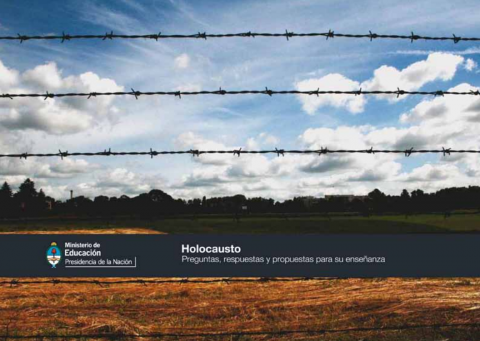 Holocausto : Preguntas, respuestas y propuestas para su ensenanza سنة النشر: 2010 المؤلف المؤسسي: Argentina. Ministerio de Educacion This publication, released by the "Education and Memory" department of the Ministry of National Education of Argentina, is a handout to think about, debate and discuss some of the issues relevant to teaching about the Holocaust. Holocausto : Preguntas, respuestas y propuestas para su ensenanza سنة النشر: 2010 المؤلف المؤسسي: Argentina. Ministerio de Educacion This publication, released by the "Education and Memory" department of the Ministry of National Education of Argentina, is a handout to think about, debate and discuss some of the issues relevant to teaching about the Holocaust. Holocauste: questions, réponses et propositions pour l'enseignement سنة النشر: 2010 المؤلف المؤسسي: Argentina. Ministerio de Educacion Cette publication, publiée par le «Education et Mémoire » département du Ministère de l'Education Nationale de l'Argentine, est un document à réfléchir, débattre et discuter de certaines des questions relatives à l'enseignement de l'Holocauste.
  Educating Students about the Holocaust: A Survey of Teaching Practices More than half a century has passed since the horrific events of the Holocaust took place, but images of the state-sponsored, systematic persecution and annihilation of European Jewry by Nazi Germany are no less shocking than they were 60 years ago. Any discussion of the Holocaust inevitably leads to questions of not only how and why this event occurred in the modern era but, more importantly, how the legacy of the Holocaust can continue to raise international awareness of human rights abuses and genocide. One way of achieving this awareness is by providing holocaust education to the nation's young people. While this objective has obtained widespread support, there has been an absence of reliable nationwide information on how the Holocaust is actually taught in U.S. schools. This article attempts to fill that gap by presenting the results of a yearlong study commissioned by the United States Holocaust Memorial Museum of teaching practices in Holocaust education in the nation's secondary public schools in 2003-04. The study assessed secondary teaching practices in middle and high schools in the field of Holocaust education, and investigated teachers' rationales for teaching about the Holocaust. (By the publisher)