
الموارد
استكشف مجموعة واسعة من الموارد القيمة حول تعليم المواطنة العالمية لتعميق فهمك وتعزيز البحث والمناصرة والتعليم والتعلم.
تم العثور على 3,451 نتيجة
 Een stap in het verleden – een les voor de toekomst: Handboek voor leraren سنة النشر: 2010 المؤلف المؤسسي: European Union Agency for Fundamental Rights What role do Holocaust-related sites play in today's societies? What do they offer young people? What should schools and teachers consider when planning a visit to such a site? And how can teachers make best use of such visits for teaching about the Holocaust and human rights? This Handbook provides a number of examples, hints and historical background information, which will help teachers and students to make visits to Holocaust-related sites and exhibitions a meaningful and enriching experience.
 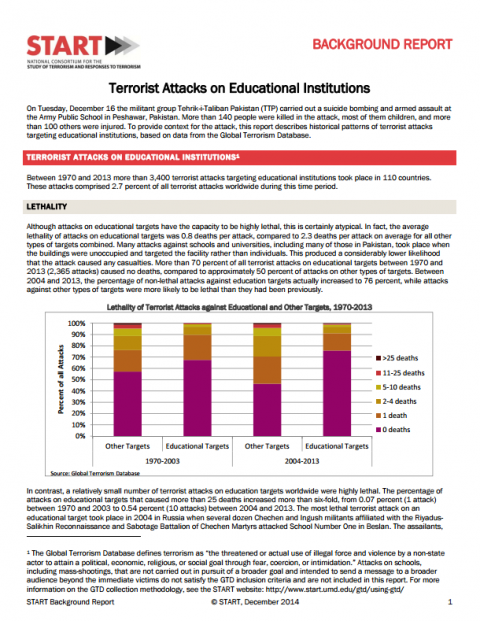 Terrorist Attacks on Educational Institutions سنة النشر: 2014 المؤلف: Erin Miller المؤلف المؤسسي: National Consortium for the Study of Terrorism and Responses to Terrorism (START) | Department of Homeland Security Science and Technology The report describes historical patterns of terrorist attacks targeting educations institutions dating back to 1970. Since that year, more than 3,400 terrorist attacks targeting educations institutions took place in 110 countries. These attacks comprised 2.7 percent of all terrorist attacks worldwide during this time period. Terrorist Attacks on Educational Institutions سنة النشر: 2014 المؤلف: Erin Miller المؤلف المؤسسي: National Consortium for the Study of Terrorism and Responses to Terrorism (START) | Department of Homeland Security Science and Technology Le rapport revient sur les attaques terroristes qui ont ciblé les institutions éducatives depuis 1970. A partir de cette année, on dénombre plus de 3.400 attaques terroristes qui avaient pour cible les institutions éducatives, dans 110 pays. Ces attaques représentent 2,7 % de l’ensemble des attaques terroristes perpétrées à travers le monde au cours de cette période. An Evaluation of UNESCO Publications on Human Rights Education سنة النشر: 2002 المؤلف المؤسسي: University of Leicester (UK) | Centre for Citizenship Studies in Education The purpose of this evaluation was to contribute to the formulation of a future strategy on Human Rights Education (HRE). The evaluation focused on nine publications commissioned by UNESCO Headquarters and field offices between 1997 and 2001.The relevance of the publications was assessed in light of UNESCO’s HRE goals and objectives. These were identified in UNESCO documents such as the 1995 Declaration and Integrated Framework of Action on Education for Peace, Human Rights and Democracy. The evaluation also included a report on the perception of users and UNESCO staff of the dissemination and impact of these publications, based on 11 staff interviews and an email questionnaire with 11 responses from 10 countries. In addition, the evaluators provided guidelines for the future development and evaluation of HRE publications.
  Global Monitoring of Target 4.7: Themes in National Curriculum Frameworks; Background Paper Prepared for the 2016 Global Education Monitoring Report سنة النشر: 2016 المؤلف المؤسسي: UNESCO International Bureau of Education (IBE) This study is an initial attempt to monitor ESD and GCED content in curricula globally. The goal here is to analyse national curriculum documents to reveal if, how, and to what extent ESD and GCED content is present across the globe. For this purpose, the research team developed a coding scheme based on key ESD and GCED knowledge, skills, behaviours and pedagogies that was used in evaluating the various national curriculum documents for evidence of ESD and GCED content. In this paper, we present the study in the following order. Further explanation of ESD and GCED, and a discussion of issues relating to their implementation and monitoring will come first. Then we will review similar studies that have also attempted to monitor GCED and ESD through content analysis. The study’s methods and findings will then be presented, followed by a discussion of the challenges addressed in developing a coding system to monitor curricula effectively. Finally, we share a series of recommendations that will focus on ways for moving forward in monitoring GCED and ESD effectively, both at a curricular level and beyond.
 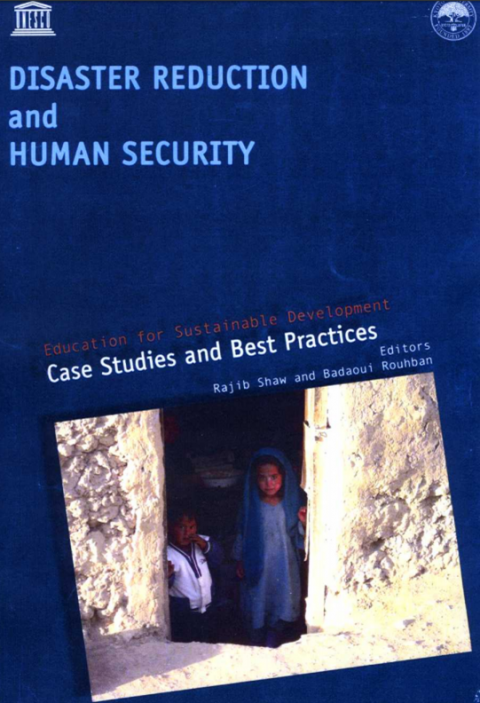 Disaster reduction and human security: education for sustainable development; case studies and best practices سنة النشر: 2005 المؤلف المؤسسي: Kyoto University. Graduate School of Global Environmental Studies Disaster reduction, human security, education and sustainable development are the four key issues, which are considered in the current compilation. A quick glance of the case studies will tell us the varieties of focus areas. WCD R Thematic Cluster 3 (Knowledge, Innovation and Education: To Build a Culture of Safety and Resilience) identifies four themes under the cluster: Education, Research, Public Awareness and Community Empowerment. A majority of case studies focus on community activities, especially on ho w the communities were able to cope with different types of disasters in different socio-economic context. These are all learning processes for the community, especially to enhance the resilience among its members. A number of these studies include public awareness, training and capacity building programmes. Quite a number of case studies focus on professional expertise, like microzonation, mapping, planning, hazard assessment, and development of risk reduction tools. These are all related to education and research. There are some case studies, which focus on formal education at school and colleges, but are linked to practical learning exercise. Distance learning has appeared as one of the possible media to reach the global mass, and to reach the farthest and the most needy group. The link between on-site testing and on-line learning has been emphasized by several case studies. La prévention des catastrophes et de la sécurité humaine: l'éducation pour le développement durable; études de cas et les meilleures pratiques سنة النشر: 2005 المؤلف المؤسسي: Kyoto University. Graduate School of Global Environmental Studies La prévention des catastrophes, la sécurité humaine, l'éducation et le développement durable sont les quatre questions clés, qui sont pris en compte dans la compilation actuelle. Un rapide coup d'œil des études de cas va nous dire les variétés de domaines d'intervention. WCD R thématique Cluster 3 (Connaissance, innovation et éducation: construire une culture de la sécurité et la résilience) identifie quatre thèmes du groupe: l'éducation, la recherche, la sensibilisation du public et l'autonomisation des communautés. La majorité des études de cas se concentrent sur les activités communautaires, en particulier sur ho w les communautés ont pu faire face à différents types de catastrophes dans le contexte socio-économique différent. Ce sont tous les processus d'apprentissage pour la communauté, en particulier pour améliorer la résilience parmi ses membres. Un certain nombre de ces études comprennent des programmes de sensibilisation du public, la formation et le renforcement des capacités. Un certain nombre d'études de cas se concentrer sur l'expertise professionnelle, comme microzonage, la cartographie, la planification, l'évaluation des risques, et le développement d'outils de réduction des risques. Ceux-ci sont tous liés à l'éducation et à la recherche. Il y a quelques études de cas, qui mettent l'aCECnt sur l'éducation formelle à l'école et les collèges, mais sont liés à la pratique d'exercice d'apprentissage. L'enseignement à distance est apparu comme l'un des médias possibles pour atteindre la masse globale, et d'atteindre le plus loin et le groupe le plus nécessiteux. Le lien entre les tests sur site et l'apprentissage en ligne a été soulignée par plusieurs études de cas. Enseigner le respect pour tous: activité 2: cartographie des matériels et pratiques existants, en coopération avec les universités et les centres de recherche, rapport final سنة النشر: 2013 المؤلف: Peter G. Kirchschlaeger | Stefanie Rinaldi | Franziska Brugger | Tanja Mitrovic المؤلف المؤسسي: University of Teacher Education (Switzerland). Centre of Human Rights Education The constant rise of racism, xenophobia and intolerance despite the renewed commitments made by the international community is giving the United Nations Educational, Scientific and Cultural Organisation (UNESCO) a reason to consider education as key to strengthen the foundations of tolerance, reducing discrimination and violence and learning to live together. It is required to cultivate respect for all people regardless of colour, gender, descent or national, ethnic or religious identity. The project “teaching respect for all” aims at reducing intolerance, violence and discrimination trough education. The project is founded on the universal values and common core principles promoted by UNESCO, even though UNESCO is aware, that the countries differ from one another in dealing with issues related to anti-racism and tolerance in education according to each country’s history and culture. Teaching respect for all: activity 2: mapping of existing materials and practices in cooperation with universities and research centres; final report سنة النشر: 2013 المؤلف: Peter G. Kirchschlaeger | Stefanie Rinaldi | Franziska Brugger | Tanja Mitrovic المؤلف المؤسسي: University of Teacher Education (Switzerland). Centre of Human Rights Education The constant rise of racism, xenophobia and intolerance despite the renewed commitments made by the international community is giving the United Nations Educational, Scientific and Cultural Organisation (UNESCO) a reason to consider education as key to strengthen the foundations of tolerance, reducing discrimination and violence and learning to live together. It is required to cultivate respect for all people regardless of colour, gender, descent or national, ethnic or religious identity. The project “teaching respect for all” aims at reducing intolerance, violence and discrimination trough education. The project is founded on the universal values and common core principles promoted by UNESCO, even though UNESCO is aware, that the countries differ from one another in dealing with issues related to anti-racism and tolerance in education according to each country’s history and culture. Address by Mr Koïchiro Matsuura, Director-General of UNESCO, on the occasion of the Award Ceremony of the 2004 UNESCO Prize for Human Rights Education; Bangkok, Thailand, 23 March 2005 سنة النشر: 2005 المؤلف المؤسسي: UNESCO. Director-General, 1999-2009 (Matsuura, K.) This speech was given by Mr Koïchiro Matsuura, Director-General of the United Nations Educational, Scientific and Cultural Organization (UNESCO) on the occasion of the Award Ceremony of the 2004 UNESCO Prize for Human Rights Education.