
الموارد
استكشف مجموعة واسعة من الموارد القيمة حول تعليم المواطنة العالمية لتعميق فهمك وتعزيز البحث والمناصرة والتعليم والتعلم.
تم العثور على 1,405 نتيجة
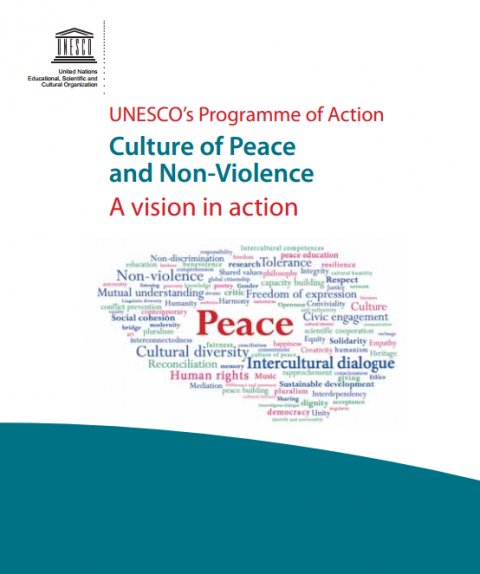 UNESCO's programme of action: culture of peace and non-violence, a vision in action سنة النشر: 2013 المؤلف المؤسسي: UNESCO This document builds upon the experience and resources of the Intersectoral Platform for a Culture of Peace and Non-Violence and has benefited from the contribution of Professor Arjun Appadurai. This document shows the UNESCO's mission; Buidling the defences of peace in the minds of men and women and Culture of peace and Non-violence which is positive values, attitudes and behaviours for everyday peace. This document pointed out today's multiple crisis, and then introduced the programme of action on a culture of peace and non-violence. After drew the UNESCO's strategies, UNESCO's peace activities were followed. UNESCO's programme of action: culture of peace and non-violence, a vision in action سنة النشر: 2013 المؤلف المؤسسي: Organisation des Nations Unies pour l'éducation, la science et la culture (UNESCO) Ce document se fonde sur l'expérience et les ressources de la plate-forme intersectorielle pour une Culture de la Paix et la non-violence et a bénéficié de la contribution du Professeur Arjun Appadurai. Ce document montre la mission de l'UNESCO; Buidling Construire les défenses de la paix dans l'esprit des hommes et des femmes et la culture de la paix et de non-violence qui est des valeurs positives, les attitudes et les comportements pour la paix tous les jours. Ce document a souligné multiples crises d'aujourd'hui, et a ensuite présenté le programme d'action sur une culture de paix et de non-violence. Après les stratégies de l'UNESCO, les activités de paix de l'UNESCO ont été suivies.
  Dialogue interculturel: impliquer les jeunes dans le monde entier سنة النشر: 2010 المؤلف: Elizabeth Khawajkie المؤلف المؤسسي: UNESCO | DAIMLER It is hoped that this review will help to highlight why there is a persistent call for the continuation of such endeavors, like Mondialogo, which promoted dialogue among cultures and people, mutual respect and understanding so effectively. The Mondialogo journey, begun as an exploratory exercise, ended with compelling and often moving experiences.
 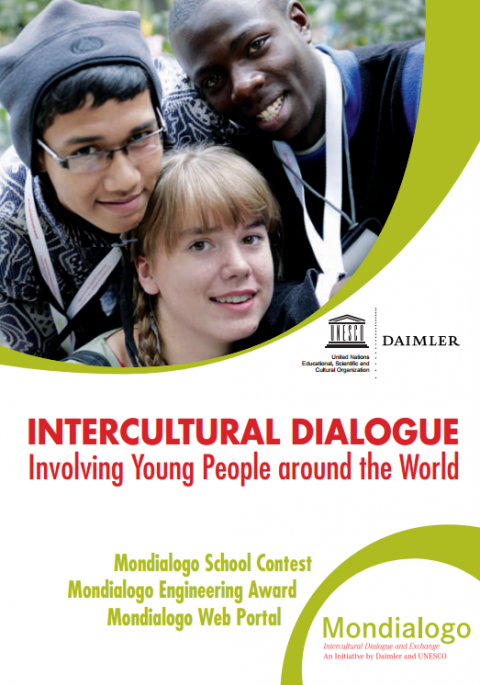 Intercultural dialogue: involving young people around the world سنة النشر: 2010 المؤلف: Elizabeth Khawajkie المؤلف المؤسسي: UNESCO | DAIMLER It is hoped that this review will help to highlight why there is a persistent call for the continuation of such endeavors, like Mondialogo, which promoted dialogue among cultures and people, mutual respect and understanding so effectively. The Mondialogo journey, begun as an exploratory exercise, ended with compelling and often moving experiences. Le dialogue interculturel: la participation des jeunes à travers le monde سنة النشر: 2010 المؤلف: Elizabeth Khawajkie المؤلف المؤسسي: UNESCO | DAIMLER Il est à espérer que cet examen permettra de mettre en évidence la raison pour laquelle il y a un appel persistant pour la poursuite de ces efforts, comme Mondialogo, qui a favorisé de manière efficace le dialogue entre les cultures et les peuples, le respect mutuel et la compréhension. Le voyage Mondialogo, commencé comme un exercice exploratoire, a pris fin avec des expériences convaincantes et souvent en mouvement.
  Civic education for media professionals: a training manual سنة النشر: 2009 المؤلف: Fackson Banda المؤلف المؤسسي: UNESCO Civic awareness enables both media practitioners and users to appreciate the role of journalism and media in building democratic societies. This manual serves as a resource for journalism students and media professionals in developing countries, providing them with essential knowledge for the analysis of the relationship between media functions and active citizenship, and the underlying nexus of democracy, development and the media based on the fundamental principles of democracy and human rights that lie at the heart of UNESCO’s mandate. For the purpose of this manual, civic education refers to the cultivation of civic knowledge, civic skills and civic virtues. Civic knowledge consists of fundamental ideas and information that learners must know and use to become effective and responsible citizens in a democracy. Civic skills include the intellectual skills needed to understand, explain, compare, and evaluate principles and practices of government and citizenship. They also include participatory skills that enable citizens to monitor and influence public policies. Civic virtues include the traits of character, dispositions, and commitments necessary for the preservation and improvement of democratic governance and citizenship. Examples of civic virtues are respect for the worth and dignity of each person, civility, integrity, self-discipline, tolerance, and compassion. Commitments include a dedication to human rights, the common good, equality and the rule of law. L'éducation civique pour les professionnels des médias: un manuel de formation سنة النشر: 2009 المؤلف: Fackson Banda المؤلف المؤسسي: UNESCO La conscience civique permet aux deux professionnels des médias et aux utilisateurs d'apprécier le rôle du journalisme et des médias dans l'édification de sociétés démocratiques. Ce manuel sert de ressource pour les étudiants en journalisme et les professionnels des médias dans les pays en développement, en leur fournissant des connaissances essentielles pour l'analyse de la relation entre les fonctions des médias et la citoyenneté active, et le lien sous-jacent de la démocratie, le développement et les médias sur la base des principes fondamentaux de la démocratie et des droits humains qui sont au cœur du mandat de l'UNESCO. Aux fins de ce manuel, l'éducation civique fait référence à la culture des connaissances civiques, les compétences civiques et les vertus civiques. la connaissance civique se compose d'idées fondamentales et de l'information que les apprenants doivent connaître et utiliser pour devenir des citoyens efficaces et responsables dans une démocratie. compétences civiques comprennent les compétences intellectuelles nécessaires pour comprendre, expliquer, comparer et évaluer les principes et les pratiques du gouvernement et de la citoyenneté. Ils comprennent également les compétences participatives qui permettent aux citoyens de suivre et d'influencer les politiques publiques. vertus civiques comprennent les traits de caractère, les dispositions et les engagements nécessaires à la préservation et l'amélioration de la gouvernance démocratique et de la citoyenneté. Des exemples de vertus civiques sont le respect de la valeur et la dignité de chaque personne, la civilité, l'intégrité, l'auto-discipline, la tolérance et la compassion. Les engagements comprennent un attachement aux droits de l'homme, le bien commun, l'égalité et la primauté du droit. Rapport relatif à l'enquête sur la mise en oeuvre de la Feuille de route pour l'éducation artistique سنة النشر: 2010 المؤلف المؤسسي: UNESCO The Road Map for Arts Education is a reference document that aims to explore the role of arts education in meeting the need for creativity and cultural awareness in the 21st Century, while placing emphasis on the strategies required to introduce or promote arts education in the learning environment. Within this conceptual framework, all UNESCO Member States interested in initiating or developing arts education practices can mould their own national policy guidelines, adapted to their socio-cultural specificities. With the Road Map, UNESCO advocates the essential role of arts education within societies, to create a common ground of understanding for all stakeholders. The development of the Road Map for Arts Education was a lengthy and comprehensive consultation process. The document was first elaborated by a group of experts and UNESCO, then presented at the First World Conference on Arts Education (Lisbon, 2006) and later revised and updated, following recommendations from NGOs and Member States. The Road Map was finally distributed to the UNESCO Member States in November 2007 in English and French and then translated into Spanish and Russian following popular demand. More than a year after this distribution, UNESCO launched a wide-ranging survey in order to assess the implementation of the Road Map in its 193 Member States. Through its National Commissions, the Organization relayed this document to Ministries of both Education and Culture. The aim of this exercise was threefold: to learn whether the Road Map was being applied and to what extent it was influencing policy decisions at national level; to act as a reminder of the importance of the UNESCO reference document and encourage its use; finally, to assess the situation of arts education in the responding countries. Thus, this survey not only acted as a catalyst for the implementation of the Road Map, but also provided precious knowledge on arts education around the world. The Member States’ responses also contributed greatly to the Second World Conference on Arts Education (Seoul, May 2010), inspiring one of its main themes and the topics for a number of workshops. They also encouraged a more integral participation of these States in the conference through preparatory consultations. Report on the survey on the implementation of the road map for arts education سنة النشر: 2010 المؤلف المؤسسي: UNESCO The Road Map for Arts Education is a reference document that aims to explore the role of arts education in meeting the need for creativity and cultural awareness in the 21st Century, while placing emphasis on the strategies required to introduce or promote arts education in the learning environment. Within this conceptual framework, all UNESCO Member States interested in initiating or developing arts education practices can mould their own national policy guidelines, adapted to their socio-cultural specificities. With the Road Map, UNESCO advocates the essential role of arts education within societies, to create a common ground of understanding for all stakeholders. The development of the Road Map for Arts Education was a lengthy and comprehensive consultation process. The document was first elaborated by a group of experts and UNESCO, then presented at the First World Conference on Arts Education (Lisbon, 2006) and later revised and updated, following recommendations from NGOs and Member States. The Road Map was finally distributed to the UNESCO Member States in November 2007 in English and French and then translated into Spanish and Russian following popular demand. More than a year after this distribution, UNESCO launched a wide-ranging survey in order to assess the implementation of the Road Map in its 193 Member States. Through its National Commissions, the Organization relayed this document to Ministries of both Education and Culture. The aim of this exercise was threefold: to learn whether the Road Map was being applied and to what extent it was influencing policy decisions at national level; to act as a reminder of the importance of the UNESCO reference document and encourage its use; finally, to assess the situation of arts education in the responding countries. Thus, this survey not only acted as a catalyst for the implementation of the Road Map, but also provided precious knowledge on arts education around the world. The Member States’ responses also contributed greatly to the Second World Conference on Arts Education (Seoul, May 2010), inspiring one of its main themes and the topics for a number of workshops. They also encouraged a more integral participation of these States in the conference through preparatory consultations.
  Thinkpiece on education and conflict سنة النشر: 2009 المؤلف: Lynn Davies المؤلف المؤسسي: UNESCO This paper looks first at the learning sites generally (violent schools, schools as a weapon of war, curriculum and textbooks). It then focuses on specific groups in conflict – gender, language, refugees, child soldiers. Thirdly it discusses education policy and donor intervention; and finally talks of the role of research. All these overlap hugely. This is not a prescription for how the Global Monitoring Report should be structured, but identification of themes and lessons learned that seem the most significant.