
الموارد
استكشف مجموعة واسعة من الموارد القيمة حول تعليم المواطنة العالمية لتعميق فهمك وتعزيز البحث والمناصرة والتعليم والتعلم.
تم العثور على 2,772 نتيجة
 Adult education and development: global citizenship education (no 82, 2015) سنة النشر: 2015 المؤلف المؤسسي: DVV International Issue 82/2015 of the international journal Adult Education and Development (AED) explores the topic global citizenship education.In the international debates, we are witnessing a growing interest in the concept of global citizenship education. It is one of the three pillars of the Global Education First Initiative (GEFI) launched by the United Nations Secretary-General in 2012 and is being internationally promoted by the work of UNESCO. According to the GEFI, education that fosters global citizenship “must fully assume its central role in helping people to forge more just, peaceful, tolerant and inclusive societies”. The 2030 Agenda for Sustainable Development, adopted by the United Nations General Assembly in September 2015, refers to global citizenship as one tool to “ensure that all learners acquire the knowledge and skills needed to promote sustainable development”.The ambitions are high, but the concrete understanding of global citizenship education and its implications differ widely. Is it just another abstract concept? What meaning can the word citizenship have if it does not refer to a specific nation? What do people in different parts of the world understand by global citizenship? And how can global citizenship education be put into practice?Adult Education and Development decided to engage in the debate and invited authors from different regions, backgrounds and disciplines to share their thoughts and experiences on the topic and related questions such as identity, migration, peace, the meaning of citizenship, globalisation and sustainable development.Irina Bokova, Director-General of UNESCO, explains the organisation’s understanding of global citizenship education, and why adult education and “learning beyond the classrooms” are crucial when it comes to promoting global citizenship. Canadian author and journalist Doug Saunders (“Arrival City: How the Largest Migration in History Is Reshaping Our World”) talks about the challenges and opportunities of what he refers to as the last great human migration, that from the countryside to the cities, and about the positive role adult education can play during this transition.In the section “Citizens’ voices” people from all over the world talk about what global citizenship means to them and in what ways they see themselves as global citizens. And photographer Viktor Hilitksi travelled through Belarus and captured with his camera how villages rediscover their local traditions and cultures. L'éducation des adultes et le développement: l'éducation à la citoyenneté mondiale (82, 2015) سنة النشر: 2015 المؤلف المؤسسي: DVV International Problème 82/2015 de la revue internationale d'Éducation des Adultes et le Développement (EAD) explore l'éducation à la citoyenneté mondiale sujet.Dans les débats internationaux, nous assistons à un intérêt croissant pour le concept d'éducation à la citoyenneté mondiale. Il est l'un des trois piliers de la Première Initiative Mondiale pour l'éducation globale avant tout(GEFI) lancé par le Secrétaire général des Nations Unies en 2012 et est internationalement promu par le travail de l'UNESCO. Selon le GEFI, l'éducation qui favorise la citoyenneté mondiale "doit assumer pleinement son rôle central en aidant les gens à forger plus justes, des sociétés pacifiques, tolérantes et inclusives". L'Agenda 2030 pour le développement durable, adoptée par l'Assemblée générale des Nations Unies en Septembre 2015, se réfère à la citoyenneté mondiale comme un outil pour «faire en sorte que tous les apprenants à acquérir les connaissances et les compétences nécessaires pour promouvoir le développement durable». Les ambitions sont élevées, mais la compréhension concrète de L'éducation à la citoyenneté Mondiale (ECM) et ses implications diffèrent largement. Est-il juste un autre concept abstrait? Quel sens le mot citoyenneté peut avoir si elle ne se réfère pas à une nation spécifique? Que font les gens dans différentes parties du monde à comprendre par la citoyenneté mondiale? Et comment L'éducation à la citoyenneté Mondiale (ECM) être mis en pratique? Education des adultes et développement ont décidé de participer au débat et a invité les auteurs de différentes régions, milieux et disciplines à partager leurs réflexions et expériences sur le sujet et les questions connexes telles que l'identité, la migration, la paix, le sens de la citoyenneté, la mondialisation et le développement durable. Irina Bokova, Directrice générale de l'UNESCO, explique la compréhension de l'organisation de l'éducation à la citoyenneté mondiale, et pourquoi l'éducation des adultes et de «l'apprentissage au-delà des salles de classe" sont cruciales en matière de promotion de la citoyenneté mondiale. auteur canadien et journaliste Doug Saunders ( «Ville d'arrivée: Comment la plus grande migration dans l'histoire remodèle notre monde») parle des défis et des possibilités de ce qu'il désigne comme la dernière grande migration humaine, que de la campagne vers les villes, et sur le rôle positif l'éducation des adultes peut jouer au cours de cette transition. Dans la section «voix des citoyens" les gens de partout dans le monde parlent de ce que signifie la citoyenneté mondiale pour eux et de quelle manière ils se considèrent comme des citoyens du monde. Et le photographe Viktor Hilitksi a voyagé à travers le Bélarus et capturé avec sa caméra comment les villages redécouvrent leurs traditions et cultures locales. Educación de adultos y desarrollo: La educación para la ciudadanía mundial (no 82, 2015) سنة النشر: 2015 المؤلف المؤسسي: DVV International Issue 82/2015 of the international journal Adult Education and Development (AED) explores the topic global citizenship education.In the international debates, we are witnessing a growing interest in the concept of global citizenship education. It is one of the three pillars of the Global Education First Initiative (GEFI) launched by the United Nations Secretary-General in 2012 and is being internationally promoted by the work of UNESCO. According to the GEFI, education that fosters global citizenship “must fully assume its central role in helping people to forge more just, peaceful, tolerant and inclusive societies”. The 2030 Agenda for Sustainable Development, adopted by the United Nations General Assembly in September 2015, refers to global citizenship as one tool to “ensure that all learners acquire the knowledge and skills needed to promote sustainable development”.The ambitions are high, but the concrete understanding of global citizenship education and its implications differ widely. Is it just another abstract concept? What meaning can the word citizenship have if it does not refer to a specific nation? What do people in different parts of the world understand by global citizenship? And how can global citizenship education be put into practice?Adult Education and Development decided to engage in the debate and invited authors from different regions, backgrounds and disciplines to share their thoughts and experiences on the topic and related questions such as identity, migration, peace, the meaning of citizenship, globalisation and sustainable development.Irina Bokova, Director-General of UNESCO, explains the organisation’s understanding of global citizenship education, and why adult education and “learning beyond the classrooms” are crucial when it comes to promoting global citizenship. Canadian author and journalist Doug Saunders (“Arrival City: How the Largest Migration in History Is Reshaping Our World”) talks about the challenges and opportunities of what he refers to as the last great human migration, that from the countryside to the cities, and about the positive role adult education can play during this transition.In the section “Citizens’ voices” people from all over the world talk about what global citizenship means to them and in what ways they see themselves as global citizens. And photographer Viktor Hilitksi travelled through Belarus and captured with his camera how villages rediscover their local traditions and cultures.
  Reconceptualising global education from the grassroots: the lived experiences of practitioners سنة النشر: 2015 المؤلف المؤسسي: DEEEP This research aims to conceptualise and reflect on DEEEP's understanding of Globalcitizenship Education(i.e., GE) in a way that is practice-led and rooted in practitioners’ experiences. We argue that the strategies practitioners use to negotiate the institutional and conceptual challenges of GE should be more systematically engaged with and central to our understanding of GE, and provide critical lessons for how practitioners can be supported, but also how we can understand the GE that results.
  School for all: experiences of municipal public schools with inclusion of students with disabilities, ASD, GDD and high ability/giftedness سنة النشر: 2017 المؤلف: Carla Mauch | Wagner Santana المؤلف المؤسسي: UNESCO Brasilia This publication is the result of a research project entitled Good Practices in Inclusive Education: the experience of Brazilian municipalities with the inclusion of students with disabilities, Autism Spectrum Disorder (ASD), Global Developmental Disorder (GDD) and of high ability/giftedness students (Boas Práticas em Educação Inclusiva: a experiência de municípios brasileiros na inclusão de alunos com deficiência, transtornos do espectro autista (TEA), transtorno global do desenvolvimento (TGD) e altas habilidades/superdotação). The study set out to identify and analyse the practices of municipal public-school networks in Brazil concerning the educational inclusion of students with disabilities, ASD and GDD, as well as gifted/talented students. The initiative arose out of a will to subsidise and strengthen processes for the formulation and implementation of policies, programmes and projects aligned with the principles of the Convention on the Rights of Persons with Disabilities (United Nations, 2006; Brazil, 2009) and the National Special Education Policy in the Perspective of Inclusive Education (Política Nacional de Educação Especial na Perspectiva da Educação Inclusiva) (Brasil. MEC/SEESP, 2008c). It is important to point out that those normative frameworks bring principles and presuppositions that have been reaffirmed in more recent documents such as the Incheon Declaration (World Education Forum, UNESCO, 2015) and the Sustainable Development Goals (SDG) (United Nations, 2015).
 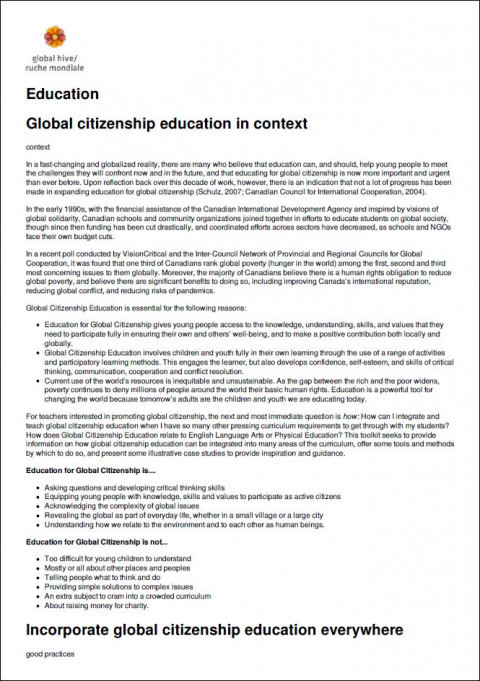 Education: global citizenship education in context المؤلف المؤسسي: Global Hive In a fast-changing and globalized reality, there are many who believe that education can, and should, help young people to meet the challenges they will confront now and in the future, and that educating for global citizenship is now more important and urgent than ever before. Upon reflection back over this decade of work, however, there is an indication that not a lot of progress has been made in expanding education for global citizenship (Schulz, 2007; Canadian Council for International Cooperation, 2004). In the early 1990s, with the financial assistance of the Canadian International Development Agency and inspired by visions of global solidarity, Canadian schools and community organizations joined together in efforts to educate students on global society, though since then funding has been cut drastically, and coordinated efforts across sectors have decreased, as schools and NGOs face their own budget cuts. In a recent poll conducted by VisionCritical and the Inter-Council Network of Provincial and Regional Councils for Global Cooperation, it was found that one third of Canadians rank global poverty (hunger in the world) among the first, second and third most concerning issues to them globally. Moreover, the majority of Canadians believe there is a human rights obligation to reduce global poverty, and believe there are significant benefits to doing so, including improving Canada’s international reputation, reducing global conflict, and reducing risks of pandemics. Global Citizenship Education is essential for the following reasons: Education for Global Citizenship gives young people access to the knowledge, understanding, skills, and values that they need to participate fully in ensuring their own and others’ well-being, and to make a positive contribution both locally and globally. Global Citizenship Education involves children and youth fully in their own learning through the use of a range of activities and participatory learning methods. This engages the learner, but also develops confidence, self-esteem, and skills of critical thinking, communication, cooperation and conflict resolution. Current use of the world’s resources is inequitable and unsustainable. As the gap between the rich and the poor widens, poverty continues to deny millions of people around the world their basic human rights. Education is a powerful tool for changing the world because tomorrow’s adults are the children and youth we are educating today. For teachers interested in promoting global citizenship, the next and most immediate question is how: How can I integrate and teach global citizenship education when I have so many other pressing curriculum requirements to get through with my students? How does Global Citizenship Education relate to English Language Arts or Physical Education? This toolkit seeks to provide information on how global citizenship education can be integrated into many areas of the curriculum, offer some tools and methods by which to do so, and present some illustrative case studies to provide inspiration and guidance.
  Global education guides سنة النشر: 2009 المؤلف المؤسسي: Global Education Network of Young Europeans (GLEN) This document was written as an introduction to global education and as a practical support tool for planning, managing and evaluating global education projects. It is addressed to members of GLEN, the Global Education Network of Young Europeans, as well as to other global educators. The following pages are the result of numerous discussions that have occurred during the last five years both within GLEN and with external global education practitioners and academics. Many of these discussions crystallised at the European Global Education Days (EGED), a five-day seminar that GLEN organised on the occasion of the network’s fifth anniversary in November 2008. The EGED brought together more than 70 global education activists, practitioners and academics from 15 European countries, with the aims of exchanging experiences and good practices of global education, discussing how to evaluate global education projects and measure impact; reflecting on the potential of global education as a tool for activists and how it relates to concepts such as citizenship or development; and using the results of these discussions for the future work of our network: planning global education projects and further engaging with other stakeholders. The world is currently going through a period of accumulated crises: the ecological crisis, the financial and economic crisis, the food crisis. And this on top of all the other problems: hunger, poverty, unequal distributions of resources, violent conflict, etc. The challenges which humankind is facing seem to be greater than ever. However, the Greek word ‘crisis’ does not mean downfall, but decision. We, as human beings and as citizens of this world, can decide to contribute our share for bringing about more just political and economic structures; and more sustainable, democratic, peaceful and inclusive ways of living together. If we do global education, it is in order to address exactly these issues; it is to empower people to become agents of change in view of this vision. So, in this spirit, let us use the present momentum and make the current ‘crisis’ a turning point. Guide d'éducation globale سنة النشر: 2009 المؤلف المؤسسي: Global Education Network of Young Europeans (GLEN) Ce document a été écrit comme une introduction à l'éducation mondiale et comme un outil de support pratique pour la planification, la gestion et l'évaluation des projets d'éducation globale. Il est adressé aux membres de GLEN, le Réseau Éducation Mondiale des Jeunes Européens, ainsi que d'autres éducateurs mondiaux. Les pages qui suivent sont le résultat de nombreuses discussions qui ont eu lieu au cours des cinq dernières années, tant au sein de GLEN et avec les praticiens de l'éducation mondiale externes et des universitaires. Beaucoup de ces discussions cristallisées lors des Journées Européennes Global Éducation (JEGÉ), un séminaire de cinq jours qui GLEN organisé à l'occasion du cinquième anniversaire du réseau en Novembre 2008. Le JEGÉ a réuni plus de 70 mondiaux éducation des militants, des praticiens et des universitaires de 15 pays européens, avec les objectifs de l'échange d'expériences et de bonnes pratiques de l'éducation mondiale, discuter de la façon d'évaluer les projets mondiaux d'éducation et de mesurer l'impact; réflexion sur le potentiel de l'éducation mondiale comme un outil pour les militants et comment il se rapporte à des concepts tels que la citoyenneté ou de développement; et en utilisant les résultats de ces discussions pour les travaux futurs de notre réseau: la planification des projets mondiaux d'éducation et engager davantage avec d'autres parties prenantes. Le monde traverse actuellement une période de crises accumulées: la crise écologique, la crise économique et financière, la crise alimentaire. Et cela au-dessus de tous les autres problèmes: la faim, la pauvreté, les distributions inégales des ressources, les conflits violents, etc. Les défis auxquels l'humanité est confrontée semblent être plus que jamais. Cependant, le mot grec ‘crise’ ne signifie pas la chute, mais la décision. Nous, en tant qu'êtres humains et en tant que citoyens de ce monde, pouvons décider de contribuer à provoquer des structures politiques et économiques plus justes; et des moyens plus durables, démocratiques, pacifiques et inclusifs de vivre ensemble. Si nous faisons l'éducation mondiale, il est dans le but de répondre exactement à ces questions; il est d'habiliter les gens à devenir des agents de changement en vue de cette vision. Donc, dans cet esprit, nous utilisons la dynamique actuelle et de faire la ‘crise’ actuelle un point tournant. 글로벌 교육 가이드 سنة النشر: 2009 المؤلف المؤسسي: Global Education Network of Young Europeans (GLEN) 본 문서는 글로벌 교육을 소개, 계획 및 관리하고 글로벌 교육 프로젝트를 평가하기 위한 실질적 지원 도구로 작성되었다. 이것은 GLEN 멤버와 영 유로피언의 글로벌 교육 네트워크뿐 아니라, 다른 글로벌 교육자들을 위한 것이다. 다음의 내용은 GLEN 내부와 외부 글로벌 교육 실무자 및 학계 양측에서 지난 5년간 이뤄졌던 수많은 논의의 결과다. 이 논의의 대부분은 2008년 11월 GLEN 네크워크 5주년에 즈음하여 조직된 5일간의 세미나- ‘유러피언 글로벌 교육의 날(EGED)’에서 결정되었다. ‘유러피언 글로벌 교육의 날(EGED)’은 유럽 15개 국에서 70명 이상의 글로벌 교육 활동가, 실무자 및 학계 관계자들이 함께 하여 어떻게 글로벌 교육 프로젝트를 평가하고 그 영향을 측정하는 가에 대한 논의를 하였다. 또한 활동가를 위한 도구로써 글로벌 교육의 잠재력을 반영하는 것과 이를 어떻게 ‘시민의식’ 혹은 ‘개발’의 개념과 연계시키는 가에 대한 논의도 이어 나갔다. 아울러, 향후 우리의 네트워크 작업을 위한 본 논의들의 결과를 어떻게 사용하는 가에 대한 방안도 모색하였는데, 여기에선 글로벌 교육 프로젝트를 계획하고 더 나아가 다른 이해관계자들도 참여시키는 방안도 모색하였다. 세계는 현재 축적된 위기의 시간을 겪고 있다. 즉, 생태 위기, 금융 및 경제 위기, 식량 위기를 겪고 있다. 그리고 그 위에 기아, 빈곤, 불평등한 자원 분배, 폭력 충돌 등 다른 문제들도 산적하고, 이러한 문제들에 직면한 인류의 도전은 그 어느 때보다 중요하게 여겨진다. 그러나 그리스어 ‘위기’라는 단어는 ‘몰락’이 아니라 하나의 ‘결정’을 의미한다. 우리는 인류와 세계시민으로서 더 정의로운 정치와 경제구조를 이끌기 위해 우리 각자의 몫을 기여할 수 있고, 더불어 평화롭게 함께 살고, 더 지속가능하고 민주적인 것에 기여하는 방법을 찾을 수 있다. 우리가 글로벌 교육을 하는 것은 바로 이러한 문제점을 해결하기 위해서이다. 다시 말해서, 미래에 대한 비전을 갖고 변화의 동인이 되는 사람에게 힘을 실어 주는 것이다. 그러므로 우리는 이러한 정신으로 현재의 동력이 되어 오늘날의 위기를 전환점으로 만들도록 한다.
  Comprehensive Societal Integration of People with Disabilities in the Arab and Islamic Society (A Historical-original View) سنة النشر: 2012 المؤلف: Ibrahim Alnuqythan المؤلف المؤسسي: Gulf Society for Diability The file is a research paper that discusses the comprehensive integration of persons with disabilities in the Arab and Islamic world. The paper seeks to answer the following questions:- Did the disabled in the Arab-Islamic civilization have a comprehensive integration into society?What are the examples of this integration in the Arab-Islamic civilization?The paper discussed and touched on live models that show the reality of inclusion of persons with disabilities in society.