
الموارد
استكشف مجموعة واسعة من الموارد القيمة حول تعليم المواطنة العالمية لتعميق فهمك وتعزيز البحث والمناصرة والتعليم والتعلم.
تم العثور على 1,472 نتيجة
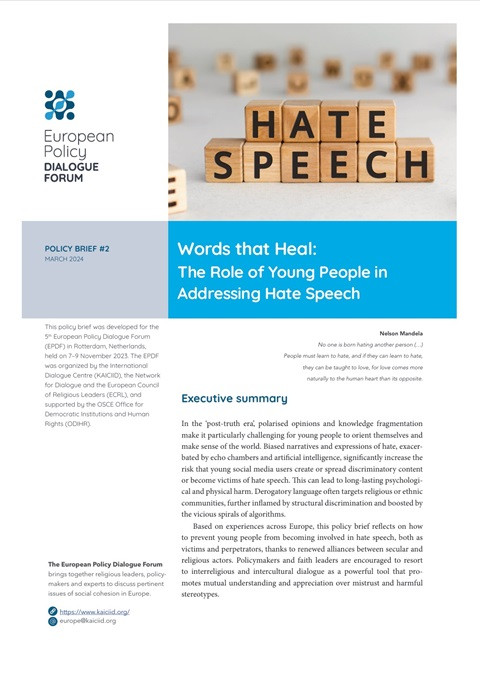 Words that Heal: The Role of Young People in Addressing Hate Speech (EPDF Policy Brief No. 2) سنة النشر: 2024 المؤلف المؤسسي: International Dialogue Centre (KAICIID) In the ‘post-truth era’, polarised opinions and knowledge fragmentation make it particularly challenging for young people to orient themselves and make sense of the world. Biased narratives and expressions of hate, exacerbated by echo chambers and artificial intelligence, significantly increase the risk that young social media users create or spread discriminatory content or become victims of hate speech. This can lead to long-lasting psychological and physical harm. Derogatory language often targets religious or ethnic communities, further inflamed by structural discrimination and boosted by the vicious spirals of algorithms. Based on experiences across Europe, this policy brief reflects on how to prevent young people from becoming involved in hate speech, both as victims and perpetrators, thanks to renewed alliances between secular and religious actors. Policymakers and faith leaders are encouraged to resort to interreligious and intercultural dialogue as a powerful tool that promotes mutual understanding and appreciation over mistrust and harmful stereotypes.
  3 minutes pour comprendre l’Europe سنة النشر: 2021 المؤلف المؤسسي: Toute l’Europe Vous n’êtes pas spécialiste des questions européennes ? Mais vous souhaitez en avoir une première approche sans vous confronter au jargon et discours trop technique ? Alors cette rubrique est pour vous ! Parce qu’il y a mille et une façons de parler de l’Union européenne, Toute l’Europe a choisi de vous présenter l’Europe “en toute simplicité” à travers des articles courts et faciles à lire. Une série d’épisodes de trois minutes, dans lesquels vous trouverez l’essentiel pour mieux comprendre l’Europe. You are not a specialist of European issues ? But you want to have a first approach without confronting yourself with too much technical language ? Then this section is for you ! Because there is a thousand and one ways to talk about the European Union, Toute l’Europe has chosen to present Europe "in all simplicity" through short and easy-to-read articles. A serie of three-minutes episodes in which you will find the essentials to better understand Europe.
 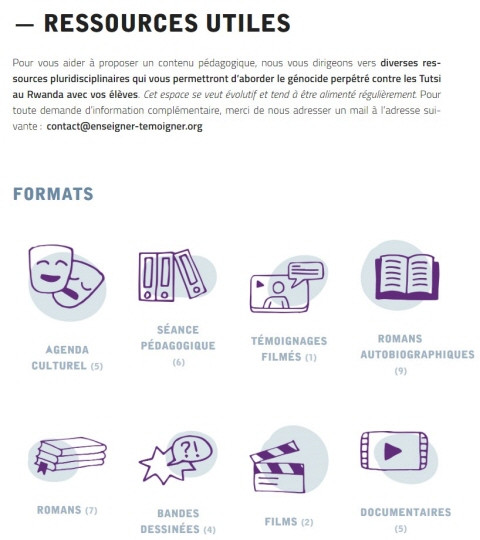 Enseigner Témoigner سنة النشر: 2024 المؤلف المؤسسي: Ligue de l'enseignement, Fédération de Paris & Ibuka France En 1994, environ 1 million de Tutsi ont été tués au Rwanda. Le génocide perpétré contre les Tutsi au Rwanda constitue l’une des principales tueries du XXème siècle. Elle a été rendue possible par l’action d’extrémistes qui ont, pendant des années, attisé la haine anti-tutsi au sein de la population rwandaise à coup de préjugés, de fausses informations, d’accusations en miroir, de stratégie de manipulation et de conditionnement des esprits à la peur, à la haine et à la violence meurtrière.Avec l’inscription récente de son enseignement dans les programmes scolaires, de plus en plus d’enseignants travaillent avec leurs élèves sur cet événement majeur de l’histoire du XXème siècle. Parallèlement, des rescapés ressentent le besoin de témoigner pour partager leur histoire avec la jeune génération et prévenir ainsi les mécanismes qui ont rendu ce drame possible. Dans ce contexte, l’association Ibuka France et la Ligue de l’enseignement engagent une action commune pour proposer un accompagnement dans l’organisation et la gestion pédagogique d’une rencontre avec un témoin-rescapé en classe. Cet accompagnement vise à créer un cadre à la fois utile et sécurisant pour l’ensemble des acteurs engagés et impactés par le témoignage en classe. In 1994, around 1 million Tutsis were killed in Rwanda. The genocide perpetrated against the Tutsis in Rwanda is one of the major killings of the twentieth century. It was made possible by the actions of extremists who, for years, stirred up anti-Tutsi hatred among the Rwandan population by means of prejudice, false informations, mirror-image accusations, a strategy of manipulation and the conditioning of minds to fear, hatred and murderous violence.With the recent inclusion of the subject in school curricula, more and more teachers are working with their pupils on this major event in the history of the 20th century. At the same time, survivors are feeling the need to share their stories with the younger generation and prevent the mechanisms that made this tragedy possible. Against this backdrop, Ibuka France and the Ligue de l'enseignement have joined forces to offer support in organising and managing a meeting with a survivor-witness in the classroom. The aim of this support is to create a framework that is both useful and reassuring for all those involved and affected by the testimonial in the classroom.
  الضمانات الدولية لحماية الحق في التعليم في القانون الإنساني الدولي (مجلة ذي قار للفنون ، المجلد 33 ، العدد 1). سنة النشر: 2019 المؤلف: Firas Jasim المؤلف المؤسسي: Dhi Qar University يعد الحق في التعليم واحداً من أهم حقوق الإنسان الذي حرص القانون الدولي على ضمان حمايته وقت السلم والنزاعات المسلحة. إذ يعزز القانون الدولي الإنساني إلى جانب الأنظمة القانونية الأخرى الأحكام القانونية الرامية لضمان حصول الأفراد على حقهم في التعليم الذي كثيرًا ما يتعرض للانتهاك في أوضاع النزاعات المسلحة. قسم البحث الى ثلاثة مباحث تضمن الأول مفهوم الحق في التعليم، في حين تناول الثاني آليات القانون الدولي الإنساني في حماية الحق في التعليم، بينما تعرض المبحث الثالث الى السبل القانونية لمواجهة انتهاكات الحق في التعليم. وانتهى البحث بخاتمة تضمنت أبرز الاستنتاجات التي توصل البحث إليها ومجموعة من التوصيات التي نأمل أن تسهم في تعزيز حماية الحق في التعليم إبان النزاعات المسلحة. International Guarantees to Protect the Right to Education in International Humanitarian Law (Thi Qar Arts Journal; vol. 33, no. 1) سنة النشر: 2019 المؤلف: Firas Jasim المؤلف المؤسسي: Dhi Qar University The right to education is one of the most important human rights that international law is keen to ensure its protection in times of peace and armed conflicts. International humanitarian law, along with other legal systems, reinforces legal provisions aimed at ensuring that individuals obtain their right to education, which is often violated in situations of armed conflict. The research was divided into three sections, the first included the concept of the right to education, while the second dealt with the mechanisms of international humanitarian law in protecting the right to education, while the third section presented legal means to confront violations of the right to education.
 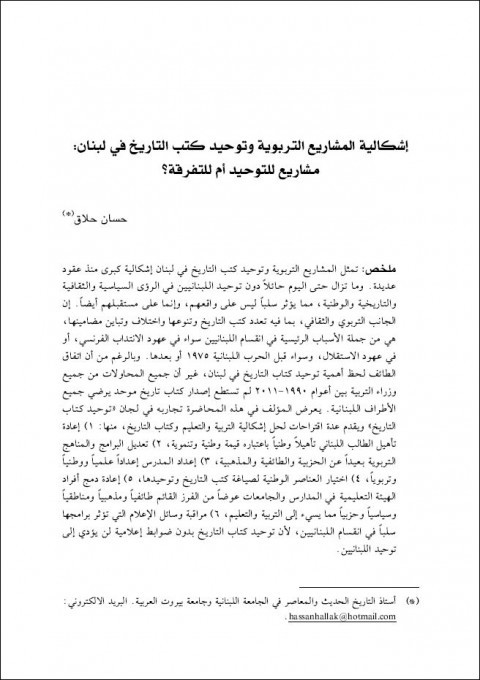 اشكالية المشاريع التربوية وتوحيد كتب التاريخ في لبنان : مشاريع للتوحيد أم للتفرقة؟ سنة النشر: 2012 المؤلف: حلاق، حسان المؤلف المؤسسي: Lebanese Association for Educational Studies (LAES) تمثل المشاريع التربوية وتوحيد كتب التاريخ في لبنان إشكالية كبرى منذ عقود عديدة. وما تزال حتى اليوم حائلاً دون توحيد اللبنانيين في الرؤى السياسية والثقافية والتاريخية والوطنية، مما يؤثر سلباً ليس على واقعهم، وإنما على مستقبلهم أيضاً. إن الجانب التربوي والثقافي، بما فيه تعدد كتب التاريخ وتنوعها واختلاف وتباين مضامينها، هي من جملة الأسباب الرئيسية في انقسام اللبنانيين سواء في عهود الانتداب الفرنسي، أو في عهود الاستقلال، وسواء قبل الحرب اللبنانية 1975 أو بعدها. وبالرغم من أن اتفاق الطائف لحظ أهمية توحيد كتاب التاريخ في لبنان، غير أن جميع المحاولات من جميع وزراء التربية بين أعوام 1990–2011 لم تستطع إصدار كتاب تاريخ موحد يرضي جميع الأطراف اللبنانية. يعرض المؤلف في هذه المحاضرة تجاربه في لجان "توحيد كتاب التاريخ" ويقدم عدة اقتراحات لحل إشكالية التربية والتعليم وكتاب التاريخ، منها: 1) إعادة تأهيل الطالب اللبناني تأهيلاً وطنياً باعتباره قيمة وطنية وتنموية، 2) تعديل البرامج والمناهج التربوية بعيداً عن الحزبية والطائفية والمذهبية، 3) إعداد المدرس إعداداً علمياً ووطنياً وتربوياً، 4) اختيار العناصر الوطنية لصياغة كتب التاريخ وتوحيدها، 5) إعادة دمج أفراد الهيئة التعليمية في المدارس والجامعات عوضاً من الفرز القائم طائفياً ومذهبياً ومناطقياً وسياسياً وحزبياً مما يسيء إلى التربية والتعليم، 6) مراقبة وسائل الإعلام التي تؤثر برامجها سلباً في انقسام اللبنانيين، لأن توحيد كتاب التاريخ بدون ضوابط إعلامية لن يؤدي إلى توحيد اللبنانيين. Educational Programs and the Unification of History Textbooks in the Lebanon: Programs to Unite or Divide? سنة النشر: 2012 المؤلف: حلاق، حسان المؤلف المؤسسي: Lebanese Association for Educational Studies (LAES) Educational programs and the question of the unification of history textbooks constitute a major problem which has been ongoing for several decades. It remains till today a hindrance on the way to unifying the Lebanese in terms of their political, cultural, historical and national perspectives.This has a negative impact not only on their present, but also on their future. Educational and cultural considerations, including the multiplicity and variety of history books and the differences and discrepancies in their content, are among the major causes for the division of the Lebanese, whether under the French mandate or since the independence years preceding the breakout of the Lebanese war in 1975 as well as in post-war years. In spite of the fact that the Taef Acord noted the importance of establishing a unified history textbook in the Lebanon, all attempts by all the ministers of national education between 1990 and 2011 failed in producing a unified history textbook satisfying all the Lebanese factions.The author presents in this paper his experience on the committees for the “unification of the history textbook”, and offers several suggestions for addressing the problems of education, including that of the history textbook. These include: 1) Reeducating Lebanese students to make them attuned to national concerns, as they constitute a valuable national and developmental resource. 2) Revising educational programs and curricula away from partisanship, sectarianism and confessionalism. 3) Preparing teachers professionally, nationally and educationally. 4) Appointing nationally minded personnel to write the history books and unify them. 5) Reintegrating the teaching staff in schools and universities to replace the current sorting by sect, confession, region, politics and partisanship, all of which works to the detriment of education and teaching. 6) Supervising the media whose programs have a negative impact by contributing to the division of the Lebanese as unifying the history textbook without putting constraints on the media will not lead to the unification of the Lebanese.
 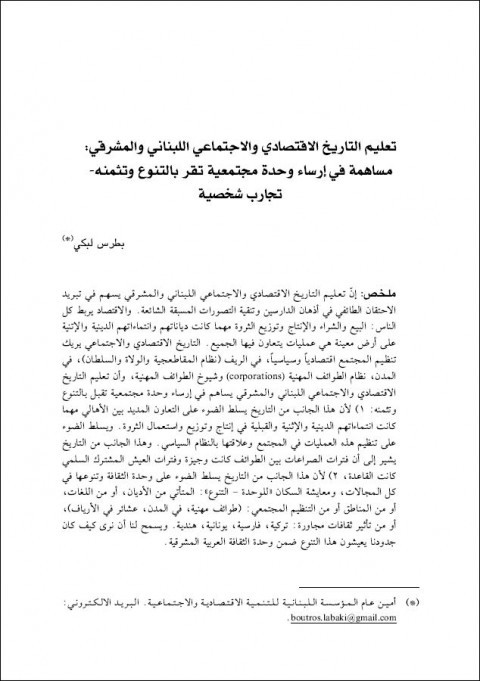 تعليم التاريخ الاقتصادي والاجتماعي اللبناني والمشرقي : مساهمة في إرساء وحدة مجتمعية تقر بالتنوع وتثمنه: تجارب شخصية سنة النشر: 2012 المؤلف: لبكي، بطرس المؤلف المؤسسي: Lebanese Association for Educational Studies (LAES) إنّ تعليم التاريخ الاقتصادي والاجتماعي اللبناني والمشرقي يسهم في تبريد الاحتقان الطائفي في أذهان الدارسين وتنقية التصورات المسبقة الشائعة. والاقتصاد يربط كل الناس: البيع والشراء والإنتاج وتوزيع الثروة مهما كانت دياناتهم وانتماءاتهم الدينية والإتنية على ارض معينة هي عمليات يتعاون فيها الجميع. التاريخ الاقتصادي والاجتماعي: يريك تنظيم المجتمع اقتصادياً وسياسياً، في الريف (نظام المقاطعجية والولاة والسلطان)، في المدن: نظام الطوائف المهنية (corporations) وشيوخ الطوائف المهنية وأن تعليم التاريخ الاقتصادي والاجتماعي اللبناني والمشرقي يساهم في إرساء وحدة مجتمعية تقبل بالتنوع وتثمنه: 1) لأن هذا الجانب من التاريخ يسلط الضوء على التعاون المديد بين الأهالي مهما كانت انتماءاتهم الدينية والإثنية والقبلية في إنتاج وتوزيع واستعمال الثروة. ويسلط الضوء على تنظيم هذه العمليات في المجتمع وعلاقتها بالنظام السياسي. وهذا الجانب من التاريخ يشير إلى أن فترات الصراعات بين الطوائف كانت وجيزة وفترات العيش المشترك السلمي كانت القاعدة، 2) لأن هذا الجانب من التاريخ يسلط الضوء على وحدة الثقافة وتنوعها في كل المجالات، ومعايشة السكان "للوحدة - التنوع": المتأتي من الأديان، أو من اللغات، أو من المناطق أو من التنظيم المجتمعي: (طوائف مهنية، في المدن، عشائر في الأرياف)، أو من تأثير ثقافات مجاورة: تركية، فارسية، يونانية، هندية. ويسمح لنا أن نرى كيف كان جدودنا يعيشون هذا التنوع ضمن وحدة الثقافة العربية المشرقية. Teaching Lebanese-Oriental Economic and Social History: Promoting a Societal Unity Which Acknowledges and Values Diversity سنة النشر: 2012 المؤلف: لبكي، بطرس المؤلف المؤسسي: Lebanese Association for Educational Studies (LAES) Teaching the economic and social history of the Lebanon and the Orient contributes towards the cooling down of sectarian tensions in the minds of learners and clears up common prejudices. Economic transactions connect everyone within a given area: Buying and selling, production and distribution of resources are operations in which everyone cooperates, regardless what their religious, confessional or ethnic affiliation might be. Economic and social history informs about the economic and political organization of society: in rural areas taxed farmers, governors and the Sultan; in the cities guilds (corporations) and the sheikhs of the guilds/corporations. Indeed, teaching the economic and social history of Lebanon and the Orient contributes to a societal unity which acknowledges and values diversity because this aspect of history highlights the longstanding cooperation among the people in the production, distribution or use of resources, no matter what their religious, ethnic or tribal affiliation might be. It also highlights the organization of these activities in society and their relation to the political system. This aspect of history also points to the fact that the intervals of conflict between the sectarian communities were short, whereas the intervals of peacefully living together were the rule. Besides, this aspect of history highlights the cultural unity and its diversity in all domains and the fact that all are shaped in their lives by this same experience of unity in diversity which comes from: religions, languages, regions, societal organization (guilds/corporations in the cities, clans in rural areas) or adjacent cultures: Turkish, Persian, Greek and Indian. It allows us to see how our ancestors lived this diversity within the unity of the Arab-Oriental culture.
 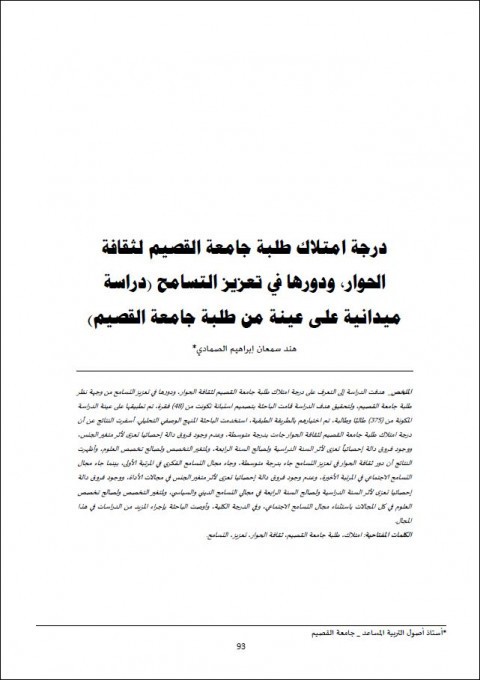 درجة امتلاك طلبة جامعة القصيم لثقافة الحوار، ودورها في تعزيز التسامح : دراسة ميدانية على عينة من طلبة جامعة القصيم سنة النشر: 2017 المؤلف: الصمادي، هند سمعان المؤلف المؤسسي: International Group for Consulting and Training (IGCT) هدفت الدراسة إلى التعرف على درجة امتلاك طلبة القصيم لثقافة الحوار ودورها في تعزيز التسامح من وجهة نظر طلبة جامعة القصيم، ولتحقيق هدف الدراسة قامت الباحثة بتصميم استبانة تكونت من (48) فقرة، تم تطبيقها على عينة الدراسة المكونة من (375) طالبا وطالبة تم اختيارهم بالطريقة الطبقية. استخدمت الباحثة المنهج الوصفي التحليلي. أسفرت النتائج عن أن درجة امتلاك طلبة جامعة القصيم لثقافة الحوار جاءت بدرجة متوسطة، وعدم وجود فروق دالة إحصائيا لأثر متغير الجنس، ووجود فروق دالة إحصائيا تعزى لأثر السنة الدراسية ولصالح السنة الرابعة، ولمتغير التخصص ولصالح تخصص العلوم، وأظهرت النتائج أن دور ثقافة الحوار في تعزيز التسامح جاء بدرجة متوسطة، وجاء مجال التسامح الفكري في المرتبة الأولى، بينما جاء مجال التسامح الاجتماعي في المرتبة الأخيرة، وعدم وجود فروق دالة إحصائيا تعزى لأثر متغير الجنس في مجالات الأداة، ووجود فروق دالة إحصائيا تعزى لأثر السنة الدراسية ولصالح السنة الرابعة في مجالي التسامح الديني والسياسي، ولمتغير التخصص ولصالح تخصص العلوم في كل المجالات باستثناء مجال التسامح الاجتماعي، وفي الدرجة الكلية. وأوصت الباحثة بإجراء المزيد من الدراسات في هذا المجال.