
الموارد
استكشف مجموعة واسعة من الموارد القيمة حول تعليم المواطنة العالمية لتعميق فهمك وتعزيز البحث والمناصرة والتعليم والتعلم.
تم العثور على 1,405 نتيجة
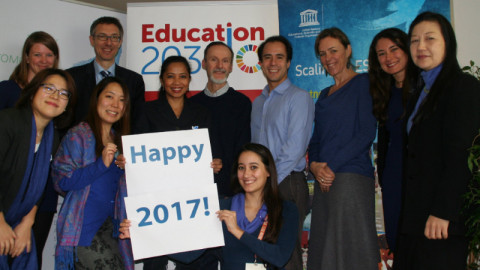 ESD Zoom Newsletters (January 2017) سنة النشر: 2017 المؤلف المؤسسي: UNESCO ESD Zoom Newsletter Highlight- UNESCO opens nominations for UNESCO-Japan Prize on ESD 2017 International Events- Call for youth: Join online discussion to participate in UNESCO Week in Canada- Asia-Pacific Network for SDG4 launched at regional meeting on Education 2030- UNESCO ASPnet trains teachers to address climate change- ESD at heart of new Mediterranean Action Plan GAP Key Partners- GAP regional meeting: The role of cities in living sustainably- GAP key partner from Peru wins prestigious Rolex Award for Enterprise- Japan holds eighth National UNESCO ASPnet Conference- Video message by Okayama Youth- Winners of International Essay Contest for Young People awards- "Green Impact": The numbers speak for themselves
  Historical efforts to implement the UNESCO 1974 Recommendation on Education in light of 3 SDGs Targets سنة النشر: 2017 المؤلف المؤسسي: UNESCO This paper presents an analytical overview of historical efforts by Member States of the United Nations Educational, Scientific and Cultural Organization (UNESCO) to implement the 1974 Recommendation concerning education for international understanding, cooperation and peace education relating to human rights and fundamental freedoms. The author of the review was hired in April 2016 to undertake an analysis of Member States’ progress reports submitted for the fourth (2008) and fifth (2012) consultations on implementation of the 1974 Recommendation. The main purpose of the review was to provide a historical overview of efforts to achieve Sustainable Development Goal (SDG) Targets 4.7, 12.8 and 13.3 and their proposed measurement indicators, based on states’ historical reporting on the Recommendation. A total of 94 country reports were reviewed for the exercise: 37 from the 4th Consultation (2008); and 57 from the 5th Consultation (2012). The coding involved retrofitting the content of reportsto conceptsthat may have been developed at a later date for the Sustainable Development Agenda and coding for data that was not explicitly requested in the Consultations. Following the coding, a quantitative and qualitative analysis was undertaken and is presented in the following report.
 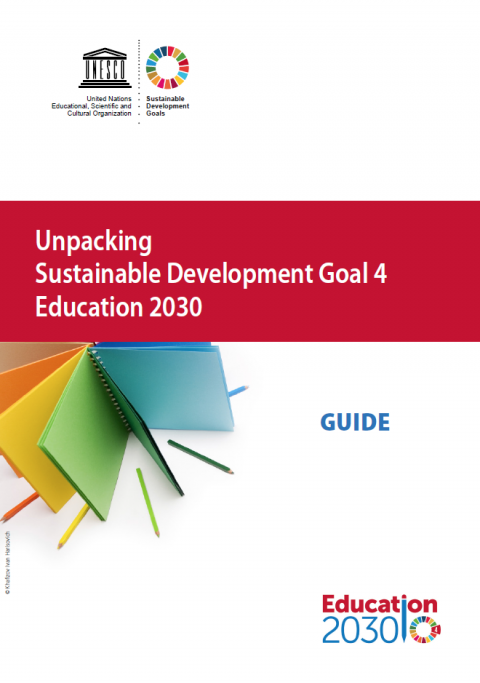 Unpacking Sustainable Development Goal 4 Education 2030: Guide سنة النشر: 2017 المؤلف المؤسسي: UNESCO This guide, organized around a set of questions and answers to “unpack” SDG4, provides overall guidance for a deeper understanding of SDG4 within the 2030 Agenda for Sustainable Development, in order to support its effective implementation. The guide outlines the key features of SDG4-Education 2030 and the global commitments expressed in the SDG4 targets as articulated in the Incheon Declaration and the Education 2030 Framework for Action. The guide also examines the implications of translating these global commitments within, and through, national education development efforts. This guide supplements the UNESCO technical guidelines (2016) for Mainstreaming SDG4-Education 2030 into sector-wide policy and planning. It was developed by Sobhi Tawil, Margarete Sachs-Israel, Huong Le Thu, and Matthias Eck of the UNESCO Section of Partnerships, Cooperation and Research (PCR) within the Division for Education 2030 Support and Coordination. Comprendre l'Objectif de développement durable 4: Education 2030, guide سنة النشر: 2017 المؤلف المؤسسي: UNESCO Le présent guide, qui s’articule autour d’une série de questions et de réponses pour « décoder » l’ODD4, contient des indications générales permettant de mieux comprendre sa place dans le Programme pour le développement durable à l’horizon 2030 et d’assurer sa mise en œuvre efficace. Il met en avant les principales caractéristiques de l’ODD4-Education 2030 et les engagements pris au niveau mondial, manifestés dans les cibles de l’ODD4 telles que formulées par la Déclaration d’Incheon et le Cadre d’action Education 2030.Ce guide complète les principes directeurs techniques de l’UNESCO (2016) pour l’intégration de l’ODD4-Education 2030 au sein de la politique et de la planification sectorielles. Il a été élaboré par Sobhi Tawil, Margarete Sachs-Israel, Huong Le Thu et Matthias Eck de la Section Partenariats, Coopération et Recherche (PCR) de l’UNESCO au sein de la Division d’appui et de coordination d’Éducation 2030.Qu’est-ce que le Programme de développement durable à l’horizon 2030 ?Le Programme de développement durable à l’horizon 2030 est un engagement intergouvernemental et un « plan d’action pour l’humanité, la planète et la prospérité ». Il se compose de 17 Objectifs de développement durable (ODD) « intégrés et indissociables qui concilient les trois dimensions du développement durable : économique, sociale et environnementale », démontrant par ailleurs l’ampleur et l’ambition de ce nouveau Programme universel. Ils ressortent de ce qui a été sans nul doute le processus de consultation le plus inclusif de toute l’histoire des Nations Unies, le fruit de la contribution substantielle de tous les secteurs de la société, de tous les acteurs de la communauté internationale et de toutes les régions du monde. Tous les États membres, l’ensemble du système des Nations Unies, les experts et les représentants de la société civile, du monde des entreprises et, le plus important, des millions de personnes du monde entier, ont pris l’engagement de concrétiser ce large programme qui s’attaque aux préoccupations communes de la planète toute entière et de promouvoir le bien public.
 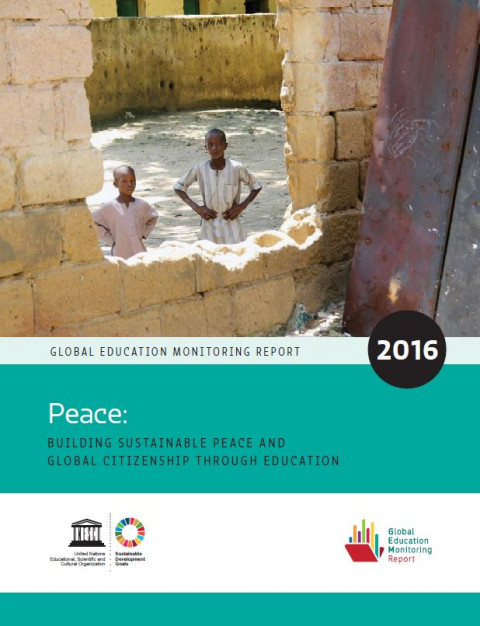 Peace: building sustainable peace and global citizenship through education;Global education monitoring report summary 2016 سنة النشر: 2017 المؤلف المؤسسي: UNESCO The 2016 GEM Report, the first of a new 15-year series, shows that education will not deliver its full potential to catapult the world forward unless rates of improvement dramatically shift, and education systems consider sustainable development in the way services are delivered. This Peace: Building sustainable peace and global citizenship through education publication is a select extract from the full 2016 Global Education Monitoring (GEM) Report: Education for people and planet: Creating sustainable futures for all. It contains two chapters from that full Report – one on peace, political participation and access to justice and the other on education for global citizenship and sustainable development — , along with the associated policy recommendations and a short section of a recent GEM Report Policy Paper Textbooks pave the way to sustainable development.
 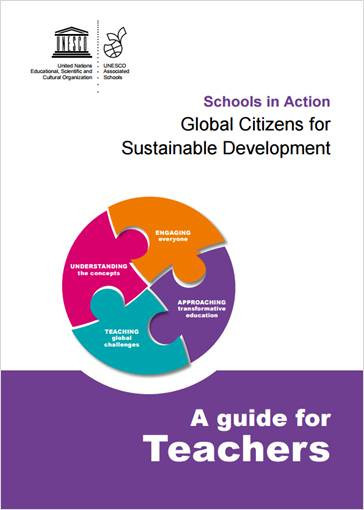 Schools in Action: Global Citizens for Sustainable Development: A Guide for Teachers سنة النشر: 2016 المؤلف المؤسسي: UNESCO The Global Citizens for Sustainable Development Teachers’ guide aims to introduce teachers to Global Citizenship Education (GCED) and Education for Sustainable Development (ESD). It provides secondary school teachers with ideas and activities to help students become global citizens and sustainable development actors. The Teachers’ guide draws on the discussions and activities of almost 1,100 participants from 104 countries, including ASPnet National Coordinators, school principals, teachers, students and experts who contributed to the Online Collaborative Platform ASPnet in Action: Global Citizens Connected for Sustainable Development in 2014 and 2015 [http://en.unesco. org/aspnet/globalcitizens] with associated activities and initiatives. The Teachers’ guide provides: An overview of what it means for learners to become global citizens and of how learners can contribute to sustainable development. Ideas for classroom activities that can help secondary school students to develop knowledge, skills, values, attitudes and behaviours that promote GCED and ESD. Selected activities on GCED and ESD from ASPnet schools around the world.
  Implementing the Right to Education: a Compendium of Practical Examples سنة النشر: 2016 المؤلف المؤسسي: UNESCO This publication is a compilation of practical examples of measures taken by Member States in implementing the provisions of the UNESCO Convention and Recommendation against Discrimination in Education. These examples are taken from national reports submitted to UNESCO for the Eighth Consultation of Member States on the implementation of these two international standard-setting instruments. The Convention and the Recommendation celebrated their fi fty-fi fth anniversary in 2015. Both express the fundamental principles of non-discrimination and equality of educational opportunities enshrined in UNESCO’'s Constitution. Since these fundamental principles were essential in the process of Education for All, the instruments have naturally become the cornerstone of this important domain.The Education 2030 development agenda will provide further opportunity to mobilise the Convention and the Recommendation in guiding Member States in the effective realization of the right to education. This compendium seeks to provide an overview of promising measures taken to ensure equality of educational opportunities and non-discrimination, while also serving as a tool for information sharing and advocacy in connection with the right to education.
  The ABCs of Global Citizenship Education سنة النشر: 2016 المؤلف المؤسسي: UNESCO UNESCO's FAQ flyers on GCED L’ABC de l’éducation à la citoyenneté mondiale سنة النشر: 2016 المؤلف المؤسسي: UNESCO Les progrès considérables des technologies de l’information et de la communication (TIC) ont permis aux individus de se rapprocher et d’interagir les uns avec les autres, où que ce soit et à tout moment. Cela a contribué à intensifier le sentiment et le fait d’être interconnectés et de vivre au-delà des frontières. En outre, l’augmentation des migrations transnationales rend les communautés locales inévitablement plus hétérogènes et accroît la nécessité d’apprendre à vivre ensemble. De plus, les tensions et les conflits entre populations, ainsi que les défis liés au développement durable, tel que le changement climatique ont des origines et des conséquences qui dépassent les frontières nationales. Cela et, exige plus de coopération et à la mise en œuvre d’actions collectives aux niveaux local et mondial.
  L'ABC de l'éducation à la citoyenneté mondiale سنة النشر: 2016 المؤلف المؤسسي: UNESCO UNESO's FAQ on Global citizenship education