
الموارد
استكشف مجموعة واسعة من الموارد القيمة حول تعليم المواطنة العالمية لتعميق فهمك وتعزيز البحث والمناصرة والتعليم والتعلم.
تم العثور على 1,727 نتيجة
 Accelerating Progress: An Empowered, Inclusive and Equal Asia and the Pacific سنة النشر: 2019 المؤلف المؤسسي: UN. Economic and Social Commission for Asia and the Pacific (UN. ESCAP) | Asian Development Bank (ADB) | United Nations Development Programme (UNDP) Accelerating progress: An empowered, inclusive and equal Asia and the Pacific responds to the theme of the 6th Asia Pacific Forum on Sustainable Development and the 2019 session of the high-level political forum on sustainable development.The report proposes a framework of four synergistic elements necessary to advance inclusion, empowerment and equality: rights and justice; norms and institutions; resources and capabilities; participation and voice. The need for action on all four fronts is illustrated by a deeper look at three pivotal challenges confronted by the region – (1) climate change and its potential to deepen inequality; (2) the urgent need to boost domestic resource mobilization; and (3) the need to strengthen social accountability and civic engagement. It draws out policy messages on how an empowerment-and-inclusion approach to policymaking can be fostered, including on addressing violence against women and girls. The report provides strong evidence that promoting empowerment and inclusion are necessary approaches to reduce inequality and accelerate progress towards a broad array of Sustainable Development Goals. It is a contribution to the ongoing national, regional and global dialogues on opportunities to empower people, ensure their inclusion and advance equality.The report is produced by the Asia-Pacific SDG partnership, comprising of the United Nations Economic and Social Commission for Asia and the Pacific (ESCAP), the Asian Development Bank, and the United Nations Development Programme.
 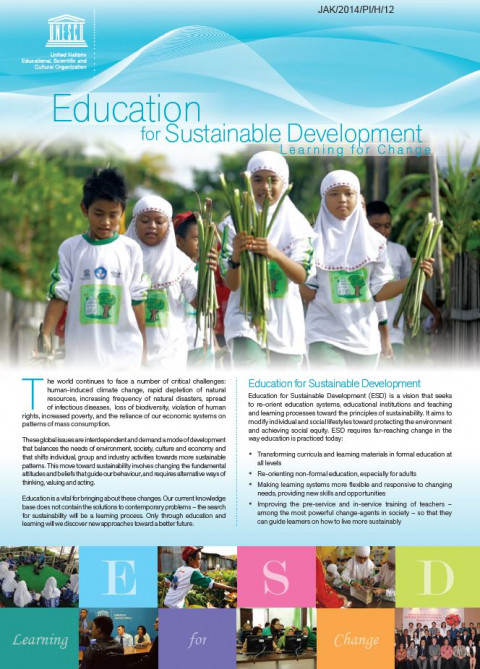 Education for Sustainable Development: Learning for Change سنة النشر: 2014 المؤلف المؤسسي: UNESCO Jakarta The world continues to face a number of critical challenges: human-induced climate change, rapid depletion of natural resources, increasing frequency of natural disasters, spread of infectious diseases, loss of biodiversity, violation of human rights, increased poverty, and the reliance of our economic systems on patterns of mass consumption. These global issues are interdependent and demand a mode of development that balances the needs of environment, society, culture and economy and that shifts individual, group and industry activities towards more sustainable patterns. This move toward sustainability involves changing the fundamental attitudes and beliefs that guide our behaviour, and requires alternative ways of thinking, valuing and acting. Education is a vital for bringing about these changes. Our current knowledge base does not contain the solutions to contemporary problems – the search for sustainability will be a learning process. Only through education and learning will we discover new approaches toward a better future.
  Developing Holistic Indicators to Promote the Internationalization of Higher Education in the Asia-Pacific سنة النشر: 2018 المؤلف: Da Wan Chang المؤلف المؤسسي: UNESCO Bangkok The internationalization of higher education has been emphasized by the global community to improve access and quality in higher education (SDG4.3), as well as to achieve other global goals by promoting cross-cultural understanding and tolerance. Even though the internationalization of higher education has diverse dimensions, ‘student mobility’ has been a predominant indicator and there are conceptual and methodological challenges in the existing sources of data and statistics. In addition to student mobility, this document proposes a holistic set of indicators to capture other important dimensions of the internationalization of higher education, such as alignment with international normative instruments, international networking, governance and management, as well as the mobility of academics and programmes, etc. The suggested indicators are categorized into domains on two levels: system and institutional. It is hoped that this policy brief will help users better understand and adapt the indicators for use in their local contexts, so as to promote the internationalization of higher education.
 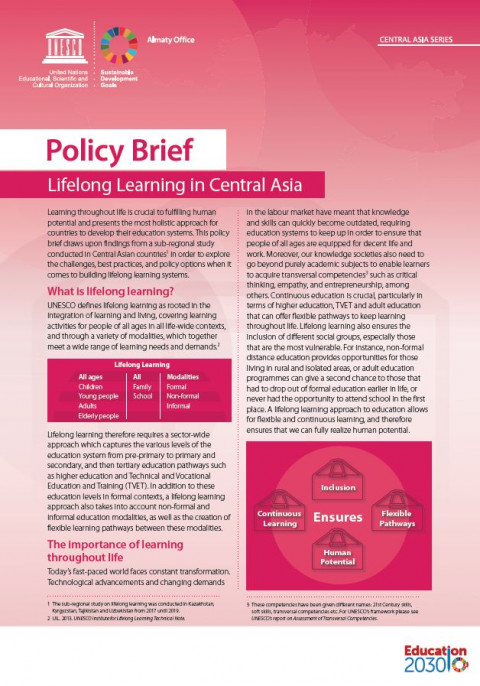 Аналитическая записка: Обучение на протяжении всей жизни в Центральной Азии سنة النشر: 2019 المؤلف المؤسسي: UNESCO Almaty Обучение на протяжении всей жизни занимает самое центральное место в глобальной повестке дня в области образования и ЦУР4 с обязательным обеспечением "инклюзивного и справедливого качественного образования и возможностей обучения на протяжении всей жизни для всех".Центральноазиатские системы образования добились успеха в обеспечении почти всеобщей грамотности, в том числе среди взрослых, а также во всеобщем предоставлении образования на начальном и среднем уровнях. Однако прежняя система Советского Союза привела к определенной негибкости систем образования в субрегионе, а также их неспособности быстро адаптироваться к разным потребностям учащихся, ставя сложную задачу в обеспечении обучения на протяжении всей жизни. Policy brief: lifelong learning in Central Asia سنة النشر: 2019 المؤلف المؤسسي: UNESCO Almaty Lifelong learning stands at the very core of the global education agenda and SDG 4, with a commitment to ensure ‘inclusive and equitable quality education and lifelong learning opportunities for all.Central Asian education systems have been successful in ensuring near-universal literacy, including among adults, as well as the universal provision of education at the primary and secondary levels. However, the legacy of the Soviet Union has resulted in a certain inflexibility of education systems in the sub-region, as well as their inability to rapidly adapt to the diverse needs of learners—posing a significant challenge to ensuring lifelong learning.
 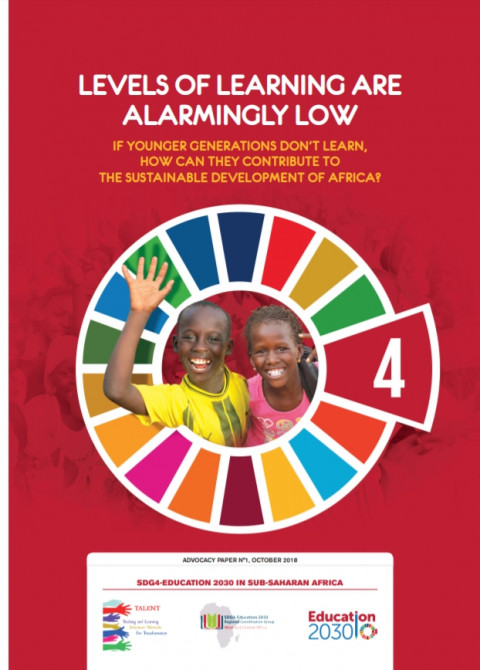 Levels of learning are alarmingly low: if younger generations don't learn, how can they contribute to the sustainable development of Africa? سنة النشر: 2018 المؤلف المؤسسي: UNESCO Dakar | Regional Coordination Group on SDG 4-Education 2030 in West and Central Africa | Teaching and Learning Educators’ Network for Transformation With the adoption of The 2030 Agenda for Sustainable Development, UN member states and partner organizations have agreed to ensure inclusive and equitable quality education and promote lifelong learning opportunities for all by 2030. Building on the unfinished agendas of the Millennium Development Goals and Education for All, quality education and learning are at the very core of both SDG4 and CESA 16-25 (see box 1). Five of the seven SDG4 targets are specifically designed with the intention of addressing the global learning crisis. Moreover, CESA 16-25 specifically calls on African Union member states to address issues of quality and equity in education, particularly at the pre-primary level, a neglected area in terms of investment and policy, and at the primary level where geographical disparities indicate that girls and women, the poorest and those leaving in remote areas are still left behind. The next question is whether these international and regional commitments have been translated into national policies and strategies that can address the alarmingly low levels of learning. Les niveaux d'apprentissage sont alarmants: si les jeunes générations n'apprennent pas, peuvent-elles contribuer au développement durable de l'Afrique? سنة النشر: 2018 المؤلف المؤسسي: UNESCO Dakar | Regional Coordination Group on SDG 4-Education 2030 in West and Central Africa | Teaching and Learning Educators’ Network for Transformation Avec l’adoption de le Programme pour le développement durable à l’horizon 2030, les États membres de l’ONU et les organisations partenaires ont convenu d’assurer, d’ici 2030, une éducation inclusive et équitable de qualité et de promouvoir des possibilités d’apprentissage tout au long de la vie pour tous. S’appuyant sur les programmes inachevés des Objectifs du Millénaire pour le développement et de l’Éducation pour tous, l’éducation et les apprentissages de qualité sont au cœur même de l’ODD4 et de la CESA 16-25 (voir l’encadré 1 dans la section suivante). En effet, cinq des sept cibles de l’ODD4 sont spécifiquement formulées pour s’attaquer à la crise mondiale de l’apprentissage. En outre, la CESA 16-25 appelle spécifiquement les États membres de l’Union Africaine à aborder les questions de qualité et d’équité dans l’éducation, en particulier au niveau pré-primaire, un domaine négligé en termes d’investissements et de politiques, et au niveau primaire où les disparités géographiques laissent sur le côté les filles et les femmes, les plus pauvres et ceux qui vivent dans les zones reculées. La question est désormais de savoir si ces engagements internationaux et régionaux ont été traduits en politiques et stratégies nationalesqui peuvent s’attaquer aux niveaux alarmants des résultats d’apprentissage.
 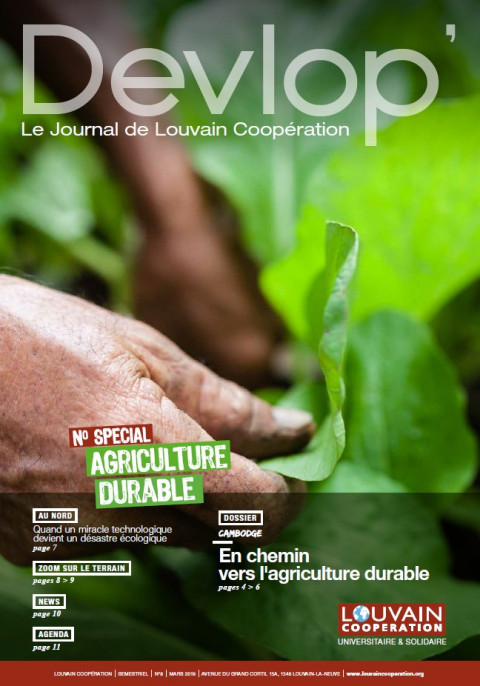 Devlop’ Le journal de Louvain Coopération 8 - MARS 2019 سنة النشر: 2019 المؤلف المؤسسي: Louvain Coopération Dans ce numéro, nous partirons de Louvain-la-Neuve avec le plaidoyer agro-écologique de Philippe Baret, doyen de la faculté d’agronomie de l’UCLouvain ; nous nous envolerons ensuite vers le Cambodge où académiques et acteurs de terrains soutiennent des paysans cambodgiens dans la réappropriation de leurs activités ; nous transiterons chez nos partenaires boliviens, dans les quartiers marginalisés d’El Alto, qui eux aussi lancent des initiatives d’agriculture urbaine pour mieux atterrir en République démocratique du Congo où place est faite à l’agro-écologie. Finalement, nous reviendrons à Louvain-la-Neuve où les Ingénieux-Sud réfléchissent avec leurs contreparties locales à mettre en place des solutions intelligentes et adaptées aux problèmes agricoles rencontrés. Nous espérons qu’à la lecture de notre journal vous serez convaincus, comme nous, que tous ensemble, producteurs, consommateurs, gouvernements, entreprises privées, associations, face aux défis agricoles, nous sommes capables de transformer des risques en opportunités.
 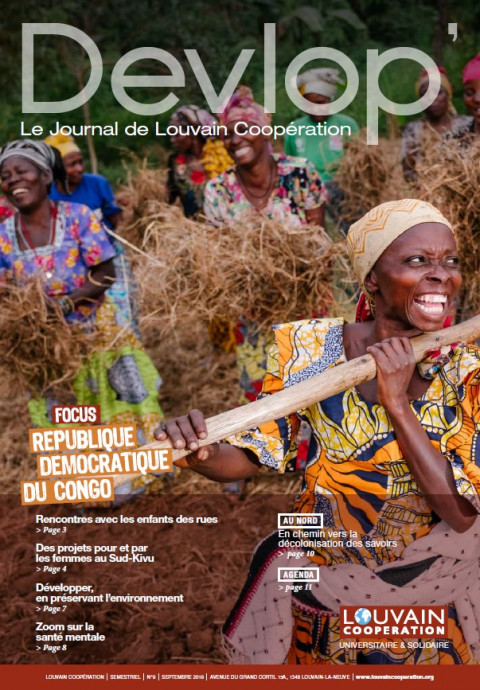 Devlop’ Le journal de Louvain Coopération 9 - SEPTEMBRE 2019 سنة النشر: 2019 المؤلف المؤسسي: Louvain Coopération Le renforcement des capacites de nos partenaires locaux est pour nous un objectif crucial et un theme transversal a tous les projets de Louvain Cooperation, ceci dans le but d’augmenter l’autonomie et la resilience des populations. Alors, oui, il n’est pas evident de travailler dans le contexte socio-politico-economique de la RDC et, oui, nous devons parfois faire face a des echecs lorsque des evenements que nous ne pouvons controler surviennent. Mais nous pouvons aussi constater chaque jour l’utilite de nos actions et la difference concrete qu’elles peuvent faire pour les personnes qui en beneficient. Voila pourquoi nous croyons en notre travail et nous voulons continuer d’agir en RDC, malgre les difficultes rencontrees. Ce Devlop’ vous invite aujourd’hui a decouvrir ces beaux projets et a rencontrer celles et ceux qui les vivent et qui les font vivre au quotidien.
  Intégrer le genre dans la coopération non gouvernementale سنة النشر: 2019 المؤلف المؤسسي: Solidarité mondiale Solidarité Mondiale place l’attention et la prise en compte du genre au cœur de ses pratiques et ses programmes. Ainsi, notre organisation s’emploie à créer une culture institutionnelle sensible au genre, tant au sein de notre équipe que dans la coopération avec nos partenaires d’ici et d’ailleurs. En effet, l’égalité des genres est essentielle pour garantir le caractère durable et inclusif de la coopération. Tant au niveau des droits du travail que de la protection sociale, les femmes se trouvent souvent dans les positions les plus précaires. C’est pourquoi Solidarité Mondiale s’est engagée pour l’égalité des genres au sein de la coopération non gouvernementale et a signé la "Charte Genre" le 29 novembre 2018. La "Charte Genre" a été signée par 56 organisations qui se sont engagées à soutenir un élan positif en leur sein autour de l’égalité et à mettre en place les actions nécessaires pour que les intentions se matérialisent. Elle inclut l’égalité des sexes (entre hommes et femmes) ainsi que la reconnaissance des droits des personnes LGBQTI (lesbiennes, gays, bisexuelles, queer, transgenres, intersexuées). Toutefois, comme nous vous l’expliquions en 2018, cette charte est issue d’un processus plus large, auquel Solidarité Mondiale a pris activement part, visant notamment à créer un guide d’inspiration. Bonne nouvelle, depuis peu, ce guide d’inspiration « Intégrer le genre dans la coopération non gouvernementale » est finalisé et accessible à tou.te.s ! Celui-ci regroupe des bonnes pratiques et des pistes d’intégration du genre dans les différentes activités propres à l’Éducation à la citoyenneté mondiale et solidaire (ECMS) en Belgique (communication, plaidoyer, mobilisation, etc.). Il a été conçu à l’aide d’un processus participatif et piloté par les 5 structures fédératives (11.11.11, ACODEV, CNCD-11.11.11, ngo-federatie et FIABEL) accompagnées du Monde selon les femmes.