
الموارد
استكشف مجموعة واسعة من الموارد القيمة حول تعليم المواطنة العالمية لتعميق فهمك وتعزيز البحث والمناصرة والتعليم والتعلم.
تم العثور على 875 نتيجة
 IBE-UNESCO preparatory report for the 48th ICE on inclusive education سنة النشر: 2007 المؤلف المؤسسي: UNESCO International Bureau of Education (IBE) The International Conference on Education (ICE) is a major international forum for educational policy dialogue among Ministers of Education and other stakeholders (researchers, practitioners, representatives of intergovernmental organizations and NGOs). The ICE is organized by the International Bureau of Education (IBE), the UNESCO institute specialized in assisting Member States in curriculum development to achieve quality Education For All. The IBE Council, composed of 28 UNESCO Member States, has proposed in January 2007 that the 48th ICE session, to be held in Geneva in November 2008, should focus on the theme “Inclusive Education: the Way of the Future”. The 48th ICE will focus on broadening the understanding of the theory and practice of inclusive education while discussing how governments can develop and implement policies on inclusive education. The IBE is hosting a series of regional preparatory workshops dedicated to exploring and advancing inclusive education in preparation for the ICE 2008. The Regional Preparatory Workshop "International Workshop on Inclusive Education, Andean and Southern Cone Regions” was held in Buenos Aires, Argentina on the 11-14 September 2007. This event was organized by the International Bureau of Education (IBE/UNESCO), the Division for the Promotion of Basic Education (ED/BAS, UNESCO Paris), the Regional Bureau of Education for Latin America and the Caribbean (OREALC/UNESCO); University of de San Andrés, Ministry of Science, Technology and Education, in collaboration with the Community of Practice - Southern Cone and Andean Regions; it had the participation of ten countries from the Southern Cone and Andean Regions. This report is based on the workshop’s country reports and presentations on the conception and status of inclusive education in participating countries, and on the ideas proposed by participants on what the next steps should be on how to advance inclusive education policy and implementation in the region. Rapport préparatoire du BIE-UNESCO pour la 48e CIE sur l'éducation inclusive سنة النشر: 2007 المؤلف المؤسسي: UNESCO International Bureau of Education (IBE) La Conférence Internationale sur l'Éducation (CIE) est un important forum international pour le dialogue sur les politiques éducatives entre les Ministres de l'Éducation et d'autres parties prenantes (chercheurs, praticiens, représentants d'organisations intergouvernementales et ONG). CIE est organisé par le Bureau International d'Éducation (BIE), l'Institut de l'UNESCO spécialisé pour aider les États membres dans l'élaboration des programmes pour atteindre une éducation de qualité pour tous. Le Conseil du BIE, composé de 28 États membres de l'UNESCO, a proposé en Janvier 2007 que la session de la CIE 48e, qui se tiendra à Genève en Novembre 2008, devrait se concentrer sur le thème «Education pour l'inclusion: la voie de l'avenir». La 48e CIE mettra l'aCECnt sur l'élargissement de la compréhension de la théorie et la pratique de l'éducation inclusive, tout en discutant comment les gouvernements peuvent élaborer et mettre en œuvre des politiques sur l'éducation inclusive. Le BIE organise une série d'ateliers préparatoires régionaux dédiés à l'exploration et de faire progresser l'éducation inclusive dans la préparation de la CIE 2008. L'Atelier régional préparatoire "Atelier international sur l'éducation inclusive, des Andes et les régions du Cône Sud» a eu lieu à Buenos Aires, Argentine sur la 11-14 Septembre 2007. Cet événement a été organisé par le Bureau International d'Éducation (BIE / UNESCO), la Division de la promotion de l'Éducation de Base (ED / BAS, UNESCO Paris), le Bureau Régional de l'Éducation pour l'Amérique latine et les Caraïbes (OREALC / UNESCO); Université de de San Andrés, Ministère de la Science, de la Technologie et de l'Éducation, en collaboration avec la Communauté de Pratique - Cône Sud et les régions andines;. il y avait la participation de dix pays du Cône Sud et les régions andines Cette rapport est basé sur les rapports et les présentations des pays de l'atelier sur la conception et le statut de l'éducation inclusive dans les pays participants, ainsi que sur les idées proposées par les participants sur les prochaines étapes devraient être sur la façon de faire progresser la politique de l'éducation inclusive et la mise en œuvre dans la région.
 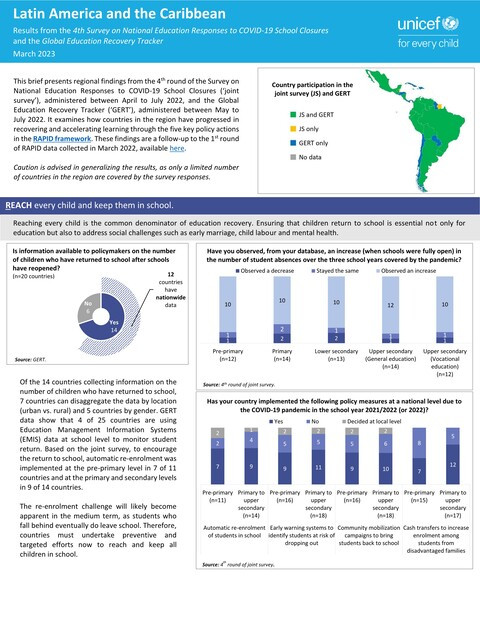 Education in a Post-COVID World: Towards a Rapid Transformation; Latin America and the Caribbean Regional Brief سنة النشر: 2023 المؤلف المؤسسي: United Nations Children's Fund (UNICEF) On March 11, 2020, the World Health Organization declared COVID-19 a global pandemic, resulting in disruptions to education at an unprecedented scale. In response to the urgent need to recover learning losses, countries worldwide have taken RAPID actions to: Reach every child and keep them in school; Assess learning levels regularly; Prioritize teaching the fundamentals; Increase the efficiency of instruction; and Develop psychosocial health and wellbeing. This brief presents regional findings from the 4th round of the Survey on National Education Responses to COVID-19 School Closures (‘joint survey’), administered between April to July 2022, and the Global Education Recovery Tracker (‘GERT’), administered between May to July 2022. It examines how countries in the region have progressed in recovering and accelerating learning through the five key policy actions in the RAPID framework. These findings are a follow-up to the 1st round of RAPID data collected in March 2022.
  Toolbox for Educational Institutions: Lines of Action of Socio-Emotional Skills Vocational and Professional Orientation سنة النشر: 2017 المؤلف المؤسسي: ENEL Foundation | Organization of Ibero-American States for Education, Science and Culture (OEI) This toolbox is aimed at educational agents who are motivated to articulate in their pedagogical work actions aimed at facilitating the decision-making of young people during their life path, by strengthening socio-emotional skills and vocational and professional guidance, in order to enable transformations, whether personal, family or social, and with a view to sustainable development. Caja de herramientas para instituciones educativas: Líneas de acción de Habilidades socioemocionales orientación vocacional y profesional سنة النشر: 2017 المؤلف المؤسسي: ENEL Foundation | Organización de Estados Iberoamericanos para la Educación, la Ciencia y la Cultura (OEI) Esta caja de herramientas está dirigida a agentes educativos que se encuentren motivados en articular a su quehacer pedagógico acciones encaminadas a facilitar la toma de decisiones de los jóvenes durante su trayectoria de vida, mediante el fortalecimiento de las habilidades socioemocionales y la orientación vocacional y profesional, con el fin de posibilitar transformaciones ya sea de tipo personal, familiar o social y en miras al desarrollo sostenible.
  Challenges and Perspectives of Inclusive Education: A Regional Perspective سنة النشر: 2024 المؤلف المؤسسي: National Commission for the Continuous Improvement of Education (Mejoredu) | Organization of Ibero-American States for Education, Science and Culture (OEI) This work compiles the four analysis tables Challenges and perspectives of inclusive education, which, to contribute to this purpose, were constituted as spaces for reflection and plural and democratic dialogue. During the analysis tables held in June 2023, the prominent speakers gave life to a space for reflection and plural and democratic dialogue, seeking to contribute through conversations to a topic of debate that cannot be postponed in the life of schools, speaking about the current situation of populations historically violated in their fundamental rights, the challenges of inclusive education in the region, experiences in educational care for historically disadvantaged populations and proposals for actions that contribute to educational systems moving towards inclusive education. Retos y perspectivas de la educación inclusiva: Una mirada regional سنة النشر: 2024 المؤلف المؤسسي: National Commission for the Continuous Improvement of Education (Mejoredu) | Organización de Estados Iberoamericanos para la Educación, la Ciencia y la Cultura (OEI) Esta obra compila las cuatro mesas de análisis Retos y perspectivas de la educación inclusiva, las cuales, para contribuir a este propósito, se constituyeron en espacios de reflexión y diálogo plural y democrático. Durante las mesas de análisis realizadas en junio de 2023, los destacados ponentes dieron vida a un espacio de reflexión y diálogo plural y democrático, buscando aportar mediante conversatorios a un tema de debate inaplazable en la vida de las escuelas, hablando sobre la situación actual de las poblaciones históricamente vulneradas en sus derechos fundamentales, los desafíos de la educación inclusiva en la región, experiencias en atención educativa de poblaciones históricamente desfavorecidas y propuestas de acciones que contribuyan a que los sistemas educativos avancen hacia una educación inclusiva.
 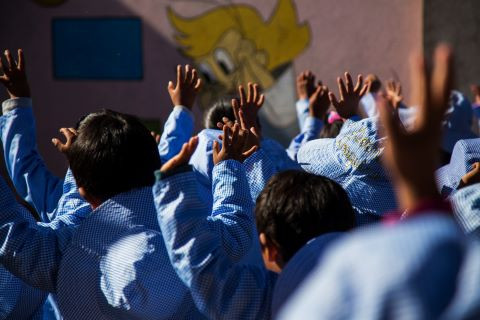 Weaving Education and Equity in Ibero-America سنة النشر: 2024 المؤلف: Ricardo Cuenca المؤلف المؤسسي: Organization of Ibero-American States for Education, Science and Culture (OEI) Addressing the complex relationship between education and inequality in Latin America is a challenge. Economic and social disparities create a complex network in the region. Despite progress, access remains an obstacle for many. During its 75-year history, the OEI has been working to break down the barriers that hinder equitable education for all. Ricardo Cuenca, member of the OEI Advisory Board, explains to what extent educational policies can contribute to mitigating these inequalities in Latin America. Tejiendo educación y equidad en Iberoamérica سنة النشر: 2024 المؤلف: Ricardo Cuenca المؤلف المؤسسي: Organización de Estados Iberoamericanos para la Educación, la Ciencia y la Cultura (OEI) Abordar la compleja relación entre educación y desigualdad en Iberoamérica es todo un desafío. Las disparidades económicas y sociales tejen un entramado complejo en la región. A pesar de los avances, el acceso sigue siendo un obstáculo para muchos. En esta travesía, la OEI ha venido trabajando durante sus 75 años de historia para derribar las barreras que obstaculizan una formación equitativa para todos. Ricardo Cuenca, miembro del Consejo Asesor de la OEI, nos explica hasta qué punto las políticas educativas pueden contribuir a mitigar esas desigualdades en Iberoamérica.
  Young People: Protagonists of Democratic Transformation سنة النشر: 2024 المؤلف المؤسسي: Organization of Ibero-American States for Education, Science and Culture (OEI) The involvement of young people in democracy is essential for the development and sustainability of our societies. Recognizing the value of their contribution as agents of change, the Citizen Academy project in Panama launched the course "The Role of Youth in Democracy." This educational tool is offered free of charge through the platform www.academiaciudadana.org. The initiative, promoted by the Organization of Ibero-American States (OEI), is the result of a collaboration with the Electoral Tribunal, Fundamorgan and the Panamanian Debate Association (Aspade), and aims to promote a more just and equitable society through civic education for the new generations. Daniela Hidalgo, institutional coordinator of Aspade, explains how they seek to transform youth participation in the democratic life of the Central American country.