
الموارد
استكشف مجموعة واسعة من الموارد القيمة حول تعليم المواطنة العالمية لتعميق فهمك وتعزيز البحث والمناصرة والتعليم والتعلم.
تم العثور على 2,657 نتيجة
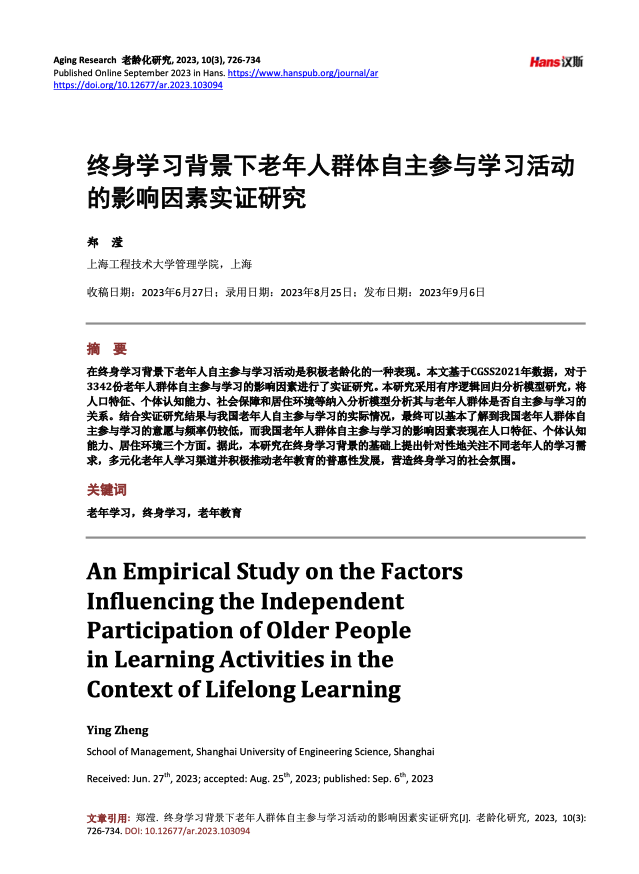 终身学习背景下老年人群体自主参与学习活动的影响因素实证研究 (老龄化研究 第10卷 第3期) سنة النشر: 2023 المؤلف: 郑滢 在终身学习背景下老年人自主参与学习活动是积极老龄化的一种表现。本文基于CGSS2021年数据,对于3342份老年人群体自主参与学习的影响因素进行了实证研究。本研究采用有序逻辑回归分析模型研究,将人口特征、个体认知能力、社会保障和居住环境等纳入分析模型分析其与老年人群体是否自主参与学习的关系。结合实证研究结果与我国老年人自主参与学习的实际情况,最终可以基本了解到我国老年人群体自主参与学习的意愿与频率仍较低,而我国老年人群体自主参与学习的影响因素表现在人口特征、个体认知能力、居住环境三个方面。据此,本研究在终身学习背景的基础上提出针对性地关注不同老年人的学习需求,多元化老年人学习渠道并积极推动老年教育的普惠性发展,营造终身学习的社会氛围。
 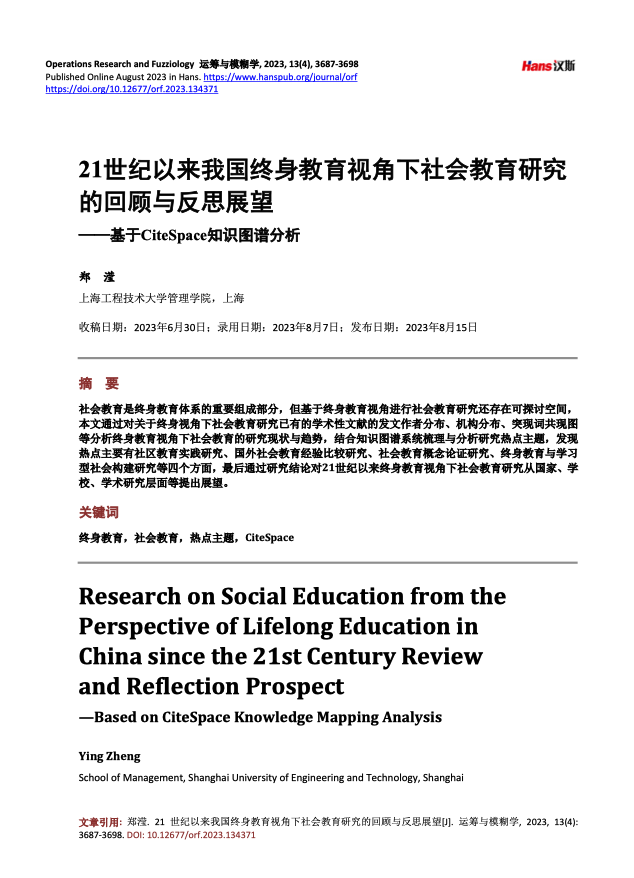 21世纪以来我国终身教育视角下社会教育研究的回顾与反思展望 : 基于CiteSpace知识图谱分析 (运筹与模糊学 第13卷 第4期) سنة النشر: 2023 المؤلف: 郑滢 社会教育是终身教育体系的重要组成部分,但基于终身教育视角进行社会教育研究还存在可探讨空间,本文通过对关于终身视角下社会教育研究已有的学术性文献的发文作者分布、机构分布、突现词共现图等分析终身教育视角下社会教育的研究现状与趋势,结合知识图谱系统梳理与分析研究热点主题,发现热点主要有社区教育实践研究、国外社会教育经验比较研究、社会教育概念论证研究、终身教育与学习型社会构建研究等四个方面,最后通过研究结论对21世纪以来终身教育视角下社会教育研究从国家、学校、学术研究层面等提出展望。
 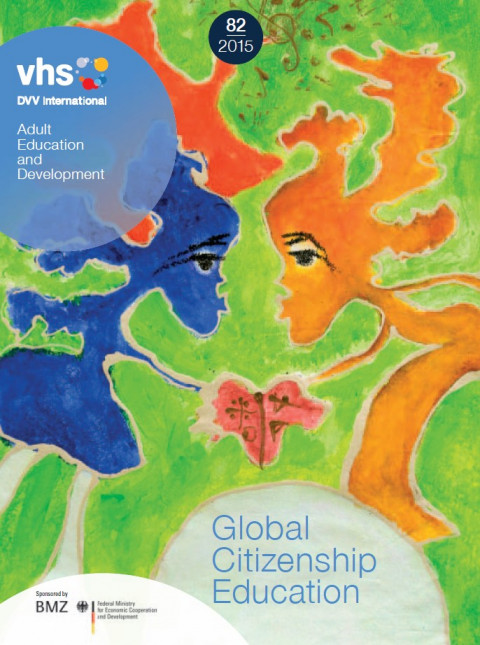 Adult education and development: global citizenship education (no 82, 2015) سنة النشر: 2015 المؤلف المؤسسي: DVV International Issue 82/2015 of the international journal Adult Education and Development (AED) explores the topic global citizenship education. In the international debates, we are witnessing a growing interest in the concept of global citizenship education. It is one of the three pillars of the Global Education First Initiative (GEFI) launched by the United Nations Secretary-General in 2012 and is being internationally promoted by the work of UNESCO. According to the GEFI, education that fosters global citizenship “must fully assume its central role in helping people to forge more just, peaceful, tolerant and inclusive societies”. The 2030 Agenda for Sustainable Development, adopted by the United Nations General Assembly in September 2015, refers to global citizenship as one tool to “ensure that all learners acquire the knowledge and skills needed to promote sustainable development”. The ambitions are high, but the concrete understanding of global citizenship education and its implications differ widely. Is it just another abstract concept? What meaning can the word citizenship have if it does not refer to a specific nation? What do people in different parts of the world understand by global citizenship? And how can global citizenship education be put into practice? Adult Education and Development decided to engage in the debate and invited authors from different regions, backgrounds and disciplines to share their thoughts and experiences on the topic and related questions such as identity, migration, peace, the meaning of citizenship, globalisation and sustainable development. Irina Bokova, Director-General of UNESCO, explains the organisation’s understanding of global citizenship education, and why adult education and “learning beyond the classrooms” are crucial when it comes to promoting global citizenship. Canadian author and journalist Doug Saunders (“Arrival City: How the Largest Migration in History Is Reshaping Our World”) talks about the challenges and opportunities of what he refers to as the last great human migration, that from the countryside to the cities, and about the positive role adult education can play during this transition. In the section “Citizens’ voices” people from all over the world talk about what global citizenship means to them and in what ways they see themselves as global citizens. And photographer Viktor Hilitksi travelled through Belarus and captured with his camera how villages rediscover their local traditions and cultures. Éducation des adultes et développement: L'éducation à la citoyenneté mondiale (ECM) (no 82, 2015) سنة النشر: 2015 المؤلف المؤسسي: DVV International Le numéro 82/2015 de la revue internationale l’Éducation des Adultes et Développement(AED) explore le sujet de l'éducation à la citoyenneté mondiale. Dans les débats internationaux, nous assistons à un intérêt croissant pour le concept d'éducation à la citoyenneté mondiale. Il est l'un des trois piliers de l'Initiative Mondiale pour l'Éducation Avant Tout (GEFI) lancé par le Secrétaire général des Nations Unies en 2012 et est promu à l'échelle internationale par le travail de l'UNESCO. Selon le GEFI, l'éducation qui favorise la citoyenneté mondiale "doit assumer pleinement son rôle central en aidant les gens à forger plus justes, des sociétés pacifiques, tolérantes et inclusives". L'Agenda 2030 pour le développement durable, adoptée par l'Assemblée générale des Nations Unies en Septembre 2015, se réfère à la citoyenneté mondiale comme un outil pour «faire en sorte que tous les apprenants à acquérir les connaissances et les compétences nécessaires pour promouvoir le développement durable». Les ambitions sont grandes, mais la compréhension concrète de L'éducation à la citoyenneté mondiale(ECM) et ses implications diffèrent largement. Est-il juste un autre concept abstrait? Quel sens le mot citoyenneté peut avoir si elle ne se réfère pas à une nation spécifique? Qu'est-ce que les gens dans les différentes parties du monde comprennent par la citoyenneté mondiale? Comment l'éducation à la citoyenneté mondiale(ECM) peut-elle être mise en pratique? Education des adultes et développement ont décidé de participer au débat et a invité les auteurs de différentes régions, milieux et disciplines à partager leurs réflexions et expériences sur le sujet et les questions connexes telles que l'identité, la migration, la paix, le sens de la citoyenneté, la mondialisation et le développement durable. Irina Bokova, Directrice générale de l'UNESCO, explique la compréhension de l'organisation de l'éducation à la citoyenneté mondiale, et pourquoi l'éducation des adultes et de «l'apprentissage au-delà des salles de classe" sont cruciales en matière de promotion de la citoyenneté mondiale. L'auteur et journaliste canadien Doug Saunders ( «La ville d'arrivée: comment la plus grande migration dans l'histoire remodèle notre monde») parle des défis et des opportunités de ce qu'il appelle la dernière grande migration humaine, celle des campagnes aux villes et Sur le rôle positif que l'éducation des adultes peut jouer au cours de cette transition. Dans la section «La voix des citoyens», des gens du monde entier parlent de ce que la citoyenneté mondiale signifie pour eux et de la manière dont ils se perçoivent comme des citoyens du monde. Et le photographe Viktor Hilitksi a parcouru la Biélorussie et a capturé avec sa caméra comment les villages redécouvrent leurs traditions et cultures locales.
  Éducation des adultes et développement: l’éducation à la citoyenneté mondiale (no 82, 2015) سنة النشر: 2015 المؤلف المؤسسي: DVV International Issue 82/2015 of the international journal Adult Education and Development (AED) explores the topic global citizenship education. In the international debates, we are witnessing a growing interest in the concept of global citizenship education. It is one of the three pillars of the Global Education First Initiative (GEFI) launched by the United Nations Secretary-General in 2012 and is being internationally promoted by the work of UNESCO. According to the GEFI, education that fosters global citizenship “must fully assume its central role in helping people to forge more just, peaceful, tolerant and inclusive societies”. The 2030 Agenda for Sustainable Development, adopted by the United Nations General Assembly in September 2015, refers to global citizenship as one tool to “ensure that all learners acquire the knowledge and skills needed to promote sustainable development”. The ambitions are high, but the concrete understanding of global citizenship education and its implications differ widely. Is it just another abstract concept? What meaning can the word citizenship have if it does not refer to a specific nation? What do people in different parts of the world understand by global citizenship? And how can global citizenship education be put into practice? Adult Education and Development decided to engage in the debate and invited authors from different regions, backgrounds and disciplines to share their thoughts and experiences on the topic and related questions such as identity, migration, peace, the meaning of citizenship, globalisation and sustainable development. Irina Bokova, Director-General of UNESCO, explains the organisation’s understanding of global citizenship education, and why adult education and “learning beyond the classrooms” are crucial when it comes to promoting global citizenship. Canadian author and journalist Doug Saunders (“Arrival City: How the Largest Migration in History Is Reshaping Our World”) talks about the challenges and opportunities of what he refers to as the last great human migration, that from the countryside to the cities, and about the positive role adult education can play during this transition. In the section “Citizens’ voices” people from all over the world talk about what global citizenship means to them and in what ways they see themselves as global citizens. And photographer Viktor Hilitksi travelled through Belarus and captured with his camera how villages rediscover their local traditions and cultures.
 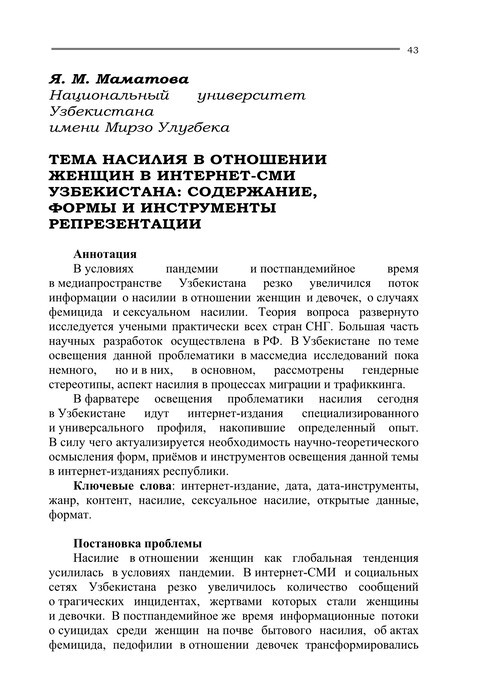 The Theme of Violence Against Women on the Internet Media of Uzbekistan: Content, Tools of Representation (PR and Advertising in a Changing World: Regional Aspect; No.28, 2023) سنة النشر: 2023 المؤلف: Я. М. Маматова In the context of the pandemic and post-pandemic in the media space of Uzbekistan, the flow of information about violence against women and girls, about cases of femicide and sexual violence has increased dramatically. In Uzbekistan, there are still few studies on the topic of coverage of this issue in the mass media, but they also mainly consider gender stereotypes, the aspect of violence in the processes of migration and trafficking. Тема насилия в отношении женщин в интеренет-СМИ Узбекистана: содержание, формы и инструменты репрезентации (PR и реклама в изменяющемся мире: региональный аспект; No.28, 2023) سنة النشر: 2023 المؤلف: Я. М. Маматова В условиях пандемии и постпандемийное время в медиапространстве Узбекистана резко увеличился поток информации о насилии в отношении женщин и девочек, о случаях фемицида и сексуальном насилии. В Узбекистане по теме освещения данной проблематики в массмедиа исследований пока немного, но и в них, в основном, рассмотрены гендерные стереотипы, аспект насилия в процессах миграции и трафиккинга.
  Inequalities and Gender Violence in Latin America and the Caribbean سنة النشر: 2023 المؤلف: Karina Batthyány المؤلف المؤسسي: Consejo Latinoamericano de Ciencias Sociales (CLACSO) The chapters of this book are the result of the powerful research work carried out within the framework of the call “Inequalities and gender violence in Latin America and the Caribbean", promoted by CLACSO. They seek, as a whole, to outline answers to these questions, through innovative methodologies that redefine conventional tools and give the texts great singularity. The point of view is, in all cases, novel and localized: territorially, but also in terms of theory and epistemology. The reading of This book manages to immerse the reader's gaze in a truly critical approach to the reality of the continent. Desigualdades y violencias de género en América Latina y el Caribe سنة النشر: 2023 المؤلف: Karina Batthyány المؤلف المؤسسي: Consejo Latinoamericano de Ciencias Sociales (CLACSO) Los capítulos del presente libro son fruto de los potentes trabajos de investigación realizados en el marco de la convocatoria “Desigualdades y violencias de género en América Latina y el Caribe", promovida por CLACSO. Buscan, en su conjunto, esbozar respuestas a dichos interrogantes, mediante metodologías innovadoras que resignifican herramientas convencionales y dotan a los textos de gran singularidad. El punto de vista es, en todos los casos, novedoso y localizado: territorialmente, pero también en lo que a la teoría y a la epistemología se refiere. La lectura de este libro logra sumergir la mirada de la lectora o el lector a un acercamiento verdaderamente crítico a la realidad del continente.
 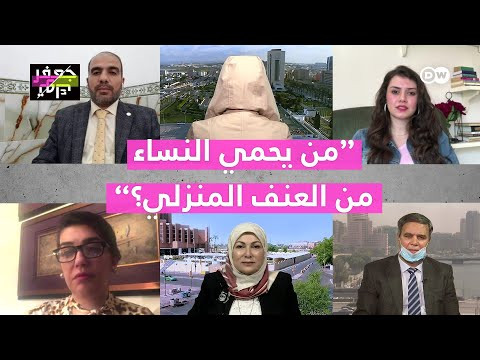 Domestic Violence Escalated in the Time of Corona ... Who Protects Women? سنة النشر: 2020 المؤلف: Jaafar Abdul Karim المؤلف المؤسسي: DW Jaafar Talk A program of DW TV broadcasting from Berlin. The program talks about the physical violence experienced by some women in the Arab world during the time of the new Corona virus. The program is characterized by its review of multiple cases of violence during quarantine, and seeks to discuss the causes and solutions to this issue.