
الموارد
استكشف مجموعة واسعة من الموارد القيمة حول تعليم المواطنة العالمية لتعميق فهمك وتعزيز البحث والمناصرة والتعليم والتعلم.
تم العثور على 1,725 نتيجة
 Lessons Learned from Mental Health and Education: Identifying Best Practices for Addressing Violent Extremism سنة النشر: 2015 المؤلف: Stevan Weine | B. Heidi Ellis | Ron Haddad | Alisa B. Miller | Rebecca Lowenhaupt | Chloe Polutnik المؤلف المؤسسي: National Consortium for the Study of Terrorism and Responses to Terrorism (START) Il s’agit dans cette recherche d'identifier des ressources dans le domaine de l'éducation à la santé mentale qui pourraient contribuer aux meilleures pratiques dans la prévention et l'intervention contre l'extrémisme violent. Plus précisément, les auteurs ont cherché à répondre aux questions suivantes : 1) Quelles sont les connaissances, les programmes ou les interventions requis dans le domaine de l'éducation à la santé mentale pouvant contribuer aux meilleures pratiques et autres stratégies dans la lutte contre l'extrémisme violent ? 2) Comment les professionnels de l'éducation à la santé mentale peuvent s’impliquer davantage dans la lutte contre l'extrémisme violent ?
 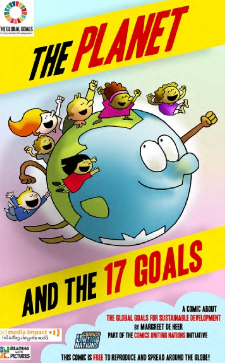 The Planet and the 17 Goals المؤلف: Margreet De Heer المؤلف المؤسسي: United Nations Children's Fund (UNICEF) UNICEF has teamed up with the Comics UnitingNations initiative to use the creative and exciting medium of comics to bring the messages of sustainable development to comics fans globally! Comics have been developed by world renown illustrators, writers and comics developers from around the world.Dutch illustrator Margreet de Heer has lent her talents to the Comics United Nations project to help inform children and youth about the new global goals.
  Mahatma Gandhi Institute of Education for Peace and Sustainable Development: a joint initiative by UNESCO and the government of India سنة النشر: 2013 المؤلف المؤسسي: Mahatma Gandhi Institute of Education for Peace and Sustainable Development (MGIEP) The United Nations Educational, Scientific and Cultural Organization (UNESCO) and the Government of India are embarking on a major new partnership to create the Mahatma Gandhi Institute of Education for Peace and Sustainable Development. Through research and capacity-building, the Institute aims to develop and promote new approaches to education, empowering learners to transform their lives and build a more peaceful and sustainable world. Based in New Delhi, this will be the first UNESCO specialized education Institute in India, and the first in the Asia-Pacific region. It is particularly fitting that the Institute is hosted by India, the birthplace of Mahatma Gandhi and a country that has made a significant commitment to education over the past decades. Institut Mahatma Gandhi d'éducation pour la paix et le développement durable: une initiative conjointe de l'UNESCO et le gouvernement de l'Inde سنة النشر: 2013 المؤلف المؤسسي: Mahatma Gandhi Institute of Education for Peace and Sustainable Development (MGIEP) L'Organisation des Nations Unies pour l'éducation, la science et la culture (UNESCO) et le Gouvernement de l'Inde se lancent dans un nouveau partenariat majeur pour créer l'Institut Mahatma Gandhi d'éducation pour la paix et le développement durable. Grâce à la recherche et le renforcement des capacités, l'Institut vise à développer et promouvoir de nouvelles approches de l'éducation, l'autonomisation des apprenants pour transformer leur vie et construire un monde plus pacifique et durable. Basé à New Delhi, ce sera le premier Institut de l'UNESCO spécialisé de l'éducation en Inde, et la première dans la région Asie-Pacifique. Il est particulièrement approprié que l'Institut est hébergé par l'Inde, le lieu de naissance du Mahatma Gandhi et un pays qui a pris un engagement important à l'éducation au cours des dernières décennies. Mahatma Gandhi Institute of Education for Peace and Sustainable Development: UNESCO's first category 1 Institute in the Asia-Pacific سنة النشر: 2014 المؤلف المؤسسي: Mahatma Gandhi Institute of Education for Peace and Sustainable Development (MGIEP) The Mahatma Gandhi Institute of Education for Peace and Sustainable Development (MGIEP) is UNESCO’s first Category 1 Institute in the Asia-Pacific. The Institute will be a key strategic player in UNESCO’s work towards quality Education for All and the transformative shift envisioned for the Post 2015 agenda. Established in cooperation with the Government of India, MGIEP has been created to play a leading role in research, knowledge sharing, capacity building and policy formulation in the area of peace and sustainability education. The Institute aims to promote, assimilate and generate high quality research to lead the intellectual and policy discourse for education and global citizenship in the region. It was named after Mahatma Gandhi, as a tribute to his ideas of non-violence and sustainable living. The President of India and the Director-General of UNESCO jointly announced the establishment of the Institute in November, 2012. It is located in New Delhi. Mahatma Gandhi Institute of Education for Peace and Sustainable Development: UNESCO's first category 1 Institute in the Asia-Pacific سنة النشر: 2014 المؤلف المؤسسي: Mahatma Gandhi Institute of Education for Peace and Sustainable Development (MGIEP) L'Institut Mahatma Gandhi d'éducation pour la paix et le développement durable (MGIEP) est la première catégorie de l'UNESCO 1 Institut dans la région Asie-Pacifique. L'Institut sera un acteur stratégique clé dans le travail de l'UNESCO à l'éducation de qualité pour tous et le changement de transformation envisagé pour le programme post 2015. Fondée en coopération avec le Gouvernement de l'Inde, MGIEP a été créé pour jouer un rôle de premier plan dans la recherche, le partage des connaissances, le renforcement des capacités et la formulation des politiques dans le domaine de l'éducation de la paix et de la durabilité. L'Institut vise à promouvoir, d'assimiler et de générer des recherches de haute qualité pour diriger le discours intellectuel et politique de l'éducation et la citoyenneté mondiale dans la région. Il a été nommé d'après le Mahatma Gandhi, comme un hommage à ses idées de non-violence et de vie durable. Le Président de l'Inde et le Directeur général de l'UNESCO ont annoncé conjointement la mise en place de l'Institut en Novembre 2012. Il est situé à New Delhi. Mahatma Gandhi Institute of Education for Peace and Sustainable Development: UNESCO's first category 1 institute in the Asia-Pacific brochure سنة النشر: 2014 المؤلف المؤسسي: Mahatma Gandhi Institute of Education for Peace and Sustainable Development (MGIEP) The Mahatma Gandhi Institute of Education for Peace and Sustainable Development (MGIEP) is UNESCO’s first Category 1 Institute in the Asia-Pacific. The Institute will be a key strategic player in UNESCO’s work towards quality Education for All and the transformative shift envisioned for the Post 2015 agenda. Established in cooperation with the Government of India, MGIEP has been created to play a leading role in research, knowledge sharing, capacity building and policy formulation in the area of peace and sustainability education. The Institute aims to promote, assimilate and generate high quality research to lead the intellectual and policy discourse for education and global citizenship in the region. It was named after Mahatma Gandhi, as a tribute to his ideas of non-violence and sustainable living. The President of India and the Director-General of UNESCO jointly announced the establishment of the Institute in November, 2012. It is located in New Delhi. Institut Mahatma Gandhi d'Éducation pour la Paix et le Développement Durable: UNESCO premier institut de catégorie 1 dans la brochure Asie-Pacifique سنة النشر: 2014 المؤلف المؤسسي: Mahatma Gandhi Institute of Education for Peace and Sustainable Development (MGIEP) L'Institut Mahatma Gandhi d'éducation pour la paix et le développement durable (MGIEP) est la première catégorie de l'UNESCO 1 Institut dans la région Asie-Pacifique. L'Institut sera un acteur stratégique clé dans le travail de l'UNESCO à l'éducation de qualité pour tous et le changement de transformation envisagé pour le programme post 2015. Fondée en coopération avec le Gouvernement de l'Inde, MGIEP a été créé pour jouer un rôle de premier plan dans la recherche, le partage des connaissances, le renforcement des capacités et la formulation des politiques dans le domaine de l'éducation de la paix et de la durabilité. L'Institut vise à promouvoir, d'assimiler et de générer des recherches de haute qualité pour diriger le discours intellectuel et politique de l'éducation et la citoyenneté mondiale dans la région. Il a été nommé d'après le Mahatma Gandhi, comme un hommage à ses idées de non-violence et de vie durable. Le Président de l'Inde et le Directeur général de l'UNESCO ont annoncé conjointement la mise en place de l'Institut en Novembre 2012. Il est situé à New Delhi. Address by Irina Bokova, Director-General of UNESCO, on the occasion of Seminar on Global Citizenship Education, UNHQ; New York, 6 March 2015 سنة النشر: 2015 المؤلف المؤسسي: UNESCO. Director-General, 2009-2017 (Bokova, I.G.) This document is an address by Irina Bokova, Director-General of UNESCO on the occasion of "Seminar on Global Citizenship Education" in New York, 6 March 2015. She highlights the importance of GCED for education in the 21st century. Défi des professeurs d'université à cultiver la citoyenneté Mondiale des étudiants سنة النشر: 2014 المؤلف المؤسسي: National Science and Technology Council (Taiwan) A l'intersection de la mondialisation et de la localisation depuis les années 1990, la nation se retire dans l'ère de la mondialisation et en même temps faire face aux défis de problèmes intérieurs, tels que l'indifférence du vote, le retrait de la protection sociale, la discrimination raciale, les conflits culturels, etc. La politique, les droits économiques, sociaux et culturels des citoyens sont également accompagnés de responsabilités. Le rôle de l'éducation est d'aider les gens à réaliser leurs rôles en tant que citoyens du monde, en améliorant la qualité des citoyens, et la promotion de la maturité de la société entière et la sphère publique.