
الموارد
استكشف مجموعة واسعة من الموارد القيمة حول تعليم المواطنة العالمية لتعميق فهمك وتعزيز البحث والمناصرة والتعليم والتعلم.
تم العثور على 1,727 نتيجة
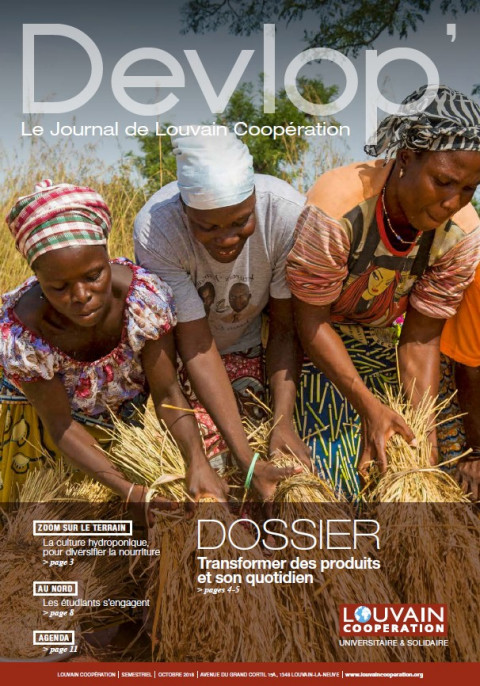 Devlop’ Le journal de Louvain Coopération 7 - OCTOBRE 2018 سنة النشر: 2018 المؤلف المؤسسي: Louvain Coopération Universitaire pour l’avenir En tant que premier cadre partant à la retraite, on m’offre le privilège d’écrire cet édito, que je consacre à l’opportunité que représente l’ancrage universitaire de notre ONG. Pendant mes quelques années au sein de cette organisation, j’ai pu observer et contribuer à quelques initiatives qui m’ont convaincu de la valeur ajoutée d’être une ONG universitaire. Les interactions avec l‘UCLouvain les plus intéressantes et pertinentes sont selon moi celles qui impliquent et renforcent des organisations et universités du Sud. Le développement durable étant avant tout l’affaire des citoyens locaux concernés, notre binôme avec l’UCLouvain doit relever le défi de renforcer les capacités locales du Sud à formuler et mettre en oeuvre ses propres politiques de développement : évoluer d’une dépendance aux idées du Nord vers une interdépendance avec les idées du Sud. J’encourage donc l’équipe à soutenir les capacités de recherche et d’innovation des partenaires du Sud. C’est le meilleur gage d’une appropriation de leur développement et d’une adaptation à leur contexte de stratégies adéquates. Au Nord, de nombreux chercheurs universitaires participent aux processus multi-acteurs qui orientent nos propres transitions sociétales. Pourquoi ne pas contribuer à cette capacitation-là au Sud ? Le défi pour Louvain Coopération consisterait alors à développer de plus en plus de collaborations incluant des ONG, étudiants et chercheurs universitaires du Sud. Ainsi nous pourrons évoluer vers des alliances entre partenaires de plus en plus égaux, et améliorerons notre ancrage social au sein du milieu universitaire. Les processus de transformations des productions agricoles présentés dans ce numéro de Devlop’ sont au coeur de cette problématique d’appropriation. Bonne lecture !
 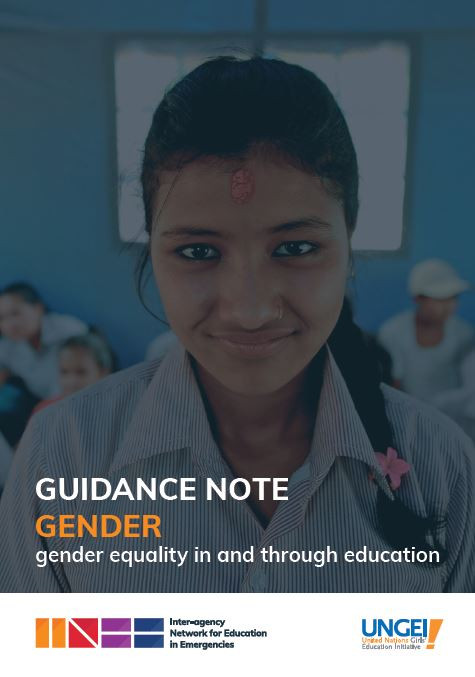 INEE Guidance Note on Gender: Equality in and Through Education سنة النشر: 2019 المؤلف المؤسسي: Inter-agency Network for Education in Emergencies (INEE) With the launch of the Global Goals for Sustainable Development (SDGs) in 2015, the international community committed to providing inclusive and equitable quality education for all (SDG4) as well as achieving gender equality and the empowerment of all women and girls (SDG5). The Global Goals also emphasize the need to “leave no one behind” by focusing on those furthest behind first, such as those affected by crisis. In line with this, the Education 2030 Framework for Action stresses the importance of providing education in “safe, supportive and secure learning environments free from violence” and recommends a stronger, better coordinated response to ensure the protective space of education is maintained during crises and subsequent recovery efforts.In response to these global commitments, the INEE Guidance Note on Gender provides strategies to ensure that girls, boys, women, and men in contexts of conflict and crisis equally enjoy the protection and learning outcomes that quality education can provide. It also outlines principles for gender-responsive programming, in alignment with the INEE Minimum Standards for Education in Emergencies. The Guidance Note on Gender shows how attention to gender dynamics and social constraints will result in better education for all crisis-affected populations and help build inclusive, equitable education systems for the future. This guidance note also responds to recent developments in the humanitarian context, including the historic commitment made by G7 partners to quality education for girls in crisis situations. The ensuing Charlevoix Declaration on Quality Education for Girls, Adolescent Girls, and Women in Developing Countries recognizes that quality education can contribute to peace and stability as well as positive health and life outcomes for all. It is critical that the development community now harnesses this global momentum by working together to break the particular barriers that prevent too many girls and boys in situations of crisis and conflict from accessing the education they need. It is our hope that this Guidance Note on Gender will help better equip those at the frontlines of this work to do just that.
 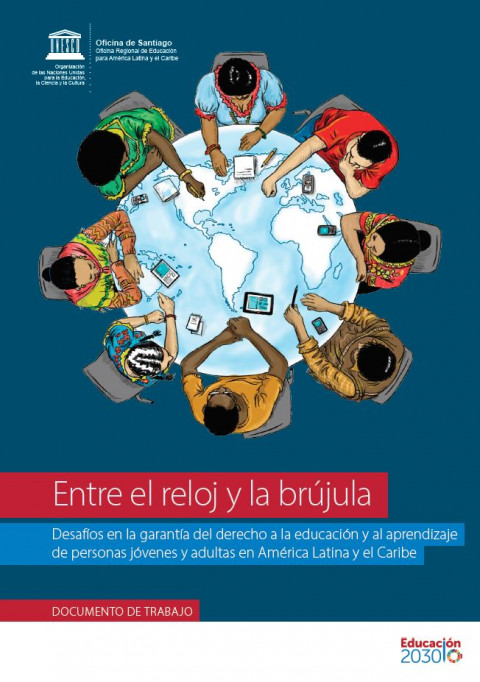 Entre el reloj y la brújula: desafíos en la garantía del derecho a la educación y al aprendizajede personas jóvenes y adultas en América Latina y el Caribe; documento de trabajo سنة النشر: 2019 المؤلف: Henry Renna المؤلف المؤسسي: UNESCO Santiago Este documento tiene por objetivo proporcionar una visión general de la educación y del aprendizaje de personas jóvenes y adultas como derecho humano y social. Los instrumentos de derecho vinculante y no vinculante que la sustentan son históricos y de larga data, como también contingentes, amplios y extensos en su alcance, con presencia regional e internacional. El documento muestra —sobre la base de los Indicadores del Objetivo de Desarrollo Sostenible 4 (ODS 4 Agenda 2030)— que los principales desafíos para los países de América Latina y el Caribe tienen relación con la lentitud de los progresos (el desafío del reloj) dejando a muchas y muchos jóvenes y adultos al margen de oportunidades educativas, de conocimientos, habilidades y aptitudes, y privados de alcanzar el bienestar integral. Este informe también sostiene —basado en los informes nacionales del Tercer Reporte Global de Educación y Aprendizaje de Adultos— que muchos desafíos están vinculados con la dirección de las políticas (el desafío de la brújula), con sentidos reduccionistas y homogeneizadores detrás de las instituciones y de la acción pública, lo que precariza y fragiliza la garantía del derecho a la educación y al aprendizaje de las personas jóvenes y adultas. Este documento es consistente con el llamado de la UNESCO a «repensar la educación» e invita a reconstruir en el siglo XXI un mundo y una educación sin muros, donde se difuminen las fronteras mentales e institucionales que reducen, dividen y aislan los sistemas educativos, con el fin de liberar su poder transformador para todos y todas.
 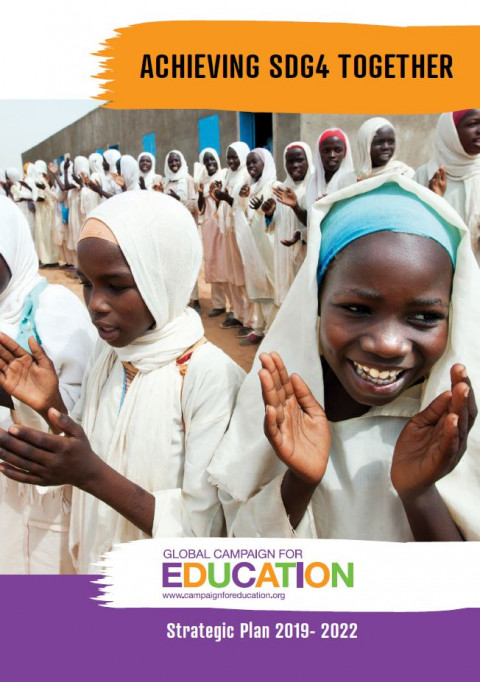 Achieving SDG 4 Together: Strategic Plan 2019 - 2022 سنة النشر: 2018 المؤلف المؤسسي: Global Campaign for Education (GCE) The 2019-2022 strategic plan of the Global Campaign for Education was adopted during the 6th World Assembly of the movement in November 2018, Kathmandu. The plan identifies 4 priority strategic areas: Inclusivity and non-discrimination, Transformative education, Education in emergencies and Financing education. The plan also focus on strengthening the global movement and integrating youth voices.On the eve of celebrating its 20th anniversary, the Global Campaign for Education (GCE) is the largest civil society organisation movement working to promote the human right to education and to put pressure on governments and the international community to fulfil their commitments to provide free, inclusive, quality public education and lifelong learning for all, particularly for children. Our regional and national coalitions encompass many thousands of civil society organisations and represent millions of individuals across the world. Each is independent, and all are united by the commitment to the human right to education, and to achieving change through the mobilisation of citizens and civil society.
  Transforming Systems in Times of Adversity: Education and Resilience; White Paper سنة النشر: 2019 المؤلف: Ritesh Shah المؤلف المؤسسي: United States Agency for International Development (USAID) This white paper was commissioned to provide USAID, including Missions, Regional Bureaus, Pillar Bureaus, and the Office of U.S. Foreign Disaster Assistance (OFDA), with an overview of global and Agency thinking and practice on education and resilience and a foundation and justification for positioning USAID education efforts more concretely within a resilience frame.The white paper is organized into three key sections. The first section outlines the business case for resilience, explaining how and why resilience is an important consideration for education programs to consider in contexts of crisis and conflict and how education is well poised as a sector to contribute to strengthening resilience. The second section presents a conceptual framework for understanding how resilience operates through and within the education sector and program interventions. The third section provides a series of key considerations for developing and supporting USAID education programs with a resilience lens or focus.
 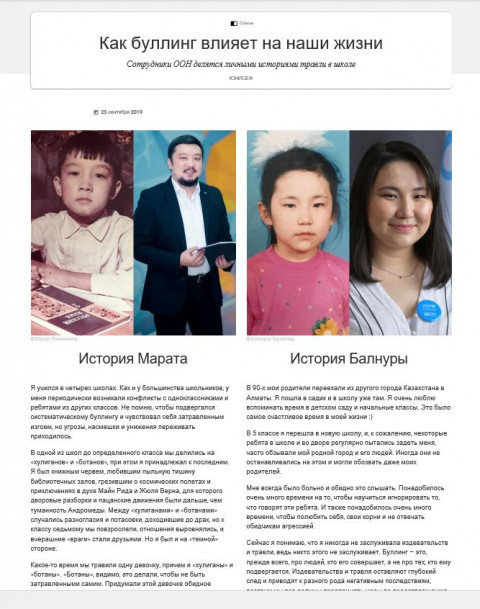 How Bullying Affects Our Lives سنة النشر: 2019 المؤلف المؤسسي: UNICEF Kazakhstan In this article, UN staff members share personal stories showing how they dealt with bullying at school. Как буллинг влияет на наши жизни سنة النشر: 2019 المؤلف المؤسسي: UNICEF Kazakhstan В данной статье сотрудники ООН делятся личными историями травли в школе.
  Accountability for Gender Equality سنة النشر: 2018 المؤلف: Elaine Unterhulter | Amy North | Orlanda Ward The aim of this paper is to consider approaches to understanding and evaluating accountability in education from the perspective of concerns with gender equality in education. This task has a number of facets and complexities, because ‘gender’ is not one simple set of relationships, and the notion of gender equality in education can be read in a number of different ways. Thus developing adequate conceptualizations for the key terms (accountability, and gender equality and education) needs to take account of gender as a particularly fluid, contextually located and contested idea signaling processes, which link with different formulations of policy and practice to enhance gender equality and accountability in education.In this paper we look at a range of different meanings of accountability, distilled in the main GEM Report (UNESCO, 2017) and consider their implications in relation to debates about gender and gender equality in education. The aim of the paper is to develop a ‘bespoke’ interpretation of accountability and different forms of gender equality in education through which we can assess a number of research studies and country examples of forms of accountability.This paper is also background paper prepared for the 2018 Global education monitoring report gender review: Meeting our commitments to gender equality in education.
 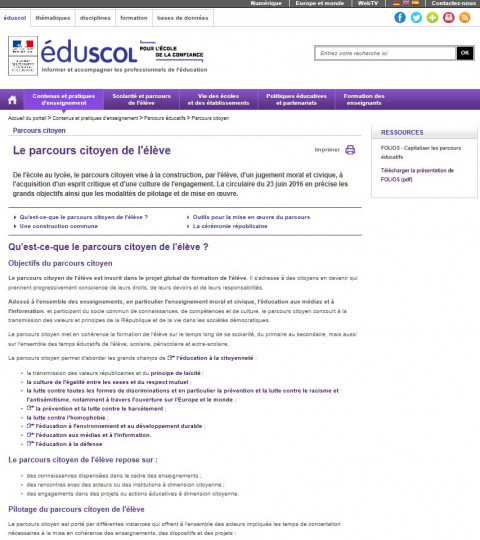 Le parcours citoyen de l'élève سنة النشر: 2016 المؤلف المؤسسي: éducscol De l'école au lycée, le parcours citoyen vise à la construction, par l'élève, d'un jugement moral et civique, à l'acquisition d'un esprit critique et d'une culture de l'engagement. La circulaire du 23 juin 2016 en précise les grands objectifs ainsi que les modalités de pilotage et de mise en œuvre. Qu'est-ce-que le parcours citoyen de l'élève ? Une construction commune Outils pour la mise en œuvre du parcours La cérémonie républicaine
  La fondation Zentrum fir politesch Bildung : Un centre pour l’éducation à la citoyenneté سنة النشر: 2016 المؤلف المؤسسي: Fondation Zentrum fir politesch Bildung | Le Gouvernement du Grand-Duché de Luxembourg L’éducation à la citoyenneté fait partie des priorités du gouvernement dans le cadre de la politique éducative. Il s’agit de préparer le citoyen, durant son enfance et sa jeunesse, à la transition vers sa vie d’adulte responsable, capable de participer activement à une société en constante évolution, en faisant preuve de tolérance, de respect et d’esprit critique.Le gouvernement a opté pour la création d’une structure indépendante, chargée d’élaborer les concepts pour une éducation à la citoyenneté, tant à l’école que dans les structures d’accueil, de centraliser les efforts, de développer des offres pédagogiques, de mettre en place des campagnes d’information et de promouvoir la compréhension de la démocratie et la participation politique des enfants et des jeunes, …Ce Centre pour l’éducation à la citoyenneté - Zentrum fir politesch Bildung – prend la forme d’une fondation de droit privé afin de garantir son autonomie.