
الموارد
استكشف مجموعة واسعة من الموارد القيمة حول تعليم المواطنة العالمية لتعميق فهمك وتعزيز البحث والمناصرة والتعليم والتعلم.
تم العثور على 3,451 نتيجة
 Principes mondiaux des Nations Unies pour l’intégrité de l’information: Recommandations pour une action multipartite سنة النشر: 2024 المؤلف المؤسسي: United Nations (UN) Les avancées technologiques ont révolutionné les communications, connectant les personnes à une échelle autrefois inimaginable. Elles ont soutenu les communautés en temps de crise, amplifié les voix marginalisées et contribué à la mobilisation mondiale pour la justice raciale et l’égalité des genres. Pourtant, ces mêmes avancées ont également favorisé la propagation de la désinformation, des informations fallacieuses (ou « fake news ») et des discours de haine à une vitesse, une ampleur et une viralité sans précédent, menaçant ainsi l’intégrité de l’écosystème informationnel. Les risques émergents et croissants liés aux progrès rapides de l’intelligence artificielle font du renforcement de l’intégrité de l’information l’un des défis les plus urgents de notre époque. Cette menace mondiale, claire et actuelle, exige une action internationale coordonnée. La publication Principes mondiaux des Nations Unies pour l’intégrité de l’information nous montrent qu’un autre avenir est possible.
 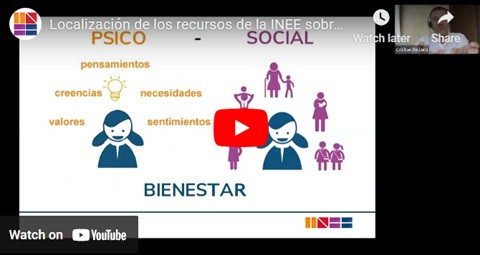 Localización de los recursos de la INEE sobre PSS-SEL سنة النشر: 2024 المؤلف المؤسسي: Harvard Graduate School of Education (HGSE) | Inter-agency Network for Education in Emergencies (INEE) En estos talleres, los participantes aprendieron cómo localizar los recursos de PSS-SEL de la INEE, incluyendo el Documento de referencia de la INEE sobre Apoyo psicosocial y psicoeducación en niños, niñas y jóvenes en situaciones de emergencia, la nota de orientación de la INEE sobre PSS, la Caja de herramientas de PSS-SEL, y la nota de orientación sobre bienestar docente en situaciones de emergencia, y cómo adaptarlos eficazmente a los distintos contextos.
 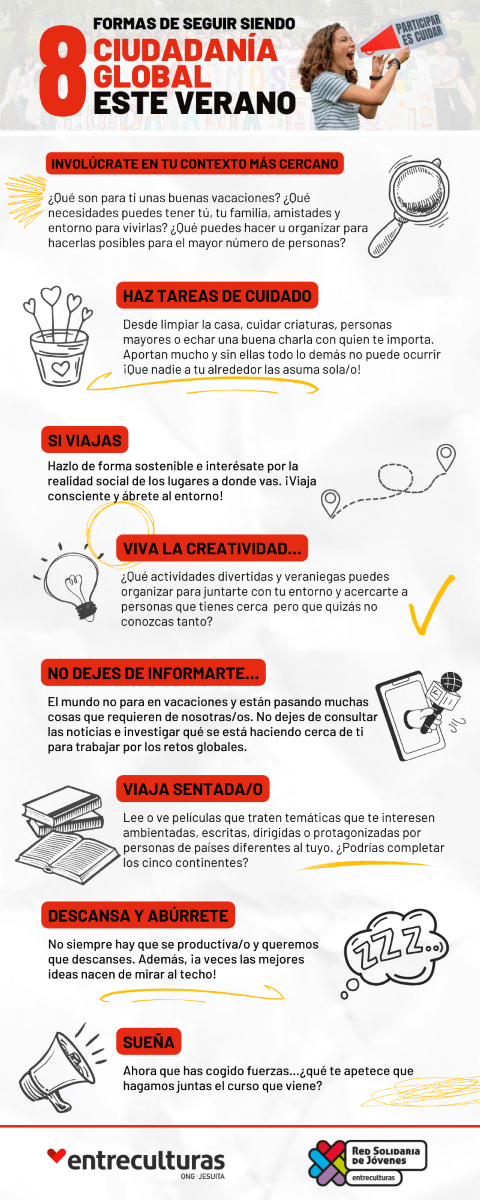 A Conscious Summer: 8 Ways to Remain a Global Citizen سنة النشر: 2024 المؤلف المؤسسي: Entreculturas The holidays are here, and with them new ways of building global citizenship. Don't underestimate all that we can continue to do during the summer, through enjoyment, meeting and relaxation. In this infographic we present ideas to continue being global citizens. Go ahead and work on it with your groups and your environment! Un verano consciente: 8 formas de seguir siendo ciudadanía global سنة النشر: 2024 المؤلف المؤسسي: Entreculturas Llegan las vacaciones, y con ellas nuevas maneras de construir ciudadanía global. No subestimes todo lo que, desde el disfrute, el encuentro y el descanso, podemos seguir haciendo durante el verano. En esta infografía presentamos ideas para seguir siendo ciudadanos globales. ¡Anímate a trabajarlo con tus grupos y tu entorno!
 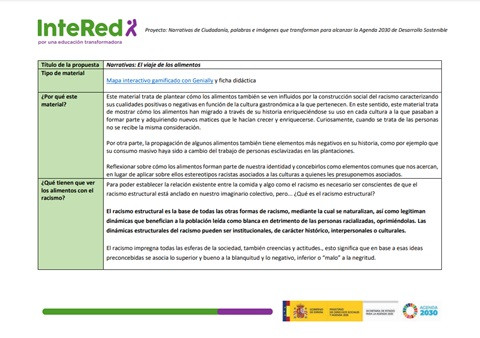 Narratives: The Journey of Food سنة النشر: 2024 المؤلف المؤسسي: InteRed This is an interactive game that raises the question of how food is also influenced by the social construction of racism, characterising its positive or negative qualities, depending on the gastronomic culture to which it belongs. In this sense, this material tries to show how food has migrated throughout history, enriching its use in each culture it became part of and acquiring new nuances that made it grow and become richer. Curiously, when it comes to people, the same consideration is not given. On the other hand, the spread of some foods also has more negative elements in their history, such as the fact that their mass consumption has been in exchange for the work of enslaved people on plantations. Narrativas: El viaje de los alimentos سنة النشر: 2024 المؤلف المؤسسي: InteRed Este es un juego interactivo que plantea cómo los alimentos también se ven influidos por la construcción social del racismo caracterizando sus cualidades positivas o negativas, en función de la cultura gastronómica a la que pertenecen. En este sentido, este material trata de mostrar cómo los alimentos han migrado a través de su historia enriqueciéndose su uso en cada cultura de la que pasaban a formar parte y adquiriendo nuevos matices que les hacían crecer y enriquecerse. Curiosamente, cuando se trata de las personas, no se recibe la misma consideración. Por otra parte, la propagación de algunos alimentos también tiene elementos más negativos en su historia, como por ejemplo que su consumo masivo haya sido a cambio del trabajo de personas esclavizadas en las plantaciones.
  Podcast: Right to Education Against Hate Speech (SAME 2024) سنة النشر: 2024 المؤلف المؤسسي: Global Campaign for Education (GCE) The Global Action Week for Education (GAE) 2024 has been the perfect setting for children and adolescents to contribute their voice and perspective to the issue of hate speech. Through awareness-raising and reflection workshops, children and adolescents have shared complex personal situations and cases of hate that they have witnessed, reproduced or experienced first-hand. Guided by their reflections, the participants designed a two-chapter podcast, where they addressed the issues that concern them most. This process not only allowed them to deepen their understanding of the normalization of hate speech and structural violence, but also to prepare for the production of the podcast, where they were able to express their thoughts and proposals in a creative and accessible way for a wider audience. Podcast: Derecho a la educación contra los discursos de odio (SAME 2024) سنة النشر: 2024 المؤلف المؤسسي: Global Campaign for Education (CME) La Semana de Acción Mundial por la Educación (SAME) 2024, ha sido el escenario perfecto para que las niñas, niños y adolescentes aporten su voz y perspectiva a la problemática sobre los discursos de odio. A través de talleres de sensibilización y reflexión, las niñas, niños y adolescentes han compartido situaciones personales complejas y casos de odio que han presenciado, reproducido o vivido en sus propias carnes. Guiados por sus reflexiones, los participantes diseñaron un podcast, de dos capítulos, donde abordaron los temas que más les preocupan. Este proceso no solo les permitió profundizar en su comprensión de la normalización de discursos de odio y violencia estructural, sino también a prepararse para la producción del podcast, donde pudieron expresar sus pensamientos y propuestas de una manera creativa y accesible para un público más amplio.
  Carbon Inequality Kills: Why Curbing the Excessive Emissions of an Elite Few Can Create a Sustainable Planet for All سنة النشر: 2024 المؤلف: Mira Alestig | Nafkote Dabi | Abha Jeurkar | Alex Maitland | Max Lawson | Daniel Horen Greenford | Corey Lesk | Ashfaq Khalfan المؤلف المؤسسي: Oxfam International The only way to beat climate breakdown and deliver social justice is to radically reduce inequality. This briefing paper reveals the catastrophic climate impacts of the richest individuals in the world, and proposes taking urgent action to protect people and the planet. What little carbon dioxide we can still safely emit is being burned indiscriminately by the super-rich. We share new evidence of how the yachts, jets and polluting investments of the 50 richest billionaires are accelerating the climate crisis. Oxfam’s research shows that the emissions of the world’s super-rich 1% are causing economic losses of trillions of dollars; contributing to huge crop losses; and leading to millions of excess deaths. As global temperatures continue to rise, risking the lives and livelihoods of people living in poverty and precarity, we must act now to curb the emissions of the super-rich and make rich polluters pay. Notice of Corrections available for this report. LA Desigualdad de las emisiones de carbono MATA: Limitar el exceso de emisiones de una reducida élite para lograr un mundo más sostenible para todas las personas سنة النشر: 2024 المؤلف: Mira Alestig | Nafkote Dabi | Abha Jeurkar | Alex Maitland | Max Lawson | Daniel Horen Greenford | Corey Lesk | Ashfaq Khalfan المؤلف المؤسسي: Oxfam International La única manera de evitar el colapso climático y garantizar la justicia social es reducir drásticamente las desigualdades. El presente informe pone de manifiesto las nefastas consecuencias que el estilo de vida de las personas más ricas del mundo tiene sobre el cambio climático, y plantea la adopción de medidas urgentes que permitan proteger a las personas y el planeta.Son los más ricos quienes están consumiendo, indiscriminadamente, la limitada cantidad de dióxido de carbono que aún podemos emitir de forma segura. En este estudio se publican nuevos datos que demuestran que los yates, los aviones privados y las contaminantes inversiones de 50 de las personas más ricas del mundo están acelerando la crisis climática. La investigación de Oxfam pone de manifiesto que las emisiones generadas por el 1 % más rico de la población mundial están ocasionando perjuicios económicos por valor de billones de dólares, además de contribuir a enormes pérdidas de cosechas y millones de muertes.Mientras tanto, la temperatura global sigue aumentando, lo cual pone en riesgo la vida y los medios de vida de millones de personas en situación de pobreza y precariedad. Por eso, es urgente que se adopten medidas que permitan frenar las emisiones de los más ricos, y lograr que quienes más contaminan asuman el coste.