
الموارد
استكشف مجموعة واسعة من الموارد القيمة حول تعليم المواطنة العالمية لتعميق فهمك وتعزيز البحث والمناصرة والتعليم والتعلم.
تم العثور على 1,727 نتيجة
 Training the European Citizen? Reflections on the Concept of Civic Education within the Framework of the European Transnational Integration Policy سنة النشر: 2017 المؤلف: Daniela Heimpel المؤلف المؤسسي: Eurostudia This article discusses the possibility of thinking a European citizenship education from the perspective of political theory. In 2009, the European Economic and Social Committee advised the European Union (EU) to introduce a “[c]ommon European civic education” to give “its citizens a real sense of belonging” to Europe. Civic education programs already exist on the national level, for state-based citizenships. Yet, their pure transposition from the national to the European context – somewhat similar to the nation-state – cannot be taken for granted. Besides practical concerns, the raisons are twofold: first, the EU does not follow the same logic of construction which once characterized the nation-state. It seems thus neither productive nor desirable to attribute education in the European integration process the same role it played in nation-building. Secondly, the EU has some specific features which pose challenges when civic education is applied to European citizenship; indeed, the concept of civic education has traditionally been thought on nation-state assumptions (categories, issues, problems). In this article, the author proposes an analysis of these challenges and indicates routes for re-thinking civic education in the framework of the EU. To do this, she relies on post- and transnational writings in European studies as well as on different studies on the role of schools in nation-state construction and research on civic education as a political and ethical problem. Former le citoyen européen ? Réflexions sur le concept d’éducation civique dans le cadre de l’intégration politique transnationale de l’Europe سنة النشر: 2017 المؤلف: Daniela Heimpel المؤلف المؤسسي: Eurostudia Dans cet article, l’auteure s’interroge, du point de vue de la théorie politique, sur la possibilité de penser une éducation à la citoyenneté européenne. En 2009, le Comité économique et social européen a suggéré à l’Union européenne (UE) l’introduction d’une « instruction civique européenne commune » afin de « donner à ses citoyens un réel sentiment d’appartenance » à l’Europe. Si des programmes d’éducation civique existent au niveau national, leur transposition, de manière analogue, au cadre européen et à la citoyenneté européenne ne va pas de soi. En effet, et sans compter les raisons politico-pratiques, l’UE ne souscrit pas à la même logique de construction que jadis les États-nations. Il semble à la fois contre-productif et indésirable, quant au processus d’intégration européenne, d’attribuer à l’éducation le rôle qu’elle a pu avoir dans la construction étatique. De plus, l’UE présente quelques traits spécifiques qui posent des défis particuliers à l’application de l’éducation civique à la citoyenneté européenne ; en effet, ce type d’enseignement a traditionnellement été pensé à partir de présupposés stato-nationaux (catégories, questionnements et problèmes). En s’appuyant sur les travaux post- et transnationaux en études européennes et différents écrits sur le rôle des écoles dans la construction des États-nations et sur l’éducation civique en tant que problème éthique et politique, l’auteure entame ici une analyse de ces défis et offre quelques pistes pour repenser l’éducation civique dans le cadre européen.
  Experience and Project: Dewey thought Translated into Pedagogical Action سنة النشر: 2016 المؤلف: Marc Boutet المؤلف المؤسسي: Phronesis John Dewey talks about child as an «agency of doing» which, by its action, strives to create meaning. From this view, Dewey offers new teaching principles focusing on learning in a context of free activity rather than in a context of restrictive discipline. The child is no longer just invited to represent the phenomenon to understand, it is somehow invited to meet it, to experience it, experience being defined as a transaction between the human being and physical and social environment. Dewey also said that the lack of continuity in the experience marks the beginning of the learning process, he called inquiry, no longer described as essentially individualistic, which bases his epistemic perception of democracy. After briefly describing our meeting with Dewey’s educational thought, we will try to establish, from his conception of action, inquiry and democracy, how his thought can be considered as a foundation for a major innovation educational innovation symbolizing education reform in Quebec of the 2000s: the project approach.
  Religion, « communauté » et citoyenneté : le cas des écoles Steiner, musulmane et juive en contexte montréalais سنة النشر: 2012 المؤلف: Stéphanie Tremblay المؤلف المؤسسي: Diversité urbaine Nous proposons, à partir d’une étude ethnographique menée dans la région de Montréal, d’explorer la conception de la citoyenneté véhiculée au sein de trois écoles privées de groupes ou de courants minoritaires (Steiner, musulmane et juive). Après avoir dressé un rapide panorama des critiques adressées aux écoles religieuses dans les débats éducatifs, sociaux et politiques, nous aborderons d’un point de vue théorique les notions de communauté éducative et de citoyenneté. Ces précisions nous permettront de mettre en lumière comment les enseignants de ces trois écoles cherchent à développer, par des voies à la fois différentes et convergentes, une formation du citoyen porteuse d’un « particularisme universel » (Riedel 2008). Les trois écoles aspirent en effet, malgré leurs spécificités, à s’ouvrir à la diversité ambiante et à la participation de leurs élèves au reste de la société, mais ceci à travers un vecteur spirituel ou religieux particulier, servant de dais sacré aux valeurs civiques.
  Never again ! Does Holocaust education have an effect on pupils' citizenship values and attitudes? سنة النشر: 2006 المؤلف المؤسسي: Scottish Executive. Department of Social Research As the education for citizenship agenda continues to make an impact on schools, this research sets out to examine whether teaching the Holocaust, in the upper primary, either as part of a study on World War 2 or as a topic on its own, has an impact, both immediate and longer term, on pupils’ citizenship values and attitudes, and particularly those values and attitudes relating to various minority or disadvantaged groups in Scotland. (By the author)
  Indicators of the Concept of Secularism in the Context of Conversations Between Teachers on the Topic of Civic Education in High Schools سنة النشر: 2015 المؤلف: Sylvie Courtine Sinave | France Jutras المؤلف المؤسسي: McGill University. Faculty of Education As part of a collaborative research project on civic education, conversations between high school teachers and faculty were analyzed from the perspective of indicators of secularism, namely, freedom of conscience and religion as they relate to tolerance, equality of rights, fraternity, emancipation, separation between church and state, and law and order. The results show that, according to these educators, the role of the school is paramount to the learning of social behaviour and that some values related to secularism are actualized in the context of teaching history and civic education, such as the primacy of human rights, emancipation, and the importance of the public space. Éléments indicateurs de la laïcité dans le cadre de discussions d’enseignants sur l’éducation à la citoyenneté à l’école secondaire سنة النشر: 2015 المؤلف: Sylvie Courtine Sinave | France Jutras المؤلف المؤسسي: McGill University. Faculty of Education Dans le cadre d’une recherche collaborative sur l’éducation à la citoyenneté, les discussions d’enseignants du secondaire et d’universitaires sont analysées sous l’angle d’indicateurs de la laïcité, c’est-à-dire de la liberté de conscience et de culte liée à la tolérance, l’égalité des droits, la fraternité, l’émancipation, la séparation de l’Église et de l’État, le droit et l’ordre public juste. L’analyse des discussions permet de dégager que, selon ces intervenants, le rôle de l’école est primordial dans la gestion du social et que des valeurs reliées à la laïcité sont actualisées dans le cadre de l’enseignement de l’histoire et éducation à la citoyenneté au secondaire : la primauté du droit, l’émancipation, l’importance de l’espace public.
 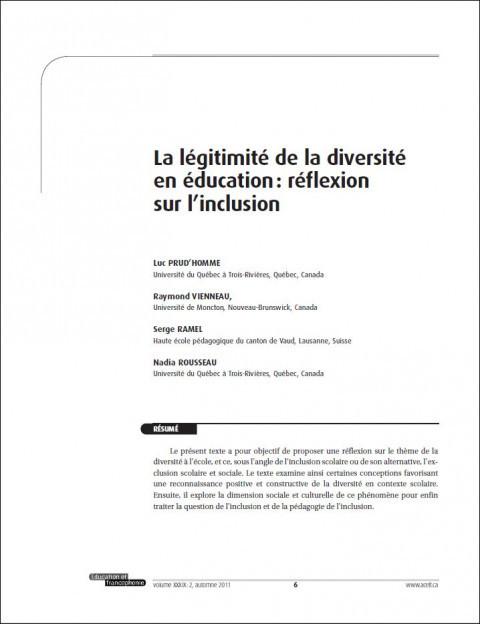 The Legitimacy of Diversity in Education: A Reflection on Inclusion سنة النشر: 2011 المؤلف: Luc Prud’homme | Raymond Vienneau | Serge Ramel | Nadia Rousseau المؤلف المؤسسي: Éducation et francophonie The objective of this article is to explore the theme of diversity in the classroom from the perspective of scholastic inclusion, or its alternative, scholastic and social exclusion. The article examines concepts that foster the positive and constructive recognition of diversity in the school setting, along with the social and cultural dimension of inclusion and the pedagogy of inclusion. La légitimité de la diversité en éducation : réflexion sur l’inclusion سنة النشر: 2011 المؤلف: Luc Prud’homme | Raymond Vienneau | Serge Ramel | Nadia Rousseau المؤلف المؤسسي: Éducation et francophonie Le présent texte a pour objectif de proposer une réflexion sur le thème de la diversité à l’école, et ce, sous l’angle de l’inclusion scolaire ou de son alternative, l’exclusion scolaire et sociale. Le texte examine ainsi certaines conceptions favorisant une reconnaissance positive et constructive de la diversité en contexte scolaire. Ensuite, il explore la dimension sociale et culturelle de ce phénomène pour enfin traiter la question de l’inclusion et de la pédagogie de l’inclusion.
 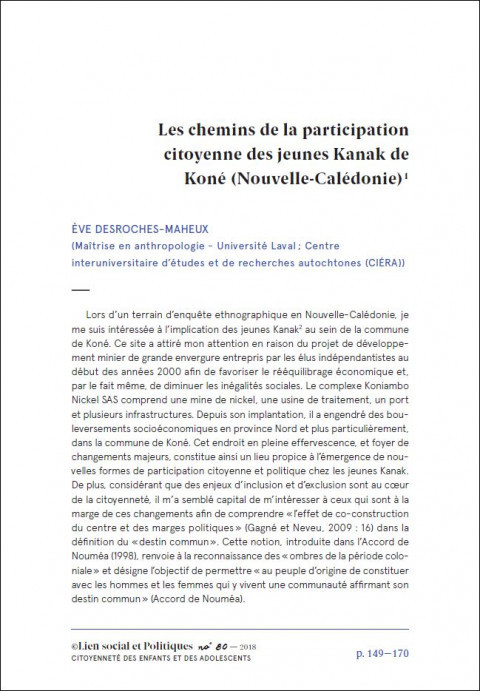 Paths Towards Citizen Participation Among Kanak Youth in Koné (New-Caledonia) سنة النشر: 2018 المؤلف: Ève Desroches-Maheux المؤلف المؤسسي: Lien social et Politiques Based on an ethnographic fieldwork, this article explores the forms and modalities taken by the civic participation of the Kanak youths living in Province Nord, New Caledonia. Being at the dawn of a referendum on its accession to a full sovereignty, this French territory of a sui generis status is now at a turning point in its history. In preparation for this event, the Nouméa Accord laid the foundations of a New-Caledonian citizenship, situated, for the moment, within the French citizenship. However, this citizenship in construction poses the question of the place given in it to the Kanak, the indigenous people of the territory. Approaching citizenship as a set of “political subjectivation processes” producing a citizenship simultaneously “determined by the state and by the subjects composing it ”, we explore the answers and “negotiation attempts” made by the Kanak youths toward it. Results show that despite some negative representations playing against them, the youths still appropriate possibilities opened up by public policies and programs in hope to make their grievances heard and to implement structuring projects. Furthermore, as those forms of civic practices are used as handles to resist French hegemony in Province Sud by youths that seek above all to strongly affirm their Kanak identities, north youth participation in the public space appears rather embedded in an inclusive approach toward other communities.