
الموارد
استكشف مجموعة واسعة من الموارد القيمة حول تعليم المواطنة العالمية لتعميق فهمك وتعزيز البحث والمناصرة والتعليم والتعلم.
تم العثور على 1,187 نتيجة
 Global citizenship education: the school as a foundation for a fair world سنة النشر: 2009 المؤلف المؤسسي: Conectando Mundos Consortium (Cidac, inizjamed, Intermon Oxfam, Ucodep) This publication is based on an initiative about the development education, intercultural education, popular education, the education of values, human rights education, education for sustainability, education for peace, education for gender equality, etc. The pedagogical proposal of Global Citizenship Education aspires to integrate in a coherent and challenging vision all these themes, keeping them in a close relationship with one another and taking into consideration the (increasing) interdependence of human beings living in a planet whose sustainability is under threat. This book is the fruit of a process that was triggered off by the joint effort of four European development NGOs, namely Cidac, Inizjamed, Intermón Oxfam and Ucodep within the frame of a project co-financed by the European Commission. These organisations set for themselves the objective to promote the acknowledgment and the inclusion of the contents and the methodology of Global Citizenship Education in the formal educational contexts in their respective countries, in order to kick-start a process of change in attitudes, values, and the beliefs of the pupils. Thanks to the initiative and efforts of the above-mentioned four organisations, and through various meetings and seminars carried out over the last three years in Spain, Italy, Portugal and Malta, groups of educators have been able to come face-to-face with each other, exchange experiences and reflect on the role of formal education with respect to the challenges of our times. Among the other experiences, the publication contains that of a key moment in the process. This took place in July 2008 in Cortona, a small and beautiful Tuscan city close to the border with Umbria, and in which many educators shared the benefit of what was the first international encounter of educators for global citizenship. The Cortona experience, in which around ninety teachers coming from Spain, Portugal, Malta, Italy, the Dominican Republic and Costa Rica have participated, was one of the stages – the starting point, in fact – of a process and a relationship that it is our aim to develop at the regional, national and international levels. In this publication, therefore, one can find theoretical cues put forward at Cortona that encourage educators to share their experiences and to compare the work done by different groups.This publication has two parts. The first part contains contributions of a theoretical type, whereas the second part concentrates on the educational experiences of the participants in the Cortona meeting. Global citizenship education: the school as a foundation for a fair world سنة النشر: 2009 المؤلف المؤسسي: Conectando Mundos Consortium (Cidac, inizjamed, Intermon Oxfam, Ucodep) Cette publication est basée sur une initiative sur l'éducation au développement, l'éducation interculturelle, l'éducation populaire, l'éducation des valeurs, l'éducation des droits de l'homme, l'éducation pour le développement durable, l'éducation pour la paix, l'éducation pour l'égalité des sexes, etc. La proposition pédagogique de l’éducation à la citoyenneté mondiale aspire d'intégrer dans une vision cohérente et stimulante, tous ces thèmes, les maintenir dans une relation étroite avec l'autre et en tenant compte de la (augmentation) interdépendance des êtres humains vivant dans une planète dont la pérennité est menacée. Ce livre est le fruit d'un processus qui a été déclenché par l'effort conjoint de quatre ONG européennes de développement, à savoir Cidac, Inizjamed, Intermon Oxfam et Ucodep dans le cadre d'un projet cofinancé par la Commission européenne. Ces organisations se sont données pour objectif de promouvoir la reconnaissance et la prise en compte du contenu et de la méthodologie de l’Éducation à la Citoyenneté Mondiale dans les contextes éducatifs formels dans leurs pays respectifs, afin de démarrer un processus de changement dans les attitudes, les valeurs et les croyances des élèves. Merci à l'initiative et les efforts des quatre organisations mentionnées ci-dessus, et par le biais de diverses réunions et séminaires réalisés au cours des trois dernières années en Espagne, Italie, Portugal et Malte, des groupes d'éducateurs ont été en mesure de venir en face-à-face avec les uns des autres, d'échanger des expériences et réfléchir sur le rôle de l'éducation formelle par rapport aux défis de notre temps. Parmi les autres expériences, la publication contient celle d'un moment clé dans le processus. Cela a eu lieu en Juillet 2008 à Cortona, une petite et belle ville Toscane près de la frontière avec l'Ombrie, et dans lequel de nombreux éducateurs partagent le bénéfice de ce qui était la première rencontre internationale des éducateurs pour la citoyenneté mondiale. L'expérience Cortona, dans lequel près de quatre-vingt dix enseignants venant d'Espagne, le Portugal, Malte, l'Italie, la République dominicaine et le Costa Rica ont participé, a été l'une des étapes - le point de départ, en fait - d'un processus et d'une relation avec pour objectif de développer aux niveaux régional, national et international. Dans cette publication, par conséquent, on peut trouver des indices théoriques mis en avant à Cortona qui encouragent les éducateurs à partager leurs expériences et de comparer le travail accompli par les différents groupes. Cette publication comporte deux parties. La première partie contient des contributions d'un type théorique, alors que la deuxième partie se concentre sur les expériences éducatives des participants à la réunion Cortona. Monitoring education for global citizenship: a contribution to debate سنة النشر: 2015 المؤلف: Harm-Jan Fricke | Cathryn Gathercole | Amy Skinner المؤلف المؤسسي: DEEEP | CONCORD DARE Forum 1. This report aims to provide a stimulus for further thought, work and debate in the design of assessment frameworks for an education that supports people in leading fulfilling lives in a changing, globalised world, and in particular within the context of debates around post-2015 universal targets and indicators that are relevant to an education for global citizenship (EfGC). 2. In providing that stimulus the report addresses the following questions: a. What are the key differences and similarities between diverse forms of ‘adjectival educations’ that contribute to, or generally express themselves as allied to an ‘education for global citizenship’? b. What do they contribute to an education for global citizenship? c. How, if at all, do they interpret the notion of ‘transformation’? d. What do practitioners consider to be the major challenges and opportunities for monitoring (transformative) education for global citizenship? e. Which approaches and means of monitoring and assessing transformative education for global citizenship appear to be feasible? 3. The report is based on information obtained from: a. Literature reviews; b. Workshops, involving 65 educators in total, held in Brazil, Tanzania, Zimbabwe, and three locations in Europe; c. Responses to a questionnaire completed by 218 educators working in more than 50 countries, albeit with a predominance of respondents based in Europe. 4. The origins and key characteristics of development education, global education and global learning, human rights education, and education for sustainable development are explored, leading to statements about their commonalities and contributions to an education for global citizenship. These commonalties appear to be particularly in the areas of their shared global orientation, pursuit of personal and/or societal transformation, active and enquiry based teaching and learning methodologies, and overlapping content. 5. The commonalities which the discussed educations contribute to - and share with – education for global citizenship appear to be particularly around: a. values and dispositions which enable a response to, and advocacy for, change, b. engagement with diverse ideas, opinions and understandings, c. a stimulus to investigate and develop creativity by means of learning, d. building skills and capacities as part of a process of lifelong learning, e. a generic educational approach that aims at involvement in an explicit process of change. 6. Within such a context differences appear amongst practitioners and theoreticians in the use, meaning and function of the term ‘global citizenship’, with some seeing it primarily as a tool in advocacy while others view it primarily as a means of explanation of human relations globally. 7. Critique on the usefulness and use of the terms ‘global citizenship’ is outlined and the world-wide, universal, use of the term ‘education for global citizenship’ is questioned. However, its intentions as an approach of transformative education for critical and active engagement in a globalised society are seen as having universal relevance. 8. That approach is described as “a learning process for people’s critical and active engagement in and with global society, involving people in developing their capacities, capabilities and motivation to be actively engaged in personal and collective human development. It does this by drawing on a critical understanding and consideration of global processes and interdependencies, of other people’s perspectives and interests, of environmental opportunities and limitations, and of universal rights.” 9. The approach is further defined by a number of ‘core signifiers’ (which can form the basis for indicators of achievement) relating to: a. pedagogy – characteristics of the teaching process, b. capacities and capabilities – regarding the learner’s competence, c. values – as exhibited in the teaching and learning process, d. content – the learner’s acquisition of core understandings, e. outcome – regarding the learner’s dispositions, f. social transformation – regarding the learner’s contributions to community and wider society. 10. The report continues by providing a summary review of selected literature regarding the design of monitoring frameworks that appear pertinent to an education for global citizenship. It discusses work done in relation to universal targets and indicators, country based frameworks, education institutional monitoring, educator competence, and learner outcomes. It draws particular attention to the importance of quality assessment, the need to involve the range of education stakeholders in the design, application and interpretation of indicators, and the need to enable learning from experiences. 11. Further information about the challenges and opportunities for monitoring education for global citizenship is obtained from ideas and opinions given by workshop participants and questionnaire respondents. Respondents recognise that developing a universal monitoring framework can help to clarify the purpose and meaning of EfGC for both practitioners and policy makers. However, they also recognise that there is a risk that agreement might be reached around a lowest common denominator approach. The importance of participation by practitioners in, and their ownership of, the monitoring content and process is highlighted. The potential uses of monitoring data and analyses in demonstrating the impact of EfGC on broader cross-curricular outcomes and educational achievements, is seen by respondents as a means to gain further recognition of the value of EfGC. 12. Based on the foregoing, the final chapter of the report provides a number of suggestions as a stimulus for further work, thought and debate. These suggestions focus on: a. a monitoring framework that addresses the holistic nature of EfGC; b. an assessment framework to do with learning outcomes that exemplify the core signifiers mentioned in paragraph 9 above; c. indicators and a monitoring approach that is applicable at national levels, enabling monitoring of progress for specific sectoral aspects of EfGC (teacher education is given as an example of such a sectoral aspect); d. a universal target that builds on the description of EfGC given in paragraph 8 above; e. indicator groupings that can show progress against such a universal target. Suivi de l’ éducation à la citoyenneté mondiale: une contribution au débat سنة النشر: 2015 المؤلف: Harm-Jan Fricke | Cathryn Gathercole | Amy Skinner المؤلف المؤسسي: DEEEP | CONCORD DARE Forum 1. Le présent rapport vise à fournir un stimulus pour la pensée plus loin, le travail et le débat dans la conception de cadres d'évaluation pour une éducation qui prend en charge les gens à mener une vie épanouissante dans un monde changeant, globalisé, et en particulier dans le contexte des débats autour de l ' activités après 2015 des objectifs universels et les indicateurs qui sont pertinents pour une éducation à la citoyenneté mondiale (ECM). 2. En fournissant ce stimulus le rapport aborde les questions suivantes: a. Quelles sont les principales différences et similitudes entre les diverses formes de «éducations adjectivales» qui contribuent à, ou généralement eux-mêmes expriment comme allié à une «éducation à la citoyenneté mondiale»? b. Que contribuent-ils à l'éducation à la citoyenneté mondiale? c. Comment, le cas échéant, interprètent-ils la notion de «transformation»? ré. Qu'est-ce que les praticiens considèrent comme les principaux défis et opportunités pour l'éducation suivi (transformation) pour la citoyenneté mondiale? e. Quelles approches et des moyens de Suivi et évaluation de l'éducation transformatrice à la citoyenneté mondiale semblent être faisable? 3. Le rapport est basé sur des informations obtenues à partir de: a. Les revues littéraires; b. Ateliers, impliquant 65 enseignants au total, tenu au Brésil, en Tanzanie, au Zimbabwe, et trois sites en Europe; c. Les réponses à un questionnaire rempli par 218 éducateurs travaillant dans plus de 50 pays, mais avec une prédominance des répondants basés en Europe. 4. Les origines et les caractéristiques clés de l'éducation au développement, l'éducation globale et l'apprentissage global, l'éducation aux droits de l'homme, et de l'éducation pour le développement durable sont explorés, conduisant à des déclarations sur leurs points communs et des contributions à l'éducation à la citoyenneté mondiale. Ces points communs semblent particulièrement dans les domaines de leur orientation partagée globale, la poursuite de personnel et / ou transformation de la société, active et en fonction d'enseignement et d'apprentissage des méthodes d'enquête, et le contenu de chevauchement. 5. Les points communs qui les éducations discutées contribuent - et partagent avec - l'éducation à la citoyenneté mondiale semblent être particulièrement autour de: a. des valeurs et des dispositions qui permettent une réponse à, et le plaidoyer pour, changement, b. l'engagement avec des idées diverses, des opinions et interprétations, c. un stimulus pour étudier et développer la créativité au moyen d'apprentissage, d. le renforcement des compétences et des capacités dans le cadre d'un processus d'apprentissage continu, e. une approche éducative générique qui vise à la participation à un processus de changement explicite. 6. Dans un de ces différences de contexte apparaissent entre les praticiens et les théoriciens de l'utilisation, le sens et la fonction de la notion de «citoyenneté mondiale», avec certains le voir avant tout comme un outil de plaidoyer tandis que d'autres le considèrent principalement comme un moyen d'explication des relations humaines à l'échelle mondiale. 7. Critique sur l'utilité et l'utilisation des termes de citoyenneté mondiale »est définie et le monde entier, universel, l'utilisation du terme« éducation à la citoyenneté mondiale »est remise en question. Cependant, ses intentions comme une approche de l'éducation transformatrice pour l'engagement critique et active dans une société mondialisée sont considérés comme ayant une pertinence universelle. 8. Cette approche est décrite comme «un processus d'apprentissage pour l'engagement critique et active de la population et avec la société globale, impliquant des personnes à développer leurs capacités, les capacités et la motivation à participer activement dans le développement humain individuel et collectif. Elle le fait en appuyant sur une compréhension critique et l'examen des processus mondiaux et des interdépendances, des perspectives et des intérêts des autres, des opportunités et des contraintes environnementales et des droits universels. » 9. L'approche est en outre défini par un certain nombre de« signifiants de base '(qui peut constituer la base d'indicateurs de succès) concernant: a. pédagogie - les caractéristiques du processus d'enseignement, b. les capacités et les capacités - en ce qui concerne la compétence de l'apprenant, c. valeurs - comme exposé dans le processus d'enseignement et d'apprentissage, d. contenu - l'acquisition d'une compréhension de base de l'apprenant, e. résultat - en ce qui concerne les dispositions de l'apprenant, f. transformation sociale - en ce qui concerne les contributions de l'apprenant à la communauté et la société au sens large. 10. Le rapport poursuit en fournissant un examen sommaire de la littérature sélectionnée concernant la conception des cadres de Suivi qui semblent pertinents pour une éducation à la citoyenneté mondiale. Il examine le travail fait par rapport aux objectifs universels et les indicateurs, les cadres en fonction des pays, l'éducation, les compétences institutionnelles suivi des éducateurs, et les résultats d'apprentissage. Il attire particulièrement l'attention sur l'importance de l'évaluation de la qualité, la nécessité d'associer l'éventail des acteurs de l'éducation dans la conception, l'application et l'interprétation des indicateurs, et la nécessité de permettre l'apprentissage d'expériences. 11. Pour en savoir plus sur les défis et opportunités pour l'éducation de Suivi à la citoyenneté mondiale est obtenue à partir des idées et des opinions exprimées par les participants à l'atelier et les répondants au questionnaire. Les répondants reconnaissent que l'élaboration d'un cadre de suivi universel peut aider à clarifier le but et le sens de l'ECM pour les praticiens et les décideurs politiques. Cependant, ils reconnaissent aussi qu'il existe un risque que l'accord pourrait être atteint autour d'une approche du plus petit dénominateur commun. L'importance de la participation des praticiens dans, et de leur propriété, le contenu et le processus est mis en surbrillance Suivi. Les utilisations potentielles des données de suivi et analyse pour démontrer l'impact de l'ECM sur les résultats transversales plus larges et les résultats scolaires, est perçue par les répondants comme un moyen d'obtenir une plus grande reconnaissance de la valeur de l'ECM. 12. Sur la base de ce qui précède, le dernier chapitre du rapport fournit un certain nombre de suggestions comme un stimulant pour le travail plus loin, la pensée et le débat. Ces suggestions portent sur: a. un cadre de Suivi qui traite de la nature globale de l'ECM; b. un cadre d'évaluation à faire avec les résultats d'apprentissage qui illustrent les signifiants fondamentaux mentionnés au paragraphe 9 ci-dessus; c. indicateurs et une approche de suivi qui est applicable au niveau national, permettant Suivi des progrès des aspects sectoriels spécifiques des ECM (formation des enseignants est donnée à titre d'exemple d'un tel aspect sectoriel); d. une cible universelle qui repose sur la description de l'ECM donnée au paragraphe 8 ci-dessus; e. indicateurs groupements qui peuvent montrer des progrès contre une telle cible universelle. Ecopedagogy and citizenship in the age of globalisation: connections between environmental and global citizenship education to save the planet سنة النشر: 2015 المؤلف: Greg William Misiaszek المؤلف المؤسسي: Wiley‑Blackwell Teaching the connections between environmentally-harmful acts and social conflict is essential but is often ignored in education. This article presents two ways in which these are not taught because of the policies of those who benefit from the ignorance of these connections: first, the avoidance of teaching global-local connectivity and second, the devaluing of non-dominant cultures. Ecopedagogy is a democratic, transformative pedagogy centred on increasing justice by critically teaching the politics of environmental issues. I argue that global citizenship education (GCE) must be an element of ecopedagogy to contextually learn globalisation's effects upon local communities. In addition, GCE's goal is to increase students' understanding of diverse cultures to respect them. Ecopedagogy is also essential to GCE to fully teach social conflicts resulting from environmentally harmful acts. I offer policy and pedagogical changes to disrupt reproductive environmental pedagogies that help to sustain environmental ills for ecopedagogy-GCE models to emerge. Ecopedagogy et Citoyenneté à l'ère de la Mondialisation: des liens entre l'environnement et l'éducation à la citoyenneté Mondiale (ECM) pour sauver la planète سنة النشر: 2015 المؤلف: Greg William Misiaszek المؤلف المؤسسي: Wiley‑Blackwell Enseigner les liens entre les actes nuisibles à l'environnement et les conflits sociaux est essentielle, mais est souvent ignorée dans l'éducation. Cet article présente deux façons dont ceux-ci ne sont pas enseignées à cause des politiques de ceux qui profitent de l'ignorance de ces connexions: d'abord, l'évitement de l'enseignement connectivité mondiale-locale et, deuxièmement, la dévalorisation des cultures non dominantes. Ecopedagogy est une société démocratique, la pédagogie transformative centrée sur l'augmentation de la justice par l'enseignement critique la politique des questions environnementales. Je soutiens que L'éducation à la citoyenneté Mondiale (ECM) doit être un élément de ecopedagogy apprendre contextuellement les effets de la mondialisation sur les communautés locales. En outre, l'objectif de l'ECM est d'accroître la compréhension des élèves de diverses cultures à les respecter. Ecopedagogy est également essentiel d'ECM pour enseigner pleinement les conflits sociaux résultant d'actes préjudiciables à l'environnement. Je propose des changements politiques et pédagogiques pour perturber les pédagogies environnementaux de reproduction qui aident à maintenir les maux environnementaux pour les modèles ecopedagogy-ECM à émerger.
 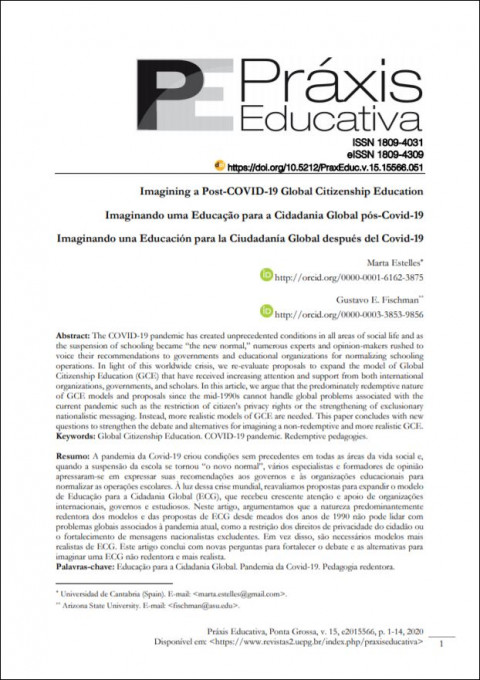 Imagining a Post-COVID-19 Global Citizenship Education سنة النشر: 2020 المؤلف: Marta Estelles | Gustavo E. Fischman المؤلف المؤسسي: State University of Ponta Grossa The COVID-19 pandemic has created unprecedented conditions in all areas of social life and as the suspension of schooling became “the new normal,” numerous experts and opinion-makers rushed to voice their recommendations to overnments and educational organizations for normalizing schooling operations. In light of this worldwide crisis, we re-evaluate proposals to expand the model of Global Citizenship Education (GCE) that have received increasing attention and support from both international organizations, governments, and scholars.In this article, we argue that the predominately redemptive nature of GCE models and proposals since the mid-1990s cannot handle global problems associated with the current pandemic such as the restriction of citizen’s privacy rights or the strengthening of exclusionary nationalistic messaging. Instead, more realistic models of GCE are needed. This paper concludes with new questions to strengthen the debate and alternatives for imagining a non-redemptive and more realistic GCE. Imaginando una educación para la ciudadanía global después del Covid-19 سنة النشر: 2020 المؤلف: Marta Estelles | Gustavo E. Fischman المؤلف المؤسسي: State University of Ponta Grossa La pandemia del Covid 19 ha creado condiciones sin precedentes en todas las áreas de la vida. A medida que la suspensión de las actividades escolares se ha convertido en "la nueva normalidad", numerosos expertos y formadores de opinión se han apresurado a lanzar sus recomendaciones a gobiernos y organizaciones educativas para normalizar las operaciones escolares. En este contexto novedoso, analizamos las propuestas para expandir el modelo de Educación para la Ciudadanía Global (ECG) que está siendo cada vez más apoyada por organizaciones internacionales, gobiernos y académicos.En este artículo, sostenemos que la orientación redentora que los modelos y propuestas de ECG han desarrollado en las últimas décadas resulta muy limitada para entender y resolver problemas actuales como la restricción de derechos de privacidad de la ciudadanía o el fortalecimiento de los nacionalismos excluyentes. En cambio, se necesitan modelos más realistas de ECG. Este documento concluye con nuevas preguntas para robustecer el debate y las alternativas para imaginar una ECG realista y no redentora. Palabras clave: Educación para la ciudadanía global. Pandemia de Covid-19. Pedagogía redentora.
  Democracy in the Educational Institution: Between the Qualification of Schooling and the Rooting of Training سنة النشر: 2017 المؤلف: Abdel Karim Belhadj | Abd al-Ilah Shrayat المؤلف المؤسسي: Supreme Council for Education, Training, and Scientific Research This paper discusses the relationship between school and democracy. It shows the intersection between them. Then the paper turns on how to educate for democracy. The paper concludes with a vision for global citizenship education. الديمقراطية بالمؤسسة التعليمية : بين تأهيل التمدرس وتأصيل التمرس سنة النشر: 2017 المؤلف: Abdel Karim Belhadj | Abd al-Ilah Shrayat المؤلف المؤسسي: Supreme Council for Education, Training, and Scientific Research تناقش الورقة العلاقة بين المدرسة والديمقراطية. وتوضح التقاطع بينهما. ثم تعرج الورقة علي كيفية التربية من أجل الديمقراطية. تنتهي الورقة بوضع تصور للتربية من أجل المواطنة العالمية.