
الموارد
استكشف مجموعة واسعة من الموارد القيمة حول تعليم المواطنة العالمية لتعميق فهمك وتعزيز البحث والمناصرة والتعليم والتعلم.
تم العثور على 109 نتيجة
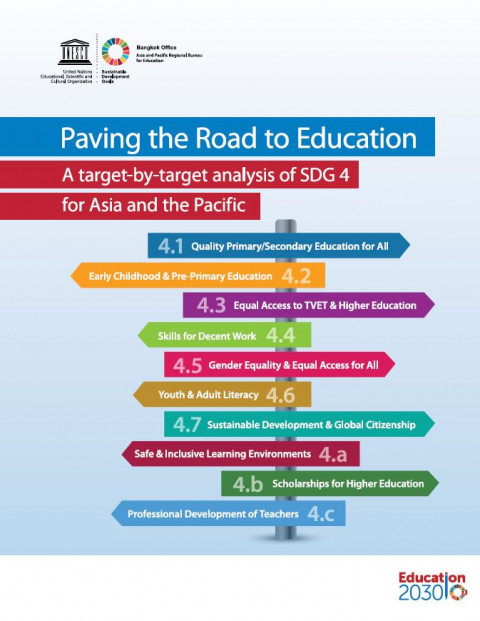 Paving the Road to Education: A Target-by-Target Analysis of SDG 4 for Asia and the Pacific سنة النشر: 2018 المؤلف المؤسسي: UNESCO Bangkok The globally adopted development agenda “Transforming our World: the 2030 Agenda for Sustainable Development” has established ambitious intentions that build on the past Millennium Development Goals but also expand on their achievements.The Sustainable Development Goal 4 on education propels forward the vision of ensuring inclusive and equitable quality education and to promote lifelong learning opportunities for all through a holistic, aspirational and systematic education agenda. Education monitoring is an integral part in this process.This publication delivers a data-rich snapshot of Sustainable Development Goal 4, its targets and their monitoring indicators while analyzing available data through a lens of inequality.Assessing the progress which countries have made in the recent past as well as where countries currently stand, this publication sets a baseline against which Member States from Asia and the Pacic are able to monitor progress in achieving the Goal 4 over time but at latest by 2030.Finally, after discussing emerging opportunities and remaining challenges in the region, this publication seeks to assist Member States in identifying what steps can be taken to ensure that the region will achieve the new education agenda.
  Blended learning for quality higher education: selected case studies on implementation from Asia-Pacific سنة النشر: 2016 المؤلف: Lim, Cher Ping | Wang Libing المؤلف المؤسسي: UNESCO Bangkok Together with The Education University of Hong Kong, UNESCO Bangkok gathered experts from higher education institutions in the Asia-Pacific region to explore the potential of blended learning, including its impact on the role of teachers, the relationship between teachers and students, and the nature of educational institutions themselves. Issues about the quality of education are at the heart of the Sustainable Development Goals, which were adopted during the United Nations Sustainable Development Summit in September 2015.
  Asia and the Pacific SDG Progress Report 2019 سنة النشر: 2019 المؤلف: Arman Bidarbakht Nia | Eric Hermouet | Dayyan Shayani | Phuong Tran المؤلف المؤسسي: United Nations (UN) This report analyses Sustainable Development Goals (SDGs) trends as well as data availability for monitoring progress in Asia and the Pacific and its five subregions. It assesses progress towards the SDGs and the gaps which must be closed for these to be achieved by 2030. This assessment is designed to ensure the region’s actions remain on target, shortcomings are addressed as they arise, and all interested parties remain engaged. It is an invaluable resource for all stakeholders involved in prioritisation, planning, implementation and follow-up of the 2030 Agenda for Sustainable Development in Asia and the Pacific.
  Accelerating Progress: An Empowered, Inclusive and Equal Asia and the Pacific سنة النشر: 2019 المؤلف المؤسسي: UN. Economic and Social Commission for Asia and the Pacific (UN. ESCAP) | Asian Development Bank (ADB) | United Nations Development Programme (UNDP) Accelerating progress: An empowered, inclusive and equal Asia and the Pacific responds to the theme of the 6th Asia Pacific Forum on Sustainable Development and the 2019 session of the high-level political forum on sustainable development.The report proposes a framework of four synergistic elements necessary to advance inclusion, empowerment and equality: rights and justice; norms and institutions; resources and capabilities; participation and voice. The need for action on all four fronts is illustrated by a deeper look at three pivotal challenges confronted by the region – (1) climate change and its potential to deepen inequality; (2) the urgent need to boost domestic resource mobilization; and (3) the need to strengthen social accountability and civic engagement. It draws out policy messages on how an empowerment-and-inclusion approach to policymaking can be fostered, including on addressing violence against women and girls. The report provides strong evidence that promoting empowerment and inclusion are necessary approaches to reduce inequality and accelerate progress towards a broad array of Sustainable Development Goals. It is a contribution to the ongoing national, regional and global dialogues on opportunities to empower people, ensure their inclusion and advance equality.The report is produced by the Asia-Pacific SDG partnership, comprising of the United Nations Economic and Social Commission for Asia and the Pacific (ESCAP), the Asian Development Bank, and the United Nations Development Programme.
 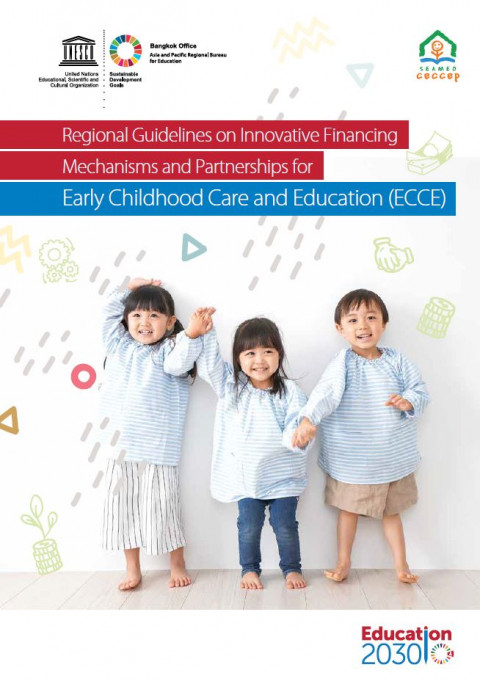 Regional Guidelines on Innovative Financing Mechanisms and Partnerships for Early Childhood Care and Education (ECCE) سنة النشر: 2019 المؤلف المؤسسي: SEAMEO. Regional Centre for Early Childhood Care Education and Parenting (CECCEP) | UNESCO Bangkok The development of the Regional Guidelines on Innovative Financing Mechanisms and Partnerships for Early Childhood Care and Education (ECCE) was a joint initiative of the UNESCO Asia-Pacific Regional Bureau for Education (UNESCO Bangkok) and the Southeast Asian Ministers of Education Organization Regional Centre for Early Childhood Care Education and Parenting (SEAMEO CECCEP). The Guidelines are part of UNESCO Bangkok’s “Exploring innovative financing and mechanisms for ensuring free inclusive and equitable quality pre-primary education for all in Asia-Pacific” project, which is supported by the Ministry of Economy and Finance Republic of Korea.
  Developing Holistic Indicators to Promote the Internationalization of Higher Education in the Asia-Pacific سنة النشر: 2018 المؤلف: Da Wan Chang المؤلف المؤسسي: UNESCO Bangkok The internationalization of higher education has been emphasized by the global community to improve access and quality in higher education (SDG4.3), as well as to achieve other global goals by promoting cross-cultural understanding and tolerance. Even though the internationalization of higher education has diverse dimensions, ‘student mobility’ has been a predominant indicator and there are conceptual and methodological challenges in the existing sources of data and statistics. In addition to student mobility, this document proposes a holistic set of indicators to capture other important dimensions of the internationalization of higher education, such as alignment with international normative instruments, international networking, governance and management, as well as the mobility of academics and programmes, etc. The suggested indicators are categorized into domains on two levels: system and institutional. It is hoped that this policy brief will help users better understand and adapt the indicators for use in their local contexts, so as to promote the internationalization of higher education.
 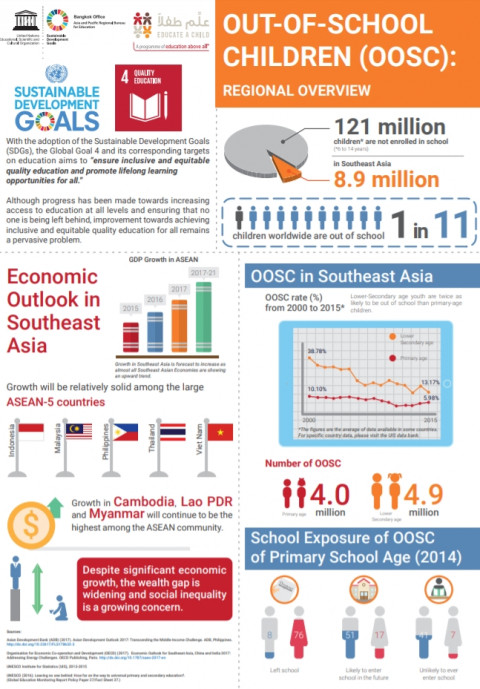 Out-of-School Children (OOSC): regional overview سنة النشر: 2017 المؤلف المؤسسي: UNESCO Bangkok This leaflet provides a regional overview of out-of-school children (OOSC) situation in Southeast Asia including school exposure of OOSC of primary school age. To provide learning opportunities for OOSC in the region, UNESCO Bangkok has launched the project titled “Strengthening Education Systems for Out of School Children” with the support of Educate a Child (EAC). Information on country activities implemented under the project is included in the leaflet.
  Gender in Education Network in Asia-Pacific (GENIA) Toolkit: Promoting Gender Equality in Education سنة النشر: 2019 المؤلف المؤسسي: UNESCO Bangkok The GENIA Toolkit was originally designed in 2003 when the Gender in Education Network in Asia Pacific was established. The fifth edition of the GENIA Toolkit (25 tools) is designed for use by gender focal points and education planners and implementers. It introduces key concepts and theoretical debates, and outlines practical approaches for mainstreaming gender equality throughout the education system, and within education policy.The toolkit is designed to be used selectively, depending on the user’s needs. It can be used as a self-study tool. Readers can select topics that they have identified as priority learning areas to help them improve their own understanding and practical capacity. The toolkit can also be used by trainers to facilitate training sessions. Trainers can choose tools from the kit that best match the needs of their trainees.
 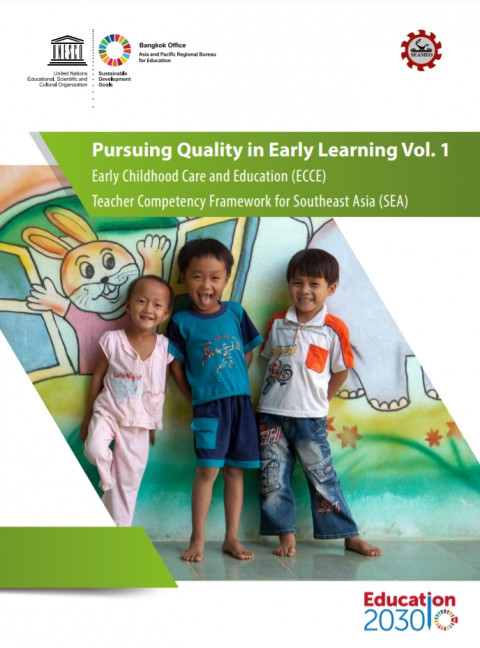 Pursuing quality in early learning, vol. 1: Early childhood care and education (ECCE) teacher competency framework for Southeast Asia (SEA) سنة النشر: 2018 المؤلف المؤسسي: Southeast Asian Ministers of Education Organization (SEAMEO) | UNESCO Bangkok With the United Nation’s (UN) Sustainable Development Goals (SDGs) as a platform for achieving quality early childhood care and education outcomes by 2030, ECCE policy-makers, practitioners, and academicians from Asia-Pacific countries gathered at the second Asia-Pacific Regional Policy Forum on Early Childhood Care and Education in Putrajaya, Malaysia in 2016 to share experiences, innovations, and lessons learned in developing and implementing ECCE policies and initiatives. This document first provides a brief background, and discusses the purposes and intended audience for which the framework was developed (Section I). A succeeding section reflects on the regional ECCE landscape (Section II), before proceeding to a discussion of the ECCE teacher competency framework for Southeast Asia (Section III). Section IV suggests possible uses of the ECCE teacher competency framework; a final section concludes with areas for future action.
  Online Programme and Meeting Document Situation Analysis of SDG 4 with a Gender Lens, Target 4.C سنة النشر: 2018 المؤلف المؤسسي: UNESCO Bangkok Teachers play a critical role in delivering high-quality education and learning outcomes. Indeed, the quality of an education system cannot exceed that of its teachers (OECD, 2010). Target 4.c recognizes this fact by calling on countries to increase the supply of qualified teachers. East Asia and the Pacific does not have enough trained and qualified teachers, particularly in remote and impoverished areas where children are most in need of highquality education. Moreover, the gender distribution of teachers is uneven across the education system, in teaching and administration. While integrating Target 4.c into national education policies and sector plans, governments should develop specific strategies to ensure that teachers are trained, qualified and deployed in an equitable manner.