
الموارد
استكشف مجموعة واسعة من الموارد القيمة حول تعليم المواطنة العالمية لتعميق فهمك وتعزيز البحث والمناصرة والتعليم والتعلم.
تم العثور على 518 نتيجة
 L'éducation pour une culture de la paix, les droits de l'homme, la citoyenneté, la démocratie et l'intégration régionale: manuel de référence de la CEDEAO, pour une utilisation par le formateur de formateurs سنة النشر: 2013 المؤلف المؤسسي: UNESCO Dakar | Economic Community of West African States (ECOWAS) Le manuel comprend sept modules traitant de la culture de la paix et gestion des conflits; Droits de l'homme; Civisme et citoyenneté; Démocratie et bonne gouvernance; Genre et développement; La santé publique, l'environnement et le développement durable; et l'intégration régionale. Chaque module comporte des sous-thèmes avec des introductions, des documents de référence, des objectifs généraux pour guider le formateur et tables pédagogiques génériques qui sont suffisamment souples pour être adaptés aux ressources pédagogiques disponibles dans les différents pays de la CEDEAO. Il est également adapté et adaptable à la formation des enseignants impliqués à la fois dans la prestation de l'éducation formelle et non formelle à différents niveaux d'enseignement et d'apprentissage. Le but ultime du Manuel est de construire une masse critique de citoyens de la CEDEAO dotés de compétences compétentes, non seulement pour les domaines cognitif et psycho-moteur de l'éducation, mais aussi des habiletés affectives pour les valeurs positives, les attitudes et les comportements qui favorisent la paix, la tolérance et pacifique co-existence des citoyens communautaires. Guide d'utilisation du manuel d'apprentissage de la démocratie pour les jeunes en Tunisie, à l'attention des formateurs et adultes-relais سنة النشر: 2013 المؤلف المؤسسي: UNESCO Rabat As part of its project to support education for democracy for young people in Tunisia, UNESCO has developed in cooperation with the Ministry of Education, the National Commission for Education, Science and Culture, CAWTAR, IADH, CNIPRE and UNI, a handbook on democracy for young people in Tunisia.This handbook is composed of twenty factsheets illustrated with drawings by Plantu. It popularizes the standards and universal principles, as well as major international instruments that protect and emphasize the national legal framework, key issues and challenges and good practices in Tunisia. One of the comparative advantages of this module is the fact that it highlights local issues and ongoing legal reforms in Tunisia.The present handbook has been developed as a pedagogical tool to help adult intermediaries (teachers, social educators etc…) responsible for the training of young people in school and community settings. It provides a series of exercises and situations to facilitate the learning and acquisition of knowledge in the field of democracy.The contents of this guidebook develops an approach based on "the discovery by oneself" which offers to participants activities, exercises and situations that require the mobilization of resources and contents of the training handbook on democracy for young people in Tunisia.Its use requires flexibility and creativity on the part of the trainer to enrich and/ or adapt the proposed exercises. It is in the light of the training context, prior knowledge of the concerned learners, the level of engagement of participants and according to thematic representations, that the trainer designs the training content. دليل لفائدة المكونين و الوسطاء لإستعمال " دليل شباب تونس في تعلم الديمقراطية " سنة النشر: 2013 المؤلف المؤسسي: UNESCO Rabat As part of its project to support education for democracy for young people in Tunisia, UNESCO has developed in cooperation with the Ministry of Education, the National Commission for Education, Science and Culture, CAWTAR, IADH, CNIPRE and UNI, a handbook on democracy for young people in Tunisia.This handbook is composed of twenty factsheets illustrated with drawings by Plantu. It popularizes the standards and universal principles, as well as major international instruments that protect and emphasize the national legal framework, key issues and challenges and good practices in Tunisia. One of the comparative advantages of this module is the fact that it highlights local issues and ongoing legal reforms in Tunisia.The present handbook has been developed as a pedagogical tool to help adult intermediaries (teachers, social educators etc…) responsible for the training of young people in school and community settings. It provides a series of exercises and situations to facilitate the learning and acquisition of knowledge in the field of democracy.The contents of this guidebook develops an approach based on "the discovery by oneself" which offers to participants activities, exercises and situations that require the mobilization of resources and contents of the training handbook on democracy for young people in Tunisia.Its use requires flexibility and creativity on the part of the trainer to enrich and/ or adapt the proposed exercises. It is in the light of the training context, prior knowledge of the concerned learners, the level of engagement of participants and according to thematic representations, that the trainer designs the training content. Educação para a cultura da paz, os direitos humanos, a cidadania, a democracia e a integração regional: manual de referência da CEDEAO, à intenção do(a) formador/formador(a) de formadores/formadoras سنة النشر: 2013 المؤلف المؤسسي: UNESCO Dakar | Economic Community of West African States (ECOWAS) The manual comprises seven modules dealing with the Culture of Peace and Conflict Management; Human Rights; Civism and Citizenship; Democracy and Good Governance; Gender and Development; Public Health, Environment and Sustainable Development; and Regional Integration. Each module has sub-themes with introductions, reference materials, general objectives to guide the trainer and generic pedagogical tables that are flexible enough to be adapted to available teaching resources in the different ECOWAS countries. It is also suitable and adaptable to the training of teachers involved in both formal and non-formal education delivery at different levels of teaching and learning. The ultimate goal of the Manual is to build a critical mass of ECOWAS citizens equipped with competent skills, not only for cognitive and psycho-motor domains of education, but also affective skills for positive values, attitudes and behaviors that promote peace, tolerance and peaceful co-existence of community citizens. Education à la culture de la paix, aux droits humains, à la citoyenneté, à la démocratie et à l'intégration régionale: manuel de référence de la CEDEAO, à l'usage de la formatrice/du formateur de formateurs/formatrices سنة النشر: 2013 المؤلف المؤسسي: UNESCO Dakar | Economic Community of West African States (ECOWAS) The manual comprises seven modules dealing with the Culture of Peace and Conflict Management; Human Rights; Civism and Citizenship; Democracy and Good Governance; Gender and Development; Public Health, Environment and Sustainable Development; and Regional Integration. Each module has sub-themes with introductions, reference materials, general objectives to guide the trainer and generic pedagogical tables that are flexible enough to be adapted to available teaching resources in the different ECOWAS countries. It is also suitable and adaptable to the training of teachers involved in both formal and non-formal education delivery at different levels of teaching and learning. The ultimate goal of the Manual is to build a critical mass of ECOWAS citizens equipped with competent skills, not only for cognitive and psycho-motor domains of education, but also affective skills for positive values, attitudes and behaviors that promote peace, tolerance and peaceful co-existence of community citizens. Forum panafricain: sources et ressources pour une culture de la Paix سنة النشر: 2013 المؤلف المؤسسي: African Union The Pan-African Forum “ Sources and resources for a culture of peace” was held in Luanda, Angola, from 26 to 28 March 2013, and was jointly organized by UNESCO, the African Union and the Government of Angola, under the High Patronage of H. E. Mr José Eduardo dos Santos, President of the Republic of Angola. This forum was the result of a close cooperation between UNESCO and the African Union, one of their main objectives being building peace in Africa, through the promotion of a culture of peace based on the intrinsic values of African societies. The Republic of Angola Government, through its President of the Republic H. E. Mr José Eduardo dos Santos, resolutely engaged in this process with major financial and technical support for the organization of the Forum in the Angolan capital city. As indicated in the Action Plan adopted by the participants in plenary (Annex I), recommendations made during the Forum are directed at all components of African society : political leaders, national and regional institutions, civil society, community associations, youth movements and women’s organizations, religious and traditional leaders, entrepreneurs and leaders from the private sector, etc. The implementation of the Action Plan will be continuously monitored by the two institutions that jointly organized the Luanda Forum, the African Union and UNESCO. Representatives from the 55 African countries participating in the Forum will both contribute to the proposal for action by bringing their national experience and take the lead in the follow‐up of the recommendations made at country level. In order to ensure this follow‐up it will be important to link together the participants by the creation of an African Network for the Promotion of a Culture of Peace and Non‐violence. The representatives of African countries will play the role of focal points of the awareness campaign at the national level. Finally, the agenda of the Forum includes a plan to hold a roundtable on the establishment of a multi-stakeholder partnership for action. Organized with the participation of regional institutions, public and private economic actors as well as representatives of Governments and Civil Society, this session will be the occasion to launch a continental and lasting Movement for the promotion of a culture of peace. For this round table and for the Campaign, the stakeholders can now witness the action as their Foundation / Company / Institution / Organization leads to help in building the defence of peace in the minds of men and women and ensure that peace is a reality: "Make Peace Happen".
 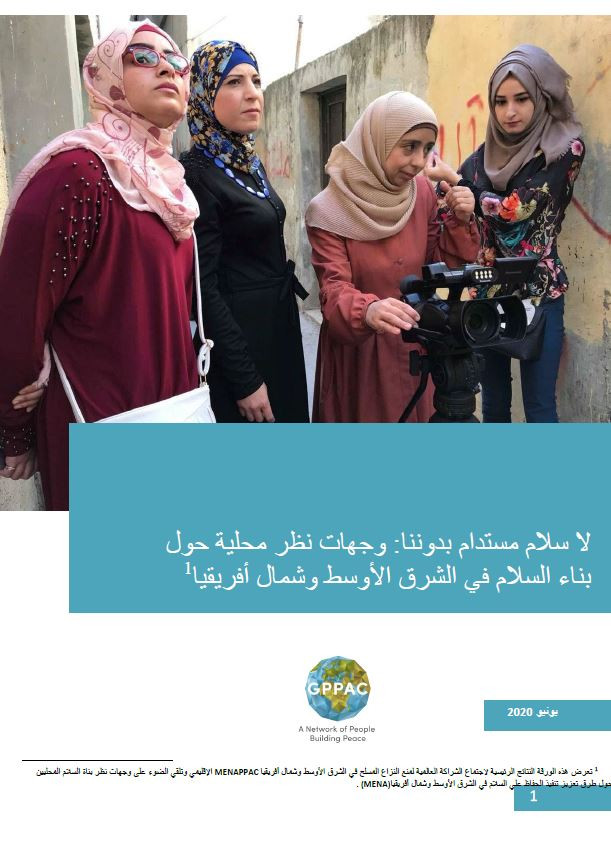 No Sustainable Peace Without Us: Local Perspectives on Peacebuilding in the Middle East and North Africa سنة النشر: 2020 المؤلف المؤسسي: Global Partnership for the Prevention of Armed Conflict (GPPAC) This paper presents the main outcomes of the Global Partnership for the Prevention of Armed Conflict in the Middle East and North Africa meeting. The paper sheds light on the perspectives of local peacebuilders on ways to promote peacekeeping in the Middle East and North Africa region. لا سلام مستدام بدوننا: وجهات نظر محلية حول بناء السلام في الشرق الأوسط وشمال أفريقيا سنة النشر: 2020 المؤلف المؤسسي: Global Partnership for the Prevention of Armed Conflict (GPPAC) تعرض هذه الورقة النتائج الرئيسية لاجتماع الشراكة العالمية لمنع النزاع المسلح في الشرق الأوسط وشمال أفريقيا. وتلقي الورقة الضوء على وجهات نظر بناة السلام المحليين حول طرق تعزيز الحفاظ على السلام في منطقة الشرق الأوسط وشمال أفريقيا. Fórum Panafricano: fundamentos e recursos para uma cultura de paz سنة النشر: 2013 المؤلف المؤسسي: African Union The Pan-African Forum “ Sources and resources for a culture of peace” was held in Luanda, Angola, from 26 to 28 March 2013, and was jointly organized by UNESCO, the African Union and the Government of Angola, under the High Patronage of H. E. Mr José Eduardo dos Santos, President of the Republic of Angola. This forum was the result of a close cooperation between UNESCO and the African Union, one of their main objectives being building peace in Africa, through the promotion of a culture of peace based on the intrinsic values of African societies. The Republic of Angola Government, through its President of the Republic H. E. Mr José Eduardo dos Santos, resolutely engaged in this process with major financial and technical support for the organization of the Forum in the Angolan capital city. As indicated in the Action Plan adopted by the participants in plenary (Annex I), recommendations made during the Forum are directed at all components of African society : political leaders, national and regional institutions, civil society, community associations, youth movements and women’s organizations, religious and traditional leaders, entrepreneurs and leaders from the private sector, etc. The implementation of the Action Plan will be continuously monitored by the two institutions that jointly organized the Luanda Forum, the African Union and UNESCO. Representatives from the 55 African countries participating in the Forum will both contribute to the proposal for action by bringing their national experience and take the lead in the follow‐up of the recommendations made at country level. In order to ensure this follow‐up it will be important to link together the participants by the creation of an African Network for the Promotion of a Culture of Peace and Non‐violence. The representatives of African countries will play the role of focal points of the awareness campaign at the national level. Finally, the agenda of the Forum includes a plan to hold a roundtable on the establishment of a multi-stakeholder partnership for action. Organized with the participation of regional institutions, public and private economic actors as well as representatives of Governments and Civil Society, this session will be the occasion to launch a continental and lasting Movement for the promotion of a culture of peace. For this round table and for the Campaign, the stakeholders can now witness the action as their Foundation / Company / Institution / Organization leads to help in building the defence of peace in the minds of men and women and ensure that peace is a reality: "Make Peace Happen".
 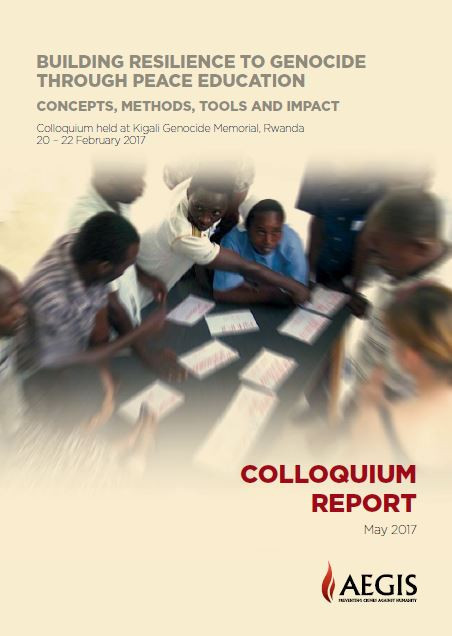 Colloquium Report: Building Resilience to Genocide through Peace Education: Concepts, Methods, Tools and Impact سنة النشر: 2017 المؤلف: Jonathan Bower, Mariana Goetz المؤلف المؤسسي: Aegis Trust A three-day Colloquium in Kigali in February brought together academics and practitioners in and around the field of peace education to share concepts, methods and means of measuring impact, contributing to a stronger evidence base for the effectiveness of peace education. Three interesting takeaways from the Colloquium: 1. Building resilience against genocide requires critical thinking about the process of identity-based violence and its reversal.2. The content of peace education programmes matters: interactive role-play type activities have been shown to have a longer lasting impact.3. Unhealed wounds need to be addressed to prevent a repeat of violence; psychosocial support must accompany peace education to reduce anxiety, which can be an obstacle when accessing empathy. A major achievement resulting from the consortium’s advocacy has been that the Government of Rwanda through the Ministry of Education has integrated Peace and Values education into the school curriculum. In a new phase of work Aegis is now supporting the implementation of the revised national curriculum that has integrated peace and values education (2016-19).